Within Search Failure
Why Forests Swallow Meteorites So Quickly
Leaf litter, roots, soft soil and dense brush can hide small meteorites within minutes of impact.
On this page
- How vegetation conceals small dark stones
- How weather and soil alter fresh fragments
- Why a negative woodland search proves very little
Page outline Jump by section
Introduction
One reason meteorite recoveries fail is surprisingly simple: forests are exceptionally good at hiding small objects. In the context of the Kecksburg UFO incident, this matters because a negative search in dense woodland is weak evidence that no meteorite landed there. By the time searchers arrive, surviving fragments may already be concealed beneath leaves, mixed with dark soil, tangled in roots or hidden by undergrowth. Even experienced recovery teams struggle in such environments, which is one reason many successful modern recoveries rely on precisely calculated fall zones rather than broad visual searches.[arXiv]arxiv.orgSuccessful Recovery of an Observed Meteorite Fall Using Drones and Machine LearningMarch 3, 2022…
How vegetation conceals small dark stones
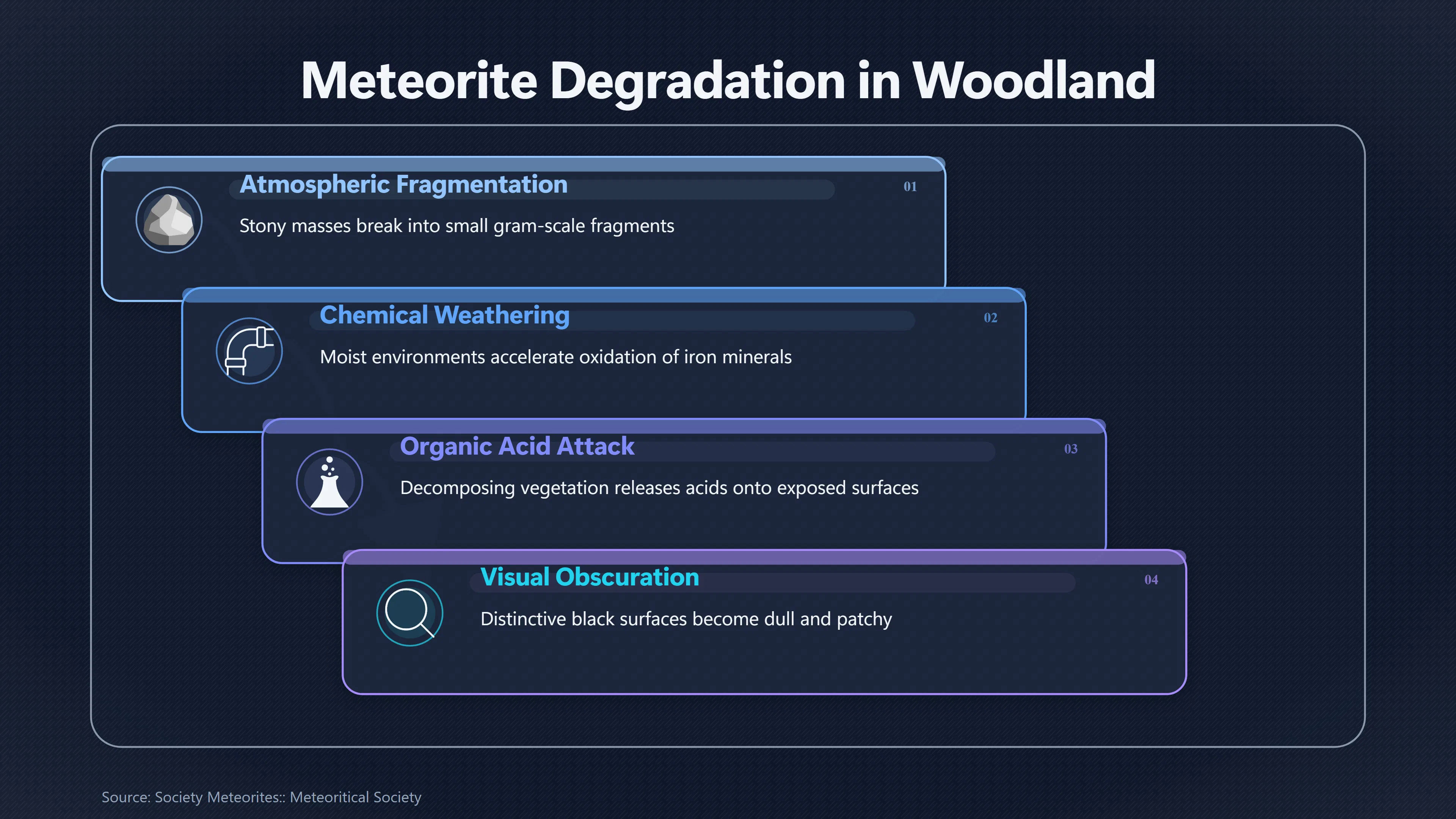
Fresh stony meteorites are rarely the large, dramatic masses shown in museums. After atmospheric fragmentation, many surviving pieces weigh only a few grams to a few hundred grams. In woodland, objects of that size are remarkably difficult to distinguish from ordinary stones, bark, seed pods and decaying wood.[Meteoritical Society]meteoritical.orgSociety Meteorites:: Meteoritical SocietyMeteoritical SocietyMeteorites:: Meteoritical Society…
Several features of forests combine to defeat visual searches:
- Leaf litter creates an instant camouflage layer. Fallen leaves, pine needles and twigs can completely cover a small meteorite after only a short period.
- Uneven ground breaks sight lines. Hollows, roots, fallen logs and thick vegetation prevent searchers from scanning the surface systematically.
- Natural colour matching. Although fresh meteorites often possess a dark fusion crust, woodland floors contain countless dark rocks, burnt wood fragments and organic debris with similar appearance.
- Limited visibility. Dense shrubs and tree trunks reduce the distance over which searchers can examine the ground, forcing slow, metre-by-metre inspection.
Unlike open farmland or desert, where a searcher can scan large areas while walking, woodland usually demands painstaking grid searches. Even then, complete coverage is rarely achievable.
How weather and soil alter fresh fragments
The forest floor does not simply hide meteorites; it also begins changing them.
Moist environments accelerate chemical weathering. Iron-bearing minerals oxidise, producing rust that obscures the fresh fusion crust. Organic acids released by decomposing vegetation can further attack exposed surfaces, while repeated wetting and drying gradually alters a meteorite’s appearance. Over time, once-distinctive black surfaces become brown, dull or patchy, making identification increasingly difficult.[Meteoritical Society]meteoritical.orgSociety Meteorites:: Meteoritical SocietyMeteoritical SocietyMeteorites:: Meteoritical Society…
Soft woodland soils also work against recovery.
Small fragments can:
- sink into loose humus after rain;
- become covered by fresh leaf fall within days or weeks;
- be incorporated into developing soil by biological activity such as earthworms and root growth;
- disappear beneath moss or other ground vegetation.
These processes are especially problematic because most meteorite searches begin after witnesses report a fireball rather than immediately after impact. Every passing day increases the chance that natural processes will obscure surviving fragments.

Why woodland searches are difficult to complete
Search strategy matters as much as search effort.
Modern recovery teams usually begin with trajectory modelling, atmospheric data and dark-flight calculations to estimate a strewn field before entering the landscape. Even with these advantages, recovery remains challenging because only a fraction of the predicted landing area can often be searched thoroughly.[arXiv]arxiv.orgSuccessful Recovery of an Observed Meteorite Fall Using Drones and Machine LearningMarch 3, 2022…
Dense woodland introduces practical limitations that are largely absent in open terrain:
- GPS navigation is less efficient beneath heavy tree cover.
- Straight search lines are interrupted by fallen timber, streams and dense vegetation.
- Visibility varies dramatically over just a few metres.
- Fatigue increases because progress is slow and physically demanding.
- Small errors in the predicted fall line can shift searchers into entirely different patches of forest that appear identical.
These difficulties explain why technological approaches such as drones and machine-learning image analysis have been developed primarily for relatively open landscapes. Their effectiveness decreases substantially where tree canopies hide the ground from aerial observation.[arXiv]arxiv.orgarXiv Recovery of Meteorites Using an Autonomous Drone and Machine LearningRecovery of Meteorites Using an Autonomous Drone and Machine LearningJune 11, 2021…
Why a negative woodland search proves very little
Failure to recover a meteorite from forest does not demonstrate that no meteorite fell there.
Meteorite distribution records show a strong observational bias. Large numbers of finds come from deserts and Antarctica, not because those regions receive vastly more meteorites, but because dark rocks remain visible on bright, stable surfaces for long periods. In humid, vegetated environments, meteorites weather, become buried and are far less likely to be noticed.[DOI]doi.orgThe Meteoritical Bulletin, No. 114The Meteoritical Bulletin, No. 114 - Gattacceca - 2026 - Meteoritics & Planetary Science - Wiley Online LibraryApril 20, 2026…
Applied to the Kecksburg context, this means the absence of recovered meteorites cannot, on its own, distinguish between competing explanations for the reported fireball. If surviving fragments were small and landed within heavily wooded terrain, recovery odds would have been substantially lower than they would have been on open fields or barren ground. A negative woodland search therefore represents an absence of evidence from a difficult search environment, not positive evidence that no natural meteorite reached the ground.
Amazon book picks
Further Reading
Books and field guides related to Why Forests Swallow Meteorites So Quickly. Use these as the next step if you want deeper reading beyond the article.
Meteorite Hunting: How to Find Treasure from Space
"This is the definitive guide to finding meteorites, written by one of the best-known personalities in the field and co-host of the award...
Rocks from Space: Meteorites and Meteorite Hunters
Appendices A-C: Meteorite verification laboratories, Commercial meteorite dealers, Selected list of suspected impact craters worldwide.
Field Guide to Meteors and Meteorites
What is unique about Richard Norton's book is that it is both a field guide to observing meteors, and also a field guide to locating, pre...
Meteorites and their Parent Planets
Thoroughly revised second edition of a highly successful book describing all aspects of meteorites.
eBay marketplace picks
Marketplace Samples
Live-tested eBay searches with available results related to this page.
Selected fromUFO disclosure poster oneBay.co.uk.



Endnotes
1.
Source: arxiv.org
Link:https://arxiv.org/abs/2203.01466
Source snippet
Successful Recovery of an Observed Meteorite Fall Using Drones and Machine LearningMarch 3, 2022...
Published: March 3, 2022
2.
Source: meteoritical.org
Title: Society Meteorites:: Meteoritical Society
Link:https://meteoritical.org/meteorites
Source snippet
Meteoritical SocietyMeteorites:: Meteoritical Society...
3.
Source: arxiv.org
Title: arXiv Recovery of Meteorites Using an Autonomous Drone and Machine Learning
Link:https://arxiv.org/abs/2106.06523
Source snippet
Recovery of Meteorites Using an Autonomous Drone and Machine LearningJune 11, 2021...
Published: June 11, 2021
4.
Source: doi.org
Title: The Meteoritical Bulletin, No. 114
Link:https://doi.org/10.1111/maps.70157
Source snippet
The Meteoritical Bulletin, No. 114 - Gattacceca - 2026 - Meteoritics & Planetary Science - Wiley Online LibraryApril 20, 2026...
Published: April 20, 2026
5.
Source: meteoritical.org
Title: This project aimed
Link:https://meteoritical.org/news/research-grant-report-laboratory-experiments-terrestrial-alteration-cm-chondrites
Source snippet
Research grant report: "Laboratory experiments on terrestrial alteration of CM chondrites":: Meteoritical SocietyMay 1, 2026 — RESEARCH...
Published: May 1, 2026
6.
Source: meteoritical.org
Title: 3646 meteorites approved 2024
Link:https://meteoritical.org/news/3646-meteorites-approved-2024
7.
Source: doi.org
Link:https://doi.org/10.1111/maps.14173
8.
Source: doi.org
Title: Recovery of meteorites using an autonomous drone and machine learning
Link:https://doi.org/10.1111/maps.13663
9.
Source: doi.org
Title: Doppler weather radar as a meteorite recovery tool
Link:https://doi.org/10.1111/j.1945-5100.2010.01115.x
10.
Source: meteoritical.org
Link:https://meteoritical.org/publications/meteoritical-bulletin
11.
Source: onlinelibrary.wiley.com
Link:https://onlinelibrary.wiley.com/doi/abs/10.1111/maps.70157
Source snippet
114 - Gattacceca - 2026 - Meteoritics & Planetary Science - Wiley Online LibraryApril 20, 2026 — In detail, 1053 were collected in Africa...
Published: April 20, 2026
12.
Source: usgs.gov
Link:https://www.usgs.gov/search?keywords=meteorites
13.
Source: usgs.gov
Link:https://www.usgs.gov/search?keywords=meteorite
14.
Source: usgs.gov
Link:https://www.usgs.gov/search?keywords=fallen
Additional References
15.
Source: onlinelibrary.wiley.com
Title: Online Library The Meteoritical Bulletin, No. 114
Link:https://onlinelibrary.wiley.com/doi/10.1111/maps.70157
Source snippet
114 - Gattacceca - 2026 - Meteoritics & Planetary Science - Wiley Online LibraryApril 20, 2026 — The meteorites listed in MB114 include 1...
Published: April 20, 2026
16.
Source: usgs.gov
Link:https://www.usgs.gov/science/faqs/geology
17.
Source: usgs.gov
Link:https://www.usgs.gov/publications/meteorite-and-meteoroid-new-comprehensive-definitions
18.
Source: youtube.com
Title: Meteorite recovery using drones: Initial successes and future plans
Link:https://www.youtube.com/watch?v=E1yedIiy1Mk
Source snippet
Meteorite Men | S03 E01 | Morasko Craters Poland...
19.
Source: youtube.com
Title: Meteorite Men | S03 E01 | Morasko Craters Poland
Link:https://www.youtube.com/watch?v=-i10oYQIkeI
Source snippet
Hunting $56,000 Meteorites in Sweden's Arctic Circle - Epic Finds...
20.
Source: usgs.gov
Title: I think I found a meteorite. How can I tell for sure? | U.S. Geological Survey
Link:https://www.usgs.gov/faqs/i-think-i-found-a-meteorite-how-can-i-tell-sure
21.
Source: tcmeteorites.com
Link:https://www.tcmeteorites.com/pages/where-are-meteorites-usually-found
22.
Source: nature.com
Title: Meteorite recovery at risk | Nature Climate Change
Link:https://www.nature.com/articles/s41558-024-01944-0
23.
Source: sciencedirect.com
Title: Grove Mountains meteorite recovery and relevant data distribution service
Link:https://www.sciencedirect.com/science/article/abs/pii/S0098300411001890
24.
Source: pnnl.gov
Title: fall recovery and classification park forest meteorite
Link:https://www.pnnl.gov/publications/fall-recovery-and-classification-park-forest-meteorite