Within Meteor Case
Can a Meteor Trail Look Like a Turn?
The Detroit-area trail could twist in high-altitude winds, making a straight meteor path appear to bend, slow or turn.
On this page
- How persistent meteor trains form
- Why winds distort the visible trail
- What the Detroit photographs actually captured
Page outline Jump by section
Introduction
One of the strongest natural explanations for reports that the 9 December 1965 fireball appeared to slow down, bend or even change direction is the behaviour of a persistent meteor train rather than the flight of the meteoroid itself. A bright fireball can pass through the atmosphere in only a few seconds, yet leave behind a glowing or smoky column that remains visible for minutes. Because this trail exists high in the atmosphere, where winds vary sharply with altitude, it can twist, curl and drift into shapes that no longer resemble the meteor’s original straight-line path. This distinction is important when assessing witness reports connected with the Kecksburg incident: many observations made after the brilliant flash may have been descriptions of the evolving trail rather than of the moving object itself.[NASA]nasa.govFireball Leaves Persistent Train over Western SkiesFireball Leaves Persistent Train over Western Skies - NASADecember 20, 2018…
How persistent meteor trains form
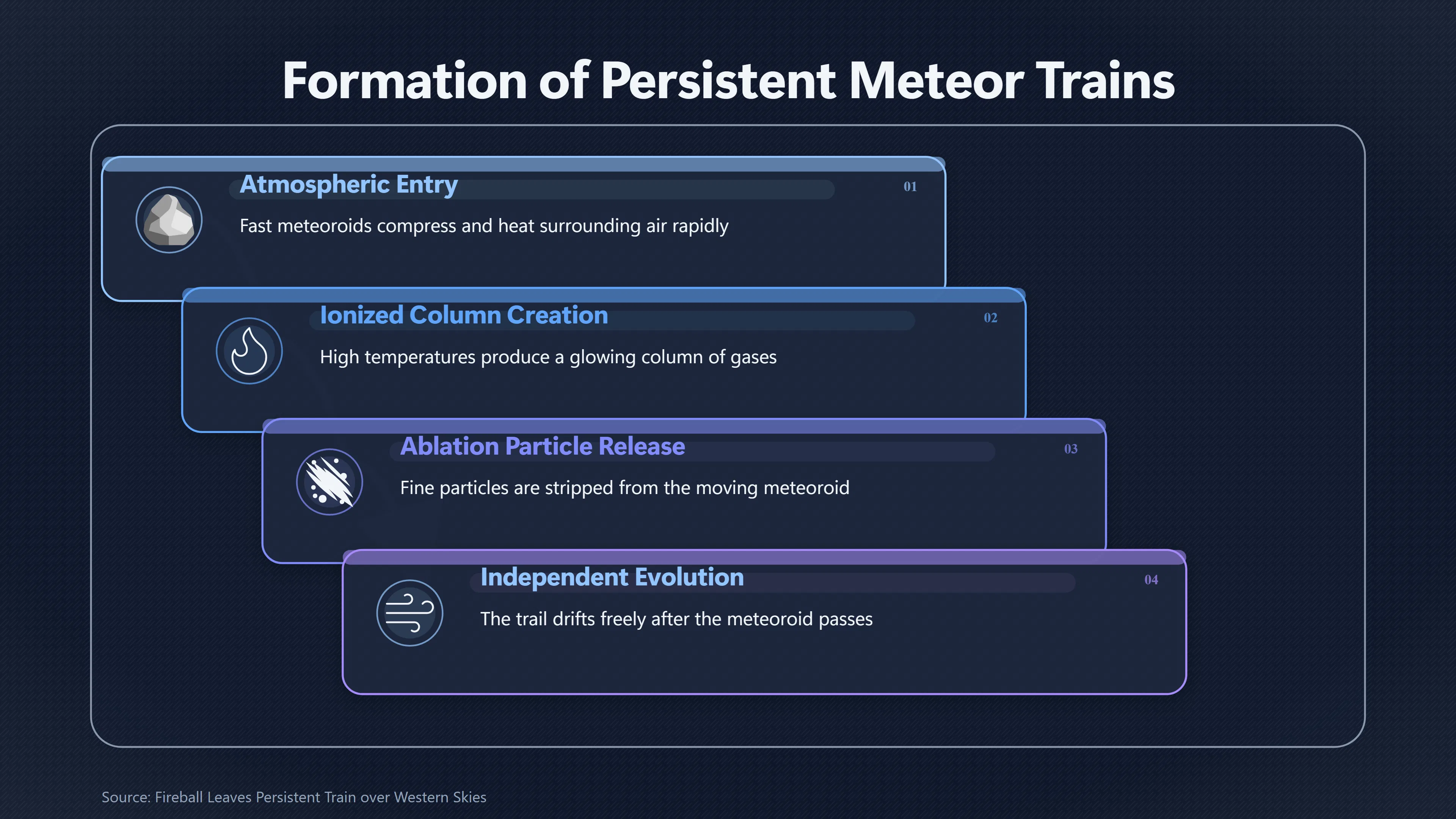
A persistent meteor train is not the meteoroid continuing to fly. It is the atmosphere responding to the meteoroid’s passage.
As a fast meteoroid enters the upper atmosphere, it compresses and heats the surrounding air to extremely high temperatures. The resulting column contains ionised gases, excited atmospheric molecules and fine particles produced during ablation. While the brilliant fireball itself usually lasts only a second or two, the ionised column may continue to glow, and dust left behind may continue to scatter sunlight after the meteoroid has disappeared.[American Meteor Society]amsmeteors.orgAmerican Meteor Society Fireball FAQsAmerican Meteor SocietyFireball FAQs - American Meteor Society…
Two related but distinct trail types are commonly recognised:
- Persistent luminous trains, consisting primarily of glowing ionised atmospheric gases, most often formed by bright, fast meteors at altitudes above roughly 80 km.
- Smoke or dust trails, consisting of fine particles stripped from the meteoroid during ablation. These are especially noticeable in bright daylight fireballs and can remain visible after the luminous train fades.[American Meteor Society]amsmeteors.orgAmerican Meteor Society Fireball FAQsAmerican Meteor SocietyFireball FAQs - American Meteor Society…
The important point is that both are atmospheric phenomena. Once the solid meteoroid has passed, the remaining trail is free to evolve independently.
Why winds distort the visible trail
The upper atmosphere is far from still. Winds can differ dramatically over only a few kilometres of altitude, with adjacent layers moving at different speeds or even in different directions.
A meteor train often extends through several of these layers simultaneously. As each portion is carried by a different airflow, what began as an almost straight column gradually becomes bent, kinked, folded or corkscrew-shaped. To an observer on the ground, especially one viewing the trail from an angle, these changes can create the convincing illusion that the object itself has altered course.[NASA]nasa.govFireball Leaves Persistent Train over Western SkiesFireball Leaves Persistent Train over Western Skies - NASADecember 20, 2018…
Researchers studying persistent trains have documented several characteristic distortions:
- gradual sideways drift of the entire train;
- twisting into spiral or corkscrew patterns;
- development of loops and apparent hooks;
- widening and diffusion as turbulence mixes the gases;
- different parts of the trail moving in different directions simultaneously.[NASA Technical Reports Server]ntrs.nasa.govNASA Technical Reports ServerBuoyancy of the ''Y2K'' Persistent Train and the Trajectory of the 04:00:29 UT Leonid Fireball - NASA Techni…
Detailed investigations of persistent trains from Leonid fireballs have shown that these shapes can develop within a minute and continue evolving for more than ten minutes, driven by wind shear and atmospheric gravity waves rather than by any continued motion of the meteoroid.[NASA Technical Reports Server]ntrs.nasa.govNASA Technical Reports ServerBuoyancy of the ''Y2K'' Persistent Train and the Trajectory of the 04:00:29 UT Leonid Fireball - NASA Techni…
Can a trail really make a straight meteor appear to turn?
Yes—but the effect is observational rather than physical.
The meteoroid itself follows a ballistic path governed primarily by its incoming velocity and atmospheric drag. Genuine sharp turns at meteoric speeds are physically implausible. The apparent change arises because the observer is no longer watching the moving body but an evolving atmospheric marker.
Several visual effects reinforce this illusion:
- The bright head disappears first. Observers naturally continue watching the remaining luminous trail.
- Different sections brighten or fade unevenly. This shifts the apparent “active” part of the trail.
- Perspective exaggerates curvature. A three-dimensional twisted column projected against the sky can resemble a changing flight path.
- The trail moves slowly. Because the train drifts with atmospheric winds instead of travelling at kilometres per second, it may appear as though the object has dramatically slowed before turning.[nasa.gov]nasa.govFireball Leaves Persistent Train over Western SkiesFireball Leaves Persistent Train over Western Skies - NASADecember 20, 2018…
These effects are well documented in modern fireball observations and explain why eyewitness descriptions sometimes differ markedly from reconstructed trajectories.
What the Detroit photographs actually captured
The photographs taken north of Detroit shortly after the 9 December 1965 event are significant because they recorded the persistent atmospheric train rather than the fireball itself.
By the time the exposures were made, the brilliant meteoroid had already passed. The images instead show the lingering atmospheric trail undergoing deformation. This distinction matters because later viewers unfamiliar with persistent trains sometimes interpreted the changing shape as evidence that the object had manoeuvred or reversed direction.
Astronomers analysing the event used these photographs as fixed atmospheric markers to reconstruct the meteor’s earlier trajectory. The photographs therefore support, rather than contradict, the meteor explanation. The changing appearance of the trail was expected behaviour for a persistent train exposed to high-altitude wind shear.[NASA]nasa.govFireball Leaves Persistent Train over Western SkiesFireball Leaves Persistent Train over Western Skies - NASADecember 20, 2018…
Why this mechanism matters for the Kecksburg fireball
Within the broader debate over the Kecksburg incident, persistent meteor trains provide a natural explanation for a specific class of witness reports without requiring unconventional flight behaviour.
The mechanism accounts for observations that the visible feature:
- appeared to linger after the brilliant flash;
- seemed to slow dramatically;
- developed bends or curves;
- looked as though it had changed direction;
- remained visible long enough for multiple independent observers to study it.
Importantly, this explanation applies only to the atmospheric phenomenon associated with the fireball. It does not, by itself, resolve later claims about events reported in the Pennsylvania woods. Instead, it helps separate two questions that are often conflated: the well-understood behaviour of a bright meteor and the much more disputed reports that followed on the ground. By recognising that a persistent train can evolve independently of the meteoroid that created it, many seemingly anomalous descriptions of the sky event become consistent with established meteor physics.[nasa.gov]nasa.govFireball Leaves Persistent Train over Western SkiesFireball Leaves Persistent Train over Western Skies - NASADecember 20, 2018…

Amazon book picks
Further Reading
Books and field guides related to Can a Meteor Trail Look Like a Turn?. Use these as the next step if you want deeper reading beyond the article.
Meteorite
Every rock has a story tell, and none more so than those which have fallen from the sky: meteorites. Originating in the Asteroid Belt bet...
Meteor Showers and their Parent Comets
Meteor Showers and their Parent Comets is a unique handbook for astronomers interested in observing meteor storms and outbursts. Spectacu...
The Field Guide to Meteors and Meteorites
What is unique about Richard Norton's book is that it is both a field guide to observing meteors, and also a field guide to locating, pre...
Physics of Meteoric Phenomena
"Meteoric phenomena" is the accepted term for the complex of physi cal phenomena that accompany the entry of meteoric bodies into the at...
eBay marketplace picks
Marketplace Samples
Live-tested eBay searches with available results related to this page.
Selected fromastronomy art print oneBay.co.uk.
Endnotes
1.
Source: nasa.gov
Title: Fireball Leaves Persistent Train over Western Skies
Link:https://www.nasa.gov/blogs/watch-the-skies/2018/12/20/fireball-leaves-persistent-train-over-western-skies/
Source snippet
Fireball Leaves Persistent Train over Western Skies - NASADecember 20, 2018...
Published: December 20, 2018
2.
Source: ntrs.nasa.gov
Link:https://ntrs.nasa.gov/citations/20010003444
Source snippet
NASA Technical Reports ServerBuoyancy of the ''Y2K'' Persistent Train and the Trajectory of the 04:00:29 UT Leonid Fireball - NASA Techni...
3.
Source: nasa.gov
Title: Strong Winds Power Electric Fields in the Upper Atmosphere, NASA’s ICON Finds
Link:https://www.nasa.gov/missions/icon/strong-winds-power-electric-fields-in-the-upper-atmosphere-nasas-icon-finds/
Source snippet
Strong Winds Power Electric Fields in the Upper Atmosphere, NASA’s ICON Finds - NASA...
4.
Source: nasa.gov
Title: About Vapor Tracers
Link:https://www.nasa.gov/soundingrockets/about-vapor-tracers/
Source snippet
About Vapor Tracers - NASA...
5.
Source: apod.nasa.gov
Title: Astronomy Picture of the Day APOD
Link:https://apod.nasa.gov/apod/ap981127.html
Source snippet
Astronomy Picture of the DayAPOD: November 27, 1998 - Twisting Meteor Train...
Published: November 27, 1998
6.
Source: science.nasa.gov
Link:https://science.nasa.gov/mission/awe/
Source snippet
9, 2023 Location International Space Station Objective Study airglow NASA MISSION CATCHING AWESOME WAVES...
7.
Source: fireballs.ndc.nasa.gov
Link:https://fireballs.ndc.nasa.gov/skyfalls/events/20181220-013502
8.
Source: apod.nasa.gov
Link:https://apod.nasa.gov/apod/ap180817.html
9.
Source: nasa.gov
Title: Around the World in Four Days: NASA Tracks Chelyabinsk Meteor Plume
Link:https://www.nasa.gov/solar-system/around-the-world-in-four-days-nasa-tracks-chelyabinsk-meteor-plume/
10.
Source: ntrs.nasa.gov
Link:https://ntrs.nasa.gov/search.jsp?R=20010004104
11.
Source: apod.nasa.gov
Link:https://apod.nasa.gov/rjn/apod/ap981127.html
12.
Source: amsmeteors.org
Title: American Meteor Society Fireball FAQs
Link:https://www.amsmeteors.org/fireballs/faqf/
Source snippet
American Meteor SocietyFireball FAQs - American Meteor Society...
13.
Source: amsmeteors.org
Title: American Meteor Society Fireball or Contrail?
Link:https://www.amsmeteors.org/fireballs/fireball-or-contrail/
Source snippet
American Meteor SocietyFireball or Contrail? - American Meteor Society...
14.
Source: amsmeteors.org
Title: Videos: American Meteor Society
Link:https://www.amsmeteors.org/videos/?video_id=4425
15.
Source: amsmeteors.org
Title: Radio Observing
Link:https://www.amsmeteors.org/ams-programs/radio-observing/
16.
Source: amsmeteors.org
Title: Fireball over Colorado
Link:https://www.amsmeteors.org/2019/02/fireball-over-colorado/
18.
Source: amsmeteors.org
Title: fireball caught on camera on october 16th 2014
Link:https://www.amsmeteors.org/2014/10/fireball-caught-on-camera-on-october-16th-2014/
19.
Source: amsmeteors.org
Title: Meteor FAQs
Link:https://amsmeteors.org/meteor-showers/meteor-faq/
Additional References
20.
Source: youtube.com
Title: Extremely Bright Fireball w/Persistent Train
Link:https://www.youtube.com/watch?v=glCJ64QHNyA
Source snippet
This video demonstrates how high-altitude winds distort and twist a fireball's persistent ionized train over time, creating the illusion...
21.
Source: researchgate.net
Title: S. Obenberger K
Link:https://www.researchgate.net/publication/382639089_Not_So_Fast_A_New_Catalog_of_Meteor_Persistent_Trains
Source snippet
(PDF) Not So Fast: A New Catalog of Meteor Persistent TrainsJuly 25, 2024 — NOT SO FAST: A NEW CATALOG OF METEOR PERSISTENT TRAINS * July...
Published: July 25, 2024
22.
Source: agupubs.onlinelibrary.wiley.com
Link:https://agupubs.onlinelibrary.wiley.com/doi/abs/10.1029/2024JA032643
Source snippet
So Fast: A New Catalog of Meteor Persistent Trains - Cordonnier - 2024 - Journal of Geophysical Research: Space Physics - Wiley Online Li...
23.
Source: imo.net
Link:https://www.imo.net/observations/methods/video-observation/examples/
24.
Source: ntskeptics.org
Link:https://www.ntskeptics.org/1993/1993march/march1993.htm
25.
Source: youtube.com
Title: Bright Leonid Fireball with Persistent Train
Link:https://www.youtube.com/watch?v=LPgD2DCBYGk
Source snippet
Extremely Bright Fireball w/Persistent Train...
26.
Source: skyatnightmagazine.com
Title: How to observe and photograph a meteor train | BBC Sky at Night Magazine
Link:https://www.skyatnightmagazine.com/astrophotography/observe-photograph-meteor-train
27.
Source: sciencedirect.com
Title: A screw-like meteoric train photographed by double-station observations
Link:https://www.sciencedirect.com/science/article/abs/pii/S1384107606000856
28.
Source: sciencedirect.com
Title: Observation of a persistent Leonid meteor train with an all-sky camera
Link:https://www.sciencedirect.com/science/article/pii/S1364682604000811
29.
Source: youtube.com
Title: Fireball Smoke Trail Timelapse
Link:https://www.youtube.com/watch?v=XcO5p7VVUM4
Source snippet
Bright Leonid Fireball with Persistent Train...