Within Kecksburg
Why Distant Fireballs Seem to Land Nearby
A distant meteor can appear to fall behind a nearby ridge because night skies provide poor clues to distance and scale.
On this page
- Missing depth cues in the sky
- Horizon effects and false landing points
- Why reports spread across wide regions
Page outline Jump by section
Introduction
A distant fireball can look as though it has dropped into the next field, valley or patch of woodland because the night sky supplies remarkably little reliable information about distance. The observer sees a brilliant moving light but usually cannot see its true size, altitude or relationship to objects beneath it. When the light fades behind a ridge or treeline, the brain naturally treats that foreground boundary as the place where the object came down.
That impression can be vivid and sincere without identifying a real landing point. Fireballs commonly remain luminous tens of kilometres above the ground and may be visible from hundreds of kilometres away. A low fireball can therefore appear to descend towards a nearby horizon even when its actual path lies over another county, state or country. This mechanism is especially relevant to the Kecksburg incident, where a widely observed Great Lakes fireball was interpreted locally as something entering woods near the village.[nasa.gov]cneos.jpl.nasa.govFireballs and bolidesA fireball is an unusually bright meteor that reaches a visual magnitude of -3 or brighter when seen at the obs…
The Sky Withholds the Usual Depth Clues
Human vision does not measure distance directly. It estimates it by combining cues such as familiar size, overlap, perspective, atmospheric haze and motion relative to nearby objects. A fireball seen against a dark or overcast sky removes most of those clues at once.
The luminous object has no familiar physical scale. It might be a small fragment relatively low in the atmosphere or a much larger event far away; brightness alone does not resolve the difference. There may also be no texture gradient, continuous landscape or recognisable object beside it for comparison. Binocular vision contributes little at astronomical or upper-atmospheric distances because the separation between the eyes is tiny compared with the distance to the fireball. Research on depth perception shows that observers depend heavily on monocular cues such as known size, perspective, contrast and relative motion when direct stereoscopic information is weak.[nih.gov]ncbi.nlm.nih.govNCBIThe Perception of DepthSeveral strong monocular cues allow relative distance and depth to be judged…. * aerial perspective… Retinal image size allow us to…
A bright meteor also arrives suddenly and moves very quickly. That combination can strengthen the feeling of proximity: nearby objects usually sweep across the visual field faster than distant ones, so an unfamiliar light crossing several degrees of sky in seconds can be interpreted as something close at hand. Sky & Telescope notes that the sudden appearance and rapid motion of a bright meteor can create an illusion of closeness even for experienced observers.[Sky & Telescope]skyandtelescope.orgSky & Telescope About Meteors, Meteor Showers, Fireballs and More!Occasionally, a larger object will survive its descent and fall to Earth — then it's called a meteorite…. The sudden appearance and fa…
Brightness adds another misleading signal. A fireball may illuminate clouds, cast shadows or leave a glowing train, effects that feel local because they resemble lightning, fireworks or an aircraft emergency. Yet “fireball” is a brightness classification, not a statement that the object is near the observer. NASA defines it as an unusually bright meteor, while the International Meteor Organization notes that a fireball ending about 50 kilometres above Earth can still be seen at very low elevation from roughly 600 kilometres away.[CNEOS]cneos.jpl.nasa.govFireballs and bolidesA fireball is an unusually bright meteor that reaches a visual magnitude of -3 or brighter when seen at the obs…
Why a Ridge Becomes a False Landing Point
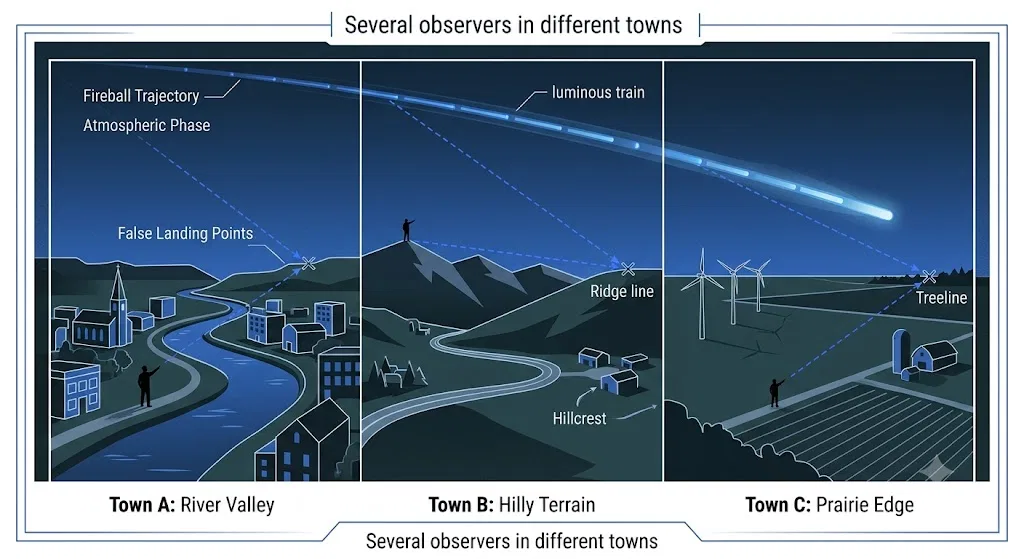
The most persuasive illusion occurs when the fireball’s visible path meets the horizon. From the observer’s position, a distant luminous trajectory and a nearby ridge may occupy the same line of sight. The ridge then hides the final portion of the path, making the object appear to pass behind it or strike the ground just beyond it.
This is an occlusion effect, not a measurement of location. A person standing several kilometres away would see the same fireball against a different part of the landscape and might place the apparent descent behind another hill entirely. Neither observer is necessarily careless: each is accurately reporting where the light disappeared in their own field of view, but not where it was in three-dimensional space.
The endpoint is particularly deceptive because a meteor often stops shining abruptly. The visible trail ends when the material fragments, slows below the conditions needed for intense ablation, or becomes too faint to see. It does not follow that the object has reached the surface. Meteorite-producing fireballs can undergo their brightest fragmentation many kilometres above the ground, after which any surviving pieces continue in a comparatively dark phase and are moved by gravity and winds before landing. Instrumental studies of recovered falls routinely reconstruct luminous trajectories ending well above the eventual recovery area.[arxiv.org]arxiv.orgOpen source on arxiv.org.
The geometry becomes still more misleading when the trajectory points partly towards or away from the observer. A long atmospheric path may then appear foreshortened into a steep plunge. Conversely, a shallow path viewed broadside can look like a long horizontal streak. A single eyewitness sees only an angular track on the sky; without observations from other locations, that track does not provide a unique altitude, distance or ground path.
Modern fireball investigators solve this problem through triangulation. Cameras or witnesses at separated locations supply different lines of sight, allowing analysts to calculate a three-dimensional trajectory. Researchers working with NASA’s Meteoroid Environment Office have shown that eyewitness reports can contribute to approximate reconstructions, but instrumental multi-station records are much more dependable. Even sophisticated models must account for deceleration, fragmentation and deviations from a perfectly straight path.[sciencedirect.com]sciencedirect.comOpen source on sciencedirect.com.
Why Several Communities Can All Think It Landed Nearby
A major fireball is not a point-like event seen only above one town. Its luminous path may extend for many tens or hundreds of kilometres, at altitudes high enough to be visible across a very broad region. Different sections of the track can dominate the view from different places, while local hills, buildings and weather determine where each witness sees it disappear.
This produces a recurring pattern after bright meteors:
- observers in several towns report that the object passed directly overhead;
- people separated by large distances each believe that it descended beyond their local horizon;
- reports of smoke, flashes, booms or fires become attached to different apparent endpoints;
- investigators later find that the calculated atmospheric path was remote from many of those locations.
The International Meteor Organization gives a useful scale for the effect: a fireball near the horizon may be hundreds of kilometres from an observer yet remain plainly visible. The American Meteor Society’s public database also contains repeated descriptions of fireballs that seemed to vanish behind nearby trees, enter a valley or land only a few miles away. Such reports are valuable records of appearance, direction and timing, but their distance estimates are not treated as direct measurements.[imo.net]imo.netIn the case of a near-horizon meteor, the distance to the observer is very large resulting in a strong reduction of the apparent brightne…
Recent well-documented events show how wide the reporting area can be. A daylight bolide over Georgia in June 2025 generated more than 200 reports across several south-eastern US states. Some witnesses believed that it had hit the ground near them, while NASA combined eyewitness accounts with satellite, camera and weather-radar data to identify its actual path and likely meteorite-fall area.[AP News]apnews.comOpen source on apnews.com.
Sound can create further confusion because it arrives later than light. A sonic boom may be heard tens of seconds or several minutes after the fireball, depending on distance and atmospheric conditions. By then, the observer may associate the noise with a local place, vibration or flash rather than with a high-altitude track far away. The delay also means that sound reports cannot safely be matched to the visible endpoint without careful timing and geographic comparison. The American Meteor Society explains that sufficiently bright, deeply penetrating fireballs can produce sonic booms heard beneath or around their atmospheric path.[American Meteor Society]amsmeteors.orgOpen source on amsmeteors.org.
The Kecksburg View Through This Mechanism
On 9 December 1965, the central astronomical event was observed across a large part of the Great Lakes and north-eastern United States. Contemporary material records pilot reports, photographs of a persistent trail and a seismographic detection of atmospheric shock waves. A later scientific study used photographs from two locations to reconstruct the fireball’s trajectory, demonstrating why regional data are more informative than any single apparent landing direction.[Wikipedia]WikipediaKecksburg UFO incidentKecksburg UFO incident
Kecksburg residents were therefore viewing one part of a large, distant and fast-moving event through local terrain. From that perspective, a descending light could appear to pass into a wooded hollow or behind a ridge. Reports of a thump, vibration or smoke would naturally reinforce the visual interpretation, even though those observations do not by themselves establish that the luminous object reached that location.
This does not prove that every later ground-level claim was mistaken, nor does it settle what officials did during the search. It does clarify a narrower point: an eyewitness statement that the fireball “went down in the woods” is weak evidence of a physical impact there unless it is supported by converging sightlines, recovered material, a documented crater or other location-specific evidence.
The distinction is between apparent endpoint and calculated endpoint. The first is where the light seemed to meet the observer’s landscape. The second requires geometry, timing and observations from separated locations. In the Kecksburg case, the existence of numerous reports over a wide region makes the visual illusion more plausible, not less: the same high-altitude event could generate several sincere but geographically incompatible impressions of a nearby descent.
What an Eyewitness Can Reliably Establish
A fireball witness can often report useful details: the time, compass direction, angular height, direction of travel, duration, colour, fragmentation and whether sound followed. Those observations become powerful when combined with records from other locations. What a lone observer usually cannot establish is the object’s absolute distance or exact landing point.
The safest interpretation of a statement such as “it fell behind that ridge” is therefore: the luminous track disappeared along a line of sight intersecting that ridge. That is a strong description of appearance but only a hypothesis about location.
For the Kecksburg incident, this mechanism explains how a real regional fireball could become attached to one particular patch of Pennsylvania woodland. Night-time depth ambiguity, rapid apparent motion, horizon occlusion and abrupt extinction together create an exceptionally convincing impression of a nearby fall. The impression may remain one of the witness’s clearest memories, yet the physical event can still have been many tens or hundreds of kilometres away.
Amazon book picks
Further Reading
Books and field guides related to Why Distant Fireballs Seem to Land Nearby. Use these as the next step if you want deeper reading beyond the article.
Rocks from Space
Appendices A-C: Meteorite verification laboratories, Commercial meteorite dealers, Selected list of suspected impact craters worldwide.
Meteorites: The Story of Our Solar System
Contains several previously unpublished accounts of meteorite recoveries in Australia and provides deatails on many Australian contributi...
The Cambridge Encyclopedia of Meteorites
Beautifully illustrated with over 140 full colour images, The Cambridge Encyclopedia of Meteorites provides a thorough guide to these fas...
Vision Science: Photons to Phenomenology
This textbook on vision reflects the integrated computational approach of modern research scientists, combining psychological, computatio...
eBay marketplace picks
Marketplace Samples
Live-tested eBay searches with available results related to this page.
Selected fromUFO model display oneBay.co.uk.
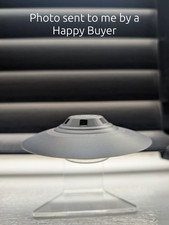
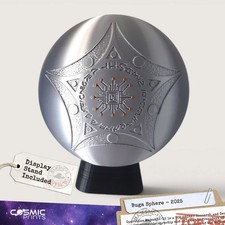
Current eBay listing
Buga Sphere UFO Model With Display Stand | 15cm (5.9") Diameter UAP
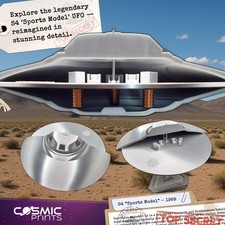
Current eBay listing
Belgium Wave UFO Model | 1989–90 UAP Display | Famous Sighting
Endnotes
1.
Source: cneos.jpl.nasa.gov
Link:https://cneos.jpl.nasa.gov/fireballs/intro.html
Source snippet
Fireballs and bolidesA fireball is an unusually bright meteor that reaches a visual magnitude of -3 or brighter when seen at the obs...
2.
Source: ncbi.nlm.nih.gov
Title: NCBIThe Perception of Depth
Link:https://www.ncbi.nlm.nih.gov/books/NBK11512/?report=reader
Source snippet
Several strong monocular cues allow relative distance and depth to be judged.... * aerial perspective... Retinal image size allow us to...
3.
Source: arxiv.org
Link:https://arxiv.org/abs/2310.17822
4.
Source: onlinelibrary.wiley.com
Link:https://onlinelibrary.wiley.com/doi/full/10.1111/maps.13977
5.
Source: sciencedirect.com
Link:https://www.sciencedirect.com/science/article/abs/pii/S0032063316302288
6.
Source: ntrs.nasa.gov
Link:https://ntrs.nasa.gov/api/citations/20160008877/downloads/20160008877.pdf
7.
Source: arxiv.org
Link:https://arxiv.org/abs/1802.02697
8.
Source: arxiv.org
Link:https://arxiv.org/abs/1911.00816
9.
Source: Wikipedia
Title: [Kecksburg UFO incident]({{ ‘kecksburg-ufo-incident/’ | relative_url }})
Link:https://en.wikipedia.org/wiki/Kecksburg_UFO_incident
10.
Source: sciencedirect.com
Title: 3D meteoroid trajectories
Link:https://www.sciencedirect.com/science/article/pii/S001910351830441X
11.
Source: space.com
Title: interstellar fireballs likely came from within our solar system study suggests
Link:https://www.space.com/stargazing/meteors-showers/interstellar-fireballs-likely-came-from-within-our-solar-system-study-suggests
12.
Source: space.com
Link:https://www.space.com/stargazing/meteor-showers/fireball-sightings-are-surging-across-the-us-heres-whats-really-going-on
13.
Source: cneos.jpl.nasa.gov
Link:https://cneos.jpl.nasa.gov/fireballs/
14.
Source: sciencedirect.com
Title: Contrast as a depth cue
Link:https://www.sciencedirect.com/science/article/pii/0042698994901163
15.
Source: arxiv.org
Link:https://arxiv.org/pdf/2602.15440
16.
Source: agupubs.onlinelibrary.wiley.com
Link:https://agupubs.onlinelibrary.wiley.com/doi/full/10.1002/2014JD021664
17.
Source: onlinelibrary.wiley.com
Link:https://onlinelibrary.wiley.com/doi/10.1111/maps.13142
18.
Source: Wikipedia
Link:https://en.wikipedia.org/wiki/Meteor
19.
Source: imo.net
Link:https://www.imo.net/observations/fireballs/fireballs/
Source snippet
In the case of a near-horizon meteor, the distance to the observer is very large resulting in a strong reduction of the apparent brightne...
20.
Source: pubmed.ncbi.nlm.nih.gov
Title: Pub Med Contrast as a depth cue
Link:https://pubmed.ncbi.nlm.nih.gov/7941367/
Source snippet
Monocular observation yielded larger apparent depth than binocular observation.... We suggest that contrast acts as a pictorial depth cu...
21.
Source: skyandtelescope.org
Title: Sky & Telescope About Meteors, Meteor Showers, Fireballs and More!
Link:https://skyandtelescope.org/stargazing-and-observing/celestial-objects-to-watch/about-meteors/
Source snippet
Occasionally, a larger object will survive its descent and fall to Earth — then it's called a meteorite.... The sudden appearance and fa...
22.
Source: fireball.amsmeteors.org
Link:https://fireball.amsmeteors.org/members/imo_view/report/402421
23.
Source: fireball.amsmeteors.org
Link:https://fireball.amsmeteors.org/members/imo_view/report/414315
24.
Source: fireball.amsmeteors.org
Link:https://fireball.amsmeteors.org/members/imo_view/report/413235
25.
Source: apnews.com
Link:https://apnews.com/article/d1d6a7459248cb0ad6a857def3289f2d
26.
Source: amsmeteors.org
Link:https://www.amsmeteors.org/fireballs/faqf/
27.
Source: fireballs.imo.net
Link:https://fireballs.imo.net/members/imo_view/report/430764
28.
Source: amsmeteors.org
Title: Fireball report
Link:https://amsmeteors.org/members/imo_view/report/425728
29.
Source: amsmeteors.org
Title: Fireball report
Link:https://www.amsmeteors.org/members/imo_view/report/422979
30.
Source: skyandtelescope.org
Title: Satellite or Meteor? Dissecting Light Trails in Your Sky Photos
Link:https://skyandtelescope.org/astronomy-news/satellite-or-meteor-dissecting-light-trails-in-your-sky-photos/
31.
Source: fireball.imo.net
Link:https://fireball.imo.net/members/imo_view/report/419623
32.
Source: fireball.amsmeteors.org
Link:https://fireball.amsmeteors.org/members/imo_view/report/414258
33.
Source: fireball.amsmeteors.org
Link:https://fireball.amsmeteors.org/imo_view/event/2026/1726
34.
Source: fireball.amsmeteors.org
Link:https://fireball.amsmeteors.org/members/imo_view/report/398387
35.
Source: fireball.amsmeteors.org
Link:https://fireball.amsmeteors.org/members/imo_view/report/390143
36.
Source: fireball.amsmeteors.org
Link:https://fireball.amsmeteors.org/imo_view/event/2025/6178
37.
Source: fireball.amsmeteors.org
Link:https://fireball.amsmeteors.org/imo_view/event/2025/3696
38.
Source: amsmeteors.org
Title: Fireball report
Link:https://www.amsmeteors.org/members/imo_view/report/425932
39.
Source: fireball.amsmeteors.org
Link:https://fireball.amsmeteors.org/members/imo_view/report/320840
40.
Source: skyandtelescope.org
Title: Delta Aquariids Kick Off Summer Meteor Showers
Link:https://skyandtelescope.org/astronomy-news/observing-news/delta-aquarids-kick-off-summer-meteor-showers/
41.
Source: skyandtelescope.org
Title: Ready for May’s Surprise Meteor Shower?
Link:https://skyandtelescope.org/astronomy-news/observing-news/mays-surprise-meteor-shower/
42.
Source: skyandtelescope.org
Title: Catch a “Shooting Star”
Link:https://skyandtelescope.org/uncategorized/catch-a-shooting-star/
43.
Source: skyandtelescope.org
Title: Perseid Meteors in Their Prime
Link:https://skyandtelescope.org/press-releases/perseid-meteors-in-their-prime/
44.
Source: imo.amsmeteors.org
Link:https://imo.amsmeteors.org/members/imo_view/report/9939
45.
Source: skyandtelescope.org
Title: How well defined is a meteor-shower radiant?
Link:https://skyandtelescope.org/astronomy-resources/astronomy-questions-answers/how-well-defined-is-a-meteor-shower-radiant/
46.
Source: skyandtelescope.org
Title: Why do photos of lunar or Martian craters sometimes appear inside-out?
Link:https://skyandtelescope.org/astronomy-resources/astronomy-questions-answers/is-it-possible-that-photos-of-lunar-or-martian-landscapes-show-craters-as-blisters/
47.
Source: skyandtelescope.org
Link:https://skyandtelescope.org/astronomy-resources/astronomy-questions-answers/will-meteor-showers-be-enchanced-if-you-fly-3000-feet-above-the-ground-in-an-airplane/
48.
Source: skyandtelescope.org
Title: Does a comet’s tail (or lack there-of) tell us what direction it’s heading?
Link:https://skyandtelescope.org/astronomy-resources/astronomy-questions-answers/why-dont-we-on-earth-see-an-angled-view-of-comet-holmes-tail/
49.
Source: skyandtelescope.org
Title: Catch the Green Flash!
Link:https://skyandtelescope.org/stargazing-and-observing/celestial-objects-to-watch/catch-the-green-flash/
50.
Source: amsmeteors.org
Link:https://www.amsmeteors.org/
51.
Source: amsmeteors.org
Title: ams q1 2026 fireball analysis
Link:https://amsmeteors.org/ams-q1-2026-fireball-analysis.html
52.
Source: amsmeteors.org
Link:https://www.amsmeteors.org/videos?video_id=22128
53.
Source: amsmeteors.org
Link:https://www.amsmeteors.org/fireballs/
54.
Source: amsmeteors.org
Link:https://www.amsmeteors.org/fireballs/fireball-report/
55.
Source: pubmed.ncbi.nlm.nih.gov
Link:https://pubmed.ncbi.nlm.nih.gov/7971108/
56.
Source: imo.net
Title: fireball and probable meteorite fall in scoltand on july 2nd
Link:https://www.imo.net/fireball-and-probable-meteorite-fall-in-scoltand-on-july-2nd/
57.
Source: fireball.imo.net
Title: browse events
Link:https://fireball.imo.net/members/imo_view/browse_events
58.
Source: imo.net
Link:https://www.imo.net/observations/fireballs/observations/
59.
Source: youtube.com
Link:https://www.youtube.com/watch?v=RKdkEdOrRUw
60.
Source: youtube.com
Link:https://www.youtube.com/watch?v=TuZ-TP0UN30
61.
Source: skyandtelescope.org
Link:https://skyandtelescope.org/stargazing-and-observing/celestial-objects-to-watch/meteors/
62.
Source: education.nationalgeographic.org
Link:https://education.nationalgeographic.org/resource/meteor/
63.
Source: scistarter.org
Title: American Meteor Society
Link:https://scistarter.org/american-meteor-society-meteor-observing
Additional References
64.
Source: hitl.washington.edu
Link:https://www.hitl.washington.edu/projects/knowledge_base/virtual-worlds/EVE/III.A.1.c.DepthCues.html
Source snippet
The psychological depth cues are retinal image size, linear perspective, texture gradient, overlapping, aerial perspective, and shades an...
65.
Source: adsabs.harvard.edu
Link:https://adsabs.harvard.edu/full/1967JRASC..61..184C
Source snippet
Astrophysics Data SystemThe Fireball of December 9, 1965-Part Iby VD Chamberlain · 1967 · Cited by 6 — Photographs, taken from two locati...
Published: December 9, 1965
66.
Source: youtube.com
Link:https://www.youtube.com/watch?v=tU7WSHZye5w
Source snippet
'I do believe something happened': Search for answers about Kecksburg UFO in Pennsylvania...
67.
Source: youtube.com
Link:https://www.youtube.com/watch?v=HX_RrO7ZQaU
Source snippet
The Kecksburg Incident: What Really Happened Here?...
68.
Source: youtube.com
Link:https://www.youtube.com/watch?v=REsZcbglO3c
Source snippet
The 1965 Kecksburg Incident: A UFO Crash the Government Hides to This Day...
69.
Source: youtube.com
Title: The Kecksburg Incident: What Really Happened Here?
Link:https://www.youtube.com/watch?v=BXh2zTD9Kug
Source snippet
Kecksburg UFO Crash: The Untold Story | The Government Lied! | Full Documentary | UFOTV®...
70.
Source: reddit.com
Link:https://www.reddit.com/r/space/comments/dyhfv5/1111_missouri_meteor_fireball_position/
71.
Source: researchgate.net
Link:https://www.researchgate.net/publication/375897896_The_Golden_meteorite_fall_Fireball_trajectory_orbit_and_meteorite_characterization
72.
Source: instagram.com
Link:https://www.instagram.com/p/DZiXEZFCUGi/?hl=da
73.
Source: instagram.com
Link:https://www.instagram.com/reel/DPbQJd1CVdl/