Within Space Debris
Could Fallen Space Debris Still Contain Toxic Fuel?
A scorched spacecraft tank could still release toxic hydrazine vapour or liquid even when no flames are visible.
On this page
- Why hydrazine survives as a response concern
- What responders might observe at an impact site
- Why distance and specialist handling matter
Page outline Jump by section
Introduction
A key reason emergency services treat unidentified space hardware with caution is the possibility that toxic propellant remains inside apparently inert debris. Even after the intense heating of atmospheric re-entry, spacecraft components such as propellant tanks, valves and thrusters can survive largely intact. If residual hydrazine or related propellants remain trapped inside damaged hardware, a cracked fitting or ruptured tank may release highly toxic vapour or liquid without any visible fire. This possibility is one reason modern aerospace recovery procedures emphasise isolation of suspected spacecraft debris until specialists have assessed the hazard.[esa.int]technology.esa.intTechnology Re-entry SafetyESA TechnologyRe-entry SafetyNovember 3, 2023…
Within the wider discussion of hazardous debris in relation to the Kecksburg incident, hydrazine is significant because it illustrates why authorities could have viewed an unidentified aerospace object as a chemical hazard regardless of whether it appeared to be cooling or inactive. The existence of this hazard does not demonstrate that hydrazine was present at Kecksburg, but it provides a technically well-established explanation for why responders would avoid allowing the public to approach unknown spacecraft hardware.
Why hydrazine survives as a response concern
Hydrazine has been one of the most widely used spacecraft monopropellants for decades because it remains chemically stable during long storage, decomposes rapidly when passed over a catalyst and provides reliable thrust for orbital manoeuvres. These same characteristics make it valuable in space and hazardous on the ground.
Atmospheric re-entry does not guarantee that every propellant tank is emptied or destroyed. While many tanks rupture or burn through, the outcome depends on vehicle orientation, heating, impact conditions and structural design. Titanium and stainless-steel pressure vessels are among the components most likely to survive re-entry, meaning that residual propellant or decomposition products can remain confined until impact damage or later disturbance creates a leak. ESA therefore includes hazardous substances alongside impact hazards within its re-entry safety framework.[esa.int]technology.esa.intTechnology Re-entry SafetyESA TechnologyRe-entry SafetyNovember 3, 2023…
Hydrazine also presents a different risk from dramatic fuel fires often associated with launch vehicles. A damaged spacecraft may appear quiet and cold while still containing dangerous chemicals. The absence of flames or smoke therefore provides little assurance that an object is safe to approach.
NASA continues to treat residual hydrazine as a serious operational hazard even after successful spacecraft re-entry. Recovery planning for the Orion capsule explicitly analyses the consequences of possible hydrazine leakage after landing and uses atmospheric dispersion modelling to determine safe recovery procedures.[NASA Technical Reports Server]ntrs.nasa.govNASA Technical Reports ServerRisk Analysis Associated with Loss of Toxic Gases During Orion Landing and Recovery Operations - NASA Techni…
What responders might observe at an impact site
A responder arriving at an unidentified impact site cannot determine from appearance alone whether hydrazine is present. Modern guidance therefore assumes that unknown spacecraft debris should be assessed before being handled.
Possible observations could include:
- an acrid ammonia-like odour, although smell is not considered a reliable warning because dangerous concentrations may overwhelm the senses or be absent;
- clear or slightly coloured liquid leaking from damaged fittings;
- scorched vegetation or chemically damaged ground near a leaking component;
- white vapour or fumes under suitable temperature and humidity conditions;
- no visible warning signs whatsoever despite the continued presence of hazardous residue.
Hydrazine is readily absorbed through inhalation, skin contact and ingestion. Acute exposure can affect the eyes, skin, lungs and nervous system, while repeated exposure has been associated with liver injury and an increased cancer risk in laboratory studies. Because of these health effects, emergency personnel are trained not to rely on visual inspection when assessing potential contamination.[nih.gov]ncbi.nlm.nih.govNCBIPUBLIC HEALTH STATEMENTToxicological Profile for Hydrazines - NCBI BookshelfSeptember 1, 1997…
Importantly, many of these observations are non-specific. Burnt vegetation or unusual odours could arise from several unrelated causes, meaning that responders would generally assume the worst until specialist identification became possible.
Why distance and specialist handling matter
The principal response to suspected hydrazine contamination is not immediate recovery of the object but control of the surrounding area.
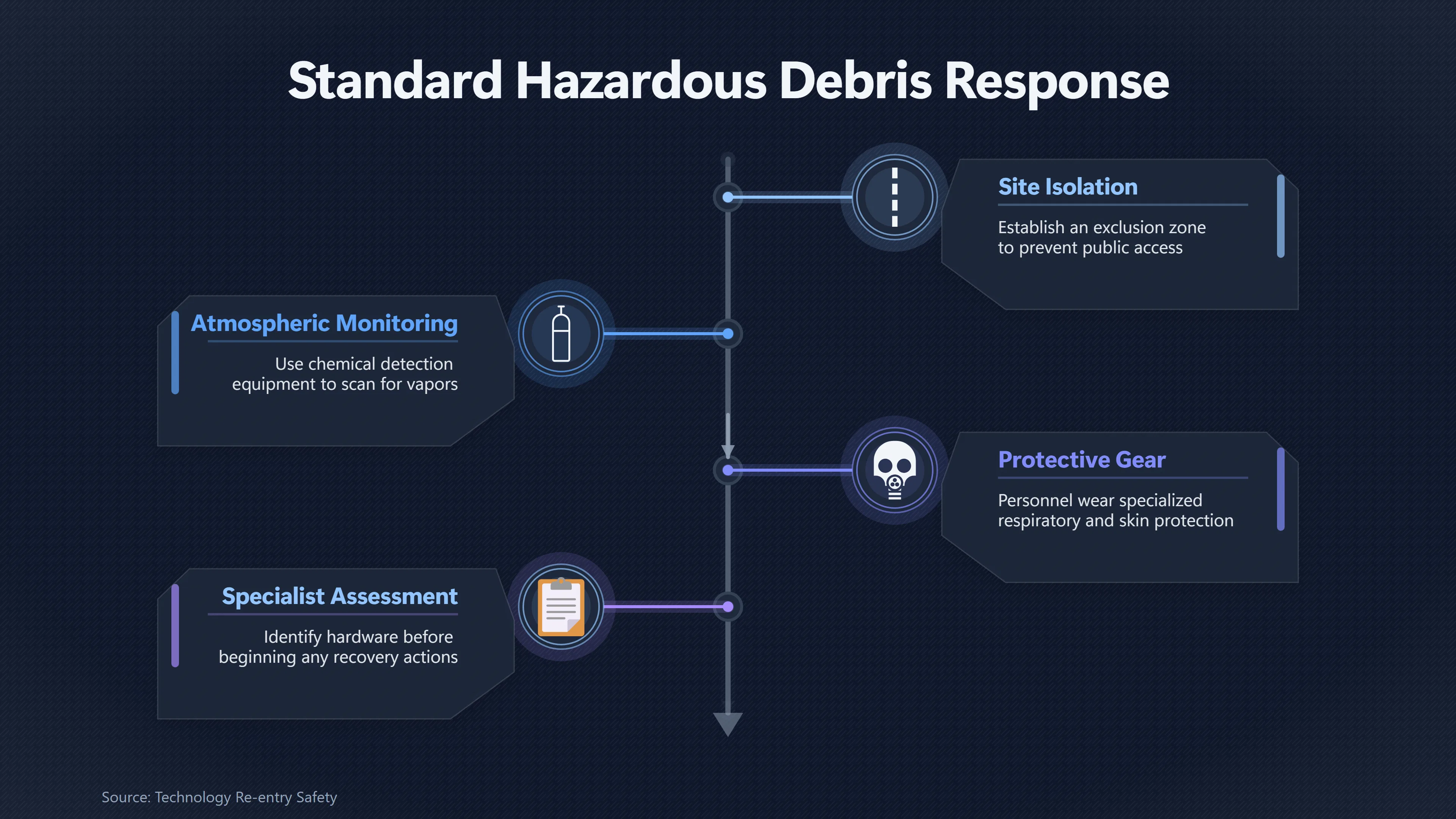
Specialist hazardous-material teams typically seek to:
- establish an exclusion zone;
- prevent unnecessary public access;
- avoid moving damaged tanks or propulsion assemblies;
- monitor the atmosphere with chemical detection equipment;
- wear appropriate protective clothing before approaching the object;
- identify the hardware before recovery begins.
This conservative approach reflects uncertainty rather than proof of contamination. A leaking pressure vessel can change condition unexpectedly, and moving damaged hardware may release trapped chemicals or rupture weakened components.
NASA’s operational planning reflects the same principle. Even for crewed spacecraft expected to land normally, recovery personnel consider hydrazine monitoring an essential part of post-landing operations because residual fuel cannot simply be assumed absent. NASA has supported the development of specialised respiratory protection specifically intended for first responders dealing with hydrazine and related spacecraft contaminants.[nasa.gov]ntrs.nasa.govNASA Technical Reports ServerRisk Analysis Associated with Loss of Toxic Gases During Orion Landing and Recovery Operations - NASA Techni…
What this means when considering Kecksburg
The reported military cordon around the Kecksburg site has often been interpreted solely through the lens of secrecy surrounding unidentified flying objects. However, viewed from a hazardous-response perspective, restricting access to an unidentified aerospace object would also have been consistent with standard safety practice if responders could not exclude the possibility of toxic propellant.
In 1965, personnel reaching an unknown object in woodland would have had no immediate way to determine whether it was a meteorite, classified aerospace hardware, foreign space technology or conventional aircraft debris. Any of those possibilities could have involved hazardous chemicals or pressurised systems. Establishing distance until experts arrived would therefore have represented a precautionary response rather than evidence that responders already knew the object’s identity.
Hydrazine risk alone cannot explain what, if anything, landed near Kecksburg. Nor does it provide evidence that spacecraft fuel was actually present. Instead, it demonstrates why an apparently cooled object could still have been regarded as dangerous enough to justify restricting public access and waiting for specialist assessment before any recovery took place.[esa.int]technology.esa.intTechnology Re-entry SafetyESA TechnologyRe-entry SafetyNovember 3, 2023…

Amazon book picks
Further Reading
Books and field guides related to Could Fallen Space Debris Still Contain Toxic Fuel?. Use these as the next step if you want deeper reading beyond the article.
Ignition!: An Informal History of Liquid Rocket Propellants
John Clark tells here, with irreverent and eyewitness immediacy, the story of the search for a power packaging which could be trusted to...
Rocket Propulsion Elements
Rating: 4.5/5 from 11 Google Books ratings
Aerospace Engineering/Mechanical Engineering The definitive text on rocket propulsion-now completely revised to reflect rapid advancement...
Space Debris: Models and Risk Analysis
In Space Debris Models and Risk Analysis the authors will provide the reader with a comprehensive background to understand the various so...
The Poisoner's Handbook
Equal parts true crime, twentieth-century history, and science thriller, The Poisoner's Handbook is "a vicious, page-turning story that r...
eBay marketplace picks
Marketplace Samples
Live-tested eBay searches with available results related to this page.
Selected fromspacecraft model oneBay.co.uk.
Endnotes
1.
Source: technology.esa.int
Title: Technology Re-entry Safety
Link:https://technology.esa.int/page/re-entry-safety
Source snippet
ESA TechnologyRe-entry SafetyNovember 3, 2023...
Published: November 3, 2023
2.
Source: ntrs.nasa.gov
Link:https://ntrs.nasa.gov/citations/20190027186
Source snippet
NASA Technical Reports ServerRisk Analysis Associated with Loss of Toxic Gases During Orion Landing and Recovery Operations - NASA Techni...
3.
Source: reentry.esoc.esa.int
Title: Reentry Predictions ESA’s re-entry predictions
Link:https://reentry.esoc.esa.int/
Source snippet
ESA Reentry PredictionsESA’s re-entry predictions...
4.
Source: esa.int
Title: European Space Agency ESA
Link:https://www.esa.int/content/view/full/413425
Source snippet
European Space AgencyESA - Reentry and collision avoidance...
5.
Source: techport.nasa.gov
Title: Tech Port NASA Tech Port
Link:https://techport.nasa.gov/projects/17989
Source snippet
ProjectJanuary 22, 2026 — Small Business Innovation Research/Small Business Tech Transfer A [FIRST RESPONSE]({{ 'first-response/' | relative_url }}) CREW MASK FOR AMMON...
Published: January 22, 2026
6.
Source: techport.nasa.gov
Title: Tech Port NASA Tech Port
Link:https://techport.nasa.gov/projects/16793
Source snippet
NASA TechPortNASA TechPort - Project...
7.
Source: nasa.gov
Title: 4.0 In-Space Propulsion
Link:https://www.nasa.gov/smallsat-institute/sst-soa/in-space_propulsion/
Source snippet
May 7, 2026 — 4.6 STATE-OF-THE-ART IN SMALL SPACECRAFT PROPULSION 4.6.1 IN-SPACE CHEMICAL PROPULSION In-space chemical propulsion sys...
Published: May 7, 2026
8.
Source: nasa.gov
Title: A technical bulletin captures critical engineering information or best practice
Link:https://www.nasa.gov/nesc/knowledge-products/nesc-technical-bulletins/
Source snippet
NESC Technical Bulletins - NASAMarch 9, 2026 — NESC TECHNICAL BULLETINS NESC Technical Bulletins can result from NESC independent testing...
Published: March 9, 2026
9.
Source: techport.nasa.gov
Link:https://techport.nasa.gov/projects/33810
10.
Source: techport.nasa.gov
Link:https://techport.nasa.gov/projects/13762
11.
Source: nasa.gov
Title: Lessons Learned
Link:https://www.nasa.gov/nesc/knowledge-products/lessons-learned/
12.
Source: spinoff.nasa.gov
Link:https://spinoff.nasa.gov/node/11576
13.
Source: science.nasa.gov
Title: end of mission
Link:https://science.nasa.gov/mission/dawn/toolkit/end-of-mission/
14.
Source: blogs.esa.int
Title: int ER S-2 reentry – frequently asked questions – Rocket Science
Link:https://blogs.esa.int/rocketscience/2024/02/05/ers-2-reentry-frequently-asked-questions/comment-page-1/
15.
Source: ntrs.nasa.gov
Link:https://ntrs.nasa.gov/citations/20220013364
16.
Source: ntrs.nasa.gov
Link:https://ntrs.nasa.gov/citations/20210017830
17.
Source: esa.int
Link:https://www.esa.int/Space_Safety/Clean_Space/Space_debris_feel_the_burn
18.
Source: nasa.gov
Title: Heat Shield Testing Recycles Waste on Earth
Link:https://www.nasa.gov/humans-in-space/heat-shield-testing-recycles-waste-on-earth/
19.
Source: ntrs.nasa.gov
Link:https://ntrs.nasa.gov/citations/20205007928
20.
Source: standards.nasa.gov
Title: KSC SPEC P 0017
Link:https://standards.nasa.gov/standard/KSC/KSC-SPEC-P-0017
21.
Source: esa.int
Link:https://www.esa.int/Space_Safety/Clean_Space/Sending_a_satellite_safely_to_sleep
22.
Source: nasa.gov
Title: Toxic Sensors
Link:https://www.nasa.gov/centers-and-facilities/white-sands/toxic-sensors/
23.
Source: heasarc.gsfc.nasa.gov
Title: Beppo SAX FAQs
Link:https://heasarc.gsfc.nasa.gov/docs/sax/BeppoSAX_FAQs.html
24.
Source: ntrs.nasa.gov
Link:https://ntrs.nasa.gov/citations/20000110066
25.
Source: ntrs.nasa.gov
Link:https://ntrs.nasa.gov/citations/19870016455
26.
Source: ntrs.nasa.gov
Link:https://ntrs.nasa.gov/archive/nasa/casi.ntrs.nasa.gov/19720019028.pdf
27.
Source: spinoff.nasa.gov
Link:https://spinoff.nasa.gov/node/10952
28.
Source: esa.int
Link:https://www.esa.int/Space_Safety/Space_Debris/Space_Debris_FAQ_Frequently_asked_questions
29.
Source: ncbi.nlm.nih.gov
Title: NCBIPUBLIC HEALTH STATEMENT
Link:https://www.ncbi.nlm.nih.gov/books/NBK595578/
Source snippet
Toxicological Profile for Hydrazines - NCBI BookshelfSeptember 1, 1997...
Published: September 1, 1997
30.
Source: GOV.UK
Title: www.gov.uk Hydrazine: general information
Link:https://www.gov.uk/government/publications/hydrazine-properties-and-incident-management/hydrazine-general-information
31.
Source: ncbi.nlm.nih.gov
Link:https://www.ncbi.nlm.nih.gov/books/NBK592403/
32.
Source: GOV.UK
Title: www.gov.uk Hydrazine: general information and incident management
Link:https://www.gov.uk/government/publications/hydrazine-properties-and-incident-management
33.
Source: ncbi.nlm.nih.gov
Link:https://www.ncbi.nlm.nih.gov/books/NBK220003/
Additional References
34.
Source: youtube.com
Title: The Metal Spheres That Just Fell From The Sky Onto This Beach Shouldn’t Exist
Link:https://www.youtube.com/watch?v=ZGVwW7BtbK0
Source snippet
The 2-Hour Space Disaster That Took 3 Years to Plan | Salvage Masters...
35.
Source: youtube.com
Title: Aegis BMD “Burnt Frost” Satellite Shoot-Down Documentary
Link:https://www.youtube.com/watch?v=pDqNjnUNUl8
Source snippet
The Pentagon says a missile launched from a Navy ship struck a dying U.S. spy satellite passing 130...
36.
Source: youtube.com
Title: Toxic [space debris]({{ ‘space-debris/’ | relative_url }}) washes up on Queensland beach | 7NEWS
Link:https://www.youtube.com/watch?v=13FvDQVfsiU
Source snippet
The Metal Spheres That Just Fell From The Sky Onto This Beach Shouldn't Exist...
37.
Source: youtube.com
Title: The 2-Hour Space Disaster That Took 3 Years to Plan | Salvage Masters
Link:https://www.youtube.com/watch?v=l3FVIFkhlE0
Source snippet
Aegis BMD "Burnt Frost" Satellite Shoot-Down Documentary...
38.
Source: youtube.com
Link:https://www.youtube.com/watch?v=-oLHtWQZ3MY