Within Kecksburg
Can Government Records Resolve Kecksburg?
Efforts to obtain official files test whether the mystery reflects hidden evidence, lost paperwork or ordinary archival gaps.
On this page
- What researchers have sought
- Archival loss and classification problems
- How to judge transparency claims
Page outline Jump by section
Introduction
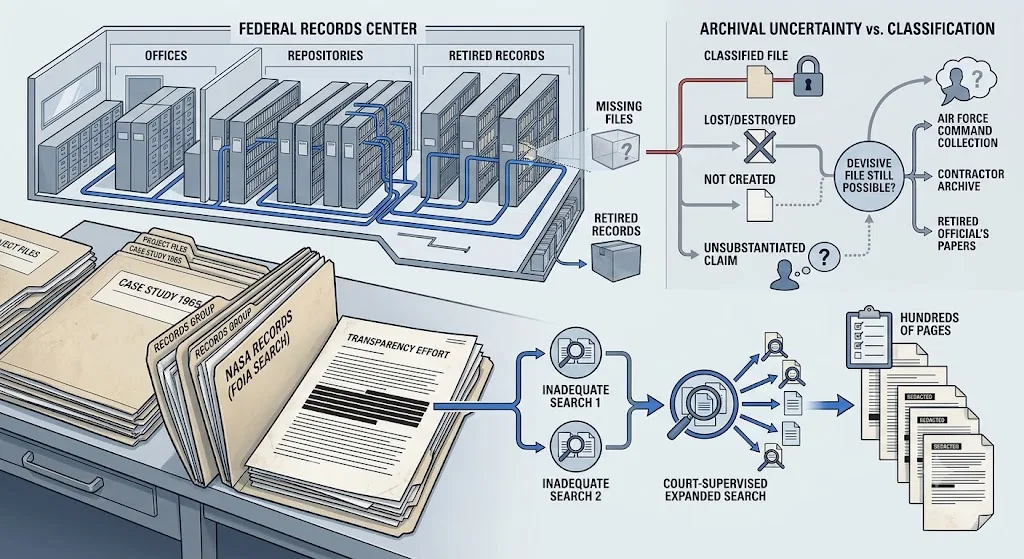
Government records have not resolved the Kecksburg incident, but they have clarified an important part of the mystery: the difference between evidence being classified, evidence being lost and evidence never having existed in the form researchers expected. The most significant transparency effort was journalist Leslie Kean’s Freedom of Information Act lawsuit against NASA, begun after a 2003 request for records connected with the events of 9 December 1965. NASA acknowledged that its first two searches had been inadequate, and a later court-supervised settlement required a much broader search. That process produced hundreds of pages, but no document confirming the recovery of an unusual craft.[casemine.com]casemine.comKEAN v. NATIONAL AERONAUTICS SPACE ADMINSULLIVAN, District Judge. Plaintiff Leslie Kean brings this suit against the National Aer…
The lawsuit therefore did not prove either a government cover-up or complete government openness. It exposed weak searches, inconsistent public statements and gaps in old record collections. At the same time, Freedom of Information law could compel NASA to look properly only for records it possessed; it could not reconstruct documents destroyed decades earlier, force another agency’s files to appear or establish that witnesses’ recollections were correct. Kecksburg remains a useful case study in how archival uncertainty can resemble secrecy without necessarily proving it.
What researchers have sought
Records researchers have generally pursued three overlapping questions. First, did any federal agency send personnel to Kecksburg or take custody of material there? Secondly, did NASA, the Air Force or another organisation later examine metallic debris associated with the event? Thirdly, were relevant files withheld because they remained classified, or were they absent because of poor recordkeeping, routine disposal or searches conducted in the wrong offices?
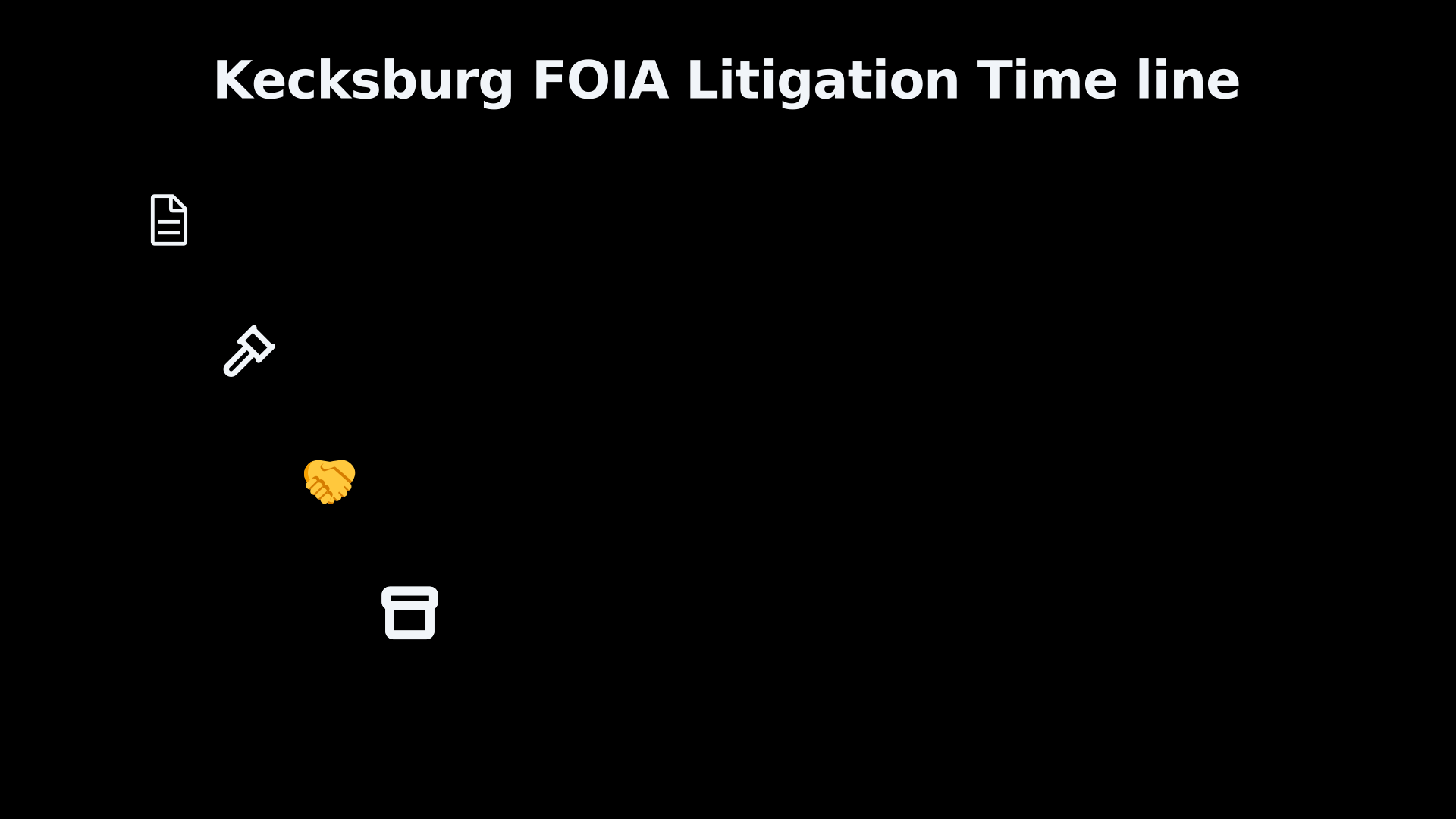
The most visible campaign began in 2002, when Kean led a records initiative supported by the Sci Fi Channel and the Coalition for Freedom of Information. Her January 2003 Freedom of Information Act request sought NASA documents relating to Kecksburg. When the response failed to satisfy her, she sued the agency in federal court. The litigation record is especially significant because NASA admitted that its first two attempts to find responsive material were inadequate. That admission was procedural rather than sensational: it established that NASA had not initially searched as thoroughly as the law required, not that it possessed a hidden report describing a recovered spacecraft.[CaseMine]casemine.comKEAN v. NATIONAL AERONAUTICS SPACE ADMINSULLIVAN, District Judge. Plaintiff Leslie Kean brings this suit against the National Aer…
In October 2007, after several years of litigation, NASA agreed to conduct a more extensive search and to pay $50,000 towards the requester’s legal fees and costs. Reports on the settlement described federal judge Emmet Sullivan as dissatisfied with the agency’s earlier diligence. NASA was required to revisit offices, repositories and retired records under court scrutiny rather than simply repeat its original response.[Reporters Committee]rcfp.orgOpen source on rcfp.org.
The expanded search was completed in August 2009. It delivered hundreds of additional documents, including material concerning NASA’s historical role in analysing re-entering spacecraft and foreign space debris. Yet it produced no “smoking gun” record stating that NASA recovered, transported or identified an object from the Kecksburg woods. Kean argued that the released material raised further questions, particularly about missing files and government arrangements for handling non-US space hardware, but the documentary result remained inconclusive.[Space]space.com7589 case finally closed 1965 pennsylvania ufo mysteryIs Case Finally Closed on 1965 Pennsylvania 'UFO Mystery'? | Space…
Researchers have also examined the Air Force’s Project Blue Book collection. These records matter because the Air Force publicly investigated unidentified aerial reports between 1947 and 1969 and acknowledged searching near Kecksburg. The surviving Blue Book files are declassified and held by the US National Archives. The collection comprises roughly 37 cubic feet of chronological case files, additional administrative and investigative material, photographs and 94 rolls of microfilm, with indexes organised by date and location.[National Archives]archives.govNational Archives Project BLUE BOOKNational ArchivesProject BLUE BOOK - Unidentified Flying Objects | National Archives…
Public access to that collection provides a useful baseline: there is an official record of the aerial report and the Air Force’s meteor assessment, but no publicly available Blue Book document confirms the retrieval of a large manufactured object. That is relevant evidence against claims that a recovery report sits openly within the ordinary Blue Book file. It does not exclude the possibility that another military, intelligence or technical programme handled material outside Blue Book, but such a possibility requires independent documentary support rather than inference from the absence of a Blue Book record.
Why the NASA search became controversial
The records dispute became more confusing because NASA’s public explanations changed. Around the fortieth anniversary in 2005, the agency was reported as saying that specialists had examined fragments associated with Kecksburg and identified them as parts of a re-entering Soviet satellite, while the supporting records had been lost during the 1980s. That statement seemed to imply a definite NASA investigation and conclusion, yet the later court-supervised search did not recover a corresponding analytical file.[Wikipedia]WikipediaKecksburg UFO incidentKecksburg UFO incident
This inconsistency is one of the strongest transparency concerns in the case. If NASA had reliable grounds for attributing recovered material to Soviet hardware, researchers reasonably expected to find a laboratory report, correspondence, tracking analysis, sample log or at least a traceable reference to the personnel and office involved. When those records could not be produced, several explanations remained possible:
- NASA once held relevant papers that were later destroyed, misplaced or separated from their original filing context.
- The public statement combined memories or second-hand information that had never been documented as an official Kecksburg finding.
- Records existed under an unexpected project, centre, contractor or technical programme rather than under the place name “Kecksburg”.
- Material from another location or another re-entry event was mistakenly associated with the Pennsylvania incident.
- NASA had only an advisory role, while the principal records belonged to the Air Force or another agency.
None of these possibilities is equivalent to proof of concealed extraterrestrial evidence. The contradiction demonstrates unreliable institutional memory and an inability to substantiate a public claim. That is a genuine transparency failure even when the underlying cause is mundane.
Contemporary reporting also stated that two boxes of documents from the relevant historical period could not be located. Their absence attracted attention because potentially responsive papers might have been among them. Yet a missing container is not self-interpreting evidence. Without a complete inventory, researchers cannot know whether the boxes concerned Kecksburg, unrelated space-debris work, administrative correspondence or subjects with only a loose connection to the request.[The Guardian]theguardian.comThe Guardian Nasa told to solve 'UFO crash' X-File | World news | The GuardianThe Guardian Nasa told to solve 'UFO crash' X-File | World news | The Guardian
The legal outcome should therefore be stated carefully. The court did not rule that NASA had recovered a UFO, nor did it order the agency to reveal a known classified object. The dispute centred on whether NASA had made a reasonable search for records responsive to the request. The settlement improved the quality and documentation of that search. Its value lies in forcing greater institutional effort, exposing earlier shortcomings and establishing a clearer record of where NASA looked.
Archival loss and classification problems
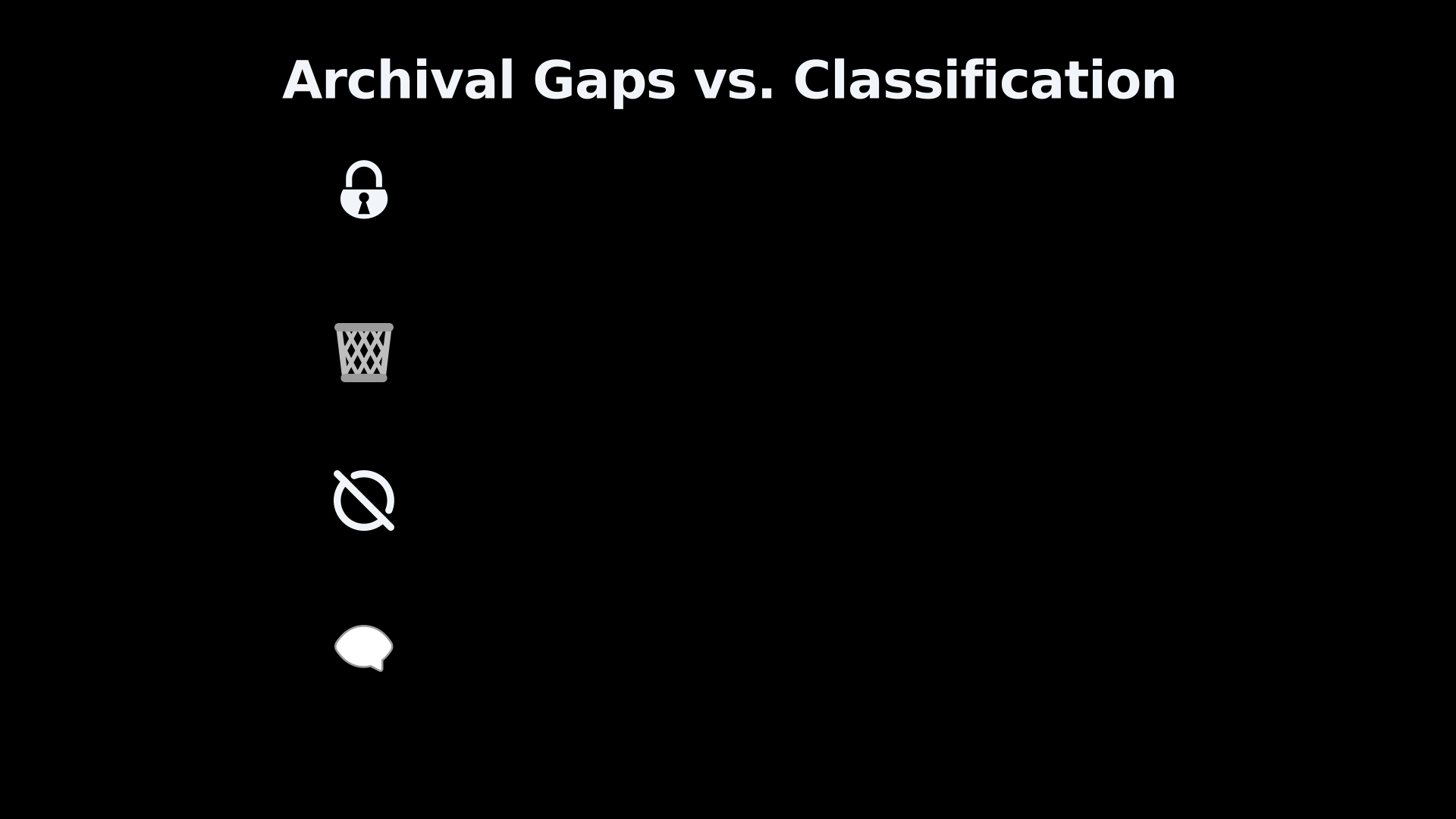
Public debate often treats every unavailable record as “classified”, but classification and archival loss are different problems. A classified document exists and is withheld under a legal authority, normally with the agency identifying an applicable Freedom of Information Act exemption. A lost or destroyed document cannot be reviewed or released at all. A record that was never created presents a third problem: government activity may have occurred without generating the type of paperwork later researchers expect.
The Kecksburg litigation principally exposed search and preservation issues, not a documented list of classified files. NASA’s inability to locate an alleged technical analysis did not come with a formal finding that the report remained secret for national-security reasons. That distinction matters. Claims that the lawsuit uncovered “classified Kecksburg files” go beyond what the public record demonstrates.
Federal recordkeeping rules nevertheless make missing official material a serious governance concern. The National Archives states that agencies must notify the Archivist about the actual, threatened or impending unlawful removal, alteration, deletion or destruction of federal records. Such rules recognise that public access depends not only on disclosure law but on records being identified, scheduled and preserved before anybody asks for them.[National Archives]archives.govNational Archives Unauthorized Disposition of Federal RecordsNational Archives Unauthorized Disposition of Federal Records
Historical collections are rarely complete. Records may be destroyed under approved retention schedules because they were considered temporary; decentralised offices may maintain different filing systems; contractors may hold technical papers outside an agency’s central index; and project terminology may change over time. A search using “Kecksburg” may miss a file catalogued under a date, tracking number, recovery programme, geographic coordinate or suspected satellite designation.
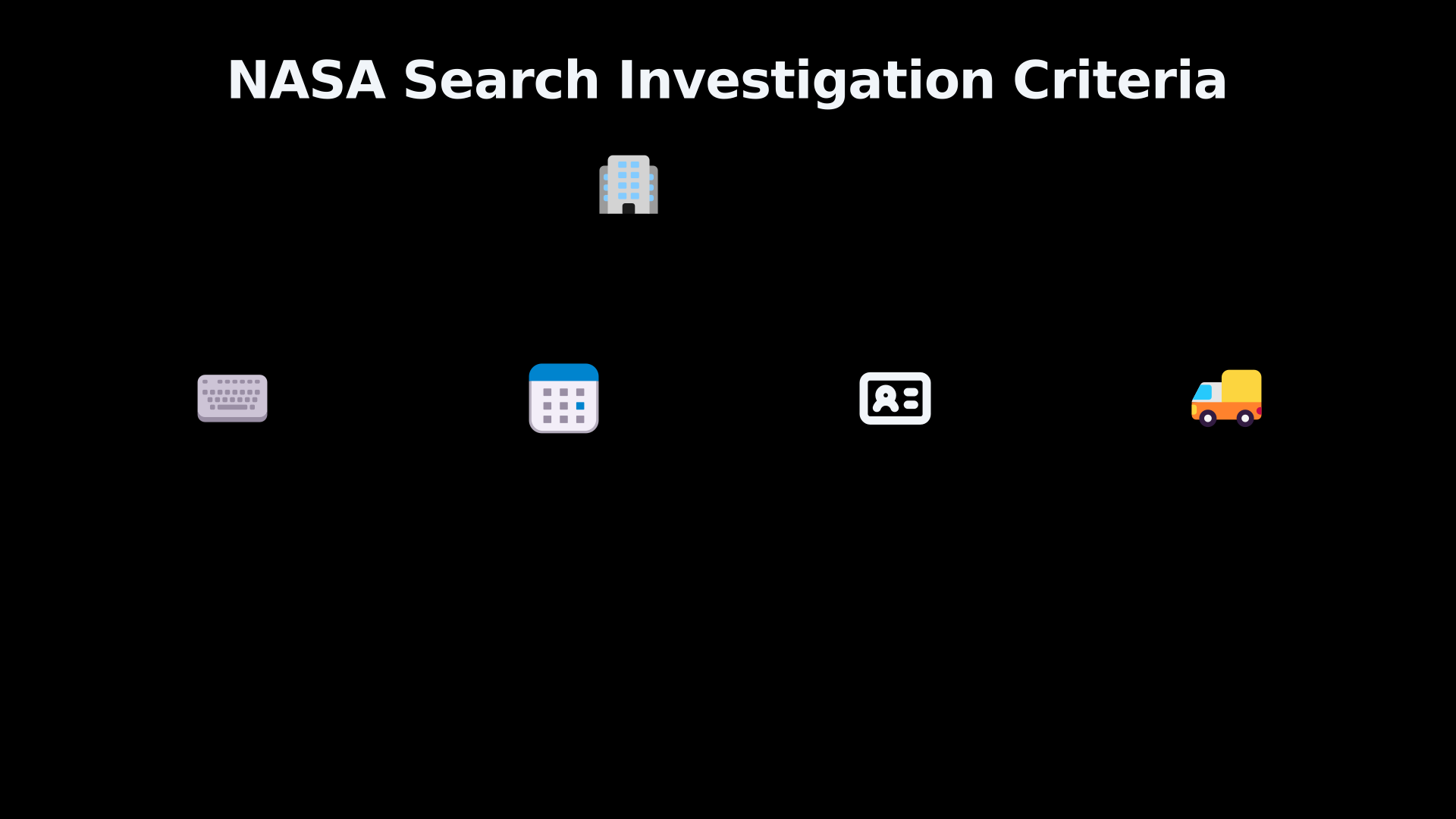
These ordinary archival mechanisms can produce gaps that look suspicious, particularly when an agency previously made a confident claim it can no longer document. The appropriate response is not to assume either conspiracy or innocence. Researchers should ask whether the agency can identify:
- the offices and record systems searched;
- the search terms, date ranges and project names used;
- the retention schedules governing the missing files;
- any transfer, destruction or disposal documentation;
- the names or positions of likely custodians;
- related records held by other agencies, field centres or contractors.
That approach shifts attention from the drama of an absent document to the traceable administrative history of the absence.
What Freedom of Information law can and cannot prove
The US Freedom of Information Act is an access mechanism, not an investigative commission. It allows a requester to seek existing agency records and challenge an inadequate search or improper withholding. It does not normally require an agency to answer questions, create a new explanation, resolve contradictions between witnesses or produce a document that no longer exists.
Courts assess whether an agency used methods reasonably calculated to locate responsive records. A search is not automatically inadequate merely because it finds nothing or fails to locate a document the requester believes must exist. Conversely, an agency cannot satisfy its duty with an unexplained or narrowly confined search when other likely record systems have not been examined. Department of Justice summaries of Freedom of Information case law emphasise that the absence of an expected record does not by itself disprove the adequacy of an otherwise reasonable search.[Department of Justice]justice.govOpen source on justice.gov.
Applied to Kecksburg, this produces two conclusions that can coexist:
NASA’s original handling was deficient. The agency conceded that its first two searches were inadequate, and sustained litigation was required before it undertook a wider, court-monitored effort. That history supports criticism of its responsiveness and initial transparency.[CaseMine]casemine.comKEAN v. NATIONAL AERONAUTICS SPACE ADMINSULLIVAN, District Judge. Plaintiff Leslie Kean brings this suit against the National Aer…
The final failure to find a recovery report is not proof that one was deliberately hidden. Once a legally adequate search has been performed, Freedom of Information law cannot convert suspicion into evidence. A missing record may justify further historical research, but it does not establish the record’s contents or even that it once existed.
This is why the lawsuit’s most durable result concerns governance rather than the physical identity of the object. It demonstrated how long delays, poor search descriptions and inconsistent agency statements can erode public confidence. Even an eventual good-faith search may not repair that damage, because the delay allows uncertainty to harden into a cover-up narrative.
How to judge transparency claims
Claims about government openness or concealment in the Kecksburg case are best assessed in layers rather than as a binary choice between “full disclosure” and “cover-up”.
Start with the provenance of each document. A dated Air Force message, NASA memorandum or archival catalogue entry carries more evidential weight than a later summary that does not identify its underlying file. Copies should be checked for agency markings, dates, authors, distribution lists and record-group references.
Separate what was withheld from what was not found. A redacted or exempted record is known to exist. A “no records” response means the search found nothing responsive, while a statement that records were destroyed or transferred raises a different set of questions. Combining these categories can falsely turn an archival gap into evidence of classification.
Examine the search, not merely the result. A credible response should say which offices, databases, retired-records repositories and custodians were checked. The Kecksburg litigation gained force because NASA acknowledged that its early searches had not met that standard.
Compare agencies carefully. NASA, the Air Force, state police and possible military recovery units had different responsibilities. NASA’s lack of a record cannot establish that the Air Force had none, and a Blue Book file cannot be assumed to contain every national-security or space-debris activity. The National Archives confirms that Blue Book’s surviving collection is extensive and publicly accessible, but its existence does not make it a universal index of all government action.[National Archives]archives.govNational Archives Project BLUE BOOKNational ArchivesProject BLUE BOOK - Unidentified Flying Objects | National Archives…
Treat institutional inconsistency as evidence of poor accountability, not automatic evidence of the extraordinary. NASA’s reported Soviet-satellite explanation deserved scrutiny because the agency could not later produce the supporting analysis. The responsible conclusion is that the explanation was insufficiently documented. It is a further, unsupported step to infer that the missing documentation must have described a non-human craft.
Ask what discovery would change the case. The strongest records would be contemporaneous transport orders, recovery logs, laboratory analyses, photographs with a documented chain of custody, communications naming the object, or records linking personnel and vehicles to a specific retrieval. General papers showing that the government collected foreign space debris establish capability and procedure, but not that those procedures were used at Kecksburg.
Can records still resolve Kecksburg?
A decisive file could still emerge, particularly from an overlooked Air Force command collection, a contractor archive, a retired official’s papers or records indexed under a programme name rather than the location. The transfer of declassified Blue Book material to the National Archives shows the value of preserving complete collections with finding aids that allow researchers to test official conclusions directly.[National Archives]archives.govNational Archives Project BLUE BOOKNational ArchivesProject BLUE BOOK - Unidentified Flying Objects | National Archives…
The prospects are limited, however, by the passage of more than six decades. Records may have been lawfully destroyed under old schedules, separated from their context or never created. Witnesses and records custodians have died, and later retellings can make it difficult to distinguish contemporary leads from details introduced years afterwards. A newly released page would therefore need strong provenance and corroboration before it could settle the matter.
The fairest assessment is that records requests have narrowed the transparency dispute without solving the incident. They show that NASA’s initial response was inadequate, that its public account was not consistently supported by retrievable documentation and that the later search found no official confirmation of an extraordinary recovery. Those facts justify scepticism about the quality of government recordkeeping. They do not, on their own, justify certainty that decisive evidence was deliberately concealed.
Amazon book picks
Further Reading
Books and field guides related to Can Government Records Resolve Kecksburg?. Use these as the next step if you want deeper reading beyond the article.
UFOs: Generals, Pilots, and Government Officials Go on the Re...
NEW YORK TIMES BESTSELLER • Impeccably researched, this riveting journalistic investigation separates fact from fiction, and documents th...
UFOs and Government: A Historical Inquiry
Governments around the world have had to deal with the UFO phenomenon for a good part of a century. How and why they did so is the subjec...
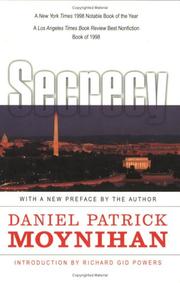
Secrecy: The American Experience
Senator Daniel Patrick Moynihan, the late senior U.S. Senator from N.Y., here presents an eloquent & fascinating account of the developme...
The Art of Access: Strategies for Acquiring Public Records
NEW TO THIS EDITION: 40 additional experts and practitioners offer tips and record ideas for opening new doorways into FOI and open data....
eBay marketplace picks
Marketplace Samples
Live-tested eBay searches with available results related to this page.
Selected fromgovernment secrets sign oneBay.co.uk.



Endnotes
1.
Source: casemine.com
Link:https://www.casemine.com/judgement/us/5914b44dadd7b0493476b750/amp
Source snippet
KEAN v. NATIONAL AERONAUTICS SPACE ADMINSULLIVAN, District Judge. Plaintiff Leslie Kean brings this suit against the National Aer...
2.
Source: space.com
Title: 7589 case finally closed 1965 pennsylvania ufo mystery
Link:https://www.space.com/7589-case-finally-closed-1965-pennsylvania-ufo-mystery.html
Source snippet
Is Case Finally Closed on 1965 Pennsylvania 'UFO Mystery'? | Space...
3.
Source: archives.gov
Title: National Archives Project BLUE BOOK
Link:https://www.archives.gov/research/military/air-force/ufos
Source snippet
National ArchivesProject BLUE BOOK - Unidentified Flying Objects | National Archives...
4.
Source: Wikipedia
Title: [Kecksburg UFO incident]({{ ‘kecksburg-ufo-incident/’ | relative_url }})
Link:https://en.wikipedia.org/wiki/Kecksburg_UFO_incident
5.
Source: archives.gov
Title: National Archives Unauthorized Disposition of Federal Records
Link:https://www.archives.gov/records-mgmt/resources/unauthorizeddispositionoffederalrecords
6.
Source: justice.gov
Link:https://www.justice.gov/archive/oip/courtdecisions/adequacy-search.html
7.
Source: archives.gov
Title: Project BLUE BOOK
Link:https://www.archives.gov/foia/ufos.html
8.
Source: nasa.gov
Link:https://www.nasa.gov/
9.
Source: Wikipedia
Title: Project Blue Book
Link:https://en.wikipedia.org/wiki/Project_Blue_Book
10.
Source: Wikipedia
Title: NASA v. Nelson
Link:https://en.wikipedia.org/wiki/NASA_v._Nelson
11.
Source: Wikipedia
Link:https://en.wikipedia.org/wiki/NASA
12.
Source: Wikipedia
Title: Kecksburg, Pennsylvania
Link:https://en.wikipedia.org/wiki/Kecksburg%2C_Pennsylvania
13.
Source: justice.gov
Title: foia guide 2004 edition litigation considerations
Link:https://www.justice.gov/archives/oip/foia-guide-2004-edition-litigation-considerations
14.
Source: justice.gov
Link:https://www.justice.gov/archive/oip/foiapost/2012-cd-march.html
15.
Source: rcfp.org
Link:https://www.rcfp.org/judge-forces-nasa-take-giant-leap-foia-suit/
16.
Source: rcfp.org
Title: nasa ordered review its records data ufo sighting
Link:https://www.rcfp.org/nasa-ordered-review-its-records-data-ufo-sighting/
Source snippet
Reporters CommitteeNASA Ordered to Review Its Records for Data on "UFO...10 Dec 2007 — A recent settlement in a four-year old Freedom of...
17.
Source: theguardian.com
Title: The Guardian Nasa told to solve ‘UFO crash’ X-File | World news | The Guardian
Link:https://www.theguardian.com/world/2007/nov/11/spaceexploration.usa
18.
Source: theguardian.com
Link:https://www.theguardian.com/science/2026/aug/05/spacex-rocket-moon-crash-impact-falcon-9
19.
Source: rcfp.org
Title: federal court rules justice adequately searched records
Link:https://www.rcfp.org/federal-court-rules-justice-adequately-searched-records/
20.
Source: theguardian.com
Link:https://www.theguardian.com/science/nasa
21.
Source: cdn.nationalarchives.gov.uk
Link:https://cdn.nationalarchives.gov.uk/documents/the-ufo-files-extract.pdf
22.
Source: nationalarchives.gov.uk
Title: Public Records Act
Link:https://www.nationalarchives.gov.uk/information-management/legislation/public-records-act/pra-faqs/
23.
Source: nationalarchives.gov.uk
Link:https://www.nationalarchives.gov.uk/about-us/how-we-work/plans-policies-performance-and-projects/our-policies/records-collection-policy/
24.
Source: nationalarchives.gov.uk
Link:https://www.nationalarchives.gov.uk/information-management/legislation/
25.
Source: foia.gov
Title: oip 101012
Link:https://www.foia.gov/iso/opa/foia/oip-101012.html
26.
Source: causeofaction.org
Link:https://causeofaction.org/tag/nara/
27.
Source: assets.publishing.service.gov.uk
Title: Freedom Information Code Practice Web Accessible
Link:https://assets.publishing.service.gov.uk/media/6114c3278fa8f506c4d84100/Freedom_Information_Code_Practice_Web_Accessible.pdf
Additional References
28.
Source: youtube.com
Link:https://www.youtube.com/watch?v=HX_RrO7ZQaU
Source snippet
Kecksburg UFO Crash: The Untold Story | The Government Lied! | Full Documentary | UFOTV®...
29.
Source: youtube.com
Link:https://www.youtube.com/watch?v=tU7WSHZye5w
Source snippet
The Kecksburg UFO Mystery + The Corporate Espionage Scandal Rocking Silicon Valley...
30.
Source: cbsnews.com
Title: nasa court ordered to search for ufo docs
Link:https://www.cbsnews.com/news/nasa-court-ordered-to-search-for-ufo-docs/
Source snippet
CBS NewsNASA Court-Ordered To Search For UFO Docs27 Oct 2007 — NASA has agreed to search its archives once again for documents on a 1965...
31.
Source: youtube.com
Link:https://www.youtube.com/watch?v=pjO6b79BChc
Source snippet
Search for answers about Kecksburg UFO in Pennsylvania...
32.
Source: youtube.com
Title: United States [Military Interest]({{ ‘military-interest/’ | relative_url }}) in UFOs with Leslie Kean
Link:https://www.youtube.com/watch?v=VssAznJmNr0
Source snippet
America's Other Roswell: the Kecksburg UFO | Conspiracy (S1, E13) | Full Episode | History...
33.
Source: nsa.gov
Link:https://www.nsa.gov/portals/75/documents/news-features/declassified-documents/ufo/usaf_fact_sheet_95_03.pdf
34.
Source: archivesfoundation.org
Link:https://archivesfoundation.org/documents/50-years-ago-government-stops-investigating-ufos/
35.
Source: instagram.com
Link:https://www.instagram.com/p/DOJujVRCfzU/
36.
Source: x.com
Link:https://x.com/NASA
37.
Source: instagram.com
Link:https://www.instagram.com/nasa/