Within Cold War Context
Why Blue Book Could Not End Suspicion
Blue Book's public conclusions could not resolve suspicion when classified explanations and inter-agency information gaps remained hidden.
On this page
- What Project Blue Book told the public
- How classified programmes limited transparent answers
- Why fragmented agencies looked like coordinated concealment
Page outline Jump by section
Introduction
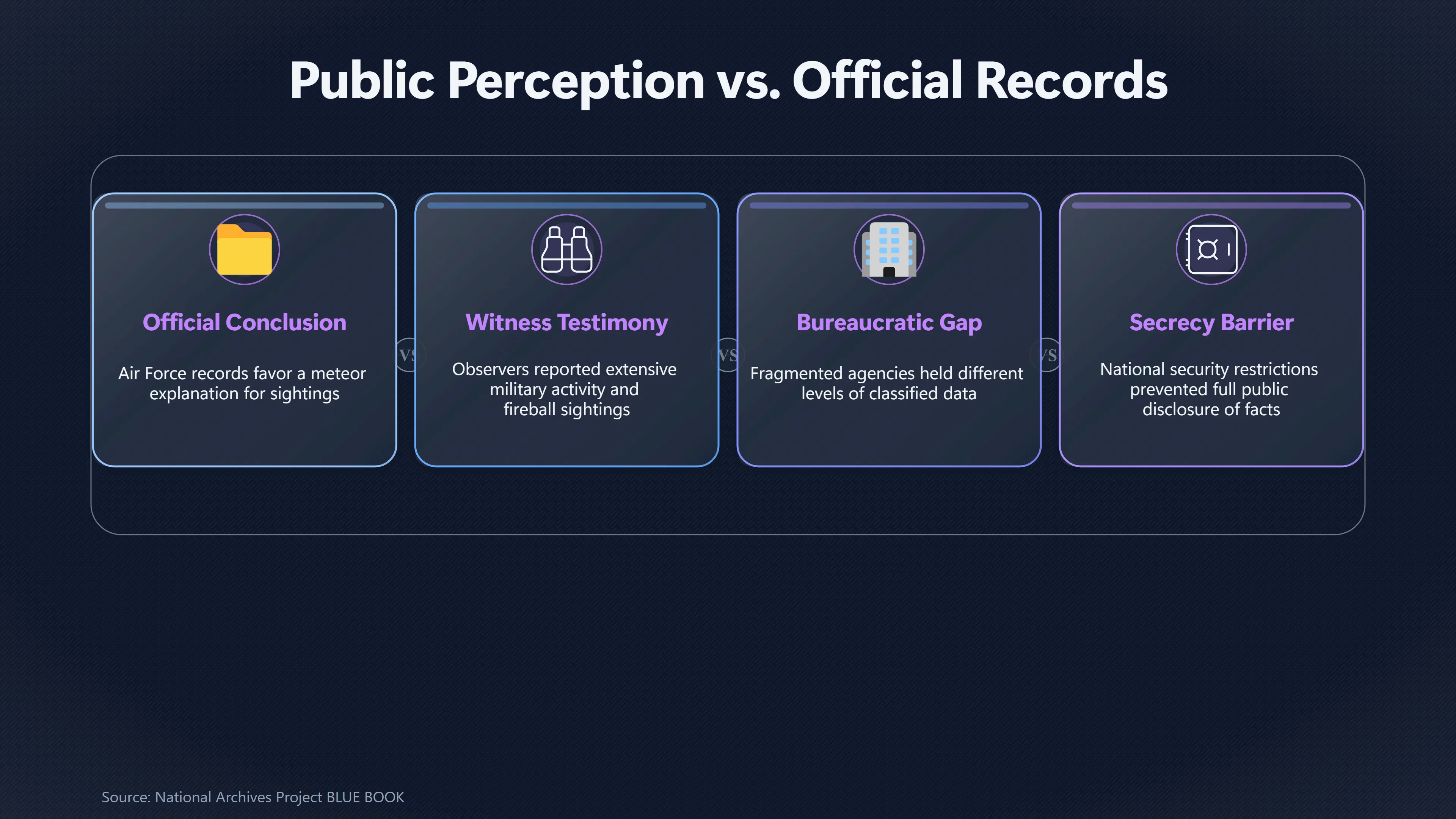
For many Americans who followed the 1965 Kecksburg incident, Project Blue Book’s conclusion that nothing extraordinary had been found did not settle the matter. The problem was not simply that some witnesses disagreed with the Air Force. Rather, Blue Book operated inside a Cold War defence establishment that routinely concealed sensitive aerospace programmes, intelligence capabilities and foreign technology recoveries. As a result, even sincere official denials could appear incomplete. When the public knew that some information genuinely had to remain classified, it became difficult to determine whether an official explanation reflected the whole story or only the part that could safely be disclosed.[Secrets Declassified]secretsdeclassified.af.milOpen source on af.mil.

In the context of Kecksburg, this tension between public investigation and national-security secrecy helps explain why Blue Book’s conclusions failed to reassure many observers. The persistence of suspicion says as much about the structure and limits of Cold War information management as it does about the incident itself.
What Project Blue Book told the public
Project Blue Book served as the U.S. Air Force’s official programme for investigating UFO reports between 1952 and 1969. Its published conclusions were consistent across thousands of cases: investigators found no evidence that reported UFOs threatened national security, represented technology beyond known science, or were extraterrestrial craft. Although hundreds of reports remained officially “unidentified”, the Air Force maintained that none justified claims of alien spacecraft.[Secrets Declassified]secretsdeclassified.af.milOpen source on af.mil.
The surviving Blue Book file relating to the Kecksburg event reflects this approach. It records an investigation that ultimately favoured a meteor explanation and states that search efforts found no recovered object of unusual significance. From the Air Force’s perspective, the case could therefore be closed without requiring further public investigation.[The Cold File]thecoldfile.com1965 kecksburgThe Cold FileThe Acorn in the Woods: The 1965 Kecksburg Incident | The Cold FileMay 25, 2026…
For many readers of the file, however, the brevity of the investigation became part of the controversy. The official record documented the Air Force’s conclusion, but it did not fully explain why numerous witnesses believed military activity had been more extensive than described. That distinction—between recording an official assessment and satisfying public curiosity—proved important.
How classified programmes limited transparent answers
The greatest obstacle to public confidence was not necessarily Blue Book itself but the environment in which it operated.
Throughout the Cold War, the U.S. military and intelligence community managed numerous classified aircraft, missile, satellite and surveillance programmes whose existence could not be acknowledged publicly. Officials investigating an unusual aerial event therefore could not always explain every possibility under consideration without risking disclosure of genuinely sensitive information.[Secrets Declassified]secretsdeclassified.af.milOpen source on af.mil.
This created a structural dilemma.
If investigators dismissed a sighting without discussing classified possibilities, critics interpreted the omission as evidence of concealment. If they acknowledged that certain explanations could not be discussed, they would implicitly reveal sensitive defence activities. Consequently, even accurate public statements could appear evasive because they omitted information for legitimate security reasons.
For incidents such as Kecksburg, where military personnel reportedly searched an area after a spectacular fireball, this tension became especially pronounced. The existence of authentic military secrecy made it difficult for observers to distinguish between ordinary national-security restrictions and an alleged effort to hide extraordinary discoveries.
Why fragmented agencies looked like coordinated concealment
Another reason Blue Book struggled to reassure the public was that it represented only one part of a much larger federal bureaucracy.
Project Blue Book investigated reported unidentified flying objects, but responsibility for missile detection, satellite tracking, intelligence collection, aerospace defence and foreign technology exploitation belonged to other organisations. Information was therefore compartmentalised rather than centrally shared. During the Cold War, compartmentalisation was considered a security feature rather than a flaw.
To outside observers, however, fragmented responsibilities often produced confusing or inconsistent public statements. One office might possess only limited information while another held classified operational details that could not be released. When agencies appeared unable to answer straightforward questions, many people interpreted the resulting gaps as evidence of deliberate coordination rather than institutional separation.
In the Kecksburg case, later researchers argued that the apparent absence of records from some military units and uncertainty over which organisations participated encouraged speculation that activities existed outside Blue Book’s documented investigation. While such claims do not establish a cover-up, they illustrate how incomplete administrative records can strengthen public suspicion when multiple agencies are involved.[Paradigm Research Group]paradigmresearchgroup.orgParadigm Research Group News Coverage ReprintsParadigm Research Group News Coverage Reprints

Blue Book’s credibility problems extended beyond Kecksburg
Blue Book also carried reputational challenges that affected how its conclusions were received.
Astronomer J. Allen Hynek, the programme’s long-serving scientific consultant, became increasingly critical of Blue Book’s methods during the 1960s. He argued that the project lacked sufficient scientific resources, relied on weak statistical practices and devoted excessive effort to routine public-relations tasks instead of carefully examining the most significant cases. His criticisms did not amount to evidence that extraterrestrial craft had been recovered, but they did undermine confidence in Blue Book as a rigorous scientific investigation.[Wikipedia]WikipediaProject Blue BookProject Blue Book
Because Hynek had worked inside the programme, later readers often regarded his concerns as especially significant. His criticism reinforced a broader perception that Blue Book’s institutional priority was resolving public reports efficiently rather than exploring every unexplained possibility in depth.
This distinction matters. A programme can reach an honestly held conclusion while still being criticised for investigative limitations. For many sceptics of the official account, Blue Book’s perceived shortcomings reduced the persuasive force of its denials even without proving those denials were false.
Why denial could not eliminate suspicion
[Kecksburg Incident]enigmalabs.ioKecksburg Incident | Enigma LabsKecksburg Incident | Enigma Labs dent demonstrates a broader pattern of Cold War public trust.
Several factors combined to weaken the reassuring effect of official denials:
- Real government secrecy existed. Americans already knew that major military and intelligence programmes were hidden from public view, making secrecy itself unsurprising.
- Witnesses reported activity inconsistent with official summaries. Whether accurate or mistaken, these accounts encouraged people to believe the public record was incomplete.
- Institutional fragmentation created information gaps. Different agencies possessed different responsibilities and different levels of access to classified material.
- Blue Book’s own reputation was contested. Internal criticism and later historical debate made some observers less willing to accept its conclusions at face value.[af.mil]secretsdeclassified.af.milOpen source on af.mil.
Taken together, these factors explain why Blue Book’s denials failed to reassure many people without requiring the conclusion that the Air Force had recovered an extraterrestrial craft.
What this means for understanding Kecksburg
From a historical perspective, the significance of Blue Book’s response lies less in whether its conclusion was correct than in why that conclusion failed to persuade.
The programme operated within a defence system designed to protect classified information, not to maximise public transparency. In such an environment, ordinary bureaucratic limits, compartmentalised knowledge and legitimate national-security secrecy could all resemble intentional concealment to outside observers. The Kecksburg incident therefore became an enduring example of how Cold War information practices could sustain public suspicion even when official investigations declared that no extraordinary object had been found.[af.mil]secretsdeclassified.af.milOpen source on af.mil.
Amazon book picks
Further Reading
Books and field guides related to Why Blue Book Could Not End Suspicion. Use these as the next step if you want deeper reading beyond the article.
The Report on Unidentified Flying Objects
Regardless of whether or not one believes that the study of UFO reports has any merit it is a simple fact that such reports were studied...
UFOs and Government: A Historical Inquiry
Governments around the world have had to deal with the UFO phenomenon for a good part of a century. How and why they did so is the subjec...
Mirage Men: A Journey into Disinformation, Paranoia and UFOs
Seeking the truth about UFOs in America, Mark Pilkington and John Lundberg uncover a 60 year-old story stranger than any conspiracy thril...
The Cold War
Rating: 4.0/5 from 10 Google Books ratings
Beginning with World War II and ending with the collapse of the Soviet Union, the author provides a thrilling account of the strategic dy...
eBay marketplace picks
Marketplace Samples
Live-tested eBay searches with available results related to this page.
Selected fromProject Blue Book poster oneBay.co.uk.
Endnotes
1.
Source: archives.gov
Link:https://www.archives.gov/news/articles/project-blue-book-50th-anniversary
2.
Source: archives.gov
Title: National Archives Project BLUE BOOK
Link:https://www.archives.gov/research/military/air-force/ufos
Source snippet
National ArchivesProject BLUE BOOK - Unidentified Flying Objects | National Archives...
3.
Source: Wikipedia
Title: Project Blue Book
Link:https://en.wikipedia.org/wiki/Project_Blue_Book
4.
Source: archives.gov
Title: 50 Years Ago: Government stops investigating UFOs | National Archives
Link:https://www.archives.gov/press/press-releases/2020/nr20-19
5.
Source: prologue.blogs.archives.gov
Title: ufos natural explanations
Link:https://prologue.blogs.archives.gov/2018/04/16/ufos-natural-explanations/
6.
Source: archives.gov
Title: Do Records Show Proof of UFOs? | National Archives
Link:https://www.archives.gov/news/articles/do-records-show-proof-of-ufos
7.
Source: unwritten-record.blogs.archives.gov
Title: project blue book looking to the film record
Link:https://unwritten-record.blogs.archives.gov/2013/09/30/project-blue-book-looking-to-the-film-record/
8.
Source: declassified.ca
Title: J. Allen Hynek
Link:https://declassified.ca/key-figures-in-ufology/j-allen-hynek/
9.
Source: youtube.com
Title: ‘Project Blue Book’ Ep. 1 Official Clip | UFO | SHOWTIME Documentary Series
Link:https://www.youtube.com/watch?v=W89jh2C2Ry8
Source snippet
Project Blue Book...
10.
Source: youtube.com
Title: Project Blue Book
Link:https://www.youtube.com/watch?v=jjinS2lZAsY
11.
Source: secretsdeclassified.af.mil
Link:https://www.secretsdeclassified.af.mil/Fact-Sheets/Display/Article/459832/project-blue-book/
12.
Source: thecoldfile.com
Title: 1965 kecksburg
Link:https://www.thecoldfile.com/articles/1965-kecksburg/
Source snippet
The Cold FileThe Acorn in the Woods: The 1965 Kecksburg Incident | The Cold FileMay 25, 2026...
Published: May 25, 2026
13.
Source: paradigmresearchgroup.org
Title: Paradigm Research Group News Coverage Reprints
Link:https://www.paradigmresearchgroup.org/News_Items-3.htm
14.
Source: en.ikwipedia.org
Title: Project Blue Book
Link:https://en.ikwipedia.org/wiki/Project_Blue_Book
Source snippet
Blue Book - IkwipediaJuly 17, 2026 — Template:UFO sidebar From March 1952 to December 17, 1969, Project Blue Book was the United States A...
Published: July 17, 2026
15.
Source: enigmalabs.io
Title: Kecksburg Incident | Enigma Labs
Link:https://enigmalabs.io/library/f45bb19d-5803-4ab6-a373-8799f64095c0
16.
Source: history.com
Title: Project Blue Book
Link:https://www.history.com/articles/project-blue-book
17.
Source: abcnews.go.com
Link:https://abcnews.go.com/Technology/Primetime/story?id=528712&page=1
Additional References
18.
Source: popularmechanics.com
Link:https://www.popularmechanics.com/military/a70995826/j-allen-hynek-project-blue-book-ufo-investigation-truth/
Source snippet
Allen Hynek from a government consultant and UFO skeptic into the foremost advocate for serious scientific study of unidentified flying o...
19.
Source: appalachianhistorian.org
Link:https://appalachianhistorian.org/the-[kecksburg-ufo-incident
Source snippet
Later accounts and official statements said searchers found nothing. That tension, between the first breathless hea...
20.
Source: youtube.com
Link:https://www.youtube.com/watch?v=HX_RrO7ZQaU
Source snippet
Project Blue Book: America's Obsession with UFOs...
21.
Source: youtube.com
Link:https://www.youtube.com/watch?v=1cO5K1np2Ig
Source snippet
'Project Blue Book' Ep. 1 Official Clip | UFO | SHOWTIME Documentary Series...
22.
Source: cufon.org
Link:https://www.cufon.org/cufon/obrien.htm
23.
Source: qsl.net
Link:https://www.qsl.net/w5www/kecksburg.html
24.
Source: osi.af.mil
Link:https://www.osi.af.mil/News/Features/Display/Article/2302429/project-blue-book-part-1-ufo-reports/
25.
Source: youtube.com
Title: Project Blue Book: America’s Obsession with UFOs
Link:https://www.youtube.com/watch?v=Xu4oTBBI5UE
Source snippet
Project Blue Book Exposed (2020) [Documentary]...
26.
Source: gutenberg.org
Link:https://www.gutenberg.org/files/25674/25674-h/25674-h.htm
27.
Source: newparadigminstitute.org
Title: disinformation series project sign to condon report
Link:https://newparadigminstitute.org/learn/library/disinformation-series-project-sign-to-condon-report/