Within Kecksburg
How Did the Witness Story Grow?
Sincere memories can change through repetition, suggestion and media exposure without deliberate fabrication.
On this page
- Memory after a startling event
- Suggestion and repeated retelling
- Separating sincerity from accuracy
Page outline Jump by section
Introduction
The Kecksburg witness story did not necessarily grow because residents deliberately invented it. A more plausible and evidence-based explanation is that sincere recollections changed as an extraordinary evening was repeatedly discussed, investigated, dramatised and commemorated. Human memory is reconstructive: people retain fragments of what they perceived, then rebuild an account using later information, expectations and repeated retrieval. Details can therefore become clearer, more coherent and more confidently held even when their historical accuracy has not improved.[National Academies]nationalacademies.orgOpen source on nationalacademies.org.
That distinction matters at Kecksburg. Contemporary reporting supports a real fireball, local concern that something might have fallen, an official search and contradictory early messages about the search area. The familiar account of a bronze, acorn-shaped object with strange markings, however, became nationally prominent much later, especially through television. The resulting testimony should not simply be dismissed, but neither should late confidence be treated as equivalent to an uncontaminated statement recorded on 9 December 1965.[Wikipedia]WikipediaKecksburg UFO incidentKecksburg UFO incident
Memory after a startling event
A brilliant fireball, sonic effects, smoke, emergency vehicles and rumours of a crash would have made the Kecksburg evening memorable without making every detail equally well encoded. Attention during a startling event is selective. A witness may remember the central impression—an intense light, a thump, activity in the woods—while retaining much less reliable information about duration, direction, distance, sequence or the appearance of something glimpsed briefly.
The National Academies’ review of eyewitness research describes memory as a continuously evolving system rather than a preserved recording. Viewing time, distance, illumination, heightened emotion and distractions can all affect what enters memory in the first place. Later reconstruction may fill gaps with expectations based on prior experience.[National Academies]nationalacademies.orgOpen source on nationalacademies.org.
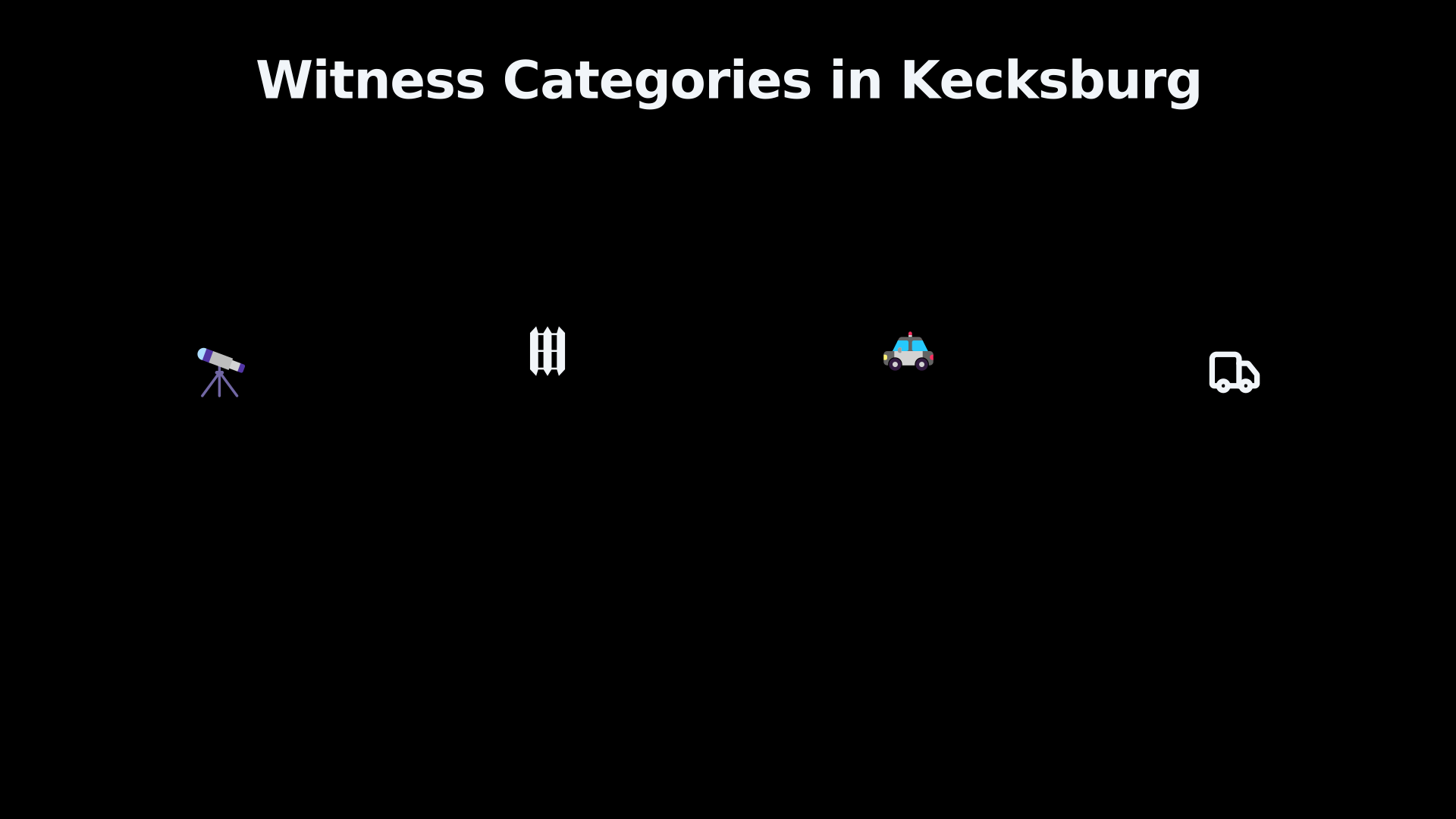
This is especially relevant when separating several kinds of Kecksburg witness:
- Fireball observers saw a luminous phenomenon in the sky, sometimes from many miles away.
- Local residents reported smoke, vibration, a thump or the belief that something had entered nearby woodland.
- People near the search area recalled police, military personnel, vehicles, restrictions or unusual activity.
- Claimed close observers later described the object itself, including its shape, colour, dimensions and markings.
- Removal witnesses recalled a large covered load leaving on a military vehicle.
These accounts do not form one single observation repeated by many independent people. They concern different moments, locations and levels of access. A person who saw the fireball did not thereby witness an object in the woods; someone who saw a tarpaulin-covered load could not directly identify what was beneath it. Treating all witnesses as if they independently confirmed the complete recovery narrative creates an appearance of corroboration stronger than the underlying testimony warrants.
The earliest records consequently deserve particular weight. Newspaper reports from December 1965 described a suspected fall, an area being restricted and an official search, followed by statements that state police and Air Force personnel had found nothing. Those records do not resolve what happened, but they provide a relatively near-contemporary baseline against which later additions can be compared.[Wikipedia]WikipediaKecksburg UFO incidentKecksburg UFO incident
How suggestion enters the story
Suggestion does not require an interviewer to pressure a witness or knowingly plant a falsehood. It can enter through ordinary conversation: a neighbour’s description, a reporter’s question, a sketch, a television reconstruction or the repeated use of a memorable comparison such as “acorn-shaped” or “the size of a Volkswagen”.
Psychological research calls this the misinformation effect: information encountered after an event can influence a person’s later report of the event. Experiments have found that people may adopt a suggested detail as their own recollection, sometimes with considerable confidence. Researchers continue to debate exactly how this happens—whether the original trace is altered, becomes less accessible, or is confused with the later source—but there is strong evidence that post-event information can affect what people subsequently report.[UW Staff Web Server]staff.washington.eduUW Staff Web ServerMisinformation and Memory The Creation of New Memories (1989)…
Kecksburg offered unusually fertile conditions for this process. The event was ambiguous from the outset. Residents heard competing explanations involving a meteor, aircraft, missile, satellite or unidentified object. Officials searched the area but publicly reported no recovery. That combination—high interest, incomplete information and apparent contradiction—encouraged residents to compare impressions and seek a coherent explanation.
Once a distinctive description circulated, it could act as a template. A vague memory of a rounded metallic form might gradually be verbalised as a bell, seed or acorn. Markings that were initially uncertain might be described through increasingly specific comparisons, such as hieroglyphs. A vehicle seen in darkness might become linked to the object described by somebody else. None of these changes requires conscious dishonesty; they can arise through source-monitoring error, in which a person remembers a detail but becomes uncertain whether it came from direct perception, conversation, a photograph, a reconstruction or later reflection.
Repeated exposure also matters. Research indicates that repetition can increase both acceptance of misleading information and confidence in it, even when the repeated claim comes from one source rather than several independent sources.[ScienceDirect]sciencedirect.comIn two experiments, we asked if one person who repeats claims wields more influence on memory and confidence than that same person making… This is important in a case where the same core imagery has appeared across interviews, documentaries, festival publicity, websites and dramatic retellings.
Retelling can stabilise a changed memory
Repetition is often assumed to preserve testimony, but repeated recall has mixed effects. Prompt early reporting can retain useful information. Over longer periods, however, each act of recollection can strengthen the version that has just been told, including inferences or later additions. The account may become smoother and more internally consistent while losing uncertainty that existed at the time.
A witness who originally thought, “It seemed as though something was under the cover,” may later shorten that to, “I saw the object on the truck.” A shape that was “rounded or bell-like” may settle into “an acorn”. Approximate dimensions may become fixed through a familiar object comparison. Such changes make a story easier to communicate and remember, but narrative precision should not be confused with observational precision.
The Kecksburg case also illustrates how interview context can shape testimony. Paranormal investigators naturally ask questions relevant to an anomalous-object hypothesis. Sceptical investigators ask about visibility, chronology and mundane alternatives. Television producers need vivid scenes, identifiable characters and a comprehensible sequence. Even when every participant behaves sincerely, those settings reward different details and may encourage witnesses to organise uncertain memories around the interviewer’s framework.
The 1990 Unsolved Mysteries programme was particularly influential. It presented the acorn-shaped object, unusual writing and military-removal story to a national audience, and the large prop created for the reconstruction later remained in Kecksburg as a local monument. Subsequent documentaries repeated recognisable elements of that narrative, including testimony about a flatbed vehicle carrying something approximately the size of a Volkswagen.[Wikipedia]WikipediaKecksburg UFO incidentKecksburg UFO incident
The prop is culturally significant, but it is not a reconstruction made from measurements, photographs or preserved wreckage. Its continued visibility can nevertheless affect how later audiences—and potentially witnesses themselves—picture the alleged object. Over time, the representation and the recollection may become difficult to separate.
The story became a shared narrative
Individual memory is only part of the process. Kecksburg developed a collective memory: a community-level account sustained through interviews, anniversaries, media productions, tourism and local identity. Collective memory does not mean that residents agreed on every fact or coordinated their testimony. It means that certain images and phrases became the recognised way of telling the event.
The acorn is the clearest example. It provides a simple visual symbol for an otherwise complicated incident involving a continental fireball, scattered reports, woodland searches and disputed official activity. Its usefulness helped it become dominant. Alternative or less dramatic recollections—uncertainty about shape, limited visibility, second-hand information or simply seeing emergency vehicles—are less likely to survive in abbreviated versions of the story.
Media retellings also compress distinctions between what was reported immediately and what emerged decades later. A dramatisation can place the fireball, close-up object, military cordon and departing truck into one continuous sequence. Viewers may then remember the sequence as established history rather than a composite assembled from separate claims.
Later programmes expanded the interpretive frame further, linking Kecksburg to extraterrestrial technology, secret military hardware and alleged German wartime projects. Those theories did not originate in the first-night evidence, yet repeated association can make them feel like longstanding parts of the case.[Wikipedia]WikipediaKecksburg UFO incidentKecksburg UFO incident
This cultural growth does not prove that the underlying object story is false. It shows why evidential analysis must trace each detail to its earliest documented appearance rather than treating the modern narrative as a single intact testimony preserved since 1965.
Separating sincerity from accuracy
The most useful assessment is not “Were the witnesses lying?” but “What did each person report, when did they first report it, and what information had they encountered beforehand?” Sincerity and accuracy are different qualities. A person may honestly describe a vivid mental image that has been reconstructed or supplemented over time.
Several principles help evaluate Kecksburg testimony fairly:
Earlier accounts generally carry more evidential weight. A statement recorded on the night or shortly afterwards has had less opportunity for contamination than an interview conducted 25 or 40 years later.
Independent agreement matters only when it is genuinely independent. Two witnesses repeating the same striking detail after years of shared discussion or exposure to the same programme are not equivalent to two separately documented contemporary reports.
Uncertainty is valuable evidence. Qualifiers such as “possibly”, “it looked like” and “I could not see clearly” preserve the limits of the observation. Later disappearance of those qualifiers may reflect narrative consolidation rather than new knowledge.
Central and peripheral details should be distinguished. Someone may accurately remember military vehicles or a restricted road while being mistaken about the vehicle’s destination, purpose or cargo.
Confidence must be dated. Present-day certainty does not reveal how confident the witness was before interviews, feedback and repeated retelling. The National Academies recommends recording confidence at the first identification precisely because confidence can change and be influenced by later events.[National Academies]nationalacademies.orgOpen source on nationalacademies.org.
Physical and documentary evidence should remain separate from recollection. A witness account can guide investigation, but it cannot substitute for photographs, contemporaneous notes, verifiable records or recovered material.
Applied to Kecksburg, these principles support a cautious middle position. It would be unjustified to assume that residents fabricated their experiences simply because accounts evolved. It would be equally unjustified to treat every late, detailed recollection as an unchanged record of the original event. The testimony is best understood as a mixture of authentic observation, inference, community discussion and decades of narrative reinforcement.
What the growth of the story establishes
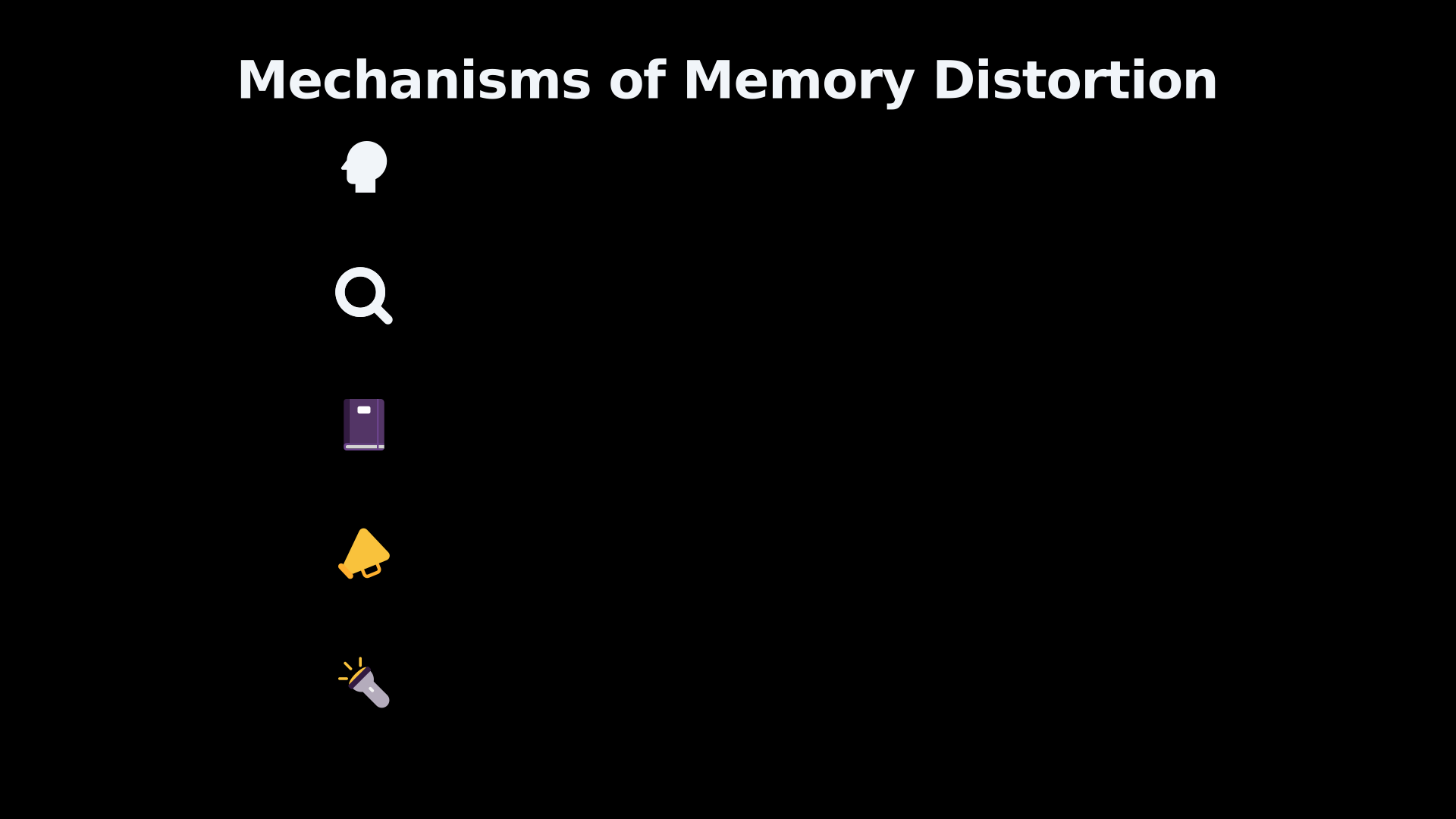
Story evolution explains how Kecksburg could acquire a stable and vivid recovery narrative without requiring either a coordinated hoax or proof that every remembered detail occurred exactly as described. The mechanisms are ordinary: incomplete initial perception, post-event information, repeated interviews, source confusion, growing confidence and the organising power of memorable imagery.
That conclusion does not settle whether an object landed, whether officials recovered anything or why the search produced conflicting impressions. It changes how those questions should be investigated. The strongest evidence comes from contemporary documents and independently recorded early testimony. Later accounts remain relevant, especially where they preserve information absent from surviving records, but they require careful attention to when each detail first appeared and how widely it had already circulated.
The enduring Kecksburg story may therefore be sincere at its human core while still being historically unstable at its edges. Recognising that possibility is not an accusation against witnesses. It is the necessary starting point for distinguishing what people experienced from the polished narrative that decades of retelling eventually produced.
Amazon book picks
Further Reading
Books and field guides related to How Did the Witness Story Grow?. Use these as the next step if you want deeper reading beyond the article.
The Seven Sins of Memory: How the Mind Forgets and Remembers
Rating: 3.5/5 from 5 Google Books ratings
A New York Times Notable Book: A psychologist's "gripping and thought-provoking" look at how and why our brains sometimes fail us (Steven...
Eyewitness Testimony
By shedding light on the many factors that can intervene and create inaccurate testimony, Elizabeth Loftus illustrates how memory can be...
The Memory Illusion: Remembering, Forgetting, and the Science...
THE INTERNATIONAL BESTSELLER 'Truly fascinating.' Steve Wright, BBC Radio 2 - Have you ever forgotten the name of someone you’ve met doze...
Remembering: A Study in Experimental and Social Psychology
This is a timely reissue of this influential 1932 study of remembering.
eBay marketplace picks
Marketplace Samples
Live-tested eBay searches with available results related to this page.
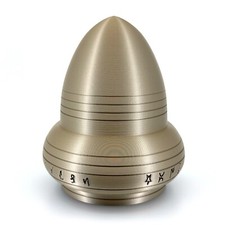
Selected fromacorn UFO model oneBay.co.uk.


Endnotes
1.
Source: Wikipedia
Title: [Kecksburg UFO incident]({{ ‘kecksburg-ufo-incident/’ | relative_url }})
Link:https://en.wikipedia.org/wiki/Kecksburg_UFO_incident
2.
Source: sciencedirect.com
Link:https://www.sciencedirect.com/science/article/pii/S000169181100223X
Source snippet
In two experiments, we asked if one person who repeats claims wields more influence on memory and confidence than that same person making...
3.
Source: unsolved.com
Title: Mysteries Kecksburg UFO
Link:https://unsolved.com/gallery/kecksburg-ufo/
Source snippet
Unsolved MysteriesKecksburg UFO - Unsolved Mysteries...
4.
Source: sciencedirect.com
Title: Effects of eye-closure on confidence-accuracy relations in eyewitness testimony
Link:https://www.sciencedirect.com/science/article/pii/S2211368114001089
5.
Source: sciencedirect.com
Link:https://www.sciencedirect.com/science/article/pii/S1889186114700083
6.
Source: sciencedirect.com
Link:https://www.sciencedirect.com/science/article/pii/S001002771200159X
7.
Source: sciencedirect.com
Link:https://www.sciencedirect.com/science/article/pii/S0022103105000065
8.
Source: nationalacademies.org
Link:https://www.nationalacademies.org/read/18891/chapter/2
9.
Source: staff.washington.edu
Link:https://staff.washington.edu/eloftus/Articles/hoff.htm
Source snippet
UW Staff Web ServerMisinformation and Memory The Creation of New Memories (1989)...
10.
Source: nationalacademies.org
Link:https://www.nationalacademies.org/projects/PGA-STL-13-02/updates
11.
Source: nationalacademies.org
Link:https://www.nationalacademies.org/index.php/projects/PGA-STL-13-02/updates
12.
Source: dictionary.apa.org
Title: misinformation effect
Link:https://dictionary.apa.org/misinformation-effect
13.
Source: nationalacademies.org
Link:https://www.nationalacademies.org/news/report-urges-caution-in-handling-and-relying-upon-eyewitness-identifications-in-criminal-cases-recommends-best-practices-for-law-enforcement-and-courts
14.
Source: sites.nationalacademies.org
Title: PGA 041696
Link:https://sites.nationalacademies.org/PGA/PGA_041696
15.
Source: nationalacademies.org
Link:https://www.nationalacademies.org/read/18891/chapter/8
16.
Source: nap.nationalacademies.org
Link:https://nap.nationalacademies.org/skim.php?act=nap&chap=1-8&record_id=18891
17.
Source: nationalacademies.org
Link:https://www.nationalacademies.org/read/24790/chapter/5
18.
Source: nationalacademies.org
Link:https://www.nationalacademies.org/read/18891
19.
Source: nap.nationalacademies.org
Link:https://nap.nationalacademies.org/skim.php?act=nap&chap=103-120&record_id=18891
20.
Source: nationalacademies.org
Link:https://www.nationalacademies.org/read/18891/chapter/6
21.
Source: nationalacademies.org
Link:https://www.nationalacademies.org/read/27887/chapter/5
Additional References
22.
Source: bpspsychub.onlinelibrary.wiley.com
Title: BPS Psych Hub The history of an idea: The misinformation effect
Link:https://bpspsychub.onlinelibrary.wiley.com/doi/pdf/10.1111/lcrp.70020
Source snippet
How to protect eyewitness memory against the misinformation effect: A meta-analysis of post-warning studies.... Eyewitness memory distor...
23.
Source: youtube.com
Link:https://www.youtube.com/watch?v=ruKDXL13lk8
Source snippet
America's Other Roswell: the Kecksburg UFO | Conspiracy (S1, E13) | Full Episode | History This documentary episode examines the initial...
24.
Source: theblackvault.com
Title: the vault files the 1965 kecksburg pennsylvania crash
Link:https://www.theblackvault.com/casefiles/the-vault-files-the-1965-kecksburg-pennsylvania-crash/
Source snippet
The Black VaultThe Vault Files: The 1965 Kecksburg, Pennsylvania Crash1 Aug 2025 — A later edition of the Tribune-Review ran the headline...
25.
Source: youtube.com
Link:https://www.youtube.com/watch?v=tU7WSHZye5w
Source snippet
When the UFO Hit the Woods! | UFO Witness | Full Episode | Discovery Channel...
26.
Source: youtube.com
Link:https://www.youtube.com/watch?v=HX_RrO7ZQaU
Source snippet
The Kecksburg UFO Mystery: Secrets, Witnesses and Vanished Evidence...
27.
Source: apa.org
Title: Is seeing believing?
Link:https://www.apa.org/monitor/2026/07-08/sensory-processing-systems.html
Source snippet
How we make sense of the world around usJuly 1, 2026 — IS SEEING BELIEVING? HOW WE MAKE SENSE OF THE WORLD AROUND US Psychological resear...
Published: July 1, 2026
28.
Source: youtube.com
Title: The Kecksburg UFO Mystery: Secrets, Witnesses and Vanished Evidence
Link:https://www.youtube.com/watch?v=vkZszbMzl3Q
Source snippet
Kecksburg UFO Crash: The Untold Story | The Government Lied! | Full Documentary | UFOTV®...
29.
Source: youtube.com
Title: When the UFO Hit the Woods! | UFO Witness | Full Episode | Discovery Channel
Link:https://www.youtube.com/watch?v=CVIKnA8cWak
Source snippet
The 1965 Kecksburg Incident: A UFO Crash the Government Hides to This Day...
30.
Source: researchgate.net
Link:https://www.researchgate.net/publication/233624001_Eyewitnesses_under_influence_How_feedback_affects_the_realism_in_confidence_judgements
31.
Source: researchgate.net
Link:https://www.researchgate.net/publication/20632653_Misinformation_and_Memory_The_Creation_of_New_Memories