Within Retrieval Story
What Paper Trail Should a Retrieval Leave?
A real recovery convoy would likely generate dispatch, access, fuel, cargo and receiving records, making the missing paper trail a testable issue.
On this page
- Dispatch and vehicle assignment records
- Gate logs, fuel stops and cargo documentation
- Secrecy, retention and realistic reasons records may be absent
Page outline Jump by section
Introduction
If the Kecksburg incident involved a genuine military recovery of a large object by truck, the strongest evidence would not necessarily be eyewitness testimony but the administrative records such an operation would normally generate. Even highly classified military activities leave logistical traces because personnel, vehicles, fuel, equipment and secure facilities must still be managed. The key question is therefore not whether every record would survive or become public, but whether a recovery convoy of the type described by witnesses would be expected to create a routine paper trail somewhere within military or civilian record systems.
This perspective shifts the debate from speculation about the object itself to a practical, testable issue. A sizeable road movement involving military vehicles would ordinarily require documentation before, during and after the journey. The absence—or continued non-discovery—of those records does not automatically prove no recovery occurred, but it raises an important evidential question about the military retrieval truck story.
What Records Would Normally Exist?
Military logistics depend on accountability. Even operations conducted under strict secrecy generally require records that identify who used vehicles, where they travelled and what resources were consumed.
For a recovery operation in rural Pennsylvania in December 1965, investigators would reasonably expect several categories of documentation.
Dispatch and Vehicle Assignment Records
A recovery convoy normally begins with vehicle allocation.
Depending on the unit involved, records could include:
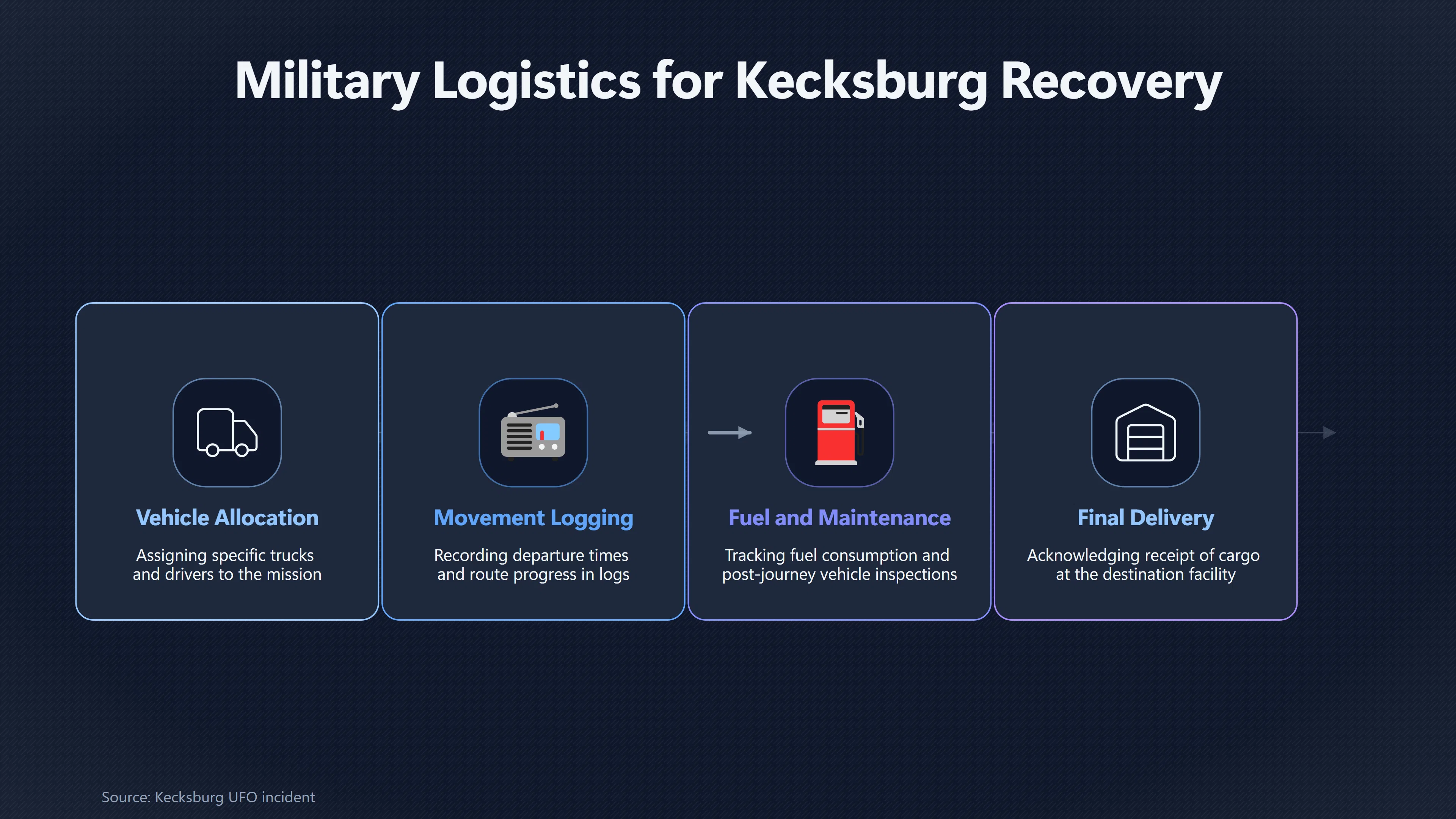
- Vehicle dispatch orders assigning specific trucks and drivers.
- Motor pool issue logs recording departure and return times.
- Driver authorisations and trip tickets.
- Maintenance records showing unusual mileage or servicing after the mission.
- Radio or operations centre logs documenting vehicle movements.
These documents would rarely describe classified cargo in detail. Instead, they would often identify only the unit, destination, mission code or administrative purpose while leaving sensitive information in separate classified files.
If vehicles originated from a nearby military installation rather than arriving from a distant base, local motor transport records would theoretically offer one of the most direct ways to test the retrieval story.
What the Journey Would Likely Leave Behind
Once a convoy was on public roads, additional administrative records could accumulate independently of the recovery site itself.
Gate Logs, Fuel Stops and Cargo Documentation
Military bases generally recorded vehicles entering and leaving secure installations. If the alleged object travelled to another military facility, several categories of records might have existed:
- Entry and exit gate logs.
- Security police duty records.
- Visitor or temporary access registers.
- Convoy movement notifications.
- Warehouse or receiving documentation acknowledging delivery.
Transport itself also creates logistical needs. Heavy trucks consume fuel, may require maintenance and often operate under scheduled movement control.
Potential supporting records might therefore include:
- Fuel issue vouchers or depot fuel records.
- Maintenance inspections after the journey.
- Weight or loading documentation where applicable.
- Equipment issue records for cranes, recovery vehicles or lifting gear.
- Communications logs coordinating arrival at the receiving installation.
None of these documents would necessarily identify an unusual object. Many would simply confirm that specific vehicles and personnel were engaged in an operation on a particular date.

Why Classified Operations Still Produce Paper Trails
A common misconception is that secret operations leave no documentation. In reality, classified programmes typically generate extensive records because governments still need to manage budgets, personnel and equipment.
Military secrecy usually changes who can read a document, not whether the document exists.
Sensitive cargo might therefore be described using generic language such as:
- “Special equipment”
- “Classified material”
- “Restricted cargo”
- Mission numbers rather than descriptive names
The most sensitive information may be compartmentalised into separate classified files, while ordinary logistical paperwork remains administrative rather than operational.
Historical Cold War recovery programmes illustrate this distinction. Projects involving foreign missile debris, reconnaissance satellites or aerospace hardware routinely required transportation, security and inventory processes even when the recovered objects themselves remained classified.
Why So Few Records Have Surfaced
The absence of publicly available transport documentation has several possible explanations, none of which is decisive on its own.
One possibility is that no extraordinary recovery occurred beyond the publicly acknowledged search activity. In that case, there would be no convoy documentation to discover.
Alternatively, records may once have existed but were never retained. Military administrative files are commonly destroyed under records-retention schedules once their operational value expires unless selected for permanent preservation.
Another possibility is that relevant records remain dispersed among multiple agencies, archived under routine logistical headings rather than the name “Kecksburg”. Researchers searching specifically for “Kecksburg UFO” may therefore overlook documents filed under motor transport, installation security, engineering support or aerospace recovery programmes.
Finally, if another federal agency rather than NASA directed any sensitive recovery, the most relevant records might never have been part of NASA’s holdings in the first place.
The NASA Records Controversy and Its Limits
One aspect of the Kecksburg case has sometimes been misunderstood. NASA became involved in a lengthy Freedom of Information Act (FOIA) dispute after journalist Leslie Kean sought records connected with the incident.
During that litigation, NASA acknowledged that some historical files relating to its investigation could not be located and that boxes of records from the relevant period were missing. This has often been cited as evidence of a cover-up. However, the missing NASA files were not known transport manifests, convoy records or truck dispatch documents. Rather, they concerned NASA’s own historical documentation and search efforts. NASA later conducted additional court-supervised searches in response to the litigation, while maintaining that it possessed no recovered spacecraft or corresponding retrieval records.[wikipedia.org]WikipediaKecksburg UFO incidentKecksburg UFO incident
Consequently, the missing NASA paperwork should not be confused with evidence that military transport records once existed and disappeared. They are separate issues.
How Historians Would Test the Truck Story
From a historical perspective, the retrieval convoy claim remains testable because logistics leave multiple independent opportunities for documentation.
Researchers would ideally seek convergence across several unrelated record types rather than a single dramatic document. For example:
- A military motor pool showing an unusual vehicle dispatch.
- Base security logs confirming convoy movements.
- Fuel or maintenance records matching the reported timing.
- Receiving records from the destination installation.
- Contemporary communications or duty officer logs referencing an emergency recovery.
Finding several ordinary administrative records that align in date and circumstance would provide stronger support than any single witness recollection. Conversely, extensive searches that consistently fail to uncover expected documentation gradually weaken the likelihood that a large, formally organised recovery occurred exactly as later described.
What the Missing Paper Trail Really Means
The absence of an identified logistical record does not prove that the Kecksburg retrieval story is false. Governments lose records, destroy routine administrative files under authorised schedules and sometimes retain classified material beyond public reach. FOIA also depends on agencies possessing responsive records in the first place, and archival searches can only locate what survives.[National Archives]archives.govNational Archives Freedom of Information Act (FOIA) | National ArchivesNational Archives Freedom of Information Act (FOIA) | National Archives
At the same time, a recovery operation involving multiple military vehicles, personnel, secure transport and delivery would normally be expected to generate numerous administrative records across several organisations. The continued lack of independently verified dispatch logs, vehicle assignments, gate registers, fuel documentation or receiving records remains one of the principal evidential weaknesses in the military retrieval truck narrative. For many historians, this missing logistical paper trail is one of the clearest ways to evaluate the claim because it relies on ordinary administrative practice rather than memories recorded decades after the event.
Amazon book picks
Further Reading
Books and field guides related to What Paper Trail Should a Retrieval Leave?. Use these as the next step if you want deeper reading beyond the article.

The Craft of Research
Rating: 4.3/5 from 6 Google Books ratings
Since 1995, students, researchers, and professionals have turned to The Craft of Research for clear and helpful guidance on how to conduc...
Supplying War: Logistics from Wallenstein to Patton
Why did Napoleon succeed in 1805 but fail in 1812? Were the railways vital to Prussia's victory over France in 1870? Was the famous Schli...
Doing History: Research and Writing in the Digital Age
DOING HISTORY: RESEARCHING AND WRITING IN THE DIGITAL AGE presents a soup to nuts approach to researching and writing about history, with...
Moving Mountains: Lessons in Leadership and Logistics from th...
Business Week described the Gulf War as "the largest military logistics operation in history." It entailed an unprecedented deployment of...
eBay marketplace picks
Marketplace Samples
Live-tested eBay searches with available results related to this page.
Selected frommilitary truck model oneBay.co.uk.



Endnotes
1.
Source: Wikipedia
Title: [Kecksburg UFO incident]({{ ‘kecksburg-ufo-incident/’ | relative_url }})
Link:https://en.wikipedia.org/wiki/Kecksburg_UFO_incident
2.
Source: nasa.gov
Title: Headquarters FOIA Library
Link:https://www.nasa.gov/foia/nasa-e-libraries/headquarters-foia-library/
Source snippet
Headquarters FOIA Library - NASA...
3.
Source: archives.gov
Title: National Archives Freedom of Information Act (FOIA) | National Archives
Link:https://www.archives.gov/foia
4.
Source: archives.gov
Link:https://www.archives.gov/research/foia/file-foia-request
5.
Source: foia.state.gov
Link:https://foia.state.gov/FOIALIBRARY/Collections2.aspx
Source snippet
state.govCollections/Discretionary ReleasesJanuary 26, 2026 — FOIA Home > FOIA Library > Collections/Discretionary Releases Image COLLECT...
Published: January 26, 2026
6.
Source: archives.gov
Title: Online Research Tools and Aids | National Archives
Link:https://www.archives.gov/research/start/online-tools
7.
Source: archives.gov
Title: Research Our Records | National Archives
Link:https://www.archives.gov/research
8.
Source: archives.gov
Title: Special Access and FOIA | National Archives
Link:https://www.archives.gov/research/foia
9.
Source: archives.gov
Link:https://www.archives.gov/research/guide-fed-records
10.
Source: archives.gov
Title: Accessing Federal Bureau of Investigation Records (RG 65) | National Archives
Link:https://www.archives.gov/research/investigations/fbi/access
11.
Source: archives.gov
Title: National Personnel Records Center
Link:https://www.archives.gov/foia/tracking/foiaweb-nrp-02.html
12.
Source: abcnews.go.com
Link:https://abcnews.go.com/Technology/story?id=3785376&page=1
Additional References
13.
Source: uapobservatory.com
Title: UAP Observatory · A graded, sourced record of unidentified anomalous phenomena
Link:https://www.uapobservatory.com/
Source snippet
July 24, 2026 — In-depthRead full reportCopy link 1965[ Dec 9 ]Kecksburg incident Contested▸ After a fireball crossed six states, witness...
Published: July 24, 2026
14.
Source: youtube.com
Link:https://www.youtube.com/watch?v=kffJ50oo4Iw
Source snippet
This video provides an in-depth investigation into the 1965 Kecksburg incident, explicitly discussing the eyewitness reports of military...
15.
Source: stangordon.info
Title: Sighting Reports & NEWS – [Stan Gordon]({{ ‘stan-gordon/’ | relative_url }})’s UFO Anomalies Zone
Link:https://www.stangordon.info/wp/news-events/
Source snippet
Navy reportedly was also involved. Numerous people who were in the area that evening confirmed seeing Army and Air Force personnel around th...
16.
Source: ufosearch.org
Title: The full Department of War PURSUE archive — d
Link:https://ufosearch.org/
Source snippet
UFO Search — PURSUE UAP ArchiveMay 8, 2026 — P PRESIDENTIAL UNSEALING & REPORTING SYSTEM FOR UAP ENCOUNTERS▍ RELEASE 01 · CLEARED 2026-05...
Published: May 8, 2026
17.
Source: youtube.com
Link:https://www.youtube.com/watch?v=HX_RrO7ZQaU
Source snippet
Kecksburg UFO Crash: The Untold Story | The Government Lied! | Full Documentary | UFOTV®...
18.
Source: youtube.com
Link:https://www.youtube.com/watch?v=tU7WSHZye5w
Source snippet
The Kecksburg UFO Mystery + The Corporate Espionage Scandal Rocking Silicon Valley...
19.
Source: youtube.com
Title: When the UFO Hit the Woods! | UFO Witness | Full Episode | Discovery Channel
Link:https://www.youtube.com/watch?v=CVIKnA8cWak
Source snippet
What is the Government hiding? THE TOP 10 UFO CRASHES: UAP AND ALIEN RETRIEVALS | Sci-Fi Documentary...
20.
Source: youtube.com
Link:https://www.youtube.com/watch?v=pjO6b79BChc
Source snippet
When the UFO Hit the Woods! | UFO Witness | Full Episode | Discovery Channel...
21.
Source: thecoldfile.com
Title: 1965 kecksburg
Link:https://www.thecoldfile.com/articles/1965-kecksburg/
Source snippet
The Acorn in the Woods: The 1965 Kecksburg Incident | The Cold FileMay 25, 2026 — UFO/UAP / Case file / Filed May 25, 2026 THE ACORN IN T...
Published: May 25, 2026
22.
Source: stangordon.info
Link:https://www.stangordon.info/wp/news-events/page/2/