Within Visual Illusion
Does Fast Motion Make a Fireball Look Closer?
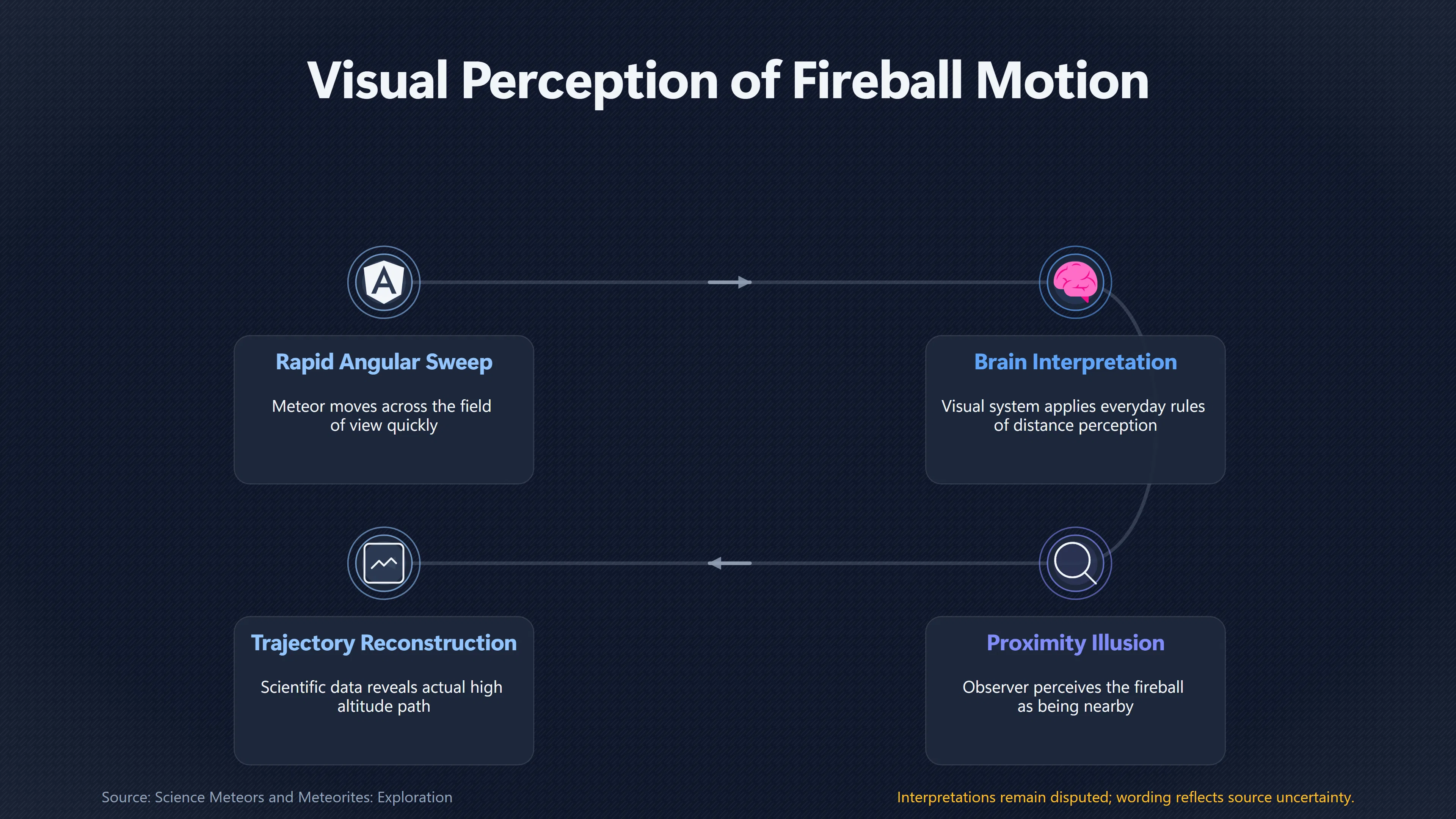
Rapid motion across the sky can mimic the visual behaviour of a close object even when the fireball is far away.
On this page
- Why fast angular motion suggests proximity
- How unfamiliar scale distorts distance judgments
- When trajectory angle strengthens the illusion
Page outline Jump by section
Introduction
A bright fireball can appear startlingly close because it races across the sky much faster than most familiar objects. That impression is compelling but often misleading. In the context of the Kecksburg incident and similar reports, one important mechanism is the way the human visual system interprets angular speed—how quickly an object sweeps across the observer’s field of view. Without reliable information about the object’s true size or altitude, rapid apparent motion can resemble the behaviour of a nearby object even when the meteor is tens of kilometres above the Earth and hundreds of kilometres away. This illusion does not require faulty observation; it arises because the brain is applying everyday rules of distance perception to an unusual atmospheric event.[skyandtelescope.org]skyandtelescope.orgSky & Telescope About Meteors, Meteor Showers, Fireballs and More!Sky & TelescopeAbout Meteors, Meteor Showers, Fireballs and More!November 1, 2012…
Does Fast Motion Make a Fireball Look Closer?
Angular speed refers to the rate at which an object moves across the observer’s field of view rather than its actual speed through space. A meteor entering the atmosphere typically travels at many kilometres per second, yet what the observer directly experiences is the rapid change in its apparent position against the stars or clouds.
In ordinary life, fast angular motion usually does indicate proximity. A bird flying overhead crosses the sky much faster than an airliner at cruising altitude, even if both have similar physical sizes in the observer’s view. Through constant experience, the visual system learns that objects moving quickly across the retina are often nearby.
A brilliant fireball exploits this expectation. Because it traverses many degrees of sky within only a few seconds, the brain naturally favours a “close object” interpretation before any conscious reasoning has time to correct it. Sky & Telescope notes that this illusion is strong enough to mislead experienced observers, including airline pilots who have reportedly manoeuvred to avoid meteors that were actually around 160 kilometres away.[Sky & Telescope]skyandtelescope.orgSky & Telescope About Meteors, Meteor Showers, Fireballs and More!Sky & TelescopeAbout Meteors, Meteor Showers, Fireballs and More!November 1, 2012…
The crucial point is that angular speed alone cannot determine distance. A meteor travelling at cosmic velocity high in the atmosphere can produce exactly the same apparent sweep across the sky as a much slower object located far nearer to the observer.
Why the Brain Has So Little to Work With
Normally, distance estimates combine several visual cues at once. During a fireball event, many of those cues are absent or unreliable.
A meteor offers no familiar physical scale. The observer cannot tell whether the glowing object is the size of a pebble, a car or something larger because its brightness bears little relationship to its dimensions. At the same time, binocular depth perception contributes almost nothing at atmospheric distances, leaving the brain dependent on indirect clues.[Sage Journals]journals.sagepub.comSage JournalsEffects of Motion Parallax and Perspective Cues on Perceived Size and Distance - Junko Tozawa, Tadasu Oyama, 2006…
Rapid angular motion therefore receives disproportionate weight. Instead of balancing speed against reliable size and depth information, the visual system is effectively solving the problem with incomplete evidence. The result is a sincere but often inaccurate feeling that the fireball must be nearby.
This explains why multiple witnesses can independently insist that the same fireball passed “just overhead” even when later trajectory reconstructions show it remained many tens of kilometres above the ground throughout its luminous flight.[NASA Science]science.nasa.govScience Meteors and Meteorites: ExplorationNASA ScienceMeteors and Meteorites: Exploration - NASA Science…
How Unfamiliar Scale Distorts Distance Judgements
The illusion becomes stronger because people rarely have experience judging the apparent motion of objects moving at meteor speeds.
Everyday objects obey familiar relationships between speed, size and distance. A fast-moving car appears larger as it approaches. An aircraft remains visible for minutes rather than seconds. Fireballs fit neither pattern.
Instead, observers see:
- an object brighter than Venus or even the full Moon;
- motion lasting only a few seconds;
- an apparently continuous path across a large portion of the sky;
- no reliable reference for its true size.
The brain attempts to reconcile these unusual features using ordinary assumptions, often producing an exaggerated sense of nearness. NASA and meteor researchers consistently emphasise that exceptionally bright fireballs are classified by their brightness rather than their proximity to the observer.[NASA]nasa.govIt’s Fireball Season! Answering Your Meteor QuestionsIt’s Fireball Season! Answering Your Meteor Questions - NASAMarch 26, 2026…
When the Direction of Travel Makes the Illusion Stronger
Trajectory also influences perceived distance.
A fireball moving obliquely downward towards the horizon produces continuously increasing alignment with landscape features such as hills, forests or rooftops. As the angular motion carries the luminous object closer to the apparent meeting point between sky and ground, observers naturally anticipate an impact.
If the meteor simultaneously slows in brightness, fragments or abruptly ceases glowing—as commonly happens during atmospheric ablation—the disappearance coincides with the visual expectation of reaching the ground. The observer may therefore remember the event as ending “behind those trees” or “just over the ridge” even though the meteor actually extinguished high in the atmosphere.[Sky & Telescope]skyandtelescope.orgSky & Telescope About Meteors, Meteor Showers, Fireballs and More!Sky & TelescopeAbout Meteors, Meteor Showers, Fireballs and More!November 1, 2012…
This effect is especially persuasive when viewed from only one location. Someone tens of kilometres away would project the same atmospheric path onto a completely different section of the landscape, placing the apparent endpoint somewhere else entirely.
Why This Matters for Interpreting the Kecksburg Reports
The Kecksburg incident illustrates the importance of separating sincere eyewitness perception from geometric reality.
Many witnesses genuinely believed they had seen an object descend into nearby woodland. That conviction is understandable when rapid angular motion combines with disappearing depth cues and an apparent downward trajectory. None of these perceptions, however, directly measure where the object actually was.
Modern meteor investigations avoid relying on a single visual impression. Instead, investigators combine observations from multiple locations, photographs, videos and instrument data to triangulate a fireball’s true path. Individual estimates of where an object “looked” to be are valuable historical evidence, but they are not sufficient for determining its physical location because angular speed and perspective can produce a powerful illusion of proximity.[nasa.gov]science.nasa.govScience Meteors and Meteorites: ExplorationNASA ScienceMeteors and Meteorites: Exploration - NASA Science…
Amazon book picks
Further Reading
Books and field guides related to Does Fast Motion Make a Fireball Look Closer?. Use these as the next step if you want deeper reading beyond the article.
Sensation and Perception
. Bruce Goldstein's SENSATION AND PERCEPTION, the best-seller which has helped over 150,000 students understand the ties between how we s...
Visual Intelligence: How We Create What We See
A unique, illustrated popular study reveals the way the human eye acts on the visual world not just to represent but to create the things...
Vision Science: Photons to Phenomenology
This textbook on vision reflects the integrated computational approach of modern research scientists, combining psychological, computatio...
The Ecological Approach to Visual Perception
This book, first published in 1979, is about how we see: the environment around us (its surfaces, their layout, and their colors and text...
eBay marketplace picks
Marketplace Samples
Live-tested eBay searches with available results related to this page.
Selected frommeteor poster oneBay.co.uk.

Current eBay listing
METEOR 1979 70s ORIGINAL MOVIE FILM ART CINEMA PRINT PREMIUM POSTER
Current eBay listing
METEOR MAN ONE SHEET ROLLED POSTER JAMES EARL JONES MARLA GIBBS 1993
Endnotes
1.
Source: science.nasa.gov
Title: Science Meteors and Meteorites: Exploration
Link:https://science.nasa.gov/solar-system/meteors-meteorites/exploration/
Source snippet
NASA ScienceMeteors and Meteorites: Exploration - NASA Science...
2.
Source: nasa.gov
Title: Fireball in the Sky!
Link:https://www.nasa.gov/blogs/watch-the-skies/2013/05/17/fireball-in-the-sky/
Source snippet
Fireball in the Sky! - NASA...
3.
Source: nasa.gov
Title: It’s Fireball Season! Answering Your Meteor Questions
Link:https://www.nasa.gov/blogs/watch-the-skies/2026/03/26/its-fireball-season-answering-your-meteor-questions/
Source snippet
It’s Fireball Season! Answering Your Meteor Questions - NASAMarch 26, 2026...
Published: March 26, 2026
4.
Source: apod.nasa.gov
Link:https://apod.nasa.gov/apod/ap211012.html
5.
Source: science.nasa.gov
Title: meteors great and small 148692
Link:https://science.nasa.gov/earth/earth-observatory/meteors-great-and-small-148692/
6.
Source: apod.nasa.gov
Link:https://apod.nasa.gov/apod/ap210315.html
7.
Source: apod.nasa.gov
Link:https://apod.nasa.gov/rjn/apod/ap210315.html
8.
Source: nasa.gov
Title: 73X Faster Than a Speeding Bullet!
Link:https://www.nasa.gov/blogs/watch-the-skies/2011/11/18/73x-faster-than-a-speeding-bullet/
9.
Source: nasa.gov
Title: Fireball in the Sky!
Link:https://www.nasa.gov/blogs/watch-the-skies/2010/10/04/fireball-in-the-sky-2/
10.
Source: cneos.jpl.nasa.gov
Link:https://cneos.jpl.nasa.gov/fireballs/intro.html
11.
Source: skyandtelescope.org
Title: Sky & Telescope About Meteors, Meteor Showers, Fireballs and More!
Link:https://skyandtelescope.org/stargazing-and-observing/celestial-objects-to-watch/about-meteors/
Source snippet
Sky & TelescopeAbout Meteors, Meteor Showers, Fireballs and More!November 1, 2012...
Published: November 1, 2012
12.
Source: journals.sagepub.com
Link:https://journals.sagepub.com/doi/10.1068/p5251
Source snippet
Sage JournalsEffects of Motion Parallax and Perspective Cues on Perceived Size and Distance - Junko Tozawa, Tadasu Oyama, 2006...
13.
Source: skyandtelescope.org
Title: Imaging Supernovae: Illuminate Echoes of Light
Link:https://skyandtelescope.org/astronomy-resources/imaging-supernovae-illuminate-echoes-of-light/
14.
Source: journals.sagepub.com
Link:https://journals.sagepub.com/doi/pdf/10.1068/p080125
15.
Source: journals.sagepub.com
Link:https://journals.sagepub.com/doi/pdf/10.1068/p5251?download=true
16.
Source: journals.sagepub.com
Link:https://journals.sagepub.com/doi/10.1068/p080125
17.
Source: imo.net
Link:https://www.imo.net/observations/fireballs/fireballs/
18.
Source: ufoencounters.co.uk
Link:https://www.ufoencounters.co.uk/kecksburg.html
Additional References
19.
Source: appalachianhistorian.org
Link:https://appalachianhistorian.org/the-[kecksburg-ufo-incident
Source snippet
24, 2026 — THE KECKSBURG UFO INCIDENT: PENNSYLVANIA’S SPACE ACORN AND THE NIGHT THE SKY FELL OVER APPALACHIA By Alex Hall / June 24, 2026...
Published: June 24, 2026
20.
Source: annualreviews.org
Link:https://www.annualreviews.org/content/journals/10.1146/annurev-vision-110323-104032
Source snippet
Reexamining the Relationship Between Stereopsis and Motion Parallax | Annual ReviewsMay 29, 2026 — ANNUAL REVIEW OF VISION SCIENCE REEXAM...
Published: May 29, 2026
21.
Source: pubmed.ncbi.nlm.nih.gov
Title: Pub Med Motion parallax as an independent cue for depth perception
Link:https://pubmed.ncbi.nlm.nih.gov/471676/
Source snippet
Motion parallax as an independent cue for depth perception - PubMed...
22.
Source: youtube.com
Link:https://www.youtube.com/watch?v=tU7WSHZye5w
Source snippet
The 1965 Kecksburg Incident: A UFO Crash the Government Hides to This Day...
23.
Source: youtube.com
Link:https://www.youtube.com/watch?v=HX_RrO7ZQaU
Source snippet
The Kecksburg Incident: What Really Happened Here?...
24.
Source: youtube.com
Link:https://www.youtube.com/watch?v=ruKDXL13lk8
Source snippet
The Kecksburg UFO Mystery: Secrets, Witnesses and Vanished Evidence...
25.
Source: nature.com
Link:https://www.nature.com/articles/367624a0
26.
Source: youtube.com
Title: The Kecksburg Incident: What Really Happened Here?
Link:https://www.youtube.com/watch?v=BXh2zTD9Kug
Source snippet
Kecksburg UFO Crash: The Untold Story | The Government Lied! | Full Documentary | UFOTV®...
27.
Source: nature.com
Link:https://www.nature.com/articles/nature06814
28.
Source: thecoldfile.com
Title: 1965 kecksburg
Link:https://www.thecoldfile.com/articles/1965-kecksburg/
Source snippet
The Acorn in the Woods: The 1965 Kecksburg Incident | The Cold FileMay 25, 2026 — UFO/UAP / Case file / Filed May 25, 2026 THE ACORN IN T...
Published: May 25, 2026