Within Kosmos 96
How a Date Match Became a Re entry Myth
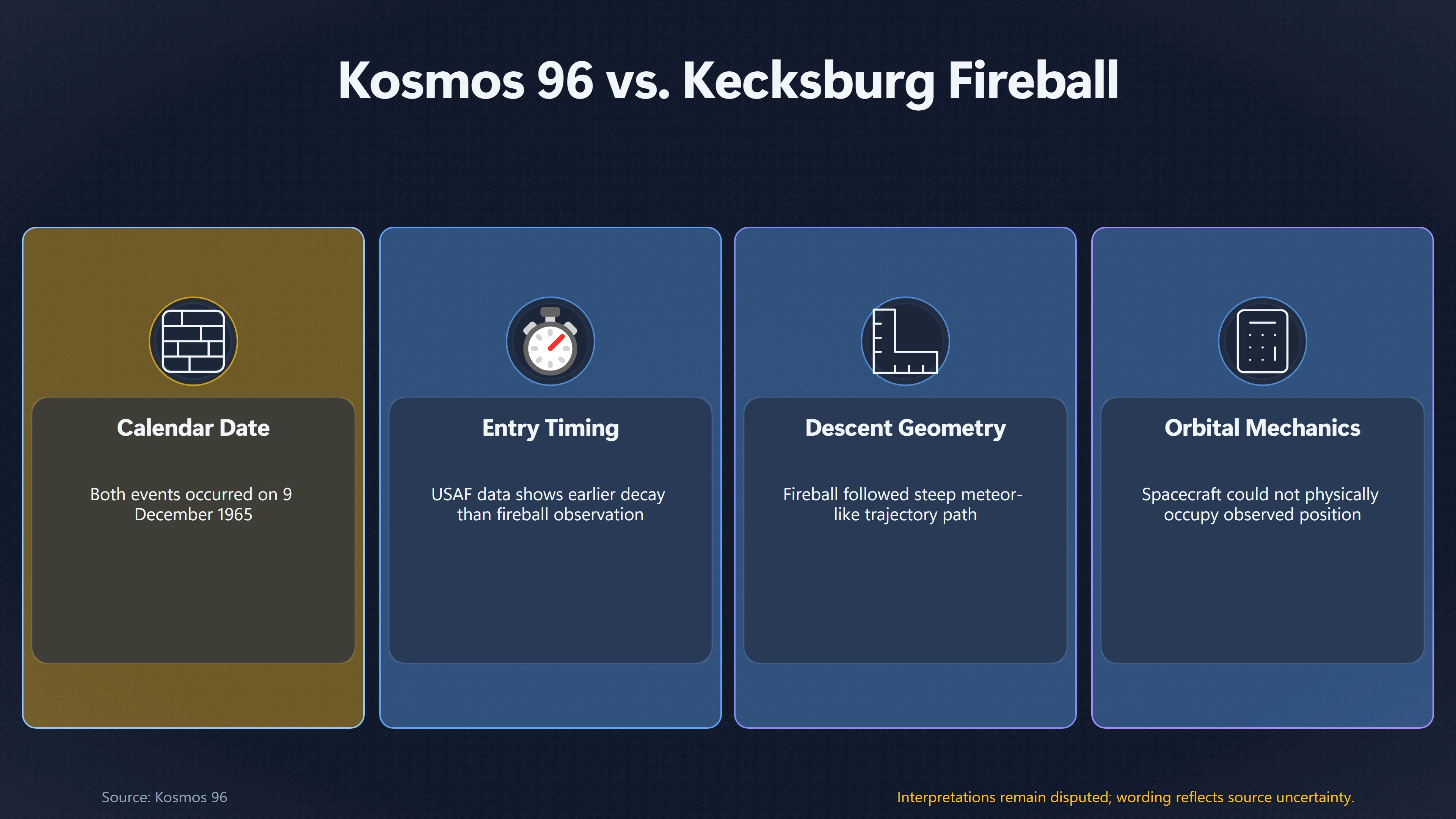
Kosmos 96 became persuasive largely because it fell on the same date, although its time, path and entry geometry did not match the fireball.
On this page
- Why the coincidence looked compelling
- The tests a real identification must pass
- How calendar matches mislead investigations
Page outline Jump by section
Introduction
The most persuasive feature of the Kosmos 96 explanation for the Kecksburg incident was never its trajectory, timing or physical evidence. It was the calendar. Both the failed Soviet Venus probe and the famous Pennsylvania fireball are associated with 9 December 1965, making the connection appear almost self-evident at first glance. That shared date has proved remarkably durable in popular accounts, even though later orbital analyses and astronomical studies found substantial contradictions between the spacecraft’s known re-entry and the observed fireball.[Wikipedia]WikipediaKosmos 96Kosmos 96
The Kosmos 96 theory therefore illustrates an important investigative trap: a striking coincidence can become the organising idea around which later interpretations are built, even after more discriminating tests point elsewhere. Understanding why the date match was so compelling—and why it ultimately proved insufficient—is central to evaluating the Kecksburg case.
Why the coincidence looked compelling
The coincidence possessed several qualities that naturally encouraged investigators and the public to connect the two events.
First, Kosmos 96 was not an imaginary object but a documented Soviet spacecraft known to have failed and re-entered Earth’s atmosphere on the same day as the Great Lakes fireball. During the Cold War, the possibility that secret Soviet hardware might fall over North America was entirely plausible. Unlike speculative UFO explanations, the spacecraft already existed and had an established history.[Wikipedia]WikipediaKosmos 96Kosmos 96
Second, the timing appeared close enough for casual comparison. Many summaries simply state that Kosmos 96 “re-entered on 9 December 1965” and that the Kecksburg object was seen later that day. When reduced to a single sentence, the overlap sounds compelling because the calendar date becomes the dominant fact while the precise orbital chronology disappears.
Finally, the secrecy surrounding unsuccessful Soviet planetary missions encouraged speculation. Western observers initially knew relatively little about the spacecraft, making it easier for assumptions about its appearance, survivability and possible recovery to fill gaps in the historical record.
The tests a real identification must pass
Matching dates are only the starting point for identifying a re-entering spacecraft. A convincing identification must satisfy several independent tests simultaneously.
A proposed match should agree on:
- Time of atmospheric entry, not merely the calendar day.
- Ground track, placing the object over the reported observation area.
- Entry geometry, including whether the descent angle matches an orbital re-entry.
- Observed behaviour, such as speed, fragmentation and luminosity.
- Orbital mechanics, showing that the spacecraft could physically occupy the observed position at the reported time.
The Kosmos 96 hypothesis performs well only on the first and weakest criterion: both events occurred on 9 December. On the more demanding tests, the correspondence breaks down.
US Air Force tracking data placed the decay of Kosmos 96 earlier than the approximately 21:43 UTC fireball observed across the Great Lakes. Independent analyses of photographs and witness observations also concluded that the visible object followed a comparatively steep, meteor-like trajectory rather than the shallow geometry expected from an object descending from low Earth orbit.[wikipedia.org]WikipediaKosmos 96Kosmos 96
These are not minor discrepancies. Timing and trajectory are primary identification criteria because they derive from orbital mechanics rather than subjective recollections.
How calendar matches mislead investigations
The Kosmos 96 debate demonstrates a broader pattern in historical investigations: memorable coincidences often receive disproportionate weight.
A same-day event is psychologically powerful because it offers an immediate narrative. Faced with two unusual occurrences—a Soviet spacecraft re-entry and reports of a brilliant fireball—people naturally infer a causal relationship. This tendency reflects a well-known cognitive shortcut: temporal coincidence is easily mistaken for physical identity.
The problem is that orbital events are constrained by precise mathematics rather than narrative plausibility. Two rare events occurring on the same date do not necessarily involve the same object.
In the Kecksburg case, the coincidence became especially influential because it appeared before many readers encountered the technical objections. Once the association had entered books, documentaries and popular discussions, the shared date continued to reinforce the theory even as later orbital reconstructions weakened it.
Why the date survived longer than the evidence
The persistence of the Kosmos 96 explanation reflects differences in how people evaluate evidence.
A simple statement such as “the Soviet probe came down on the same day” is easy to remember and repeat. By contrast, explaining why orbital decay timing, atmospheric entry angles and reconstructed flight paths disagree requires considerably more technical context.
This imbalance allows the coincidence to dominate public memory. A dramatic calendar match is cognitively simpler than discussing orbital decay predictions, observational uncertainties or photographic trajectory analysis. As a result, many retellings emphasise the coincidence while compressing—or omitting—the reasons specialists rejected it.
James Oberg, who initially regarded Kosmos 96 as a plausible candidate because of the date and Cold War context, later accepted subsequent orbital analysis indicating that the spacecraft’s tracked re-entry and the Great Lakes fireball were separate events whose occurrence on the same day was coincidental rather than causal.[Enigma Labs | Report a UFO sighting]enigmalabs.ioEnigma Labs | Report a UFO sighting Kecksburg Incident | Enigma LabsEnigma Labs | Report a UFO sightingKecksburg Incident | Enigma LabsDecember 10, 2024…

The historical lesson from the “same-day trap”
The Kosmos 96 theory remains historically valuable even if it is unlikely to explain the Kecksburg fireball itself.
It shows how an explanation can appear persuasive because it satisfies a conspicuous but low-value criterion while failing more decisive tests. The shared date provided a genuine investigative lead worth examining, but it could not substitute for agreement in timing, flight path and entry dynamics.
For that reason, the “same-day trap” has become one of the clearest methodological lessons from the Kecksburg debate. Calendar coincidence may justify investigation, but identification requires convergence across multiple independent lines of evidence. In the case of Kosmos 96, the coincidence survived popular discussion far longer than the supporting orbital evidence.[wikipedia.org]WikipediaKosmos 96Kosmos 96
Amazon book picks
Further Reading
Books and field guides related to How a Date Match Became a Re entry Myth. Use these as the next step if you want deeper reading beyond the article.
The Skeptics' Guide to the Universe: How to Know What's Reall...
An all-encompassing guide to skeptical thinking from podcast host and academic neurologist at Yale University School of Medicine Steven N...
The Demon-Haunted World: Science as a Candle in the Dark
NEW YORK TIMES BESTSELLER • From the renowned astronomer and author of Cosmos comes a “powerful [and] stirring defense of informed ration...
The UFO Experience: A Scientific Inquiry
Cited by the New York Review of Books as "the best brief for visitation," this classic study presents an analysis of UFO reports and conc...
eBay marketplace picks
Marketplace Samples
Live-tested eBay searches with available results related to this page.
Selected fromKosmos 96 model oneBay.co.uk.


Endnotes
1.
Source: Wikipedia
Title: Kosmos 96
Link:https://en.wikipedia.org/wiki/Kosmos_96
2.
Source: theblackvault.com
Title: the vault files the 1965 kecksburg pennsylvania crash
Link:https://www.theblackvault.com/casefiles/the-vault-files-the-1965-kecksburg-pennsylvania-crash/
Source snippet
The Vault Files: The 1965 Kecksburg, Pennsylvania Crash - The Black Vault Case Files...
3.
Source: enigmalabs.io
Title: Enigma Labs | Report a UFO sighting Kecksburg Incident | Enigma Labs
Link:https://enigmalabs.io/library/f45bb19d-5803-4ab6-a373-8799f64095c0
Source snippet
Enigma Labs | Report a UFO sightingKecksburg Incident | Enigma LabsDecember 10, 2024...
Published: December 10, 2024
4.
Source: wikidata.org
Title: Kosmos 96
Link:https://www.wikidata.org/wiki/Q1632091
Source snippet
September 7, 2025 — KOSMOS 96 (Q1632091) * Item * Discussion [Input] English * Read * View history [Input] Tools Tools [Button: m...
Published: September 7, 2025
5.
Source: ufodesigns3d.com
Link:https://ufodesigns3d.com/blogs/lore/the-kecksburg-incident-the-day-a-ufo-crashed-in-pennsylvania
6.
Source: military-history.fandom.com
Title: James Oberg
Link:https://military-history.fandom.com/wiki/James_Oberg
Additional References
7.
Source: appalachianhistorian.org
Link:https://appalachianhistorian.org/the-[kecksburg-ufo-incident
Source snippet
One theory involved Kosmos 96, a failed Soviet Venus probe that reentered Earth’s atmosphere on December 9, 1965. Because the spacecraft...
Published: December 9, 1965
8.
Source: nasa.gov
Title: Roscosmos Progress 96
Link:https://www.nasa.gov/event/roscosmos-progress-96/
Source snippet
February 23, 2026 — Launch Schedule ROSCOSMOS PROGRESS 96 WHEN No Earlier Than Fall 2026 Select Your Location or Timezone:[Select] [B...
Published: February 23, 2026
9.
Source: handwiki.org
Title: Astronomy:Kosmos 96
Link:https://www.handwiki.org/wiki/Astronomy%3AKosmos_96
Source snippet
June 9, 2026 — ASTRONOMY:KOSMOS 96 From HandWiki [Input] Kosmos 96 Mission type | Venus flyby ^{[1]} Operator | OKB-1 COSPAR ID |...
Published: June 9, 2026
10.
Source: youtube.com
Title: The Kecksburg UFO Mystery: Secrets, Witnesses and Vanished Evidence
Link:https://www.youtube.com/watch?v=vkZszbMzl3Q
Source snippet
Kecksburg UFO Crash: The Untold Story | The Government Lied! | Full Documentary | UFOTV®...
11.
Source: youtube.com
Link:https://www.youtube.com/watch?v=HX_RrO7ZQaU
Source snippet
Episode 184 Kecksburg Revisited with [Stan Gordon]({{ 'stan-gordon/' | relative_url }})...
12.
Source: youtube.com
Link:https://www.youtube.com/watch?v=tU7WSHZye5w
Source snippet
Mystery Object: Facts About the Kecksburg Incident...
13.
Source: thecoldfile.com
Title: 1965 kecksburg
Link:https://www.thecoldfile.com/articles/1965-kecksburg/
Source snippet
None has closed the case, and the speculation here is kept out of the account and the evidence above. A natural meteor or bolide (the off...
14.
Source: youtube.com
Title: Episode 184 Kecksburg Revisited with Stan Gordon
Link:https://www.youtube.com/watch?v=CKK66LtZ1Hs
Source snippet
The Kecksburg UFO Mystery: Secrets, Witnesses and Vanished Evidence...
15.
Source: astronomyufo.com
Link:https://www.astronomyufo.com/UFO/earthly.htm
16.
Source: scribd.com
Link:https://www.scribd.com/document/428734219/Mufon-Drones-CARET