Within Metal Reports
Meteorite, Slag or Spacecraft Metal?
Fusion crust, mineral structure and manufacturing marks can separate plausible meteorites from slag or engineered spacecraft debris.
On this page
- Visible clues and common identification mistakes
- Laboratory tests that can distinguish likely origins
- Why chain of custody must accompany composition results
Page outline Jump by section
Introduction
Reports of alleged metal fragments recovered around the Great Lakes after the 9 December 1965 fireball have long been folded into discussions of the Kecksburg incident. The central question is not whether unusual objects were found, but whether any of them can be shown to be meteorites, industrial debris or something manufactured for spaceflight. In nearly every publicly documented case, the available evidence is too limited to make that determination with confidence. Visual appearance, magnetism and proximity to a widely observed fireball are not enough. Reliable identification depends on careful laboratory analysis combined with documented recovery history from the moment an object is found.[Meteoritical Society]meteoritical.orgSociety Meteorites:: Meteoritical SocietyMeteoritical SocietyMeteorites:: Meteoritical Society…
For the scattered Great Lakes reports, this distinction is crucial. A fragment may look unusual, feel unusually heavy or attract a magnet without having any connection to the 1965 event. Likewise, a sophisticated chemical analysis has little evidential value if there is no trustworthy record showing where the specimen came from and who handled it before testing.
Visible clues and common identification mistakes
The first stage of identification is observational rather than conclusive. Certain features make a specimen worth further investigation, while others strongly suggest an ordinary terrestrial origin.
Fresh meteorites commonly display:
- A thin, dark fusion crust formed as the outer surface briefly melted during atmospheric entry.
- Greater density than most ordinary rocks.
- Metallic iron dispersed through the interior, making many specimens magnetic.
- Rounded but irregular shapes, sometimes with shallow thumbprint-like depressions known as regmaglypts rather than sharp melted blobs.[meteoritical.org]meteoritical.orgSociety Meteorites:: Meteoritical SocietyMeteoritical SocietyMeteorites:: Meteoritical Society…
By contrast, industrial slag and furnace waste frequently show characteristics that are inconsistent with meteorites:
- Numerous gas bubbles or vesicles left by molten industrial processes.
- Flow textures from cooling liquid metal.
- Mixed glassy and porous regions.
- Irregular welded fragments containing multiple industrial materials.
One of the most persistent misconceptions in recovered-fragment stories is that magnetism proves extraterrestrial origin. It does not. Slag, iron ore, steel scrap and many industrial by-products are also magnetic. Conversely, some genuine meteorites show only weak magnetic attraction. Magnetism is therefore only a screening tool, never a diagnostic test.[USGS]usgs.govI think I found a meteorite. How can I tell for sure? | U.S. Geological SurveyI think I found a meteorite. How can I tell for sure? | U.S. Geological Survey…
Another common mistake is treating any black exterior as a fusion crust. True fusion crust is usually very thin, continuous and tightly bonded to the specimen. Thick, bubbly, blistered or flaky coatings are generally more consistent with industrial melting or terrestrial weathering than atmospheric ablation.[BIM Society]bimsociety.orgBIM Society British and Irish Meteorite SocietyBIM Society British and Irish Meteorite Society
Within the context of the Great Lakes fragment reports, descriptions published in newspapers are rarely detailed enough to distinguish between these possibilities. Statements that an object was “metallic”, “burned” or “hot” shortly after discovery do not establish its origin.
Laboratory tests that can distinguish likely origins
Visual inspection can only narrow possibilities. Definitive identification normally requires laboratory examination using several complementary methods.
Internal structure
Cutting and polishing a suspected meteorite may reveal metallic iron-nickel grains or, in stony meteorites, rounded mineral inclusions called chondrules. Industrial slag generally lacks these natural structures and instead displays solidified melt textures, trapped bubbles or heterogeneous industrial inclusions.[Meteoritical Society]meteoritical.orgSociety Meteorites:: Meteoritical SocietyMeteoritical SocietyMeteorites:: Meteoritical Society…
Mineralogical analysis
Optical microscopy, scanning electron microscopy and X-ray diffraction can identify the minerals present.
Meteorites typically contain combinations of minerals such as olivine, pyroxene and iron-nickel alloys that formed under extraterrestrial conditions. Industrial slags instead contain minerals and glass produced during smelting, welding or furnace operations, often accompanied by oxidation products characteristic of industrial manufacture.
Chemical composition
Bulk chemical analysis alone rarely settles the question because terrestrial alloys can resemble meteoritic metal in major elements.
More informative measurements include:
- Nickel concentration within metallic phases.
- Cobalt-to-nickel relationships.
- Trace element patterns involving gallium, germanium and iridium.
- Distribution of iron-nickel alloys within the specimen rather than simply their presence.
Iron meteorites have characteristic elemental relationships that differ from ordinary engineering steels and foundry waste. These require laboratory instrumentation rather than portable field tests.[Meteoritical Society]meteoritical.orgSociety Meteorites:: Meteoritical SocietyMeteoritical SocietyMeteorites:: Meteoritical Society…

Isotopic and metallographic examination
Where sufficient material exists, specialists may perform isotopic measurements or examine polished metal for crystallographic structures such as Widmanstätten patterns. These features develop during extremely slow cooling inside asteroid parent bodies and cannot be reproduced in ordinary industrial production.
Conversely, if a specimen is suspected to be spacecraft debris rather than a meteorite, investigators look for evidence of manufacturing rather than natural crystallisation. Machining marks, rolled sheet structure, welds, fastener holes, uniform alloy composition or engineered coatings point towards human manufacture instead of a naturally formed meteoritic body.
Why spacecraft metal requires different evidence
The Kecksburg incident has generated speculation that recovered fragments might represent spacecraft rather than meteorites. From a materials perspective, that hypothesis demands a different set of indicators.
Engineered aerospace materials commonly exhibit:
- Precisely controlled alloy compositions.
- Machined surfaces.
- Riveted or welded joints.
- Heat-treatment patterns.
- Manufactured geometries inconsistent with natural fragmentation.
Such characteristics would be difficult to reconcile with an ordinary meteorite. At the same time, they would also need to be distinguished from conventional aircraft wreckage, industrial scrap or re-entering space hardware.
Importantly, no publicly available laboratory report has established that any alleged Great Lakes fragment from the December 1965 event possessed verified manufacturing features incompatible with known terrestrial materials. Claims of unusual alloys have generally lacked independently published analytical data or reproducible documentation.
Why chain of custody matters as much as composition
Even a technically excellent laboratory report cannot establish a fragment’s connection to the 1965 fireball if the specimen’s history is uncertain.
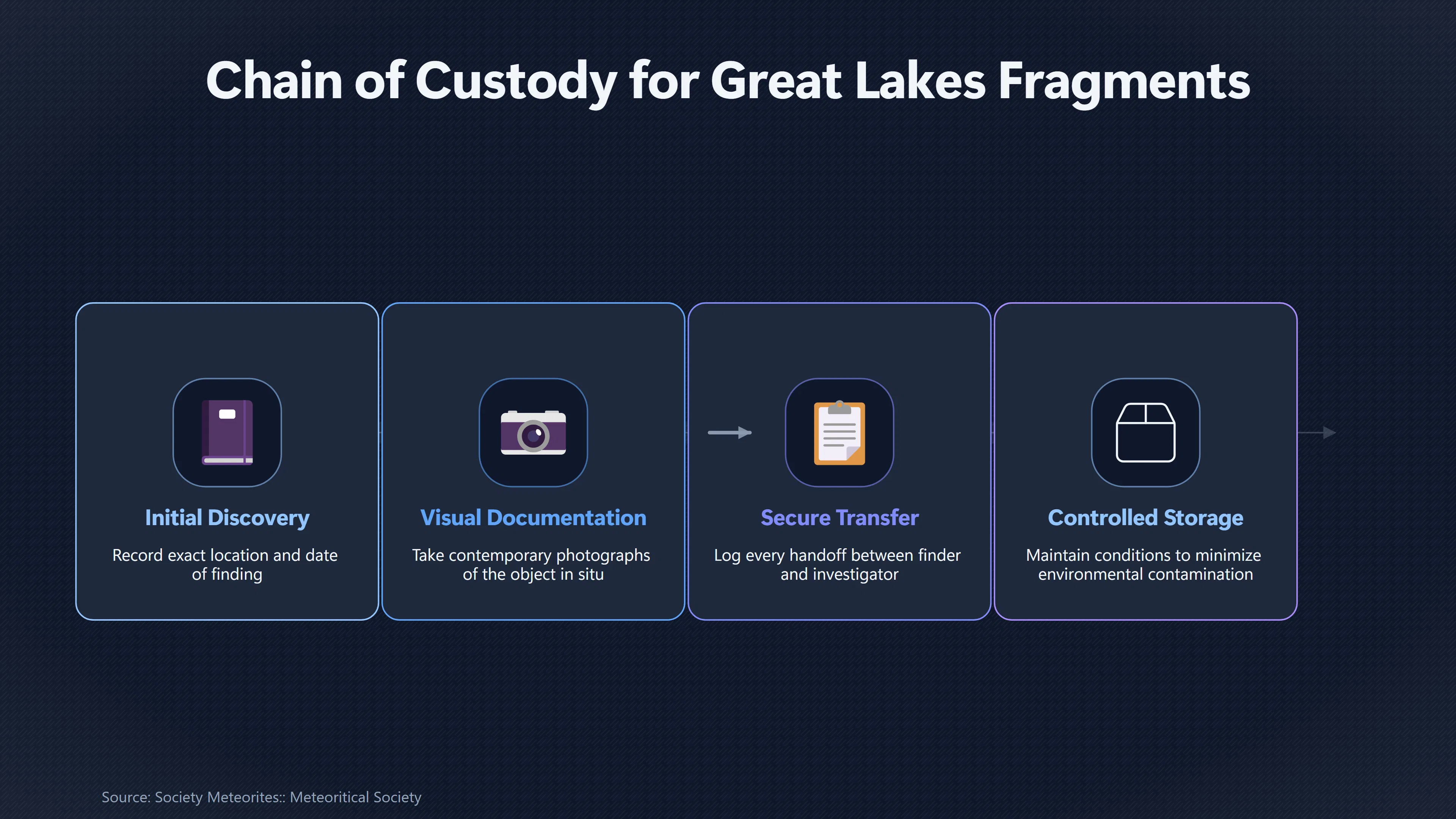
A reliable chain of custody records:
- The exact recovery location.
- The date and time of discovery.
- Contemporary photographs showing the object in place.
- Every transfer between finder, investigator and laboratory.
- Storage conditions that minimise contamination.
Without this documentation, several alternative explanations remain open. A specimen may have been collected elsewhere, exchanged with another object, contaminated during handling or simply misidentified years later.
This problem affects many alleged Great Lakes recoveries. Newspaper accounts often describe discoveries but do not provide preserved field documentation, catalogue numbers or continuous possession records. Decades later, even if a surviving specimen proved to be an authentic meteorite, it could not automatically be linked to the specific fireball associated with Kecksburg. The scientific question is therefore twofold: whether the object is extraterrestrial at all, and whether it demonstrably originated from the December 1965 event.

What fragment reports can and cannot establish
The scattered reports from Michigan and Ohio illustrate why fragment identification requires both materials science and documentary evidence.
A fragment that is merely heavy, magnetic or found shortly after a spectacular fireball cannot be confidently classified from appearance alone. Likewise, industrial slag can imitate several superficial characteristics of meteorites, while genuine meteorites can weather enough to lose some of their most recognisable surface features. Laboratory examination can distinguish likely natural, industrial and manufactured origins, but only if suitable samples remain available.
For the alleged Great Lakes recoveries associated with the Kecksburg era, the principal limitation is not the absence of possible identification techniques. It is the absence of securely documented specimens with continuous provenance. Until both laboratory evidence and an unbroken chain of custody exist for a particular fragment, claims that it represents a meteorite, industrial slag or spacecraft metal remain hypotheses rather than established conclusions.[meteoritical.org]meteoritical.orgSociety Meteorites:: Meteoritical SocietyMeteoritical SocietyMeteorites:: Meteoritical Society…
Amazon book picks
Further Reading
Books and field guides related to Meteorite, Slag or Spacecraft Metal?. Use these as the next step if you want deeper reading beyond the article.
Rocks from Space: Meteorites and Meteorite Hunters
Appendices A-C: Meteorite verification laboratories, Commercial meteorite dealers, Selected list of suspected impact craters worldwide.
Field Guide to Meteors and Meteorites
What is unique about Richard Norton's book is that it is both a field guide to observing meteors, and also a field guide to locating, pre...
Meteorites and their Parent Planets
Thoroughly revised second edition of a highly successful book describing all aspects of meteorites.
The Cambridge Encyclopedia of Meteorites
Beautifully illustrated with over 140 full colour images, The Cambridge Encyclopedia of Meteorites provides a thorough guide to these fas...
eBay marketplace picks
Marketplace Samples
Live-tested eBay searches with available results related to this page.
Selected frommeteorite display specimen oneBay.co.uk.
Endnotes
1.
Source: meteoritical.org
Title: Society Meteorites:: Meteoritical Society
Link:https://meteoritical.org/meteorites
Source snippet
Meteoritical SocietyMeteorites:: Meteoritical Society...
2.
Source: usgs.gov
Title: I think I found a meteorite. How can I tell for sure? | U.S. Geological Survey
Link:https://www.usgs.gov/faqs/i-think-i-found-a-meteorite-how-can-i-tell-sure
Source snippet
I think I found a meteorite. How can I tell for sure? | U.S. Geological Survey...
3.
Source: usgs.gov
Title: Meteorite and meteoroid: New comprehensive definitions | U.S
Link:https://www.usgs.gov/publications/meteorite-and-meteoroid-new-comprehensive-definitions
Source snippet
Geological SurveyJanuary 1, 2010 — METEORITE AND METEOROID: NEW COMPREHENSIVE DEFINITIONS January 1, 2010 Meteorites have traditionally b...
Published: January 1, 2010
4.
Source: usgs.gov
Link:https://www.usgs.gov/science/faqs/geology
5.
Source: meteorite.com
Link:https://www.meteorite.com/meteorite-information/meteorite-identification/
6.
Source: meteorites.tv
Link:https://www.meteorites.tv/content/95-Meteorite-Identification
7.
Source: usgs.gov
Title: The geologic classification of the meteorites | U.S. Geological Survey
Link:https://www.usgs.gov/publications/geologic-classification-meteorites
8.
Source: bimsociety.org
Title: BIM Society British and Irish Meteorite Society
Link:https://www.bimsociety.org/meteorites2.shtml
9.
Source: conservation.ca.gov
Link:https://conservation.ca.gov/cgs/minerals/meteorite
10.
Source: lpi.usra.edu
Link:https://www.lpi.usra.edu/science/kring/epo_web/meteorites/appearance.html
11.
Source: meteoritestructures.org
Title: Fusion crust
Link:https://www.meteoritestructures.org/Primary%20Structures%20Dec%2023/Fusion%20crust.htm
Additional References
12.
Source: youtube.com
Link:https://www.youtube.com/watch?v=HX_RrO7ZQaU
Source snippet
This selection pairs detailed educational guides on distinguishing genuine meteorites from industrial slag, metallic waste, and terrestri...
13.
Source: meteoritetesting.org
Title: This testing service is an educational outreach program fro
Link:https://www.meteoritetesting.org/
Source snippet
Meteorite Identification and TestingJanuary 11, 2026 — Updated and current - January 11, 2026 MeteoriteTesting.org Laboratory testing and...
Published: January 11, 2026
14.
Source: planetary.msfc.nasa.gov
Title: Meteorites and Craters
Link:https://planetary.msfc.nasa.gov/Meteorites_and_Craters.html
Source snippet
Fusion crust Meteorites that have fallen recently have a black, glassy or ashy crust on their surface. When a meteorite falls through the...
15.
Source: unr.edu
Title: How do I know if I found a meteorite?
Link:https://www.unr.edu/nevada-today/news/2023/atp-meteorites
Source snippet
University of Nevada, RenoJanuary 20, 2023 — HOW DO I KNOW IF I FOUND A METEORITE? GEOLOGIST EXPLAINS DIFFERENCES BETWEEN METEORITES AN...
Published: January 20, 2023
16.
Source: science.nasa.gov
Title: Science Meteors and Meteorites: Facts
Link:https://science.nasa.gov/solar-system/meteors-meteorites/facts/
Source snippet
We call the objects that creates this brilliant effect by different names, depending on where it...
17.
Source: ukmeteornetwork.org
Title: Meteorite Identification The UK Meteor Network
Link:https://ukmeteornetwork.org/meteoriteidentification/
Source snippet
How can you be sure? Many people find unusual rocks or pieces of metal and wonder if they might have fou...
18.
Source: youtube.com
Title: How to Find a Real Meteorite: Rock ID & Meteor Wrong Advice
Link:https://www.youtube.com/watch?v=TozlmXPdU_I
Source snippet
America's Other Roswell: the Kecksburg UFO | Conspiracy (S1, E13) | Full Episode | History...
19.
Source: youtube.com
Title: How to Identify a Meteorite | A New Way to Museum
Link:https://www.youtube.com/watch?v=2GV7Pl7wAp0
Source snippet
How to Find a Real Meteorite: Rock ID & MeteorWrong Advice...
20.
Source: meteorites-for-sale.com
Link:https://www.meteorites-for-sale.com/meteorite-identification.html
21.
Source: amnh.org
Link:https://www.amnh.org/exhibitions/permanent/meteorites/meteorites/what-does-a-meteorite-look-like