Within Trajectory
Could Dark Flight Carry Debris All the Way to Kecksburg?
Dark flight can move a meteorite beyond its luminous endpoint, but normal gravity and wind cannot redirect it hundreds of kilometres toward Kecksburg.
On this page
- What happens after a meteor stops glowing
- How mass shape and wind alter a fall zone
- Why forward drift differs from a cross country turn
Page outline Jump by section
Introduction
If the photographed fireball associated with the 9 December 1965 event ended its luminous flight near western Lake Erie, could a surviving fragment have continued unseen and landed at Kecksburg, Pennsylvania? The short answer is that dark flight can extend a meteorite’s journey after it stops glowing, but it cannot naturally redirect it hundreds of kilometres to a completely different impact region. Modern meteorite recovery science shows that gravity, aerodynamic drag and atmospheric winds can shift a fragment beyond the visible endpoint, sometimes by several kilometres or even tens of kilometres under favourable conditions. They do not provide a mechanism for carrying a fragment from the Lake Erie region to Kecksburg, roughly 320 kilometres away and substantially off the reconstructed trajectory.[imo.net]imo.netInternational Meteor Organization Fireballs and Meteorite Falls | IMOInternational Meteor Organization Fireballs and Meteorite Falls | IMO
What happens after a meteor stops glowing
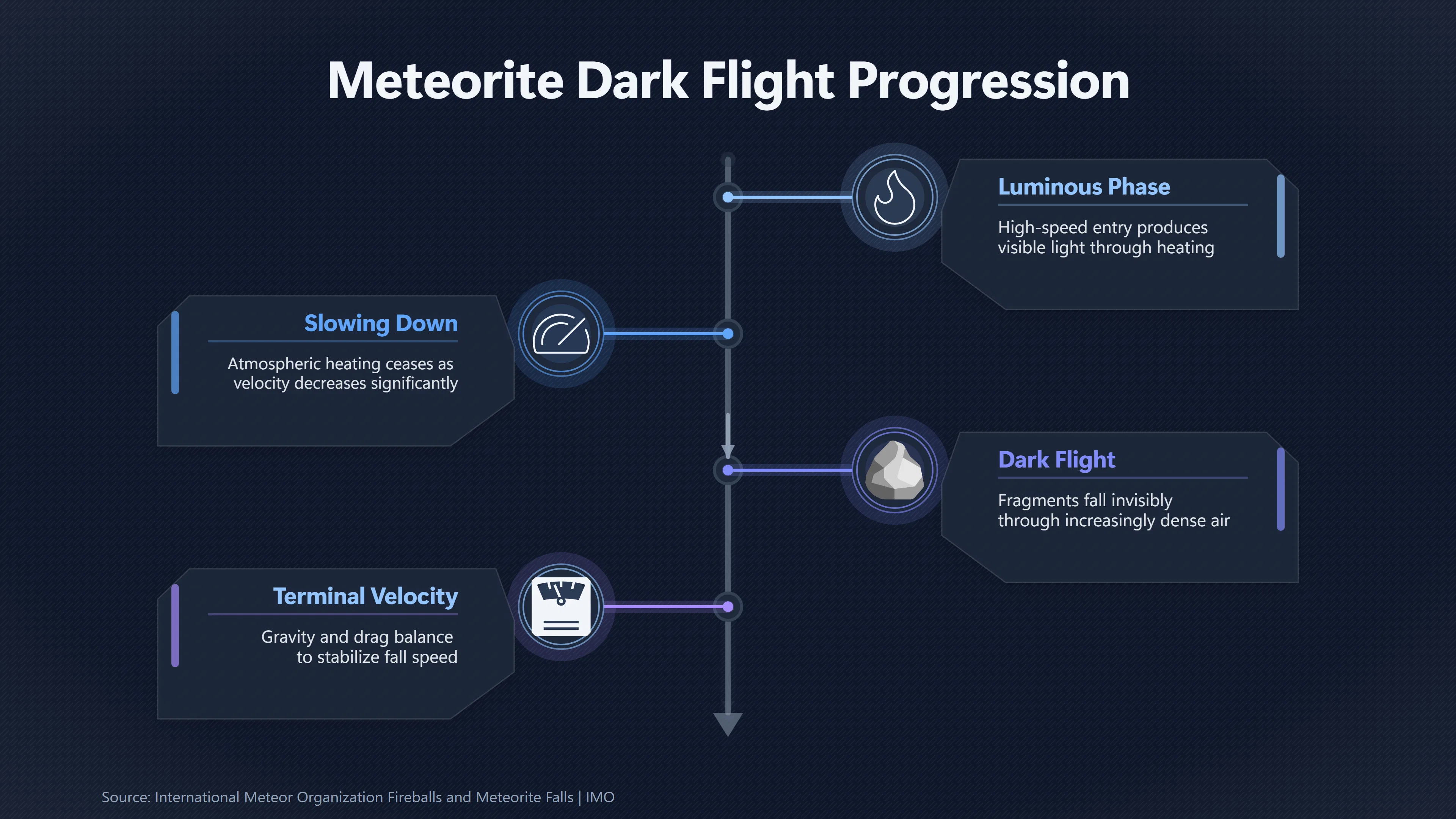
A meteor becomes invisible not because it has stopped moving, but because it has slowed enough that atmospheric heating no longer produces visible light. The surviving fragments then enter the dark flight phase.
During dark flight:[imo.net]imo.netcan a meteorite fall trigger a wildfirecan a meteorite fall trigger a wildfire
- The fragment is no longer travelling at cosmic speeds.
- Atmospheric drag rapidly reduces it towards terminal velocity.
- Gravity becomes the dominant force pulling it downward.
- Winds increasingly influence its horizontal drift.
This stage is critically important for meteorite recovery. Modern fireball networks routinely observe the bright flight, then model the dark flight to predict where meteorites should land. Search teams often recover meteorites within the predicted fall area by accounting for changing winds at different altitudes rather than simply extending the luminous trajectory to the ground.[arizona.edu]lpl.arizona.eduFebruary 6, 2018…
The important point is that dark flight begins only after the fragment has already been slowed dramatically. It is not a continuation of high-speed atmospheric flight but a ballistic fall through increasingly dense air.
How mass, shape and wind alter a fall zone
Dark flight is more complicated than dropping a stone vertically because every surviving fragment has different aerodynamic properties.
Several factors determine where it lands:
- Mass: Larger, denser fragments retain momentum longer and are less affected by wind.
- Shape: Flat or irregular fragments experience greater drag and can drift farther than compact ones.
- Atmospheric winds: Different wind speeds and directions at different altitudes gradually push fragments sideways.
- End-of-flight altitude: Fragments beginning dark flight from higher altitudes remain exposed to winds for longer.
Modern dark flight models therefore require detailed atmospheric profiles, not simply estimates of surface winds. Researchers also note that uncertainty in fragment shape is one of the largest sources of prediction error, even when the trajectory is accurately measured.[arxiv.org]arxiv.orgOpen source on arxiv.org.
Even so, these variables generally alter the location of a meteorite’s strewn field—the elongated area where fragments land—rather than producing an entirely new direction of travel.
Why forward drift differs from a cross-country turn
The distinction most relevant to the Kecksburg discussion is between drift and redirection.
Dark flight allows a fragment to continue beyond the end of the visible fireball. It also permits winds to push the falling stone sideways. However, neither process resembles powered flight or a sharp change of course.
Modern observations consistently show that:
- meteorites continue broadly along their existing momentum,
- winds modify that path gradually,
- heavier fragments stay closer to the projected fall line,
- lighter fragments may drift farther downwind.
These effects stretch and distort a fall zone rather than rotate it by hundreds of kilometres. Dark flight therefore explains why meteorites are often recovered beyond the visible endpoint, but not why they would suddenly appear far from the reconstructed trajectory.[imo.net]imo.netInternational Meteor Organization Fireballs and Meteorite Falls | IMOInternational Meteor Organization Fireballs and Meteorite Falls | IMO
Applying the mechanism to a Lake Erie endpoint
Within the framework of the photographed 1965 trajectory, dark flight is the principal natural process that could extend the descent after the fireball disappeared from view.
If the luminous phase genuinely ended near western Lake Erie, one would expect any surviving meteorites to land somewhere beyond that endpoint after accounting for:
- the remaining forward momentum,
- local atmospheric wind profiles,
- fragment size and density,
- fragmentation into multiple pieces.
That reasoning is entirely consistent with modern meteorite recovery practice. What it does not support is a natural transfer of debris to the Kecksburg area, approximately 320 kilometres to the south-east of the reconstructed terminal region. Such a displacement would require far more than the ordinary combination of gravity, drag and winds incorporated into accepted dark flight models.[oup.com]academic.oup.comOUP AcademicDetermination of strewn fields for meteorite falls | Monthly Notices of the Royal Astronomical Society | Oxford Academic…
What this means for the Kecksburg debate
Dark flight remains an essential part of understanding any meteorite-producing fireball because the visible trail rarely marks the final landing point. Ignoring dark flight would underestimate how far surviving fragments can travel after the glow disappears.
However, invoking dark flight does not resolve the discrepancy between the photographed trajectory ending near Lake Erie and claims of an impact at Kecksburg. Instead, it narrows the question. If the photographic reconstruction is broadly correct, dark flight can plausibly shift the expected fall zone around the Lake Erie region, but it does not provide a recognised physical mechanism for carrying a fragment hundreds of kilometres to Kecksburg while simultaneously departing so dramatically from the established direction of travel.[imo.net]imo.netInternational Meteor Organization Fireballs and Meteorite Falls | IMOInternational Meteor Organization Fireballs and Meteorite Falls | IMO
Amazon book picks
Further Reading
Books and field guides related to Could Dark Flight Carry Debris All the Way to Kecksburg?. Use these as the next step if you want deeper reading beyond the article.
The Field Guide to Meteors and Meteorites
What is unique about Richard Norton's book is that it is both a field guide to observing meteors, and also a field guide to locating, pre...
Meteorite
Every rock has a story tell, and none more so than those which have fallen from the sky: meteorites. Originating in the Asteroid Belt bet...
The Cambridge Encyclopedia of Meteorites
Beautifully illustrated with over 140 full colour images, The Cambridge Encyclopedia of Meteorites provides a thorough guide to these fas...
Meteorites and their Parent Planets
Thoroughly revised second edition of a highly successful book describing all aspects of meteorites.
eBay marketplace picks
Marketplace Samples
Live-tested eBay searches with available results related to this page.
Selected frommeteorite display specimen oneBay.co.uk.


Endnotes
1.
Source: onlinelibrary.wiley.com
Link:https://onlinelibrary.wiley.com/doi/10.1155/aa/3041760
Source snippet
INTRODUCTION Meteorite falls are often detectable in weather radar data and can be observed for both daytime and nighttime bolides [1–10]...
2.
Source: academic.oup.com
Link:https://academic.oup.com/mnras/article/503/3/3337/6155056
Source snippet
OUP AcademicDetermination of strewn fields for meteorite falls | Monthly Notices of the Royal Astronomical Society | Oxford Academic...
3.
Source: lpl.arizona.edu
Link:https://lpl.arizona.edu/news/spotlight/rapid-detection-and-recovery-science-hunting-meteorites
Source snippet
February 6, 2018...
Published: February 6, 2018
4.
Source: arxiv.org
Link:https://arxiv.org/abs/2108.04397
5.
Source: academic.oup.com
Link:https://academic.oup.com/mnras/article/518/3/3850/6762217
Source snippet
OUP AcademicTraspena meteorite: heliocentric orbit, atmospheric trajectory, strewn field, and petrography of a new L5 ordinary chondrite...
6.
Source: onlinelibrary.wiley.com
Link:https://onlinelibrary.wiley.com/doi/full/10.1111/maps.13368
7.
Source: imo.net
Title: International Meteor Organization Fireballs and Meteorite Falls | IMO
Link:https://www.imo.net/observations/fireballs/meteorites/
8.
Source: imo.net
Title: can a meteorite fall trigger a wildfire
Link:https://www.imo.net/can-a-meteorite-fall-trigger-a-wildfire/
9.
Source: qsl.net
Link:https://www.qsl.net/w5www/kecksburg.html
Additional References
10.
Source: appalachianhistorian.org
Link:https://appalachianhistorian.org/the-[kecksburg-ufo-incident
Source snippet
24, 2026 — THE KECKSBURG UFO INCIDENT: PENNSYLVANIA’S SPACE ACORN AND THE NIGHT THE SKY FELL OVER APPALACHIA By Alex Hall / June 24, 2026...
Published: June 24, 2026
11.
Source: youtube.com
Link:https://www.youtube.com/watch?v=ssKW6l2je9E
Source snippet
Meteorite dark flight trajectory modeling Influence of weather parameters on the dark flight computation of fireballs International Meteo...
12.
Source: theblackvault.com
Title: the vault files the 1965 kecksburg pennsylvania crash
Link:https://www.theblackvault.com/casefiles/the-vault-files-the-1965-kecksburg-pennsylvania-crash/
Source snippet
The Vault Files: The 1965 Kecksburg, Pennsylvania Crash - The Black Vault Case FilesAugust 1, 2025 — THE VAULT FILES: THE 1965 KECKSBURG...
Published: August 1, 2025
13.
Source: youtube.com
Title: Influence of weather parameters on the dark flight computation of fireballs
Link:https://www.youtube.com/watch?v=IOPa-zLD1JQ
Source snippet
Meteorites Uncovered: PART 1 "The Physics of Meteorite Falls"...
14.
Source: nature.com
Link:https://www.nature.com/articles/367624a0
15.
Source: youtube.com
Title: Meteors: Crash Course Astronomy #23
Link:https://www.youtube.com/watch?v=TuDfZ2Md5x8
Source snippet
Eyewitnesses To The Kecksburg UFO Incident Swear They Saw Alien Ship, Not A Meteor | UFO Witness...
16.
Source: youtube.com
Title: Meteorites Uncovered: PART 1 “The Physics of Meteorite Falls”
Link:https://www.youtube.com/watch?v=3vhRON-Fuow
Source snippet
Hamburg Meteor - Monte Carlo Simulation in MATLAB...
17.
Source: researchgate.net
Link:https://www.researchgate.net/publication/358755684_Dark-flight_Estimates_of_Meteorite_Fall_Positions_Issues_and_a_Case_Study_Using_the_Murrili_Meteorite_Fall?_tp=eyJjb250ZXh0Ijp7InBhZ2UiOiJzY2llbnRpZmljQ29udHJpYnV0aW9ucyIsInByZXZpb3VzUGFnZSI6bnVsbCwic3ViUGFnZSI6bnVsbH19
18.
Source: badufos.blogspot.com
Link:https://badufos.blogspot.com/2021/09/a-professional-skeptic-replies-to.html
19.
Source: badufos.blogspot.com
Link:https://badufos.blogspot.com/2014/01/discovery-canada-serves-up-kecksburg.html