Within Meteor Case
Can a Breaking Meteor Look Like a Craft?
Rapid flares and breakup can make a bolide look as though it changes speed, direction or splits into controlled objects.
On this page
- Why bolides flare during fragmentation
- How breakup alters apparent motion
- Which 1965 observations fit this mechanism
Page outline Jump by section
Introduction
One of the most persistent arguments against the meteor explanation for the Kecksburg fireball is that many witnesses believed the object appeared to slow down, change direction or behave as though it were under intelligent control. However, these impressions are not necessarily inconsistent with a large bolide breaking apart in the atmosphere. Modern meteor science shows that fragmentation can produce rapid changes in brightness, multiple glowing fragments and complex visual illusions that make a natural object appear to manoeuvre deliberately rather than follow a ballistic trajectory.[CNEOS]cneos.jpl.nasa.govOpen source on nasa.gov.

Within the broader meteor explanation for the 9 December 1965 fireball, fragmentation is one of the strongest mechanisms for explaining why sincere observers reported behaviour that sounded aircraft-like or even spacecraft-like. The key point is that witnesses describe what they perceive from a changing pattern of light, not the actual path of the surviving meteoroid.
Why bolides flare during fragmentation
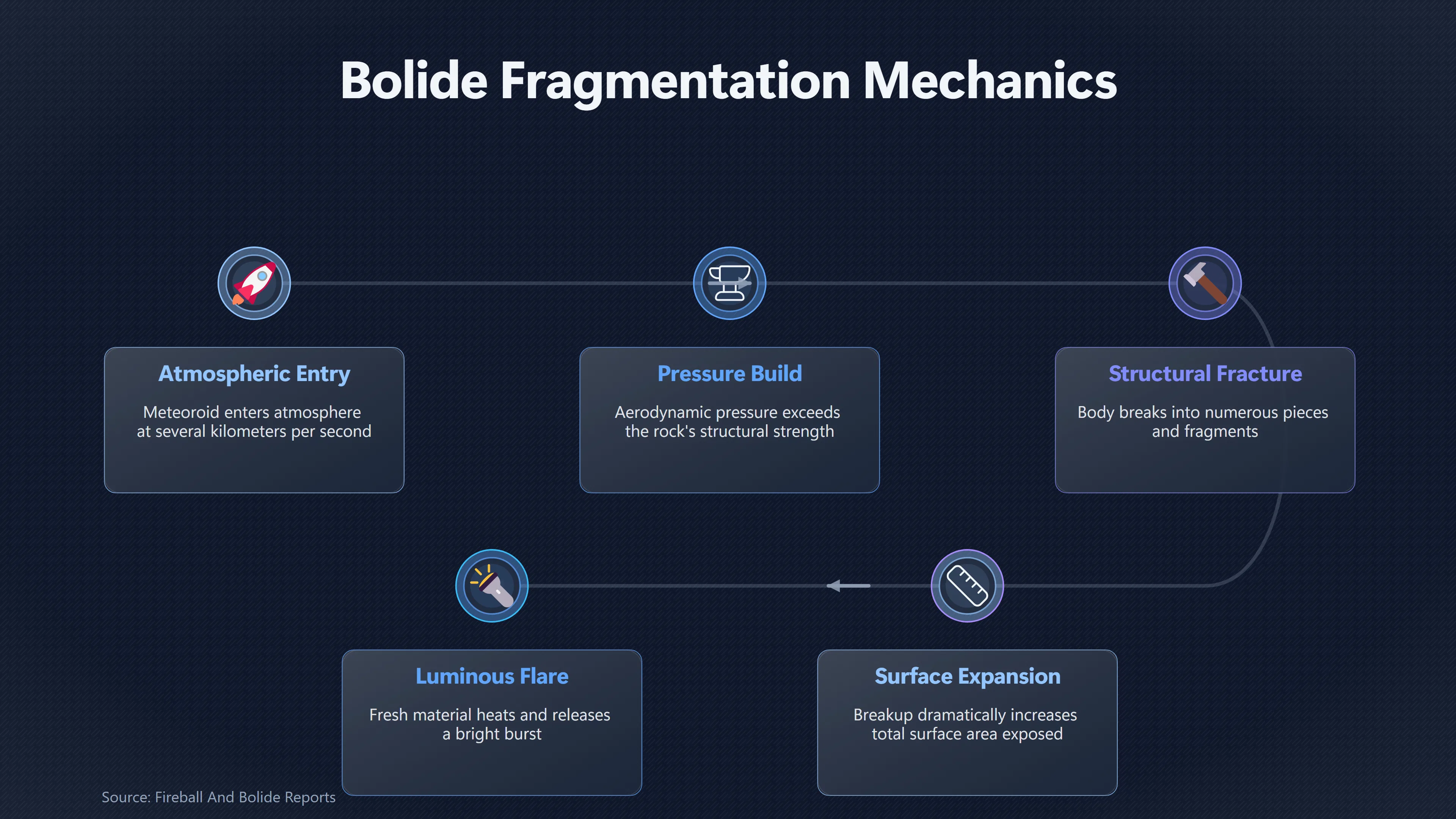
A large meteoroid entering the atmosphere is subjected to enormous aerodynamic pressure. As velocity remains many kilometres per second, the pressure acting on the body can eventually exceed the rock’s structural strength. Instead of remaining intact, it fractures into numerous pieces.
This breakup dramatically increases the total surface area exposed to the atmosphere. Fresh material is suddenly heated and ablated, releasing a burst of light that can be much brighter than the preceding flight. The resulting flare may last only fractions of a second but can completely alter how observers judge the object’s behaviour.[CNEOS]cneos.jpl.nasa.govOpen source on nasa.gov.
Modern observations of bolides routinely show light curves containing several distinct peaks rather than a smooth increase and decline. Each peak commonly represents another fragmentation episode rather than a powered acceleration or change of course. NASA’s growing archive of fireball observations specifically uses these brightness variations to study how objects break apart and what they are made of.[NASA Jet Propulsion Laboratory (JPL)]jpl.nasa.govNASA Jet Propulsion Laboratory (JPL)US Space Force Releases Decades of Bolide Data to NASA for Planetary Defense Studies | NASA Jet Propu…
How breakup alters apparent motion
Human vision estimates an object’s motion by tracking its brightest visible point. During fragmentation, that brightest point can shift rapidly between different pieces of the disintegrating body.
Several optical effects contribute to misleading impressions:
- Brightness jumps. A sudden flare can be interpreted as acceleration because the object appears to surge forward.
- Fragment succession. If one fragment fades while another brighter fragment appears nearby, observers may perceive a sharp turn or sideways movement.
- Variable visibility. Clouds, haze and changing brightness may temporarily hide parts of the trajectory, making the reappearance seem like a change of direction.
- Perspective effects. Small deviations between fragments become exaggerated when viewed from tens or hundreds of kilometres away against a dark sky.
- Persistent luminous trains. After the body has passed, glowing gas and dust continue drifting in high-altitude winds. Later observers may mistake this evolving trail for the object itself changing course.[CNEOS]cneos.jpl.nasa.govOpen source on nasa.gov.
These effects occur because the observer is not following a solid illuminated vehicle. Instead, they are watching a rapidly evolving cloud of plasma, vapour and fragments whose brightest region changes from moment to moment.

Why controlled flight is not required
Reports of apparent manoeuvring often assume that an observed change in the brightest point represents a genuine alteration of the object’s trajectory. Meteor physics shows this assumption is unreliable.
The individual fragments continue to obey ordinary ballistic motion, but they do not necessarily remain equally luminous. One fragment may extinguish while another suddenly becomes dominant. From the ground, the eye naturally follows whichever fragment is brightest, producing the impression of a single object making impossible movements.
Fragmentation can also produce multiple luminous objects travelling on closely related paths. Witnesses may therefore report one object becoming two, or several objects rejoining into one, despite the fragments simply separating and fading at different rates. These observations are well documented in modern bolide recordings and form part of the reason why brightness data are valuable for reconstructing atmospheric breakups.[NASA Jet Propulsion Laboratory (JPL)]jpl.nasa.govNASA Jet Propulsion Laboratory (JPL)US Space Force Releases Decades of Bolide Data to NASA for Planetary Defense Studies | NASA Jet Propu…
Which 1965 observations fit this mechanism
Several recurring descriptions from the 1965 fireball align naturally with fragmentation rather than powered flight.
Witnesses across the Great Lakes region described the object becoming exceptionally bright, producing flashes and in some accounts appearing to divide into multiple luminous components before continuing. Such reports are expected from a bolide undergoing successive structural failures.
Other witnesses believed the object slowed dramatically before descending. This impression is also compatible with a meteor. As a bolide penetrates deeper into denser air, atmospheric drag rapidly reduces its speed while increasing brightness through intense ablation. Although it remains travelling at several kilometres per second, the combination of deceleration, changing perspective and increasing luminosity can make the slowdown appear much greater than it really is.[CNEOS]cneos.jpl.nasa.govOpen source on nasa.gov.
Accounts describing apparent turns are less consistent with an actual change in trajectory than with changing visibility of fragments or deformation of the persistent luminous train. The broader astronomical reconstruction of the 1965 fireball, based on photographs and multiple observations, supports a continuous atmospheric path rather than repeated directional manoeuvres.
What fragmentation cannot explain
Fragmentation explains many descriptions of the fireball itself, but it does not automatically resolve every later claim associated with the Kecksburg incident.
In particular, it does not account for reports of a metallic acorn-shaped object allegedly found in woodland, military activity on the ground or later witness interpretations of those events. Those claims depend on separate evidence and should not be treated as direct consequences of the atmospheric flight.
The fragmentation mechanism addresses a narrower question: whether a natural meteor can appear to behave like a controlled craft while still following the physics expected of a bolide. On that question, decades of observational and theoretical research indicate that sudden flares, multiple fragments and shifting luminous centres are entirely normal features of large meteors and can readily produce convincing impressions of intelligent manoeuvring without requiring an actual change in flight path.[nasa.gov]cneos.jpl.nasa.govOpen source on nasa.gov.
Amazon book picks
Further Reading
Books and field guides related to Can a Breaking Meteor Look Like a Craft?. Use these as the next step if you want deeper reading beyond the article.
Meteorite
Every rock has a story tell, and none more so than those which have fallen from the sky: meteorites. Originating in the Asteroid Belt bet...
The Cambridge Encyclopedia of Meteorites
Beautifully illustrated with over 140 full colour images, The Cambridge Encyclopedia of Meteorites provides a thorough guide to these fas...
Meteorites and their Parent Planets
Thoroughly revised second edition of a highly successful book describing all aspects of meteorites.
Physics of Meteoric Phenomena
"Meteoric phenomena" is the accepted term for the complex of physi cal phenomena that accompany the entry of meteoric bodies into the at...
eBay marketplace picks
Marketplace Samples
Live-tested eBay searches with available results related to this page.
Selected frommeteor poster oneBay.co.uk.
Endnotes
1.
Source: cneos.jpl.nasa.gov
Link:https://cneos.jpl.nasa.gov/fireballs/intro.html
2.
Source: nasa.gov
Link:https://www.nasa.gov/solar-system/u-s-space-force-releases-decades-of-bolide-data-to-nasa-for-planetary-defense-studies/
Source snippet
U.S. Space Force Releases Decades of Bolide Data to NASA for Planetary Defense Studies - NASA...
3.
Source: jpl.nasa.gov
Link:https://www.jpl.nasa.gov/news/us-space-force-releases-decades-of-bolide-data-to-nasa-for-planetary-defense-studies/
Source snippet
NASA Jet Propulsion Laboratory (JPL)US Space Force Releases Decades of Bolide Data to NASA for Planetary Defense Studies | NASA Jet Propu...
4.
Source: data.nasa.gov
Title: Fireball And Bolide Reports
Link:https://data.nasa.gov/dataset/fireball-and-bolide-reports
Source snippet
set - NASA Open Data Portal...
5.
Source: jpl.nasa.gov
Title: s dart mission changed orbit of asteroid didymos around sun
Link:https://www.jpl.nasa.gov/news/nasas-dart-mission-changed-orbit-of-asteroid-didymos-around-sun/
Source snippet
nasa.govNASA’s DART Mission Changed Orbit of Asteroid Didymos Around Sun | NASA Jet Propulsion Laboratory (JPL)March 6, 2026 — NASA’S DAR...
Published: March 6, 2026
6.
Source: nasa.gov
Title: pi planetary defense
Link:https://www.nasa.gov/general/pi-planetary-defense/
Source snippet
PI - Planetary Defense - NASAApril 6, 2023 — 4 min read PI – PLANETARY DEFENSE Image: The headshot image of Loura Hall Loura Hall Apr 06...
Published: April 6, 2023
7.
Source: nasa.gov
Title: NAS A Confirms DART Mission Impact Changed Asteroid’s Motion in Space
Link:https://www.nasa.gov/news-release/nasa-confirms-dart-mission-impact-changed-asteroids-motion-in-space/
8.
Source: science.nasa.gov
Title: looking for lightning finding fireballs 149381
Link:https://science.nasa.gov/earth/earth-observatory/looking-for-lightning-finding-fireballs-149381/
9.
Source: jpl.nasa.gov
Title: tracked small asteroid before it broke up in atmosphere
Link:https://www.jpl.nasa.gov/news/nasa-tracked-small-asteroid-before-it-broke-up-in-atmosphere/
10.
Source: nas.nasa.gov
Title: feature asteroid simulations
Link:https://nas.nasa.gov/pubs/stories/2017/feature_asteroid_simulations.html
11.
Source: jpl.nasa.gov
Title: saturn moons activity could be curtain eruptions
Link:https://www.jpl.nasa.gov/news/saturn-moons-activity-could-be-curtain-eruptions/
12.
Source: jpl.nasa.gov
Title: pia10723 dissecting a light echo
Link:https://www.jpl.nasa.gov/images/pia10723-dissecting-a-light-echo/
13.
Source: ufoencounters.co.uk
Link:https://www.ufoencounters.co.uk/kecksburg.html
Additional References
14.
Source: youtube.com
Link:https://www.youtube.com/watch?v=gBRdDPmz_vI
Source snippet
This list provides documented historical context regarding the 1965 Kecksburg fireball debate alongside footage of high-altitude bolide f...
15.
Source: theblackvault.com
Title: the vault files the 1965 kecksburg pennsylvania crash
Link:https://www.theblackvault.com/casefiles/the-vault-files-the-1965-kecksburg-pennsylvania-crash/
Source snippet
The Vault Files: The 1965 Kecksburg, Pennsylvania Crash - The Black Vault Case FilesAugust 1, 2025 — THE VAULT FILES: THE 1965 KECKSBURG...
Published: August 1, 2025
16.
Source: youtube.com
Link:https://www.youtube.com/watch?v=tU7WSHZye5w
Source snippet
America's Other Roswell: the Kecksburg UFO | Conspiracy (S1, E13) | Full Episode | History...
17.
Source: youtube.com
Title: The Kecksburg UFO Mystery: Secrets, Witnesses and Vanished Evidence
Link:https://www.youtube.com/watch?v=vkZszbMzl3Q
Source snippet
Kecksburg UFO Crash: The Untold Story | The Government Lied! | Full Documentary | UFOTV®...
18.
Source: nature.com
Link:https://www.nature.com/articles/367624a0
19.
Source: youtube.com
Title: Kecksburg UFO
Link:https://www.youtube.com/watch?v=vnau2WjDhds
Source snippet
Stunning fireball over south of Spain (Oct. 12) // Espectacular bola de fuego sobre España (12 oct.)...
20.
Source: thecoldfile.com
Title: 1965 kecksburg
Link:https://www.thecoldfile.com/articles/1965-kecksburg/
Source snippet
On 9 December 1965, at roughly 4:43 to 4:44 p.m. EST (21:43 UT), a large fireball crossed the sky over the Great Lakes region, the US Nor...
Published: December 1965
21.
Source: youtube.com
Link:https://www.youtube.com/watch?v=HX_RrO7ZQaU
Source snippet
Kecksburg UFO - Aliens in Pennsylvania?...
22.
Source: sciencedirect.com
Title: Fireball fragmentation in the first half of the atmospheric trajectory
Link:https://www.sciencedirect.com/science/article/pii/S0032063319304829
23.
Source: wikidisc.org
Title: [Kecksburg UFO incident]({{ ‘kecksburg-ufo-incident/’ | relative_url }}) | Wiki Disc
Link:https://www.wikidisc.org/wiki/Kecksburg_UFO_incident