Within Shock Waves
Can Sonic Booms Reveal What the Object Was?
Meteoroids and re-entering spacecraft can both travel supersonically, so acoustic evidence alone cannot reliably identify the object.
On this page
- Shared acoustic signatures of meteors and reentries
- What trajectory and fragmentation clues may add
- Why the Kecksburg recordings remain inconclusive
Page outline Jump by section
Introduction
The sonic booms reported during the Kecksburg incident demonstrate that a high-speed object passed through the atmosphere, but they do not identify whether that object was a natural meteoroid or an artificial spacecraft. Both large meteors and re-entering space hardware travel at supersonic or hypersonic speeds, generating shock waves capable of producing delayed booms, rattling buildings and, under favourable conditions, even registering on seismographs. The acoustic evidence therefore establishes that an energetic atmospheric event occurred, yet it does not by itself resolve the long-running debate over whether the Kecksburg object was a natural fireball or space debris.[American Meteor Society]amsmeteors.orgAmerican Meteor Society Fireball FAQsAmerican Meteor SocietyFireball FAQs - American Meteor Society…
Shared acoustic signatures of meteors and re-entries
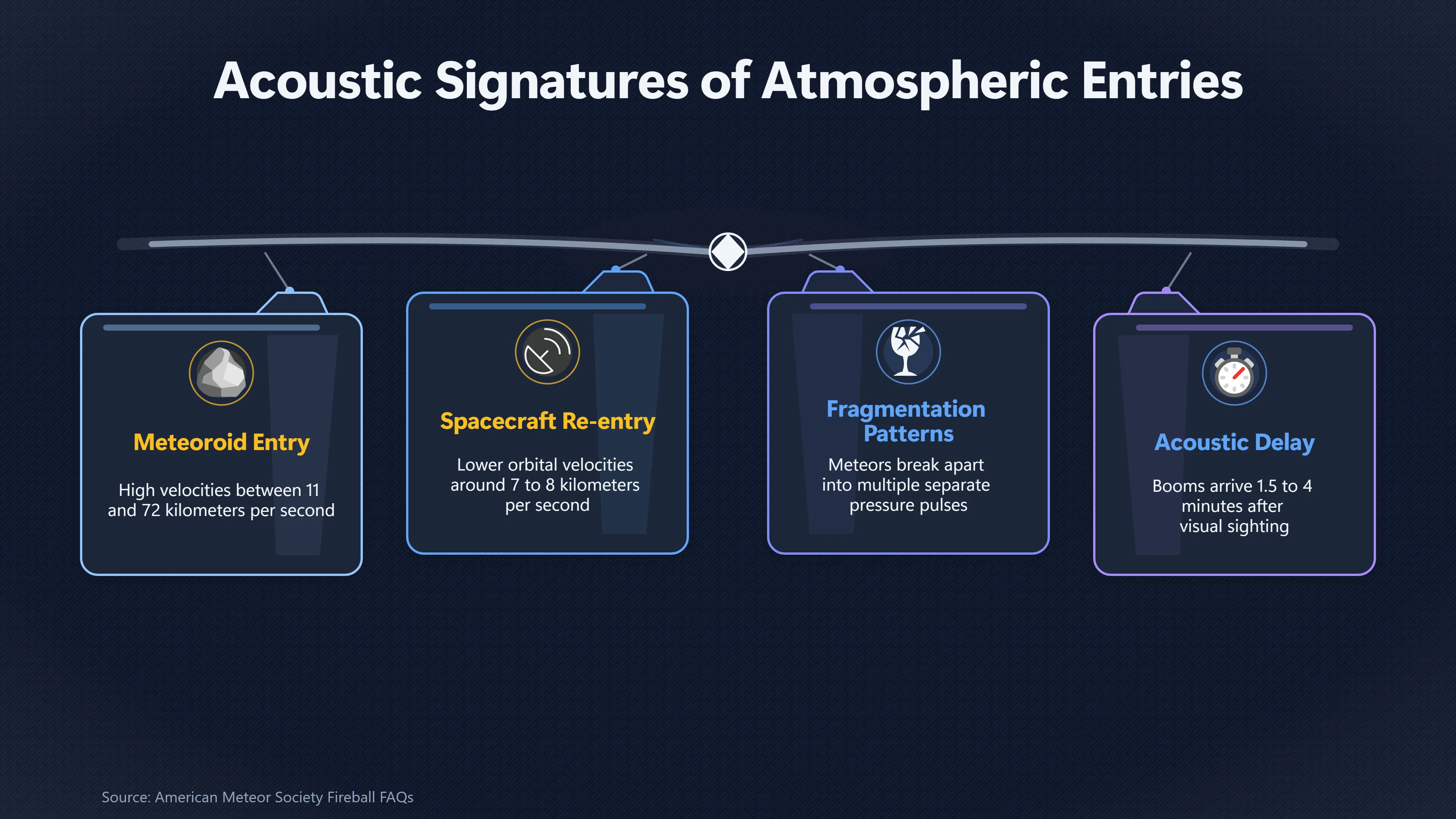
A sonic boom is created whenever an object moves faster than the speed of sound, regardless of whether that object is a rocky meteoroid or an engineered spacecraft. The pressure wave depends primarily on the object’s speed, altitude, size and flight path rather than its origin.
For that reason, listeners on the ground often experience remarkably similar effects from very different objects:
- One or more loud booms several minutes after a bright object is seen.
- Windows and buildings shaking.
- A pressure wave that may be mistaken for an explosion or small earthquake.
- Ground vibrations detectable by sensitive instruments through air-to-ground coupling.
The American Meteor Society notes that exceptionally bright fireballs commonly produce delayed sonic booms, typically arriving between about one and a half and four minutes after the visual event. Comparable delays occur during controlled spacecraft re-entries or the uncontrolled return of satellites when fragments remain supersonic deep into the atmosphere.[American Meteor Society]amsmeteors.orgAmerican Meteor Society Fireball FAQsAmerican Meteor SocietyFireball FAQs - American Meteor Society…
Because these acoustic effects arise from basic atmospheric physics, hearing a boom cannot reveal whether the source was natural or artificial.
What trajectory and fragmentation clues may add
Although the boom itself is not diagnostic, the wider pattern of observations can sometimes favour one explanation over another.
A natural meteoroid generally enters the atmosphere at extremely high velocities, often between roughly 11 and 72 kilometres per second. Most produce brilliant fireballs, intense heating and frequent fragmentation. Multiple explosions or successive booms can occur as the body breaks apart, creating separate pressure pulses in addition to the continuous ballistic shock wave.[arXiv]arxiv.orgarXiv Fireball characteristics derivable from acoustic dataFireball characteristics derivable from acoustic dataFebruary 12, 2021…
Artificial spacecraft and satellites usually re-enter at substantially lower speeds, around orbital velocity of about 7–8 kilometres per second. They also tend to fragment progressively as different components fail, often producing multiple glowing pieces travelling together over a relatively long path. This behaviour can create repeated sonic booms that resemble those from a fragmenting meteor.
The distinction therefore depends less on the sound itself than on combining several independent lines of evidence, including:
- Reconstructed flight trajectory.
- Estimated entry velocity.
- Duration of the visible passage.
- Fragmentation pattern.
- Orbital tracking data for known spacecraft.
- Recovery and laboratory analysis of any surviving debris.
Modern investigations routinely combine optical cameras, radar, satellite observations, infrasound stations and trajectory modelling to distinguish between these possibilities. Acoustic data alone rarely provide a definitive answer.[arXiv]arxiv.orgarXiv Fireball characteristics derivable from acoustic dataFireball characteristics derivable from acoustic dataFebruary 12, 2021…

Why the Kecksburg booms remain inconclusive
This limitation is especially important when assessing the Kecksburg incident.
Witnesses across several states reported delayed explosions or sonic booms after observing the brilliant object. These reports are entirely consistent with a large meteor penetrating deeply enough into the atmosphere to generate strong shock waves. They are equally consistent with the re-entry of substantial space hardware if such an object remained supersonic at similar altitudes.[American Meteor Society]amsmeteors.orgAmerican Meteor Society Fireball FAQsAmerican Meteor SocietyFireball FAQs - American Meteor Society…
The difficulty is that the available acoustic evidence from December 1965 lacks the detail needed for discrimination. Unlike modern events, there were:
- No distributed microphone arrays.
- No infrasound monitoring network.
- No digital waveform recordings.
- No precisely synchronised timing from multiple acoustic stations.
Instead, investigators must rely largely on eyewitness recollections of when booms were heard and how loud they seemed. Such reports are valuable for confirming that a significant atmospheric shock occurred but are insufficient for reconstructing the exact source.
Research on modern fireballs shows that dense acoustic networks can sometimes estimate fragmentation points and aspects of a fireball’s trajectory from shock-wave arrivals. However, even these sophisticated methods struggle to determine object type from acoustics alone and work best when combined with optical observations and atmospheric modelling.[arXiv]arxiv.orgarXiv Fireball characteristics derivable from acoustic dataFireball characteristics derivable from acoustic dataFebruary 12, 2021…
What the sounds do—and do not—tell us
The acoustic evidence narrows the range of plausible explanations without selecting a single winner.
The booms support several conclusions with reasonable confidence:
- A genuinely energetic object travelled through the atmosphere.
- The object remained supersonic long enough to generate strong shock waves.
- The reported sounds do not require an impact at Kecksburg itself, since atmospheric shock waves can travel considerable distances before reaching observers.
However, the same evidence does not establish:
- That the object was a meteor rather than a spacecraft.
- That it survived to reach the ground.
- That any reported crash location corresponded to the source of the booms.
- That the object possessed unusual or non-human characteristics.
Consequently, the sonic booms occupy an important but limited place in the Kecksburg evidence. They corroborate the occurrence of a powerful atmospheric event, yet they cannot resolve the central dispute between a natural bolide and re-entering artificial space debris. That question depends on trajectory reconstruction, orbital analyses, physical debris and other independent evidence—not on the acoustic signatures alone.[amsmeteors.org]amsmeteors.orgAmerican Meteor Society Fireball FAQsAmerican Meteor SocietyFireball FAQs - American Meteor Society…
Amazon book picks
Further Reading
Books and field guides related to Can Sonic Booms Reveal What the Object Was?. Use these as the next step if you want deeper reading beyond the article.
Rocks from Space
Appendices A-C: Meteorite verification laboratories, Commercial meteorite dealers, Selected list of suspected impact craters worldwide.
Atmospheric Re-Entry Vehicle Mechanics
Based on a long engineering experience, this book offers a comprehensive and state-of-the-art analysis of aerodynamic and flight mechanic...
Fundamentals of Acoustics
Dargestellt werden die physikalischen und mathematischen Konzepte zur Beschreibung der Erzeugung, Weiterleitung und Wahrnehmung von Schal...
eBay marketplace picks
Marketplace Samples
Live-tested eBay searches with available results related to this page.
Selected fromspace capsule model oneBay.co.uk.
Current eBay listing
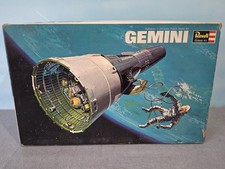
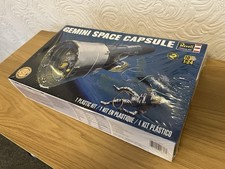
Revell Gemini Space Capsule Model Kit 1:24 Scale, vintage model kit.
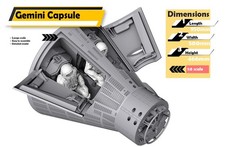
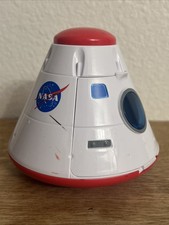
Current eBay listing
NASA Space Adventure Space Capsule W/Lights Plastic 4.2” Tall Toy
Endnotes
1.
Source: amsmeteors.org
Title: American Meteor Society Fireball FAQs
Link:https://www.amsmeteors.org/fireballs/faqf/
Source snippet
American Meteor SocietyFireball FAQs - American Meteor Society...
2.
Source: usgs.gov
Title: Sonic Booms | U.S. Geological Survey
Link:https://www.usgs.gov/programs/earthquake-hazards/sonic-booms
Source snippet
Sonic Booms | U.S. Geological Survey...
3.
Source: arxiv.org
Title: arXiv Fireball characteristics derivable from acoustic data
Link:https://arxiv.org/abs/2102.06574
Source snippet
Fireball characteristics derivable from acoustic dataFebruary 12, 2021...
Published: February 12, 2021
4.
Source: amsmeteors.org
Title: American Meteor Society Fireballs
Link:https://www.amsmeteors.org/fireballs/
Source snippet
American Meteor SocietyFireballs - American Meteor Society...
5.
Source: amsmeteors.org
Title: Has Something Changed in the Near-Earth Meteoroid Environment?
Link:https://www.amsmeteors.org/2026/03/has-something-changed-in-the-near-earth-meteoroid-environment/
6.
Source: amsmeteors.org
Title: AM S Fireball Stats Analysis
Link:https://www.amsmeteors.org/2013/03/ams-fireball-stats-analysis/
9.
Source: amsmeteors.org
Title: Fireball Logs
Link:https://www.amsmeteors.org/fireballs/fireball-report/
11.
Source: amsmeteors.org
Title: Fireball Logs
Link:https://www.amsmeteors.org/fireballs/fireball-report/page/6/
12.
Source: amsmeteors.org
Title: Fireball Logs
Link:https://www.amsmeteors.org/fireballs/fireball-report/page/7/
Additional References
13.
Source: theguardian.com
Link:https://www.theguardian.com/science/2026/jun/01/meteor-massachusetts-sonic-boom
Source snippet
June 1, 2026 — Image: a satellite image of a meteor exploding [Input] This satellite image taken on Saturday shows a meteor exploding in...
Published: June 1, 2026
14.
Source: nasa.gov
Title: It’s Fireball Season!
Link:https://www.nasa.gov/blogs/watch-the-skies/2026/03/26/its-fireball-season-answering-your-meteor-questions/
Source snippet
Answering Your Meteor Questions - NASAMarch 26, 2026 — WATCH THE SKIES Image Janet Sudnik March 26, 2026 5:18PM CATEGORIES Marshall Space...
Published: March 26, 2026
15.
Source: appalachianhistorian.org
Title: Contemporary reports said tha
Link:https://appalachianhistorian.org/the-[kecksburg-ufo-incident
Source snippet
The Kecksburg UFO Incident: Pennsylvania’s Space Acorn and the Night the Sky Fell Over Appalachia - Appalachianhistorian.orgJune 24, 2026...
Published: June 24, 2026
16.
Source: youtube.com
Title: America’s Other Roswell: the Kecksburg UFO | Conspiracy (S1, E13) | Full Episode
Link:https://www.youtube.com/watch?v=HX_RrO7ZQaU
Source snippet
Episode 184 Kecksburg Revisited with [Stan Gordon]({{ 'stan-gordon/' | relative_url }})...
17.
Source: youtube.com
Title: The Kecksburg UFO Mystery: Secrets, Witnesses and Vanished Evidence
Link:https://www.youtube.com/watch?v=vkZszbMzl3Q
Source snippet
Kecksburg UFO Crash: The Untold Story | Full Documentary...
18.
Source: usgs.gov
Link:https://www.usgs.gov/faqs/how-does-usgs-tell-difference-between-earthquake-and-a-sonic-boom
19.
Source: handwiki.org
Title: Astronomy:Kosmos 96
Link:https://www.handwiki.org/wiki/Astronomy%3AKosmos_96
Source snippet
However, due to a [launch failure]({{ 'launch-failure/' | relative_url }}), it did not depart low Earth orbit. Its re-entry into Earth's...
20.
Source: youtube.com
Title: Kecksburg UFO Crash: The Untold Story | Full Documentary
Link:https://www.youtube.com/watch?v=tU7WSHZye5w
Source snippet
Nearly 50 years later, Kecksburg UFO sighting remains mystery...
21.
Source: youtube.com
Title: Episode 184 Kecksburg Revisited with Stan Gordon
Link:https://www.youtube.com/watch?v=CKK66LtZ1Hs
Source snippet
The Kecksburg UFO Mystery: Secrets, Witnesses and Vanished Evidence...
22.
Source: ufo-graph-map.pages.dev
Link:https://ufo-graph-map.pages.dev/node/kosmos96_reentry