Within Kosmos 96
Could Tracking Error Save the Kosmos 96 Theory?
Normal uncertainty in drag and fragmentation cannot easily move Kosmos 96 through several extra orbits to Pennsylvania that evening.
On this page
- What makes decay predictions uncertain
- How many orbits thirteen hours represents
- Why the proposed correction is too large
Page outline Jump by section
Introduction
One of the most persistent attempts to reconcile the Kosmos 96 explanation for the Kecksburg incident is to argue that orbital decay predictions are inherently uncertain. That premise is correct in a general sense: uncontrolled satellite re-entries are difficult to predict because atmospheric drag varies continuously. The critical question, however, is not whether predictions can be wrong, but whether they can be wrong by enough to move the spacecraft from its tracked re-entry over Canada to the well-known fireball seen over the Great Lakes and Pennsylvania roughly thirteen hours later.

The available evidence indicates that this is the weakest part of the Kosmos 96 theory. While re-entry forecasts can shift by minutes or even several hours when made well in advance, the Kecksburg hypothesis requires a much larger correction after the spacecraft had already been continuously tracked in low Earth orbit. Independent orbital analyses and subsequent reviews conclude that the required timing shift is far beyond what normal uncertainties in atmospheric drag or fragmentation would reasonably produce.[James Oberg]jamesoberg.comJames Oberg Jim Oberg on the “NASA lawsuit over Kecksburg UFO Documents”James ObergJim Oberg on the “NASA lawsuit over Kecksburg UFO Documents”November 1, 2024…
What makes decay predictions uncertain
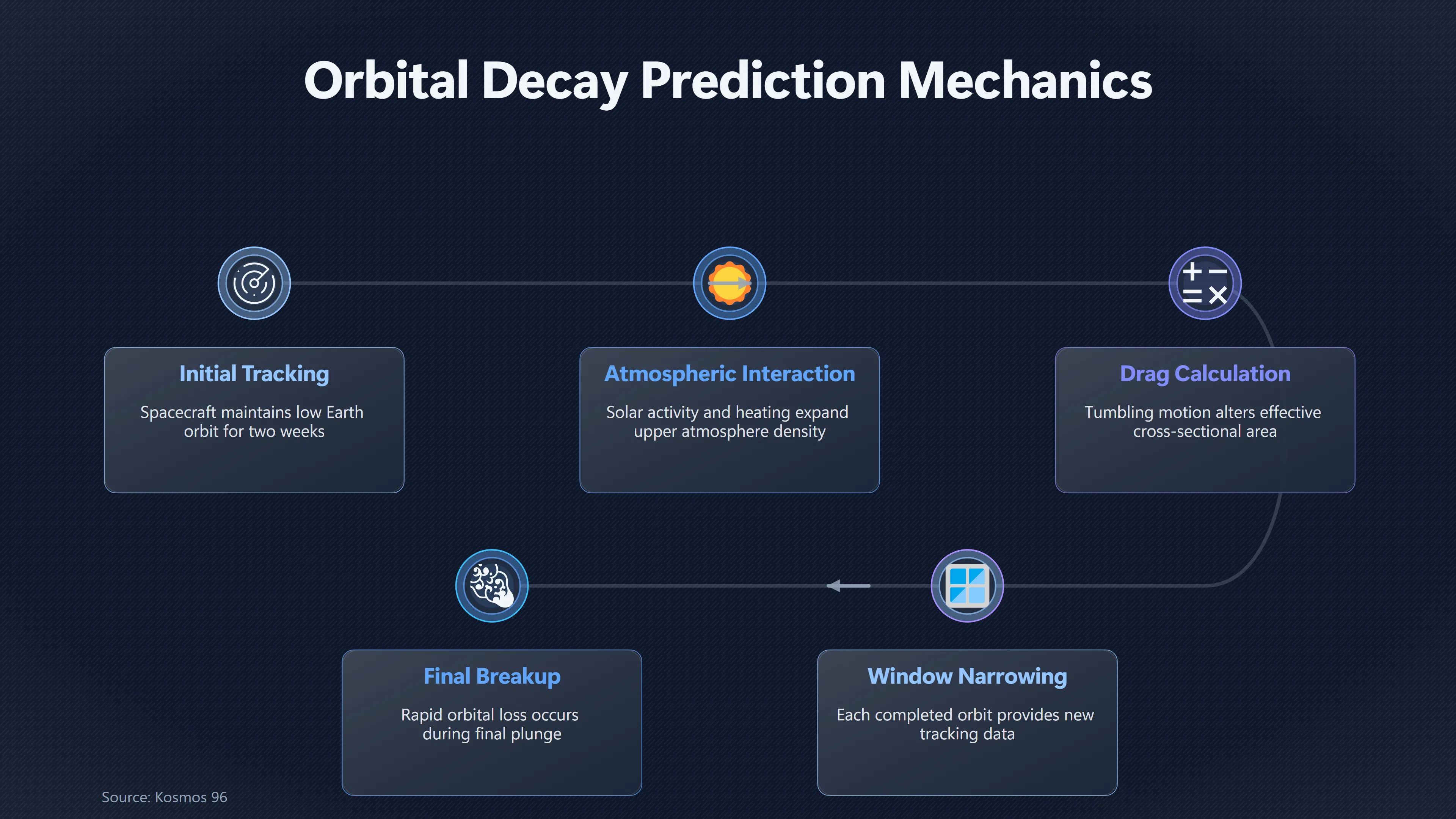
Predicting the exact moment when an uncontrolled spacecraft will re-enter is a difficult orbital mechanics problem because the final descent depends on several changing factors.
The most important source of uncertainty is atmospheric drag. Even at altitudes of 150–300 kilometres, Earth’s upper atmosphere expands and contracts in response to solar activity, geomagnetic disturbances and day-night heating. Small changes in atmospheric density alter how quickly a satellite loses orbital energy. The spacecraft’s orientation also matters because tumbling changes its effective cross-sectional area, increasing or decreasing drag over successive orbits. Modern space agencies still publish wide uncertainty windows for uncontrolled re-entries until shortly before atmospheric breakup.[Ars Technica]arstechnica.comArs TechnicaA Soviet-era spacecraft built to land on Venus is falling to Earth instead - Ars TechnicaMay 8, 2025…
These uncertainties explain why predicting an impact point days in advance is difficult. They do not imply that any later time is equally plausible. As an object descends, each completed orbit provides new tracking information that progressively narrows the prediction. By the final few revolutions, the remaining uncertainty is substantially smaller than it was days earlier.[Ars Technica]arstechnica.comArs TechnicaA Soviet-era spacecraft built to land on Venus is falling to Earth instead - Ars TechnicaMay 8, 2025…
How many orbits thirteen hours represents
A thirteen-hour discrepancy sounds modest in everyday terms, but in orbital mechanics it is enormous.
Kosmos 96 occupied a low Earth orbit with a period of approximately 90 minutes. A delay of thirteen hours therefore represents roughly eight to nine additional complete revolutions around Earth before re-entry.[Wikipedia]WikipediaKosmos 96Kosmos 96
This distinction is important because each extra orbit requires the spacecraft to retain enough orbital energy to survive another pass through the increasingly dense upper atmosphere. Near the end of orbital decay, drag rises rapidly as altitude falls. Rather than drifting indefinitely, spacecraft typically experience accelerating orbital loss during their final revolutions.
Consequently, the Kecksburg scenario does not require a small correction to the predicted decay time. It requires the object to avoid destruction through nearly an entire working day’s worth of additional orbital passes despite being tracked near the end of its orbital lifetime.

Why normal uncertainty cannot explain the gap
Supporters of the Kosmos 96 hypothesis sometimes point to the fact that re-entry forecasts can change substantially. That observation is accurate but incomplete.
Forecast uncertainty refers to predictions made before the event, when future atmospheric conditions remain unknown. The Kecksburg theory instead requires the historical tracking itself to have been fundamentally wrong after the object had already completed more than two weeks in orbit and was under observation by military tracking systems.
James Oberg, who initially considered whether American tracking data might have concealed a classified recovery effort, later concluded that subsequent orbital analysis confirmed the original tracking solution. He wrote that the reconstructed orbit could not be reconciled with the observed Great Lakes fireball, despite earlier speculation.[James Oberg]jamesoberg.comJames Oberg Jim Oberg on the “NASA lawsuit over Kecksburg UFO Documents”James ObergJim Oberg on the “NASA lawsuit over Kecksburg UFO Documents”November 1, 2024…
Likewise, later summaries of the case note that United States Air Force tracking placed Kosmos 96’s decay many hours before the 21:43 UTC fireball associated with the Kecksburg event. They also point out that independent analysis of the fireball’s path found it inconsistent with the shallow geometry expected from an object descending out of Earth orbit.[Wikipedia]WikipediaKosmos 96Kosmos 96
Fragmentation does not solve the timing problem
Another variation suggests that part of the spacecraft may have detached earlier and remained in orbit until the evening.
This does not resolve the central difficulty. Detached fragments continue to obey the same laws of orbital motion. Unless a fragment receives a significant velocity change during separation—which routine structural breakup does not provide—it remains on an orbit very similar to the parent object. Small differences may alter the precise decay time, but they do not ordinarily create an entirely separate re-entry sequence many hours later.
Similarly, atmospheric breakup occurs during the final plunge rather than creating a mechanism that postpones re-entry by multiple additional revolutions. Fragmentation changes where debris lands along the final ground track, not whether the object survives for another eight or nine orbits.
Why the proposed correction is too large
The Kecksburg theory asks orbital uncertainty to accomplish several things simultaneously:
- Delay re-entry by approximately thirteen hours.
- Preserve the spacecraft through roughly eight or nine additional orbits.
- Shift the ground track from western Canada to the Great Lakes and Pennsylvania.
- Produce a fireball whose observed trajectory was independently judged to resemble a steep meteor rather than an orbital re-entry.
Each requirement compounds the previous one. Even if modest timing errors are accepted as inevitable in uncontrolled decay, satisfying all four conditions simultaneously requires a much larger departure from the tracked orbit than specialists consider credible.[James Oberg]jamesoberg.comJames Oberg Jim Oberg on the “NASA lawsuit over Kecksburg UFO Documents”James ObergJim Oberg on the “NASA lawsuit over Kecksburg UFO Documents”November 1, 2024…
The assessment within the Kosmos 96 debate
The coincidence that Kosmos 96 re-entered on the same day as the Kecksburg incident remains genuinely intriguing and helps explain why the spacecraft became the leading conventional explanation. However, the issue is not whether orbital predictions are ever uncertain—they unquestionably are—but whether ordinary uncertainty can bridge the specific historical gap.
The evidence indicates that it cannot. Modern experience with uncontrolled re-entries demonstrates why forecasts initially carry broad time windows, yet historical tracking analyses, later orbital reconstructions and the independently derived trajectory of the observed fireball all point in the same direction: the adjustment required to place Kosmos 96 over Pennsylvania that evening is far larger than a routine correction in atmospheric drag or decay modelling.[arstechnica.com]arstechnica.comArs TechnicaA Soviet-era spacecraft built to land on Venus is falling to Earth instead - Ars TechnicaMay 8, 2025…
Amazon book picks
Further Reading
Books and field guides related to Could Tracking Error Save the Kosmos 96 Theory?. Use these as the next step if you want deeper reading beyond the article.
Orbital Mechanics for Engineering Students
Orbital Mechanics for Engineering Students, Second Edition, provides an introduction to the basic concepts of space mechanics. These incl...
Fundamentals of Astrodynamics
Rating: 4.5/5 from 12 Google Books ratings
Teaching text developed by U.S. Air Force Academy and designed as a first course emphasizes the universal variable formulation. Develops...
Fundamentals of Astrodynamics and Applications
First published 1997. Subjects: Astrodynamik.
Space Mission Analysis and Design
This volume, appropriate as a textbook for either advanced undergraduate or beginning graduate courses, or as a reference for those alrea...
eBay marketplace picks
Marketplace Samples
Live-tested eBay searches with available results related to this page.
Selected fromSoviet space patch oneBay.co.uk.

Current eBay listing
Laika, Soviet vintage space — embroidered patches, space patch


Current eBay listing
Space Mission / Aviation Patches USA NASA Soviet CCCP - Various
Endnotes
1.
Source: Wikipedia
Title: Kosmos 96
Link:https://en.wikipedia.org/wiki/Kosmos_96
2.
Source: Wikipedia
Title: 1st Space Operations Squadron
Link:https://en.wikipedia.org/wiki/1st_Space_Operations_Squadron
3.
Source: jamesoberg.com
Title: James Oberg Jim Oberg on the “[NASA lawsuit]({{ ‘nasa-lawsuit/’ | relative_url }}) over Kecksburg UFO Documents”
Link:https://www.jamesoberg.com/statement_nasa_kecksburg.pdf
Source snippet
James ObergJim Oberg on the “NASA lawsuit over Kecksburg UFO Documents”November 1, 2024...
Published: November 1, 2024
4.
Source: arstechnica.com
Link:https://arstechnica.com/space/2025/05/a-soviet-era-spacecraft-built-to-land-on-venus-is-falling-to-earth-instead/
Source snippet
Ars TechnicaA Soviet-era spacecraft built to land on Venus is falling to Earth instead - Ars TechnicaMay 8, 2025...
Published: May 8, 2025
Additional References
5.
Source: sciencedirect.com
Link:https://www.sciencedirect.com/science/article/abs/pii/S009457652600408X
Source snippet
November 1, 2026 — ACTA ASTRONAUTICA Volume 248, November 2026, Pages 736-749 Research paper Future subsequent ballistic coe...
Published: November 1, 2026
6.
Source: sciencedirect.com
Link:https://www.sciencedirect.com/science/article/pii/S1110982326000517
Source snippet
September 1, 2026 — THE EGYPTIAN JOURNAL OF REMOTE SENSING AND SPACE SCIENCES Volume 29, Issue 3, September 2026, Pages 511...
Published: September 1, 2026
7.
Source: youtube.com
Title: Kecksburg: The UFO Crash the Government Still Won’t Explain
Link:https://www.youtube.com/watch?v=Q_xZY84Sxoc
Source snippet
[Kecksburg UFO incident]({{ 'kecksburg-ufo-incident/' | relative_url }}) documentary Kecksburg UFO Crash: The Untold Story | The Government Lied! | Full Documentary | UFOTV® Sci-Fi Central...
8.
Source: in-the-sky.org
Title: Spacecraft information: COSMOS 96
Link:https://in-the-sky.org/spacecraft.php?id=1742
Source snippet
7, 2026 — Spacecraft information: COSMOS 96 Launch Details Launched | 22 November 1965 Flight ended | 8 December 1965 Status | Decayed La...
Published: November 1965
9.
Source: handwiki.org
Title: Astronomy:Kosmos 96
Link:https://handwiki.org/wiki/Astronomy%3AKosmos_96
Source snippet
June 9, 2026 — ASTRONOMY:KOSMOS 96 From HandWiki [Input] Kosmos 96 Mission type | Venus flyby ^{[1]} Operator | OKB-1 COSPAR ID |...
Published: June 9, 2026
10.
Source: ufo-graph-map.pages.dev
Title: UFO.ai Kosmos 96 re-entry (Kecksburg prosaic explanation). — UFO.ai
Link:https://ufo-graph-map.pages.dev/node/kosmos96_reentry
Source snippet
96 re-entry (Kecksburg prosaic explanation). — UFO.ai...
11.
Source: astronomyufo.com
Link:https://www.astronomyufo.com/UFO/earthly.htm
12.
Source: conference.sdo.esoc.esa.int
Link:https://conference.sdo.esoc.esa.int/proceedings/sdc7/paper/191
13.
Source: youtube.com
Title: Kecksburg UFO Crash: The Untold Story
Link:https://www.youtube.com/watch?v=tU7WSHZye5w
Source snippet
Episode 184 Kecksburg Revisited with [Stan Gordon]({{ 'stan-gordon/' | relative_url }})...
14.
Source: sciencedirect.com
Title: Multifidelity Monte Carlo for the estimation of spacecraft re-entry windows
Link:https://www.sciencedirect.com/science/article/pii/S0273117726000840