Within Fireball Timeline
Why the Fireball's Booms Arrived After the Flash
The Detroit-area seismic record helps explain why loud reports arrived after the visible fireball and seemed locally disconnected.
On this page
- The seismic detection near Detroit
- Why light and sound reached witnesses at different times
- How delayed booms created false impact impressions
Page outline Jump by section
Introduction
One of the most misunderstood aspects of the 9 December 1965 Great Lakes fireball is why many witnesses reported loud explosions, rattling windows or even ground vibrations only after the brilliant object had disappeared. This delay was not unusual or evidence that a separate object had struck nearby. Instead, it is the expected behaviour of atmospheric shock waves generated by a large meteoroid travelling through the atmosphere at many times the speed of sound. Contemporary seismic measurements near Detroit, combined with modern meteor physics, provide a straightforward explanation for why the flash and the booms seemed disconnected in both time and place.[NASA]nasa.govIt’s Fireball Season! Answering Your Meteor QuestionsIt’s Fireball Season! Answering Your Meteor Questions - NASAMarch 26, 2026…
Understanding this mechanism helps explain why reports of explosions rapidly multiplied across the Great Lakes region and why some observers became convinced that the fireball had landed close to them, even though later trajectory studies placed its terminal flight much farther away.
The Seismic Detection Near Detroit
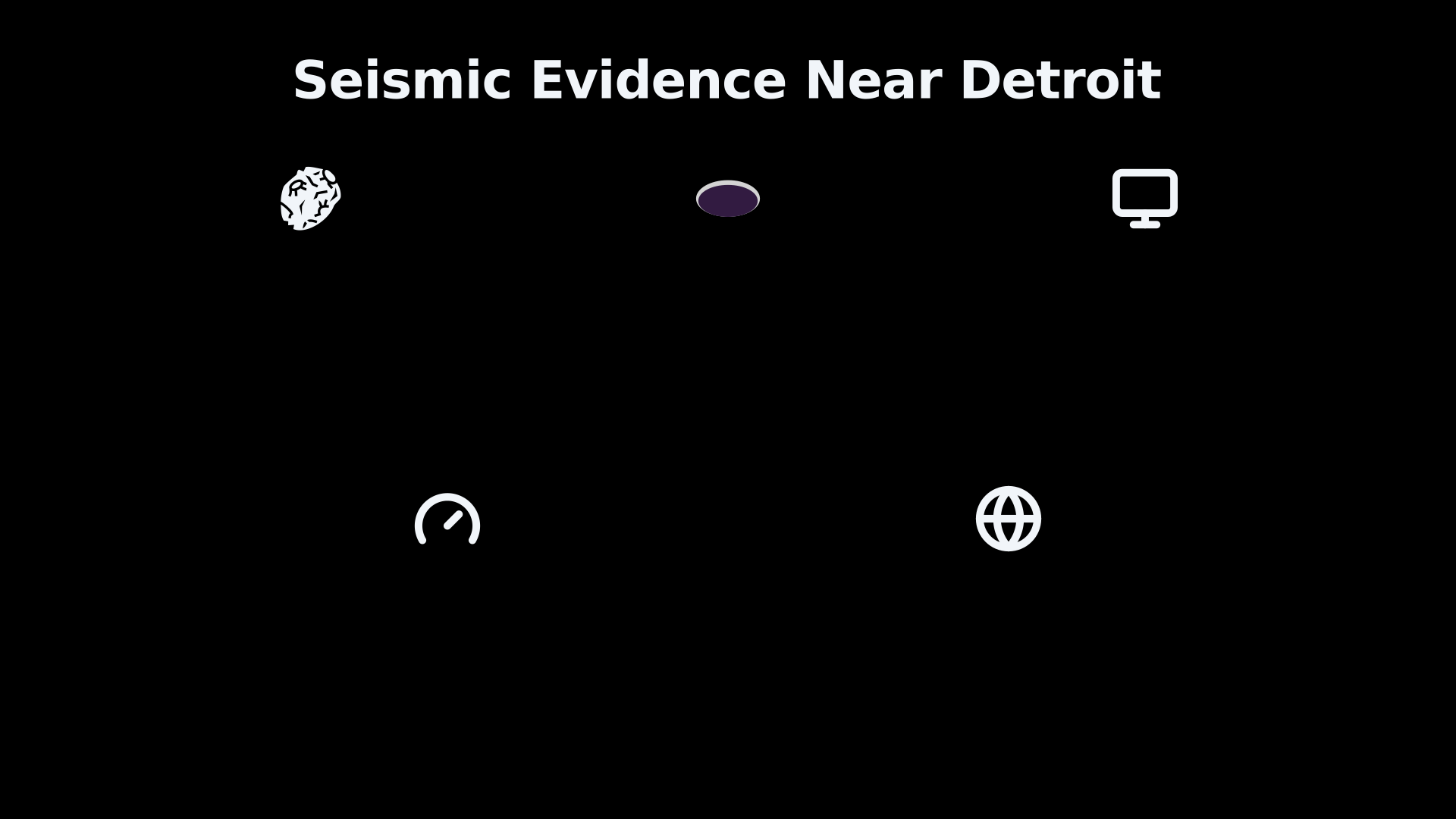
One of the strongest pieces of physical evidence from the 1965 event was not a photograph or eyewitness account but a seismic instrument.
A seismograph approximately 25 miles (40 km) south-west of Detroit recorded atmospheric shock waves associated with the fireball rather than vibrations originating from an earthquake or impact crater. The instrument detected pressure waves transmitted into the ground as the shock front swept across the area. This distinction is important because seismographs can register strong atmospheric disturbances when they couple energy into the Earth’s surface, even if nothing actually strikes the ground. Contemporary astronomical analysis used this timing alongside eyewitness reports and photographs to reconstruct the fireball’s flight through the atmosphere.[arXiv]arxiv.orgarXiv Physics of Meteor Generated Shock Waves in the Earth's AtmospherePhysics of Meteor Generated Shock Waves in the Earth's Atmosphere - A Review…
Rather than supporting an impact near Detroit, the seismic record confirmed that a powerful atmospheric event had occurred overhead, consistent with a large meteoroid travelling at hypersonic speed.
Why Light and Sound Reached Witnesses at Different Times
The apparent gap between seeing the fireball and hearing the explosion follows directly from basic physics.
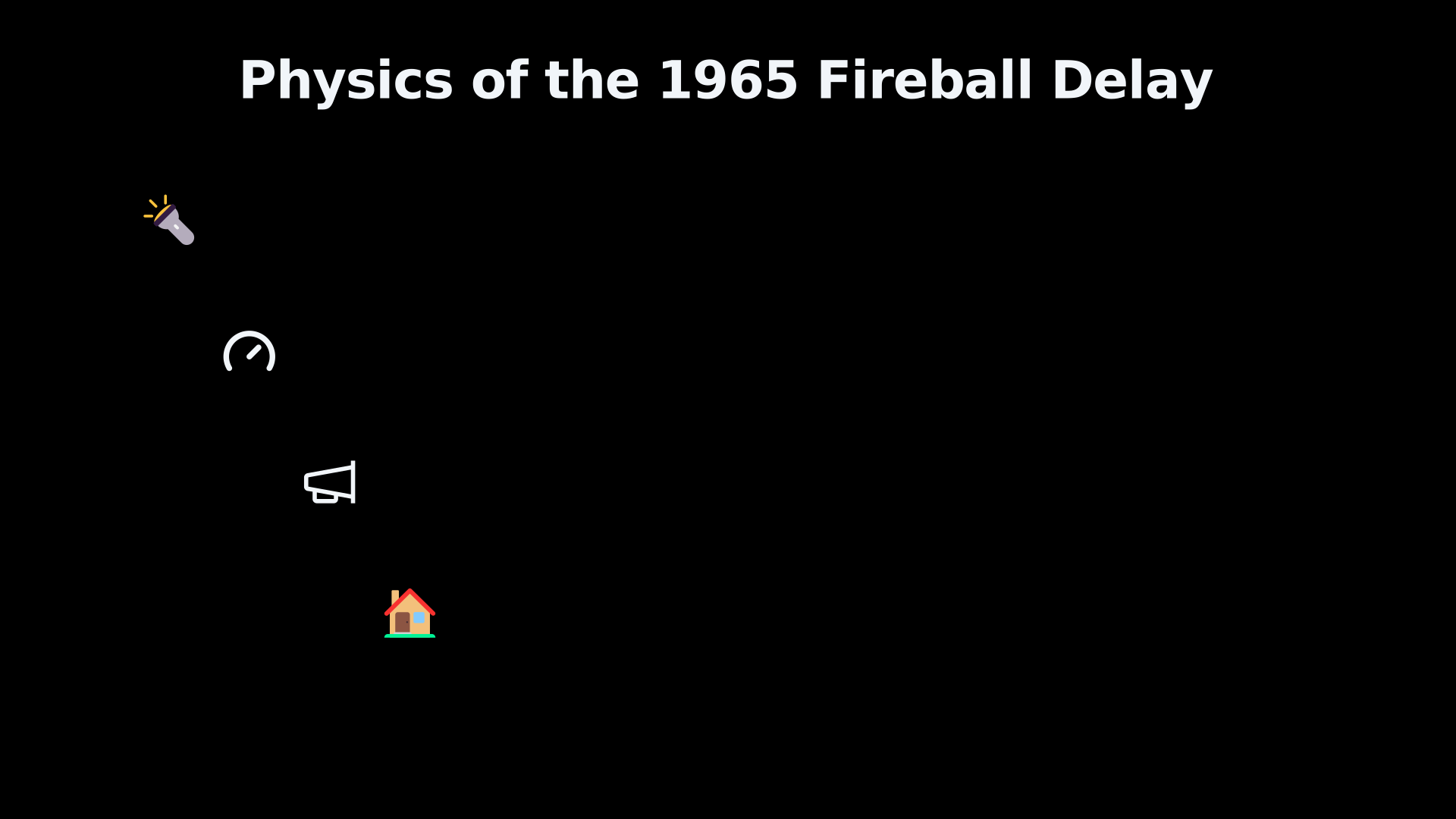
Light from the fireball travels to observers at roughly 300,000 kilometres per second, making the meteor appear almost instantaneously. The accompanying shock wave, however, propagates through air at roughly 340 metres per second under typical atmospheric conditions. Even when generated simultaneously, the sound arrives much later.
For a fireball tens of kilometres above the Earth, this delay can easily reach one or several minutes depending on:
- the altitude where the strongest shock wave formed;
- the observer’s distance from the flight path;
- atmospheric temperature and wind conditions;
- whether the meteoroid fragmented during flight.
Large meteoroids do not simply emit ordinary sound. Their extreme velocity continuously compresses the air into a moving shock front, much like the pressure wave produced by a supersonic aircraft but on a much larger scale. When fragmentation occurs, additional energy is released, often strengthening the pressure wave that eventually reaches the ground as a loud boom or series of booms.[NASA]nasa.govIt’s Fireball Season! Answering Your Meteor QuestionsIt’s Fireball Season! Answering Your Meteor Questions - NASAMarch 26, 2026…
Consequently, witnesses often remember seeing the sky become quiet after the fireball vanished, only for an apparently unrelated explosion to occur later.
Why Delayed Booms Created False Impact Impressions
The delayed arrival of shock waves strongly influences human perception.
By the time the boom arrives, the brilliant fireball is already gone. Without a visible object connecting the two events, many people naturally associate the sound with whatever lies nearest their own location—a nearby hill, woodland, field or neighbourhood.
This creates several common misconceptions:
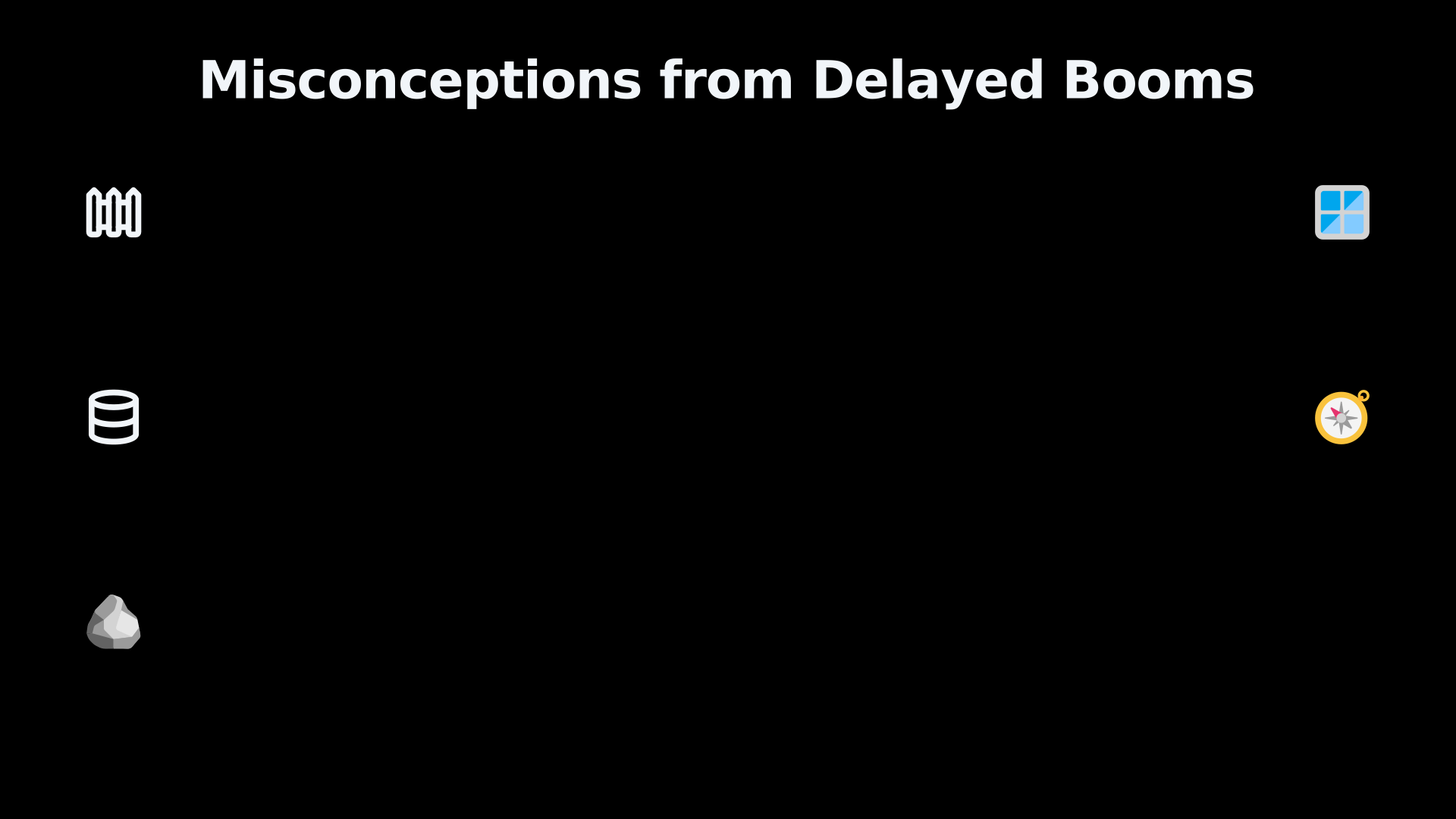
- The explosion seems local. Because the sound arrives overhead or from an unexpected direction, observers frequently believe something has landed close by.
- Window shaking suggests an impact. Pressure waves can rattle buildings, doors and glass without any object reaching the ground.
- Multiple communities infer different landing sites. A single atmospheric shock wave can spread across hundreds of kilometres, causing many towns to believe the object fell nearby.
These effects have been documented repeatedly in modern fireball events, where emergency services initially receive reports of explosions, aircraft crashes or earthquakes before astronomers identify a meteor as the cause.[space.com]space.comRare daytime fireball spotted from orbit as residents report powerful sonic boomThe meteor’s atmospheric entry was so forceful that the resulting boom caused homes to shake and was captured on video by several individ…
Why the Booms Did Not Identify the Fireball’s Endpoint
A common mistake is to treat the location where the loudest boom was heard as the point where the meteor ended its flight.
In reality, atmospheric shock waves radiate outward from an extended section of the meteoroid’s trajectory rather than from a single point. A large fireball effectively lays down a moving corridor of compressed air as it travels. Observers at different positions encounter that travelling pressure wave at different times and from different directions.
Meteor researchers therefore rely on multiple forms of evidence—including photographs, trajectory reconstruction, instrument records and, where available, recovered meteorites—rather than simply mapping where people heard explosions. Modern reviews of meteor-generated shock waves emphasise that fragmentation altitude, atmospheric structure and propagation effects can all influence where booms are eventually heard on the ground.[arXiv]arxiv.orgarXiv Physics of Meteor Generated Shock Waves in the Earth's AtmospherePhysics of Meteor Generated Shock Waves in the Earth's Atmosphere - A Review…
What This Means for the Great Lakes Timeline
Within the broader Great Lakes fireball sequence, the delayed booms help explain why reports of explosions spread across a much wider area than the reconstructed atmospheric path.
The Detroit-area seismic detection demonstrates that significant atmospheric pressure waves accompanied the fireball, while the predictable delay between the flash and the arriving shock wave explains why witnesses often experienced the two events as separate incidents. Rather than indicating multiple impacts or a continuously tracked object descending into south-western Pennsylvania, the delayed booms illustrate how one high-altitude atmospheric event could generate convincing but misleading impressions of nearby crashes in numerous locations.
Seen in this context, the shock-wave mechanism provides a coherent physical explanation for one of the most persistent features of the 1965 reports: the widespread belief that the object must have landed close to wherever the explosions were eventually heard.[NASA]nasa.govIt’s Fireball Season! Answering Your Meteor QuestionsIt’s Fireball Season! Answering Your Meteor Questions - NASAMarch 26, 2026…
Amazon book picks
Further Reading
Books and field guides related to Why the Fireball's Booms Arrived After the Flash. Use these as the next step if you want deeper reading beyond the article.
Storm in a Teacup: The Physics of Everyday Life
This book links the little things - the unexpected pinkness of blueberry jam or the way the air smells before it rains - with the big in...
Rocks from Space: Meteorites and Meteorite Hunters
Appendices A-C: Meteorite verification laboratories, Commercial meteorite dealers, Selected list of suspected impact craters worldwide.
How to Make an Apple Pie from Scratch: In Search of the Recip...
‘If you wish to make an apple pie from scratch, you must first invent the universe’ - Carl Sagan Inspired by Sagan’s famous line, How To...
Meteorites: The Story of Our Solar System
"A well-illustrated overview of the science and (literal) impact of these space rocks." -- Science News, on the first edition Leading exp...
eBay marketplace picks
Marketplace Samples
Live-tested eBay searches with available results related to this page.
Selected fromsonic boom art print oneBay.co.uk.


![Listing image for Sonic Boom [collage] Framed Wall Art Poster Canvas Print Picture](/assets/images/marketplace-covers/78a2eec27f4ab26a0235.jpg)
Endnotes
1.
Source: nasa.gov
Title: It’s Fireball Season! Answering Your Meteor Questions
Link:https://www.nasa.gov/blogs/watch-the-skies/2026/03/26/its-fireball-season-answering-your-meteor-questions/
Source snippet
It’s Fireball Season! Answering Your Meteor Questions - NASAMarch 26, 2026...
Published: March 26, 2026
2.
Source: arxiv.org
Title: arXiv Physics of Meteor Generated Shock Waves in the Earth’s Atmosphere
Link:https://arxiv.org/abs/1805.07842
Source snippet
Physics of Meteor Generated Shock Waves in the Earth's Atmosphere - A Review...
3.
Source: nasa.gov
Title: Taming the BOOM
Link:https://www.nasa.gov/centers-and-facilities/armstrong/taming-the-boom/
Source snippet
Taming the BOOM - NASA...
4.
Source: space.com
Title: Rare daytime fireball spotted from orbit as residents report powerful sonic boom
Link:https://www.space.com/stargazing/meteor-showers/rare-daytime-fireball-spotted-from-orbit-as-residents-report-powerful-sonic-boom
Source snippet
The meteor’s atmospheric entry was so forceful that the resulting boom caused homes to shake and was captured on video by several individ...
5.
Source: arxiv.org
Title: arXiv Optical Observations of Meteors Generating Infrasound
Link:https://arxiv.org/abs/1411.5406
Source snippet
Optical Observations of Meteors Generating Infrasound - II: Weak Shock Theory and Validation...
6.
Source: science.nasa.gov
Link:https://science.nasa.gov/solar-system/meteors-meteorites/facts/
7.
Source: nasa.gov
Title: interesting fact of the month 2021
Link:https://www.nasa.gov/space-science-and-astrobiology-at-ames/interesting-fact-of-the-month-current/interesting-fact-of-the-month-2021/
8.
Source: nasa.gov
Title: NAS A Investigates the ‘Fa INT’ Side of Sonic Booms
Link:https://www.nasa.gov/aeronautics/nasa-investigates-the-faint-side-of-sonic-booms/
9.
Source: apod.nasa.gov
Link:https://apod.nasa.gov/apod/ap070819.html
10.
Source: apod.nasa.gov
Link:https://apod.nasa.gov/apod/ap030504.html
11.
Source: apod.nasa.gov
Link:https://apod.nasa.gov/apod/ap010221.html
12.
Source: ntrs.nasa.gov
Link:https://ntrs.nasa.gov/citations/19930009995
13.
Source: ntrs.nasa.gov
Link:https://ntrs.nasa.gov/citations/19760043537
14.
Source: www3.nasa.gov
Title: science of sound
Link:https://www3.nasa.gov/specials/Quesst/science-of-sound.html
15.
Source: theverge.com
Title: meteor exploded new england
Link:https://www.theverge.com/science/940467/meteor-exploded-new-england
Source snippet
The event produced a sonic boom that shook houses across the region, prompting initial speculation of an earthquake. However, the US Geol...
Additional References
16.
Source: appalachianhistorian.org
Link:https://appalachianhistorian.org/the-[kecksburg-ufo-incident
Source snippet
24, 2026 — THE KECKSBURG UFO INCIDENT: PENNSYLVANIA’S SPACE ACORN AND THE NIGHT THE SKY FELL OVER APPALACHIA By Alex Hall / June 24, 2026...
Published: June 24, 2026
17.
Source: theblackvault.com
Title: the vault files the 1965 kecksburg pennsylvania crash
Link:https://www.theblackvault.com/casefiles/the-vault-files-the-1965-kecksburg-pennsylvania-crash/
Source snippet
In the absence of a definitive identification, the Kecksburg incident has invited numerous theories. Here are the leading hypotheses tha...
18.
Source: usgs.gov
Link:https://www.usgs.gov/programs/earthquake-hazards/sonic-booms
19.
Source: youtube.com
Title: Fireball flies across the sky and causes sonic boom
Link:https://www.youtube.com/watch?v=PWdya32j0d8
Source snippet
Sonic boom meteor fireball shockwave Sonic booms heard around the U.S...
20.
Source: thecoldfile.com
Title: 1965 kecksburg
Link:https://www.thecoldfile.com/articles/1965-kecksburg/
Source snippet
On 9 December 1965, at roughly 4:43 to 4:44 p.m. EST (21:43 UT), a large fireball crossed the sky over the Great Lakes region, the US Nor...
Published: December 1965
21.
Source: nature.com
Link:https://www.nature.com/articles/215672a0
22.
Source: youtube.com
Title: The sound barrier, shockwaves, sonic booms and the shock wave cone
Link:https://www.youtube.com/watch?v=Uw8zIOjzJbo
Source snippet
Chelyabinsk Meteor Shockwave Compilation...
23.
Source: nature.com
Title: Gravity Shock Waves and Stratification in the Upper Atmosphere | Nature
Link:https://www.nature.com/articles/213576a0
24.
Source: youtube.com
Title: Neil de Grasse Tyson Explains Sonic Booms
Link:https://www.youtube.com/watch?v=GQSeTNctYig
Source snippet
The sound barrier, shockwaves, sonic booms and the shock wave cone...
25.
Source: doi.org
Link:https://doi.org/10.1029/JZ072i005p01599