Within Trajectory
Could High Altitude Winds Mislead the Kecksburg Reconstruction?
Upper-atmospheric winds could bend a persistent train after passage, but the key question is whether they could erase its broad south-eastern limit.
On this page
- How persistent trains deform after a fireball
- Where point matching errors enter the reconstruction
- Why broad direction may survive local distortion
Page outline Jump by section
Introduction
The Michigan photographs used in the 1967 reconstruction of the Kecksburg-era fireball did not record the object itself. They captured its persistent atmospheric train roughly 45 seconds after the luminous flight had ended. That delay immediately raises an important question: could high-altitude winds have distorted the train enough to shift the reconstructed trajectory from a path towards Kecksburg to one terminating near western Lake Erie?
The answer is nuanced. Atmospheric science shows that persistent meteor trains can deform dramatically under mesospheric winds, sometimes twisting into loops or corkscrew shapes within minutes. However, those same studies also show that wind distortion usually redistributes different parts of the train rather than rotating the entire feature through tens of degrees. As a result, wind effects introduce uncertainty into the exact geometry of the reconstruction, but they do not by themselves demonstrate that the broad south-easterly limit of the photographed trajectory was fundamentally wrong.[nasa.gov]nasa.govFireball Leaves Persistent Train over Western SkiesFireball Leaves Persistent Train over Western Skies - NASADecember 20, 2018…
How persistent trains deform after a fireball
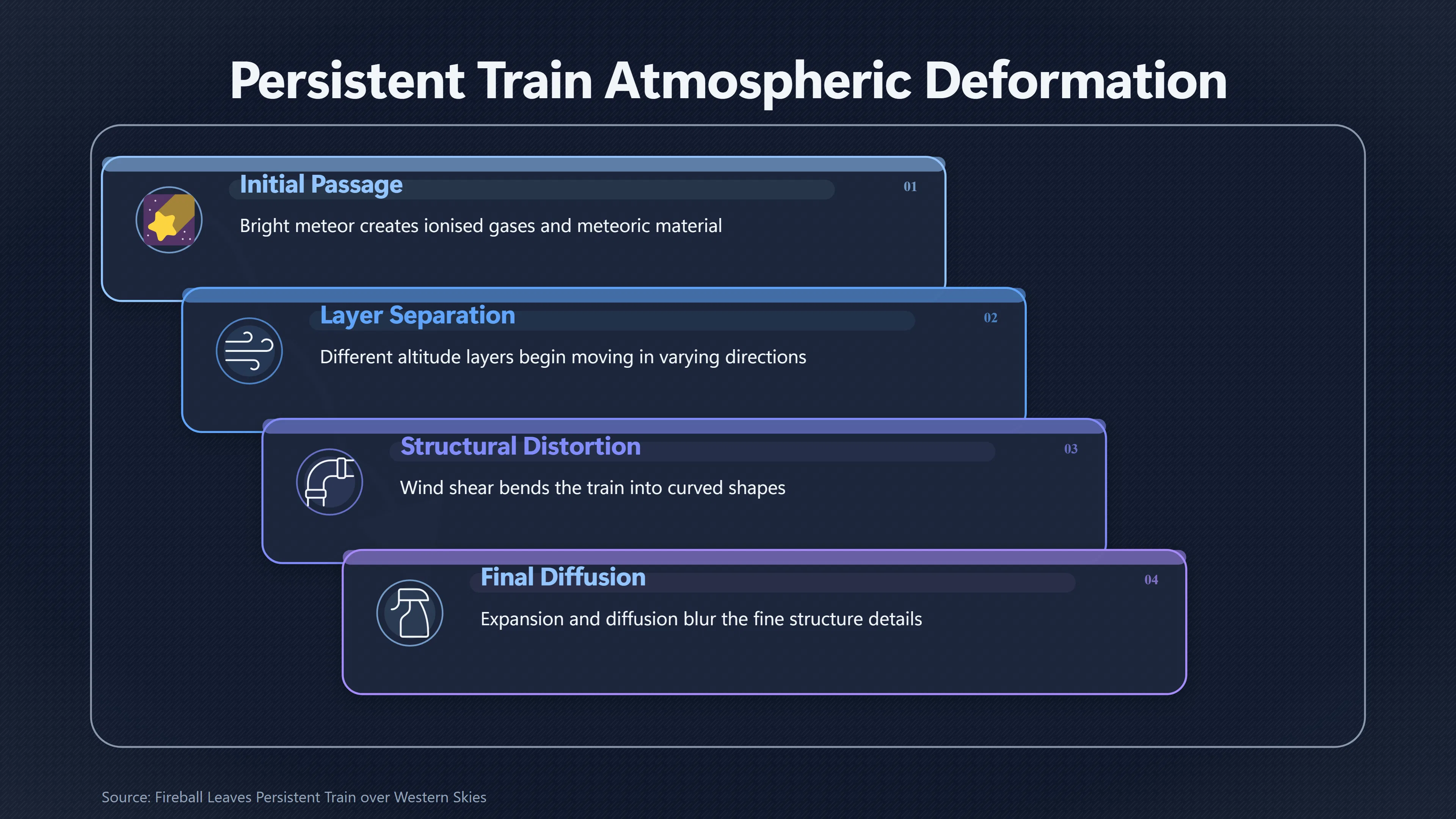
Persistent trains are a well-understood atmospheric phenomenon. After a bright meteor passes, ionised gases and fine meteoric material remain suspended at altitudes typically between about 80 and 100 km. Because winds vary strongly with height, different layers of the train begin moving in different directions almost immediately.
Modern observations repeatedly show several characteristic effects:
- Lateral drift, where the entire train slowly shifts sideways.
- Wind shear, where different altitude layers move at different speeds or directions, bending an initially straight train.
- Gravity-wave distortion, producing loops, knots or corkscrew patterns.
- Expansion and diffusion, which gradually blur fine structure and make precise point identification harder.[nasa.gov]nasa.govFireball Leaves Persistent Train over Western SkiesFireball Leaves Persistent Train over Western Skies - NASADecember 20, 2018…
NASA’s documentation of modern fireballs illustrates this clearly. Persistent trains photographed minutes after a meteor frequently appear dramatically curved despite originating from an almost straight atmospheric path. Researchers studying Leonid meteor trains have likewise used these distortions as tracers of upper-atmospheric wind fields rather than as evidence that the meteoroid itself changed course.[nasa.gov]nasa.govFireball Leaves Persistent Train over Western SkiesFireball Leaves Persistent Train over Western Skies - NASADecember 20, 2018…
Consequently, critics of the 1967 Kecksburg reconstruction are correct to note that the photographed train was not a perfectly rigid geometric marker.
Where point-matching errors enter the reconstruction
The more difficult question is not whether winds acted—they certainly did—but how much positional error they could introduce into the triangulation.
The Michigan reconstruction depended on identifying corresponding locations along the irregular train in photographs taken from separate observing sites. Any mismatch between those points changes the calculated three-dimensional line.
Several factors can increase uncertainty:
- the train had already begun evolving before the photographs were taken;
- different sections may have moved different amounts because they occupied different altitudes;
- the brightest knots seen in one photograph may not correspond perfectly to those chosen in the other;
- photographic resolution and calibration in 1965 were modest compared with modern fireball networks.
Each of these effects broadens the uncertainty envelope around the reconstructed path. They can alter estimated altitude, inclination and exact ground projection without requiring any mistake in the original calculations.[imo.net]imo.netInternational Meteor Organization Observations of Fireballs | IMOInternational Meteor Organization Observations of Fireballs | IMO
Modern meteor researchers remain aware of these issues. Contemporary fireball networks rely on synchronised imaging, precise timing and repeated astrometric measurements precisely because manual matching of changing atmospheric structures introduces avoidable uncertainty.[arXiv]arxiv.orgar Xiv3D Meteoroid Trajectoriesar Xiv3D Meteoroid Trajectories
Why broad direction is more robust than fine detail
Although winds complicate exact reconstruction, they do not affect every aspect of the geometry equally.
Wind shear tends to produce local deformation rather than wholesale rotation of the train. Individual segments may bow, kink or twist, yet the overall orientation connecting the beginning and end of the train often remains recognisable. Studies of persistent trains routinely use their changing shapes to infer atmospheric winds because the original trajectory still provides the underlying reference frame.[nasa.gov]ntrs.nasa.govNASA Technical Reports ServerBuoyancy of the ''Y2K'' Persistent Train and the Trajectory of the 04:00:29 UT Leonid Fireball - NASA Techni…
This distinction matters for the Kecksburg debate.
If the question concerns whether the endpoint lay a few kilometres east or west of the reconstructed position, wind deformation becomes a significant source of uncertainty.
If instead the proposal requires moving the entire trajectory roughly 300 km south-east—from western Lake Erie to Kecksburg—the required error is qualitatively different. Such a shift would demand either:
- systematic misidentification throughout the triangulation,
- fundamentally incorrect camera geometry,
- photographs of a different atmospheric feature than assumed, or
- another major failure in the reconstruction process beyond ordinary wind distortion.
Upper-atmospheric winds alone do not naturally produce that scale of directional displacement.[nasa.gov]ntrs.nasa.govNASA Technical Reports ServerBuoyancy of the ''Y2K'' Persistent Train and the Trajectory of the 04:00:29 UT Leonid Fireball - NASA Techni…
What modern studies suggest about the 1967 photographs
Research published since the 1960s has strengthened understanding of persistent trains rather than undermining it.
Detailed observations using video, lidar, radar and multiple-camera systems show that trains can survive for many minutes while undergoing spectacular deformation. Those observations confirm that atmospheric winds can create complex apparent shapes that were difficult to model with 1960s techniques.[sciencedirect.com]sciencedirect.comObservation of a persistent Leonid meteor train with an all-sky camera - ScienceDirect…
At the same time, these same investigations demonstrate that scientists can often recover the original trajectory despite substantial later distortion. In several modern studies, the evolving train itself has been used to estimate mesospheric wind profiles precisely because its parent trajectory remains recoverable from the changing geometry.[nasa.gov]ntrs.nasa.govNASA Technical Reports ServerBuoyancy of the ''Y2K'' Persistent Train and the Trajectory of the 04:00:29 UT Leonid Fireball - NASA Techni…
That body of work suggests a balanced interpretation of the Michigan photographs. They were not perfect records of an unchanged atmospheric feature, but neither were they rendered meaningless by wind action.
The strongest critique—and its limits
Wind distortion therefore represents one of the strongest technical criticisms of the Lake Erie reconstruction, but it is also one with identifiable limits.
The criticism succeeds in showing that:
- exact coordinates derived from the photographs should not be treated as mathematically precise;
- manual point matching necessarily involved judgement;
- uncertainty is larger than if a dedicated modern fireball camera network had recorded the event.
It is less successful as an explanation for the much larger discrepancy required to align the photographed trajectory directly with the traditional Kecksburg impact narrative.
For that larger revision, additional errors or assumptions must be introduced beyond ordinary deformation of a persistent atmospheric train. On the available evidence, high-altitude winds justify caution about fine-scale reconstruction, but they do not by themselves erase the broader directional conclusion that the photographed trajectory terminated in the western Lake Erie region rather than continuing towards Kecksburg.[nasa.gov]nasa.govFireball Leaves Persistent Train over Western SkiesFireball Leaves Persistent Train over Western Skies - NASADecember 20, 2018…

Amazon book picks
Further Reading
Books and field guides related to Could High Altitude Winds Mislead the Kecksburg Reconstruction?. Use these as the next step if you want deeper reading beyond the article.
Meteor Showers and their Parent Comets
Meteor Showers and their Parent Comets is a unique handbook for astronomers interested in observing meteor storms and outbursts. Spectacu...
The Field Guide to Meteors and Meteorites
What is unique about Richard Norton's book is that it is both a field guide to observing meteors, and also a field guide to locating, pre...
Physics of Meteoric Phenomena
"Meteoric phenomena" is the accepted term for the complex of physi cal phenomena that accompany the entry of meteoric bodies into the at...
An Introduction to Dynamic Meteorology
During the past decade, the science of dynamic meteorology has continued its rapid advance. The scope of dynamic meteorology has broadene...
eBay marketplace picks
Marketplace Samples
Live-tested eBay searches with available results related to this page.
Selected frommeteor poster oneBay.co.uk.



Current eBay listing
METEOR 1979 70s ORIGINAL MOVIE FILM ART CINEMA PRINT PREMIUM POSTER

Current eBay listing
METEOR US INSERT (14"x 36") POSTER MARTIN LANDAU TREVOR HOWARD 1979
Endnotes
1.
Source: nasa.gov
Title: Fireball Leaves Persistent Train over Western Skies
Link:https://www.nasa.gov/blogs/watch-the-skies/2018/12/20/fireball-leaves-persistent-train-over-western-skies/
Source snippet
Fireball Leaves Persistent Train over Western Skies - NASADecember 20, 2018...
Published: December 20, 2018
2.
Source: ntrs.nasa.gov
Link:https://ntrs.nasa.gov/citations/20010003444
Source snippet
NASA Technical Reports ServerBuoyancy of the ''Y2K'' Persistent Train and the Trajectory of the 04:00:29 UT Leonid Fireball - NASA Techni...
3.
Source: sciencedirect.com
Link:https://www.sciencedirect.com/science/article/pii/S1364682604000811
Source snippet
Observation of a persistent Leonid meteor train with an all-sky camera - ScienceDirect...
4.
Source: arxiv.org
Title: ar Xiv3D Meteoroid Trajectories
Link:https://arxiv.org/abs/1802.02697
5.
Source: arxiv.org
Title: arXiv Determining fireball fates using the $α$-$β$ criterion
Link:https://arxiv.org/abs/1909.11494
6.
Source: fireballs.ndc.nasa.gov
Link:https://fireballs.ndc.nasa.gov/skyfalls/events/20181220-013502
7.
Source: science.nasa.gov
Title: coastal spit lake erie 91485
Link:https://science.nasa.gov/earth/earth-observatory/coastal-spit-lake-erie-91485/
8.
Source: science.nasa.gov
Title: sunglint features lake erie united states 6643
Link:https://science.nasa.gov/earth/earth-observatory/sunglint-features-lake-erie-united-states-6643/
9.
Source: ntrs.nasa.gov
Link:https://ntrs.nasa.gov/search.jsp?R=20010004104
10.
Source: sciencedirect.com
Link:https://www.sciencedirect.com/science/article/pii/S0380133090714323
11.
Source: sciencedirect.com
Link:https://www.sciencedirect.com/science/article/abs/pii/S0380133090714323
12.
Source: sciencedirect.com
Title: Inertial Frequency Current Oscillations in the Central Basin of Lake Erie
Link:https://www.sciencedirect.com/science/article/pii/S0380133087716712
13.
Source: sciencedirect.com
Link:https://www.sciencedirect.com/science/article/abs/pii/0021916967901304
14.
Source: agupubs.onlinelibrary.wiley.com
Link:https://agupubs.onlinelibrary.wiley.com/doi/full/10.1029/2002JD002392
Source snippet
AGU PublicationsMesospheric turbulence measurements from persistent Leonid meteor train observations - Kelley - 2003 - Journal of Geophys...
15.
Source: imo.net
Title: International Meteor Organization Observations of Fireballs | IMO
Link:https://www.imo.net/observations/fireballs/observations/
16.
Source: agupubs.onlinelibrary.wiley.com
Title: AGU Publications Not So Fast: A New Catalog of Meteor Persistent Trains
Link:https://agupubs.onlinelibrary.wiley.com/doi/abs/10.1029/2024JA032643
Source snippet
AGU PublicationsNot So Fast: A New Catalog of Meteor Persistent Trains - Cordonnier - 2024 - Journal of Geophysical Research: Space Physi...
17.
Source: imo.net
Link:https://www.imo.net/observations/methods/video-observation/examples/
Additional References
18.
Source: youtube.com
Title: Episode 184 Kecksburg Revisited with [Stan Gordon]({{ ‘stan-gordon/’ | relative_url }})
Link:https://www.youtube.com/watch?v=CKK66LtZ1Hs
Source snippet
This video collection provides key background context on the 1965 Kecksburg fireball event, eyewitness reports, and investigator debates...
19.
Source: youtube.com
Title: The Kecksburg UFO Mystery: Secrets, Witnesses and Vanished Evidence
Link:https://www.youtube.com/watch?v=vkZszbMzl3Q
Source snippet
The Kecksburg UFO Mystery + The Corporate Espionage Scandal Rocking Silicon Valley...
20.
Source: youtube.com
Link:https://www.youtube.com/watch?v=ruKDXL13lk8
Source snippet
The Kecksburg UFO Mystery: Secrets, Witnesses and Vanished Evidence...
21.
Source: youtube.com
Link:https://www.youtube.com/watch?v=pjO6b79BChc
Source snippet
Episode 184 Kecksburg Revisited with Stan Gordon...
22.
Source: youtube.com
Title: Nearly 50 years later, Kecksburg UFO sighting remains mystery
Link:https://www.youtube.com/watch?v=VM68dQjp4-M
Source snippet
The 1965 Kecksburg Incident: A UFO Crash the Government Hides to This Day...
23.
Source: deepdyve.com
Link:https://www.deepdyve.com/lp/wiley/a-new-explanation-of-persistent-double-meteor-trains-4UI6zCvvdP
24.
Source: frontiersin.org
Link:https://www.frontiersin.org/journals/astronomy-and-space-sciences/articles/10.3389/fspas.2022.1027750/full
25.
Source: cambridge.org
Link:https://www.cambridge.org/core/journals/journal-of-fluid-mechanics/article/abs/nonlinear-deepwater-waves-theory-and-experiment-part-2-evolution-of-a-continuous-wave-train/D5EC464794600CB328261B855A1680A7
26.
Source: photocontest.smithsonianmag.com
Link:https://photocontest.smithsonianmag.com/photocontest/detail/looking-west-from-abandoned-railroad-station-to-lake-michigan-gone-but-not-/
27.
Source: cir.nii.ac.jp
Link:https://cir.nii.ac.jp/crid/1360018294941374976