Within Trajectory
Are Modern Meteor Errors Large Enough to Reach Kecksburg?
Instrumented meteorite falls show prediction errors of metres or kilometres, not the roughly 200-mile displacement needed to reach Kecksburg.
On this page
- What modern trajectory studies measure
- Typical differences between straight and dynamic models
- Comparing kilometre scale errors with the Kecksburg gap
Page outline Jump by section
Introduction
Modern meteor science provides a practical way to test one of the central questions raised by the Kecksburg incident: could uncertainties in reconstructing the 9 December 1965 fireball realistically shift its impact point from the western end of Lake Erie to Kecksburg, Pennsylvania? The evidence from contemporary fireball networks suggests that the answer is no. Although modern trajectory and dark-flight models continue to improve and routinely incorporate atmospheric dynamics, winds, fragmentation and aerodynamic behaviour, the remaining uncertainties are generally measured in metres to a few kilometres, or at most tens of kilometres under poor observational conditions. They do not approach the roughly 320 km (200 mile) displacement required to move the reconstructed end of the photographed trajectory from western Lake Erie to Kecksburg. Rather than weakening the original geometric reconstruction, advances in meteor modelling help quantify just how large the Kecksburg distance gap actually is.
What modern trajectory studies measure
Purpose-built fireball camera networks now observe meteor entries with a level of precision unavailable in 1965. Systems such as the European Fireball Network, the Desert Fireball Network in Australia, NASA’s all-sky camera systems and the Global Meteor Network combine calibrated cameras, precise timing and increasingly sophisticated trajectory software to reconstruct a meteoroid’s path through the atmosphere. These observations can often be supplemented with radar, infrasound and seismic records, providing multiple independent constraints on the flight path.[doi.org]doi.orgGlobal Meteor Network – Methodology and first results | Monthly Notices of the Royal Astronomical Society | Oxford AcademicAugust 10…
Modern analyses distinguish between two related but separate problems:
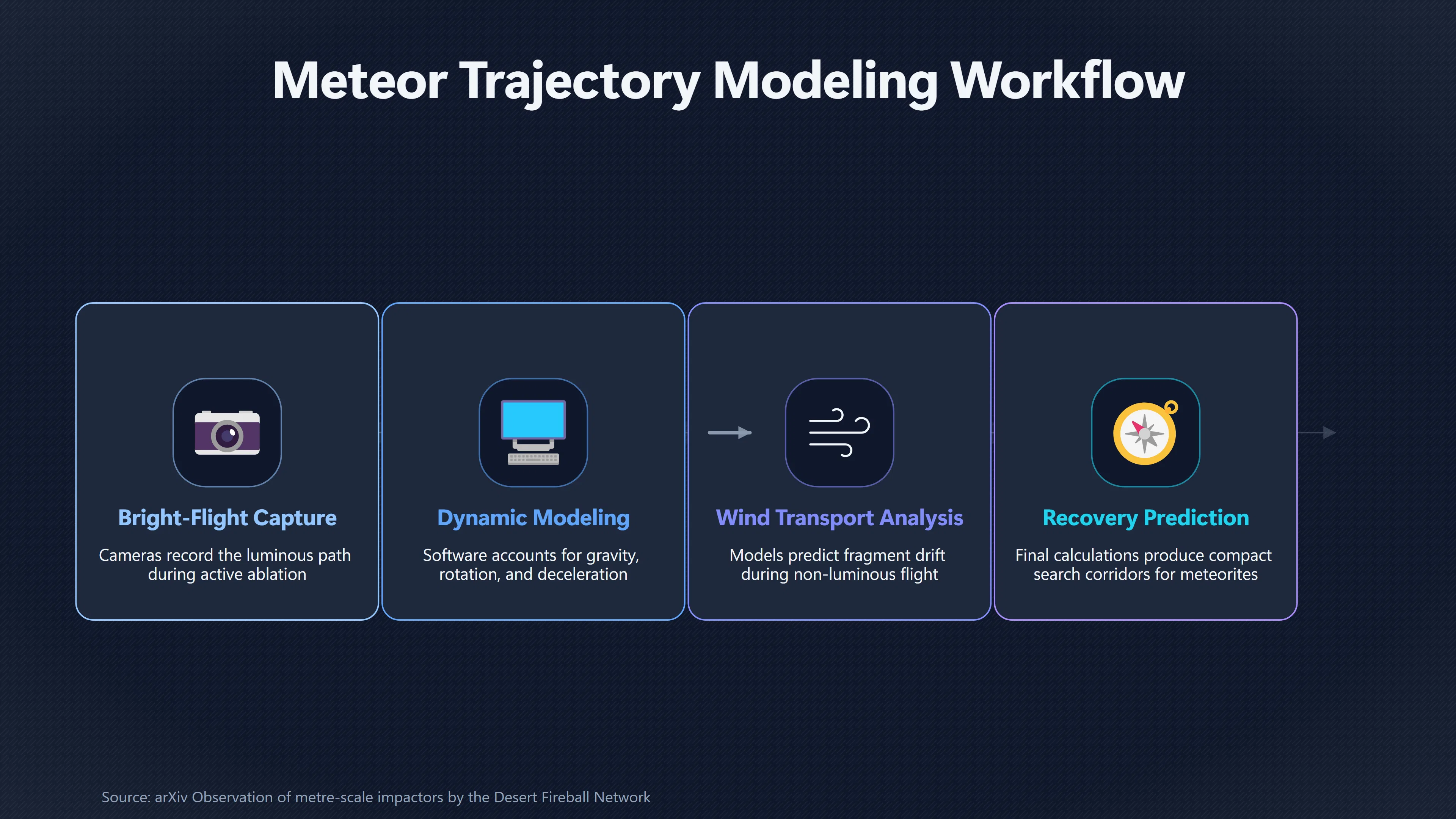
- Bright-flight reconstruction, which determines the luminous atmospheric trajectory while the meteoroid is ablating.
- Dark-flight modelling, which predicts where surviving meteorites fall after they cease glowing and descend under gravity, drag and atmospheric winds.
This distinction is important for Kecksburg. Even if a luminous trajectory is reconstructed accurately, meteorites can drift during dark flight. Modern models therefore explicitly quantify how far atmospheric winds can displace fragments after the visible fireball ends rather than assuming a straight continuation to the ground.[arXiv]arxiv.orgDarkflight estimates of meteorite fall positions: issues and a case study using the Murrili meteorite fallAugust 10, 2021…
Typical differences between straight and dynamic models
Early meteor analyses often approximated the atmospheric path as a straight line. Modern work shows that large fireballs experience measurable but generally modest deviations caused by Earth’s rotation, gravity, deceleration and fragmentation. Contemporary trajectory software therefore uses dynamic rather than purely geometric models.
Research using the Desert Fireball Network demonstrates that these refinements are scientifically important because they improve orbital reconstruction and meteorite recovery. The corrections can amount to hundreds of metres or several kilometres, particularly for long, shallow entries, but they are refinements to an already well-constrained trajectory rather than wholesale relocations of the event. Typical astrometric uncertainties in high-quality network observations correspond to positional uncertainties on the order of roughly 100 metres before atmospheric modelling is applied.[ScienceDirect]sciencedirect.comScience Direct3D meteoroid trajectories3D meteoroid trajectories - ScienceDirectMarch 15, 2019…
Recent work has continued to reduce systematic errors. For example, improved atmospheric refraction corrections have been developed because even relatively small angular biases can affect calculated trajectories and subsequent dark-flight predictions. The motivation behind such studies illustrates the scale of the remaining uncertainties: researchers are seeking improvements measured in fractions of a degree and corresponding kilometre-scale refinements, not corrections of hundreds of kilometres.[OUP Academic]academic.oup.comOUP AcademicDistance-independent atmospheric refraction correction for accurate retrieval of fireball trajectories | Monthly Notices of t…
How accurately modern models predict meteorite falls
The strongest test of any model is whether predicted meteorite locations match actual recoveries.
Modern examples show that instrumented falls frequently produce remarkably accurate strewn-field predictions. The 2014 Žďár nad Sázavou meteorite fall in the Czech Republic was reconstructed using dedicated fireball-network observations, and recovered meteorites were found almost exactly where the calculated models predicted for fragments of the corresponding masses.[arXiv]arxiv.orgThe Žďár nad Sázavou meteorite fall: Fireball trajectory, photometry, dynamics, fragmentation, orbit, and meteorite recoveryDecember…
Likewise, studies of the Golden meteorite fall and other instrumentally documented events use Monte Carlo simulations that propagate measured uncertainties in trajectory, endpoint and atmospheric conditions. The resulting uncertainty regions are typically expressed as relatively compact search corridors rather than broad continental-scale possibilities.[DOI]doi.orgThe Golden meteorite fall: Fireball trajectory, orbit, and meteorite characterization - Brown - 2023 - Meteoritics & Planetary Science…
Dark-flight modelling is not perfect. The Desert Fireball Network’s detailed study of the Murrili meteorite demonstrated that assumptions about fragment shape, density and aerodynamic behaviour can shift the predicted landing position. Even in this carefully observed case, however, the discrepancies concerned the placement of meteorites within the expected fall zone rather than moving the impact hundreds of kilometres away. The study was published precisely because such comparatively modest differences matter during meteorite recovery.[arXiv]arxiv.orgDarkflight estimates of meteorite fall positions: issues and a case study using the Murrili meteorite fallAugust 10, 2021…
Comparing kilometre-scale uncertainties with the Kecksburg gap
The photographed trajectory reconstructed in 1967 placed the terminal region near western Lake Erie, whereas Kecksburg lies approximately 320 km (200 miles) to the south-east. The question is therefore not whether meteor models contain uncertainty—they do—but whether those uncertainties could plausibly bridge that gap.
Modern evidence suggests they cannot.
Several independent sources of error can affect reconstructed meteor trajectories:
- measurement uncertainty in camera calibration;
- uncertainty in matching points along a persistent train;
- atmospheric winds affecting the dark flight of surviving fragments;
- fragmentation producing multiple meteorites with separate landing positions;
- aerodynamic uncertainty associated with fragment shape and density.
Collectively, these effects generally alter predicted landing locations by distances that matter to search teams—metres, hundreds of metres or a few kilometres, occasionally extending into tens of kilometres for particularly difficult cases. Modern literature treats such uncertainties as significant because successful meteorite recovery depends on them.[arxiv.org]arxiv.orgDarkflight estimates of meteorite fall positions: issues and a case study using the Murrili meteorite fallAugust 10, 2021…
A displacement of roughly 320 km would require an entirely different trajectory rather than an ordinary modelling correction. Neither dynamic-flight modelling nor dark-flight wind calculations produce errors of that magnitude in well-constrained observations.
What this comparison means for the Kecksburg debate
This comparison does not prove that every aspect of the 1967 reconstruction was perfect. The original investigators worked with two photographs of a persistent train rather than a modern synchronised fireball camera network, and the surviving record inevitably contains larger uncertainties than today’s instrumented observations.
Nevertheless, modern meteor science provides an important benchmark. It demonstrates that improving the physics of meteor trajectories tends to refine reconstructed paths rather than relocate them across several hundred kilometres. Contemporary models account for atmospheric dynamics, fragmentation and wind transport far more realistically than was possible in the 1960s, yet the resulting corrections remain vastly smaller than the distance separating western Lake Erie from Kecksburg. Consequently, advances in meteor modelling strengthen the conclusion that ordinary reconstruction uncertainties are insufficient to reconcile the photographed trajectory with a direct impact at Kecksburg.[sciencedirect.com]sciencedirect.comScience Direct3D meteoroid trajectories3D meteoroid trajectories - ScienceDirectMarch 15, 2019…
Amazon book picks
Further Reading
Books and field guides related to Are Modern Meteor Errors Large Enough to Reach Kecksburg?. Use these as the next step if you want deeper reading beyond the article.
The Field Guide to Meteors and Meteorites
What is unique about Richard Norton's book is that it is both a field guide to observing meteors, and also a field guide to locating, pre...
Meteor Showers and their Parent Comets
Meteor Showers and their Parent Comets is a unique handbook for astronomers interested in observing meteor storms and outbursts. Spectacu...
An Introduction to Error Analysis
John R. Taylor’s best-selling text will be released in a new third edition that features Bayesian statistics and updated new chapter-endi...
Data Reduction and Error Analysis for the Physical Sciences
The purpose of this book is to provide an introduction to the concepts of statistical analysis of data for students at the undergraduate...
eBay marketplace picks
Marketplace Samples
Live-tested eBay searches with available results related to this page.
Selected fromGreat Lakes map print oneBay.co.uk.
Endnotes
1.
Source: doi.org
Link:https://doi.org/10.1093/mnras/stab2008
Source snippet
Global Meteor Network – Methodology and first results | Monthly Notices of the Royal Astronomical Society | Oxford AcademicAugust 10...
2.
Source: arxiv.org
Title: arXiv Observation of metre-scale impactors by the Desert Fireball Network
Link:https://arxiv.org/abs/1808.09195
3.
Source: arxiv.org
Link:https://arxiv.org/abs/2108.04397
Source snippet
Darkflight estimates of meteorite fall positions: issues and a case study using the Murrili meteorite fallAugust 10, 2021...
Published: August 10, 2021
4.
Source: doi.org
Link:https://doi.org/10.1111/maps.14100
Source snippet
The Golden meteorite fall: Fireball trajectory, orbit, and meteorite characterization - Brown - 2023 - Meteoritics & Planetary Science...
5.
Source: sciencedirect.com
Title: Science Direct3D meteoroid trajectories
Link:https://www.sciencedirect.com/science/article/pii/S001910351830441X
Source snippet
3D meteoroid trajectories - ScienceDirectMarch 15, 2019...
Published: March 15, 2019
6.
Source: academic.oup.com
Link:https://academic.oup.com/mnras/article/549/1/stag196/8688112
Source snippet
OUP AcademicDistance-independent atmospheric refraction correction for accurate retrieval of fireball trajectories | Monthly Notices of t...
7.
Source: arxiv.org
Link:https://arxiv.org/abs/1912.11784
Source snippet
The Žďár nad Sázavou meteorite fall: Fireball trajectory, photometry, dynamics, fragmentation, orbit, and meteorite recoveryDecember...
8.
Source: academic.oup.com
Link:https://academic.oup.com/mnras/article/483/4/5166/5256650
9.
Source: doi.org
Title: Submillisecond fireball timing using de Bruijn timecodes
Link:https://doi.org/10.1111/MAPS.12878
10.
Source: ntrs.nasa.gov
Link:https://ntrs.nasa.gov/citations/19740011324
11.
Source: youtube.com
Link:https://www.youtube.com/watch?v=pjO6b79BChc
Source snippet
Kecksburg | HD | Horror, Sci-Fi | Full Movie in English...
12.
Source: youtube.com
Title: Kecksburg | HD | Horror, Sci-Fi | Full Movie in English
Link:https://www.youtube.com/watch?v=bntdCsyy20k
Source snippet
This video collection provides key historical context on the 1965 Kecksburg fireball event, examining witness testimonies, government rec...
13.
Source: agupubs.onlinelibrary.wiley.com
Link:https://agupubs.onlinelibrary.wiley.com/doi/full/10.1029/2025JE009440
Source snippet
AGU PublicationsMulti‐Sensor Trajectory Reconstruction of the 24 April 2025 Alaska Fireball and Implications for Planetary Defense - Scam...
Published: April 2025
Additional References
14.
Source: karmaka.de
Link:https://karmaka.de/?p=28562
Source snippet
Darkflight estimates of meteorite fall positions: issues and a case study using the Murrili meteorite fall...
15.
Source: youtube.com
Title: When the UFO Hit the Woods! | UFO Witness | Full Episode | Discovery Channel
Link:https://www.youtube.com/watch?v=CVIKnA8cWak
Source snippet
The Kecksburg UFO Mystery + The Corporate Espionage Scandal Rocking Silicon Valley...
16.
Source: youtube.com
Title: The Kecksburg UFO Mystery: Secrets, Witnesses and Vanished Evidence
Link:https://www.youtube.com/watch?v=vkZszbMzl3Q
Source snippet
Kecksburg UFO Museum Tour at Kecksburg VFD...
17.
Source: youtube.com
Title: Kecksburg UFO Museum Tour at Kecksburg VFD
Link:https://www.youtube.com/watch?v=5FUgJPhhClk
Source snippet
When the UFO Hit the Woods! | UFO Witness | Full Episode | Discovery Channel...
18.
Source: researchgate.net
Link:https://www.researchgate.net/publication/358755684_Dark-flight_Estimates_of_Meteorite_Fall_Positions_Issues_and_a_Case_Study_Using_the_Murrili_Meteorite_Fall?_tp=eyJjb250ZXh0Ijp7InBhZ2UiOiJzY2llbnRpZmljQ29udHJpYnV0aW9ucyIsInByZXZpb3VzUGFnZSI6bnVsbCwic3ViUGFnZSI6bnVsbH19
19.
Source: researchgate.net
Link:https://www.researchgate.net/publication/353819106_Darkflight_estimates_of_meteorite_fall_positions_issues_and_a_case_study_using_the_Murrili_meteorite_fall
20.
Source: heise.de
Link:https://www.heise.de/en/news/Fireball-over-western-Germany-precise-trajectory-determined-with-seismometers-11205268.html
21.
Source: imo.net
Link:https://www.imo.net/observations/fireballs/meteorites/
22.
Source: cambridge.org
Link:https://www.cambridge.org/core/journals/international-astronomical-union-colloquium/article/photographic-fireball-networks/07FBA4E55540288CFB3315F9C482B2CB
23.
Source: emeteornews.net
Title: News from the meteor library: Darkflight estimates | e Met N Meteor Journal
Link:https://www.emeteornews.net/2021/08/18/news-from-the-meteor-library-darkflight-estimates/