Within Visual Illusion
How One Fireball Seems Local to Many Towns
A high, extended fireball path can make widely separated communities each believe the event passed directly above them.
On this page
- The regional scale of a luminous meteor path
- Why local horizons create different endpoints
- How clustered reports reveal a broader trajectory
Page outline Jump by section
Introduction
One of the most striking features of a major fireball is that people in many different towns often become convinced it passed directly overhead or landed nearby. Far from being evidence of multiple objects, this is exactly what astronomers expect from a bright meteor travelling high through the atmosphere. Because the luminous part of a fireball commonly occurs tens of kilometres above the ground and can remain visible across hundreds of kilometres, widely separated observers each view the same event from a different angle. As a result, every community tends to interpret the fireball’s final visible position relative to its own horizon, creating numerous sincere but apparently contradictory reports. This pattern is especially relevant when considering the 1965 Kecksburg incident, where eyewitness accounts from across the region formed part of a much larger observation network rather than describing separate events.[CNEOS]cneos.jpl.nasa.govOpen source on nasa.gov.
The Regional Scale of a Luminous Meteor Path
Unlike aircraft or fireworks, exceptionally bright meteors are atmospheric phenomena that occur at very high altitudes. Their glowing flight often begins around 80–120 kilometres above Earth and typically ends while still tens of kilometres high. From those elevations, a single fireball may be visible over several states or across multiple countries depending on its brightness and the viewing conditions.[CNEOS]cneos.jpl.nasa.govOpen source on nasa.gov.
This enormous viewing footprint means that:
- Observers separated by hundreds of kilometres can watch the same object simultaneously.
- Each witness sees a different apparent angle across the sky.
- Every location generates its own impression of where the object disappeared.
The International Meteor Organization notes that a fireball ending about 50 kilometres above the surface can still be visible very low above the horizon to an observer roughly 600 kilometres away. That geometry alone explains why so many communities can legitimately report seeing what they believe was “their” fireball.[International Meteor Organization]imo.netInternational Meteor Organization Fireballs | IMOInternational Meteor Organization Fireballs | IMO
Why Local Horizons Create Different Endpoints
People naturally judge where an object is by comparing it with familiar landscape features such as hills, forests, buildings or distant ridges. A fireball complicates this judgement because those foreground features are vastly closer than the meteor itself.
Suppose two towns lie 80 kilometres apart. Residents of each town may watch the same fireball descend towards their western horizon. As the meteor ceases glowing, each group sees it disappear behind a completely different line of hills or trees. From both perspectives it appears to have gone down “just beyond” the visible landscape.
Neither account is necessarily inaccurate. The observers are honestly describing the direction in which the light vanished, not its true three-dimensional position.
This explains why newspaper reports following spectacular fireballs frequently contain multiple claimed landing sites spread over a broad region. The apparent contradictions arise from perspective rather than from unreliable witnesses.[International Meteor Organization]imo.netInternational Meteor Organization Fireballs | IMOInternational Meteor Organization Fireballs | IMO
Why Many Independent Reports Can Reveal One Trajectory
At first glance, dozens of reports claiming different locations seem confusing. In practice, they are one of the most valuable sources of evidence.
Meteor researchers do not expect every witness to identify the correct landing point. Instead, they compare reports from many locations, recording details such as:
- the direction of travel;
- the height above the horizon at the beginning and end;
- the apparent brightness;
- colours and fragmentation;
- the timing of the event.
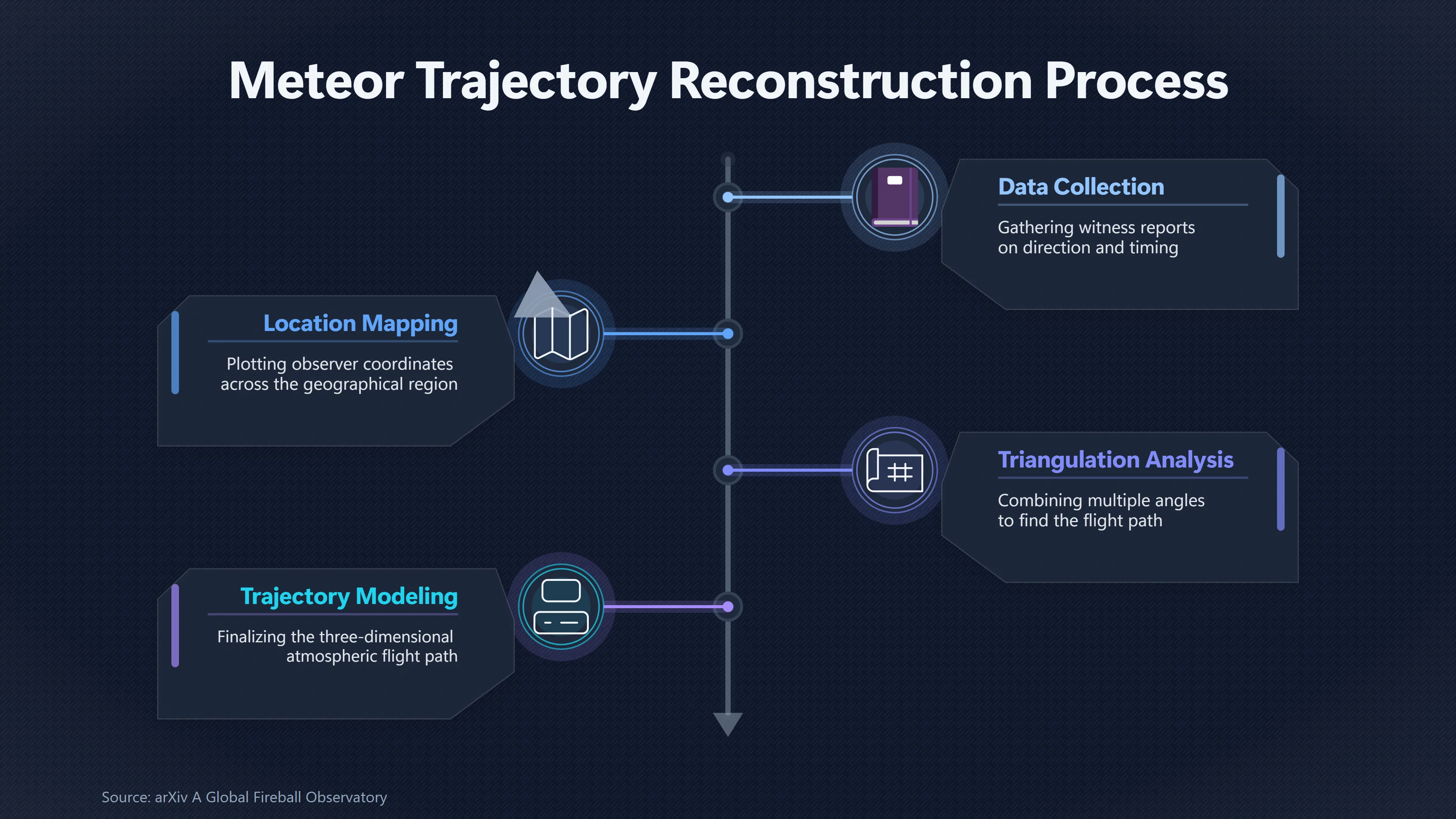
Because each observer views the fireball from a different angle, those differing perspectives can be combined through triangulation to reconstruct the actual atmospheric path. This is why organisations collecting fireball reports place so much emphasis on the observer’s location as well as the direction of the sighting. A single eyewitness cannot reliably determine distance, but many geographically separated witnesses together can produce a remarkably accurate trajectory.[imo.net]imo.netInternational Meteor Organization Fireballs | IMOInternational Meteor Organization Fireballs | IMO
The Pattern Seen in the Kecksburg Event
The Kecksburg incident illustrates this perspective effect particularly well. The brilliant fireball of 9 December 1965 was reported over a wide area of the Great Lakes and northeastern United States. Communities separated by considerable distances nevertheless produced accounts suggesting that the object had passed nearby or descended locally.
Viewed individually, these reports appear inconsistent. Viewed collectively, they instead resemble the expected observational pattern of a high-altitude fireball visible across a large region. Each community interpreted the final luminous stage relative to its own landscape, while the combined body of observations indicated a much broader atmospheric flight than any single witness could perceive.[CNEOS]cneos.jpl.nasa.govOpen source on nasa.gov.
Why Clustered Reports Strengthen Rather Than Weaken the Meteor Explanation
A common misconception is that differing eyewitness accounts undermine the idea that everyone observed the same object. In meteor science, the opposite is usually true.
When reports originate from many towns over a broad geographical area yet share consistent timing, direction of travel and general appearance, they often indicate a single high-altitude event. Modern fireball investigations routinely combine eyewitness testimony with camera networks, satellite detections and other instrumental observations to determine the object’s real path through the atmosphere.[arXiv]arxiv.orgarXiv A Global Fireball ObservatoryarXiv A Global Fireball Observatory
The important distinction is between apparent location and actual trajectory. A witness can be entirely correct about what they saw while being unable to determine how far away it occurred. Once reports from numerous towns are assembled, the overlapping observations reveal that the fireball was not repeatedly passing over different communities—it was one distant event viewed from many different perspectives.
Amazon book picks
Further Reading
Books and field guides related to How One Fireball Seems Local to Many Towns. Use these as the next step if you want deeper reading beyond the article.
Rocks from Space
Appendices A-C: Meteorite verification laboratories, Commercial meteorite dealers, Selected list of suspected impact craters worldwide.
The Cambridge Encyclopedia of Meteorites
Beautifully illustrated with over 140 full colour images, The Cambridge Encyclopedia of Meteorites provides a thorough guide to these fas...
Meteorites: The Story of Our Solar System
Contains several previously unpublished accounts of meteorite recoveries in Australia and provides deatails on many Australian contributi...
eBay marketplace picks
Marketplace Samples
Live-tested eBay searches with available results related to this page.
Selected fromGreat Lakes map print oneBay.co.uk.


Endnotes
1.
Source: cneos.jpl.nasa.gov
Link:https://cneos.jpl.nasa.gov/fireballs/intro.html
2.
Source: arxiv.org
Link:https://arxiv.org/abs/2209.11186
Source snippet
Data on 824 fireballs observed by the digital cameras of the European Fireball Network in 2017-2018. I. Description of the network...
3.
Source: arxiv.org
Title: arXiv A Global Fireball Observatory
Link:https://arxiv.org/abs/2004.01069
4.
Source: imo.net
Title: International Meteor Organization Fireballs | IMO
Link:https://www.imo.net/observations/fireballs/fireballs/
5.
Source: fireballs.ndc.nasa.gov
Link:https://fireballs.ndc.nasa.gov/skyfalls/events/20260620-001358?sort=name
Source snippet
20260620-001358June 20, 2026 — EVENT: 20260620-001358 Multiple eyewitnesses in the states of Michigan, Illinois, and Ohio and the Canadia...
Published: June 20, 2026
6.
Source: thecoldfile.com
Title: 1965 kecksburg
Link:https://www.thecoldfile.com/articles/1965-kecksburg/
Source snippet
On 9 December 1965, at roughly 4:43 to 4:44 p.m. EST (21:43 UT), a large fireball crossed the sky over the Great Lakes region, the US Nor...
Published: December 1965
7.
Source: nasa.gov
Title: It’s Fireball Season!
Link:https://www.nasa.gov/blogs/watch-the-skies/2026/03/26/its-fireball-season-answering-your-meteor-questions/
Source snippet
Answering Your Meteor Questions - NASAMarch 26, 2026 — WATCH THE SKIES Image Janet Sudnik March 26, 2026 5:18PM CATEGORIES Marshall Space...
Published: March 26, 2026
8.
Source: fireballs.ndc.nasa.gov
Link:https://fireballs.ndc.nasa.gov/skyfalls/events/20260211-043200
9.
Source: science.nasa.gov
Title: meteors great and small 148692
Link:https://science.nasa.gov/earth/earth-observatory/meteors-great-and-small-148692/
10.
Source: jpl.nasa.gov
Title: instruments image fireball over bering sea
Link:https://www.jpl.nasa.gov/news/nasa-instruments-image-fireball-over-bering-sea/
11.
Source: imo.net
Title: definitions of terms in meteor astronomy iau
Link:https://www.imo.net/definitions-of-terms-in-meteor-astronomy-iau/
12.
Source: cneos.jpl.nasa.gov
Title: fireball 130301
Link:https://cneos.jpl.nasa.gov/news/fireball_130301.html
13.
Source: cneos.jpl.nasa.gov
Link:https://cneos.jpl.nasa.gov/fireballs/
14.
Source: cneos.jpl.nasa.gov
Link:https://cneos.jpl.nasa.gov/fireballs/lc/
15.
Source: ssd-api.jpl.nasa.gov
Link:https://ssd-api.jpl.nasa.gov/doc/fireball.html
16.
Source: imo.net
Link:https://www.imo.net/observations/fireballs/observations/
17.
Source: imo.net
Link:https://www.imo.net/resources/faq/
18.
Source: imo.net
Link:https://www.imo.net/observations/fireballs/rates/
19.
Source: imo.net
Title: fireball report program
Link:https://www.imo.net/observations/fireballs/fireball-report-program/
20.
Source: ufoencounters.co.uk
Link:https://www.ufoencounters.co.uk/kecksburg.html
Additional References
21.
Source: youtube.com
Link:https://www.youtube.com/watch?v=tU7WSHZye5w
Source snippet
The Kecksburg UFO Mystery: Secrets, Witnesses and Vanished Evidence...
22.
Source: nature.com
Link:https://www.nature.com/articles/367624a0
23.
Source: youtube.com
Title: The Kecksburg UFO Mystery: Secrets, Witnesses and Vanished Evidence
Link:https://www.youtube.com/watch?v=vkZszbMzl3Q
Source snippet
Kecksburg UFO Museum Tour at Kecksburg VFD...
24.
Source: esa.int
Link:https://www.esa.int/ESA_Multimedia/Videos/2026/03/Fireball_over_Europe_8_March_2026/%28lang%29/en
Source snippet
Fireball over Europe, 8 March 2026March 9, 2026 — FIREBALL OVER EUROPE, 8 MARCH 2026 09/03/2026 20807 views 119 likes 518574 ID 00...
Published: March 9, 2026
25.
Source: esa.int
Link:https://www.esa.int/Space_Safety/Planetary_Defence/ESA_analysing_fireball_over_Europe_on_8_March_2026?pfrom=mailchimp
Source snippet
ESA analysing fireball over Europe on 8 March 2026March 9, 2026 — ESA ANALYSING FIREBALL OVER EUROPE ON 8 MARCH 2026 09/03/2026 246...
Published: March 9, 2026
26.
Source: youtube.com
Title: The Kecksburg Incident: What Really Happened Here?
Link:https://www.youtube.com/watch?v=BXh2zTD9Kug
Source snippet
The Kecksburg UFO Case: Finally Solved After 60 Years?...
27.
Source: scribd.com
Link:https://www.scribd.com/document/428734219/Mufon-Drones-CARET
28.
Source: sciencedirect.com
Link:https://www.sciencedirect.com/science/article/pii/S0032063305001790
29.
Source: youtube.com
Title: Kecksburg UFO Museum Tour at Kecksburg VFD
Link:https://www.youtube.com/watch?v=5FUgJPhhClk
Source snippet
The Kecksburg Incident: What Really Happened Here?...
30.
Source: debunker.com
Title: The Kecksburg, Pennsylvania “UFO Crash” -THE KECKSBURG, PENNSYLVANIA “UFO CRASH”
Link:https://www.debunker.com/Kecksburg.html