Within Search Failure
Where Meteorites Go After the Light Ends
Once fragments stop glowing, winds and gravity can carry them far from the place witnesses expect them to land.
On this page
- What happens when the luminous flight stops
- How wind and fragment mass reshape the fall path
- Why eyewitness landing estimates can be badly wrong
Page outline Jump by section
Introduction
One of the biggest reasons meteorite searches fail is that the object people see is not the object that reaches the ground. Once a meteoroid slows below the speed needed to produce a bright fireball, its visible flight ends high in the atmosphere. From that point onwards it enters dark flight: an invisible descent in which gravity, drag and changing winds determine where surviving fragments finally land. This hidden phase can move meteorites far from the place where eyewitnesses believe they came down, making intuitive searches surprisingly unreliable.[NASA Technical Reports Server]ntrs.nasa.govNASA Technical Reports ServerThe Jörmungandr Dark Flight Model for Meteorite and Orbital Debris Recovery - NASA Technical Reports Server…
For incidents such as the Kecksburg UFO event, dark flight is an important mechanism to understand. Even if witnesses accurately reported a brilliant object disappearing behind trees or hills, that observation alone cannot identify the true landing site. The final descent may have continued for several minutes, carrying fragments well beyond the apparent point of disappearance.
What happens when the luminous flight stops
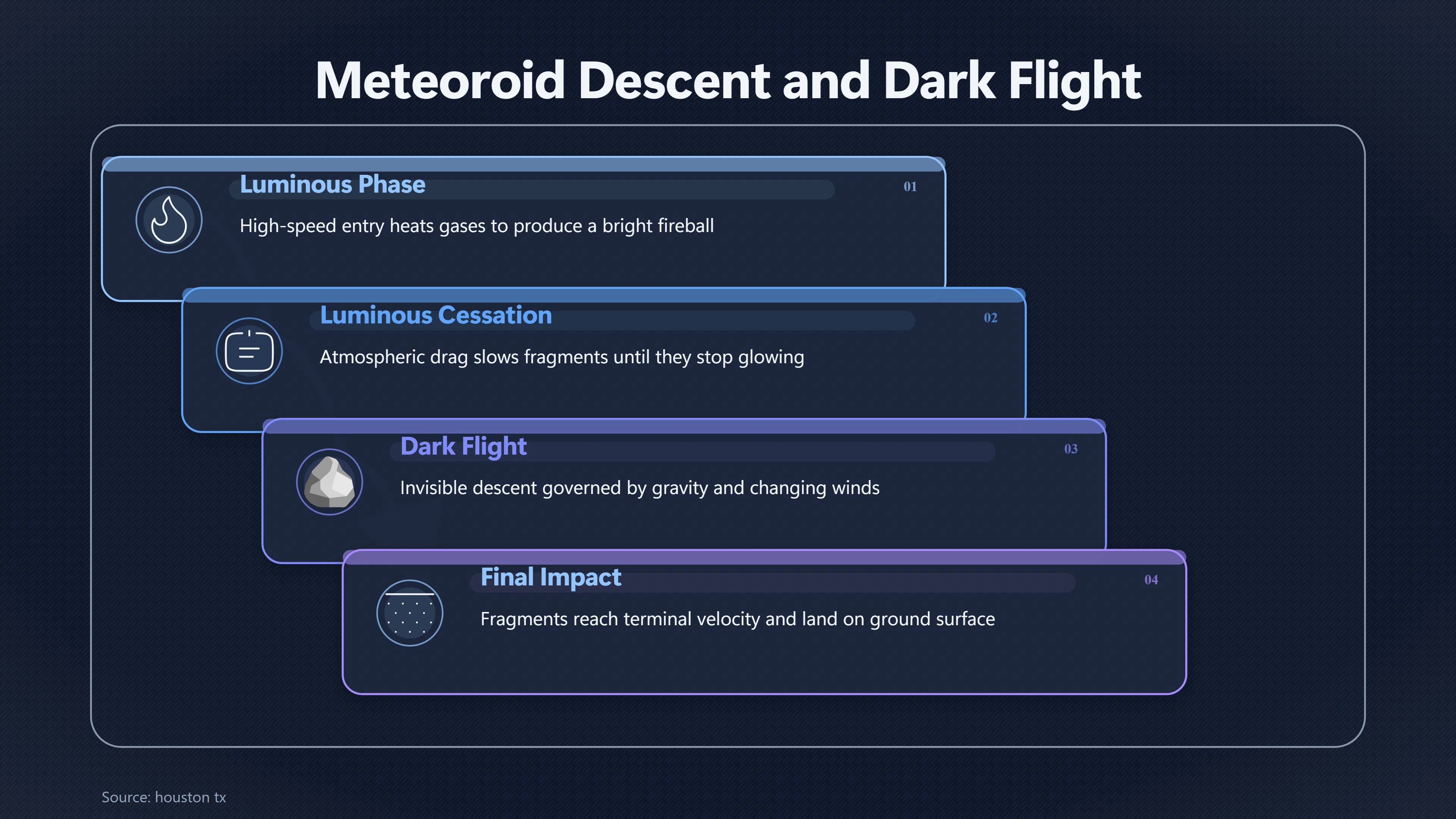
A meteor shines because it is travelling through the upper atmosphere at several kilometres per second. Intense compression of the air in front of the body heats the surrounding gases and strips material from the object’s surface. Eventually atmospheric drag slows surviving fragments enough that this glowing phase ceases, typically while they are still many kilometres above the ground.[NASA Technical Reports Server]ntrs.nasa.govNASA Technical Reports ServerThe Jörmungandr Dark Flight Model for Meteorite and Orbital Debris Recovery - NASA Technical Reports Server…
At this stage the surviving pieces are no longer behaving like blazing projectiles. Instead, they become falling objects whose motion is increasingly controlled by ordinary atmospheric physics:
- Gravity continues to pull them downward.
- Air resistance rapidly reduces their speed towards terminal velocity.
- Winds at different altitudes push them sideways.
- Each fragment follows its own path depending on its size, shape and density.
Because the fragments are no longer incandescent, observers lose visual contact precisely when the most important changes in their trajectory begin.
How wind and fragment mass reshape the fall path
Dark flight is not a simple vertical drop. Every surviving fragment responds differently to the atmosphere.
Large meteorites retain more momentum and are less affected by crosswinds. Smaller pieces lose speed more quickly and spend longer descending through moving air, allowing them to drift much farther sideways. As a result, fragments from a single meteoroid usually spread across a strewn field rather than landing in one location.[NASA Technical Reports Server]ntrs.nasa.govNASA Technical Reports ServerThe Jörmungandr Dark Flight Model for Meteorite and Orbital Debris Recovery - NASA Technical Reports Server…
Modern recovery teams therefore model multiple fragment masses instead of predicting a single impact point. A one-kilogram stone, a 100-gram fragment and a 10-gram fragment may all reach different parts of the landscape despite originating from the same fireball. NASA’s Jörmungandr dark-flight model demonstrates how these separate trajectories can be reconstructed by combining the observed fireball path with atmospheric wind profiles collected by weather balloons.[NASA Technical Reports Server]ntrs.nasa.govNASA Technical Reports ServerThe Jörmungandr Dark Flight Model for Meteorite and Orbital Debris Recovery - NASA Technical Reports Server…
The atmosphere itself adds further complexity because wind direction often changes with altitude. A fragment descending through several layers of moving air may first drift east, then south, before finally reaching the ground. Under strong crosswinds, predicted landing zones become curved or “banana-shaped” instead of narrow straight corridors.[NASA Technical Reports Server]ntrs.nasa.govNASA Technical Reports ServerThe Jörmungandr Dark Flight Model for Meteorite and Orbital Debris Recovery - NASA Technical Reports Server…
This means that even accurate observations of the fireball’s visible track cannot, by themselves, predict where meteorites will ultimately be found.
Why eyewitness landing estimates can be badly wrong
Human perception works poorly for distant objects in the sky. A fireball disappearing behind a nearby ridge or tree line often appears to have landed immediately beyond it. In reality, the luminous phase may have ended at an altitude of 20 to 30 kilometres or more, leaving several minutes of invisible descent still to come.[NASA Technical Reports Server]ntrs.nasa.govNASA Technical Reports ServerThe Jörmungandr Dark Flight Model for Meteorite and Orbital Debris Recovery - NASA Technical Reports Server…
Several factors reinforce this misunderstanding:
- Perspective compresses distance. Without reliable depth cues, observers naturally underestimate how far away the object really is.
- Brightness creates false impressions. Extremely bright fireballs appear closer than they actually are.
- The eye tracks only the glowing phase. Once the light disappears, people instinctively assume the object has already landed.
- Sound arrives later. Delayed sonic booms can further confuse estimates of where the object reached the ground.
These limitations explain why multiple sincere witnesses often point searchers towards different locations after the same fireball event.
Why modern searches rely on models instead of intuition
Successful meteorite recovery increasingly depends on reconstructing dark flight rather than following eyewitness reports alone.
Researchers begin with measurements of the luminous trajectory obtained from all-sky cameras, video recordings, radar observations or multiple witness accounts. They then combine these data with upper-atmosphere wind measurements to simulate the invisible descent of fragments of different masses. The resulting prediction is a probable strewn field rather than a single impact site.[NASA Technical Reports Server]ntrs.nasa.govNASA Technical Reports ServerThe Jörmungandr Dark Flight Model for Meteorite and Orbital Debris Recovery - NASA Technical Reports Server…
Recent NASA recovery efforts illustrate this approach. For documented meteorite falls, dark-flight modelling routinely predicts distinct landing areas for fragments ranging from gram-sized stones to kilogram-sized masses. In some cases, changing wind directions produce irregular or undulating strewn fields that would be impossible to infer simply by extending the visible fireball path.[ARES]ares.jsc.nasa.govhouston txARES | Meteorite Falls | Houston, TXMarch 21, 2026…
This represents a major shift from historical searches, many of which concentrated around the apparent point where witnesses believed the object disappeared.
What dark flight means for interpreting the Kecksburg incident
Within the broader question of why meteorite searches can fail, dark flight provides a straightforward explanation for one important source of error. If the Kecksburg fireball had been a natural meteoroid, any surviving meteorites would not necessarily have landed near the location where observers last saw the glowing object.
That possibility neither proves nor disproves a meteorite explanation for the incident. It simply shows that an unsuccessful search close to the apparent disappearance point is not, by itself, strong evidence that no meteorite reached the ground. Modern meteorite recovery has repeatedly demonstrated that the invisible dark-flight phase can displace surviving fragments by many kilometres, creating a substantial gap between what witnesses believe they saw and where the physical evidence would actually be expected.[NASA Technical Reports Server]ntrs.nasa.govNASA Technical Reports ServerThe Jörmungandr Dark Flight Model for Meteorite and Orbital Debris Recovery - NASA Technical Reports Server…
Amazon book picks
Further Reading
Books and field guides related to Where Meteorites Go After the Light Ends. Use these as the next step if you want deeper reading beyond the article.
Field Guide to Meteors and Meteorites
What is unique about Richard Norton's book is that it is both a field guide to observing meteors, and also a field guide to locating, pre...
Rocks from Space: Meteorites and Meteorite Hunters
Appendices A-C: Meteorite verification laboratories, Commercial meteorite dealers, Selected list of suspected impact craters worldwide.
Meteorite Hunting: How to Find Treasure from Space
"This is the definitive guide to finding meteorites, written by one of the best-known personalities in the field and co-host of the award...
Meteorites and their Parent Planets
Thoroughly revised second edition of a highly successful book describing all aspects of meteorites.
eBay marketplace picks
Marketplace Samples
Live-tested eBay searches with available results related to this page.
Selected frommeteorite display specimen oneBay.co.uk.

Endnotes
1.
Source: ntrs.nasa.gov
Link:https://ntrs.nasa.gov/citations/20230000491
Source snippet
NASA Technical Reports ServerThe Jörmungandr Dark Flight Model for Meteorite and Orbital Debris Recovery - NASA Technical Reports Server...
2.
Source: ntrs.nasa.gov
Link:https://ntrs.nasa.gov/api/citations/20230000491/downloads/Fries%20Jormungandr%20LPSC%202023.pdf?attachment=true
Source snippet
NASA Technical Reports ServerTHE JÖRMUNGANDR DARK FLIGHT MODEL FOR METEORITE AND ORBITAL DEBRIS...
3.
Source: ares.jsc.nasa.gov
Title: houston tx
Link:https://ares.jsc.nasa.gov/meteorite-falls/events/houston-tx
Source snippet
ARES | Meteorite Falls | Houston, TXMarch 21, 2026...
Published: March 21, 2026
4.
Source: ares.jsc.nasa.gov
Title: ARESARES | Meteorite Falls
Link:https://ares.jsc.nasa.gov/meteorite-falls/?os=app
Source snippet
Meteorite FallsJune 22, 2026 — METEORITE FALLS MOST RECENT EVENT COCKBURN ISLAND ONTARIO MOST RECENT EVENT COCKBURN ISLAND ONTARIO MOST...
Published: June 22, 2026
5.
Source: ares.jsc.nasa.gov
Title: cape cod bay ma
Link:https://ares.jsc.nasa.gov/meteorite-falls/events/cape-cod-bay-ma
Source snippet
Meteorite Falls | Cape Cod Bay MAMay 30, 2026 — CAPE COD BAY MA CAPE COD BAY MA CAPE COD BAY MA DATE/TIME 5/30/2026 @ 1806 UTC 5/30/202...
Published: May 30, 2026
6.
Source: ares.jsc.nasa.gov
Link:https://ares.jsc.nasa.gov/meteorite-falls/events/mcdonough-ga
Source snippet
Meteorite Falls | McDonough GAJune 26, 2025 — MCDONOUGH GA MCDONOUGH GA MCDONOUGH GA DATE/TIME 6/26/2025 @ 1624 UTC 6/26/2025 1624 UTC...
Published: June 26, 2025
7.
Source: ares.jsc.nasa.gov
Title: ingalls nc
Link:https://ares.jsc.nasa.gov/meteorite-falls/events/ingalls-nc
8.
Source: ntrs.nasa.gov
Link:https://ntrs.nasa.gov/citations/20240005795
9.
Source: ares.jsc.nasa.gov
Title: kingsport tn 02
Link:https://ares.jsc.nasa.gov/meteorite-falls/events/kingsport-tn-02
10.
Source: exploration.jsc.nasa.gov
Title: great salt lake ut
Link:https://exploration.jsc.nasa.gov/meteorite-falls/events/great-salt-lake-ut
11.
Source: ntrs.nasa.gov
Link:https://ntrs.nasa.gov/archive/nasa/casi.ntrs.nasa.gov/20170001522.pdf
12.
Source: ntrs.nasa.gov
Link:https://ntrs.nasa.gov/citations/20110016614
13.
Source: ntrs.nasa.gov
Link:https://ntrs.nasa.gov/citations/20220007170
Additional References
14.
Source: usgs.gov
Title: I think I found a meteorite
Link:https://www.usgs.gov/faqs/i-think-i-found-a-meteorite-how-can-i-tell-sure
Source snippet
How can I tell for sure? | U.S. Geological SurveyMay 19, 2025 — I THINK I FOUND A METEORITE. HOW CAN I TELL FOR SURE? Meteorites are frag...
Published: May 19, 2025
15.
Source: reddit.com
Title: Struggling to find much expert information about this meteorite I photographed
Link:https://www.reddit.com/r/meteorites/comments/1s2jln3/struggling_to_find_much_expert_information_about/
Source snippet
Struggling to find much expert information about this meteorite I photographed...
16.
Source: usgs.gov
Title: Meteorite and meteoroid: New comprehensive definitions | U.S. Geological Survey
Link:https://www.usgs.gov/publications/meteorite-and-meteoroid-new-comprehensive-definitions
17.
Source: usgs.gov
Title: The cali meteorite fell: A new H/L ordinary chondrite | U.S. Geological Survey
Link:https://www.usgs.gov/publications/cali-meteorite-fell-a-new-hl-ordinary-chondrite
18.
Source: youtube.com
Title: Meteorite almost hits Norwegian skydiver
Link:https://www.youtube.com/watch?v=jfEdEIwhj6s
Source snippet
Meteorite Men | S02 E07 | Mundrabilla Australia...
19.
Source: doi.org
Link:https://doi.org/10.1093%2Fmnras%2Fstab586
20.
Source: youtube.com
Title: How Weather Radars Track Meteorites
Link:https://www.youtube.com/watch?v=EcC6IoqkjDQ
Source snippet
We found New Zealand's 10th Meteorite! - Fireballs Aotearoa ☄️...
21.
Source: youtube.com
Title: Sky Fit2 tutorial
Link:https://www.youtube.com/watch?v=ao3J9Jf0iLQ
Source snippet
Meteorite almost hits Norwegian skydiver - FULL STORY...
22.
Source: sciencedirect.com
Title: Atmospheric entry and strewn fields estimation for rubble-pile meteoroids
Link:https://www.sciencedirect.com/science/article/abs/pii/S0273117724005799
23.
Source: sciencedirect.com
Title: Atmospheric entry and strewn fields estimation for rubble-pile meteoroids
Link:https://www.sciencedirect.com/science/article/pii/S0273117724005799