Within Shock Waves
One Fireball, Several Different Kinds of Boom
A continuous Mach cone and separate breakup pulses can produce very different sequences of cracks, thumps and window-rattling blasts.
On this page
- How a hypersonic body creates a ballistic shock
- How fragmentation adds separate pressure pulses
- Which boom patterns fit the Kecksburg reports
Page outline Jump by section
Introduction
The loud sounds reported during the 9 December 1965 Kecksburg fireball are often described simply as “sonic booms”, but that label hides an important distinction. A large meteoroid can produce two different kinds of acoustic event during a single atmospheric passage. First, its continuous hypersonic flight generates a long, moving ballistic shock wave. Second, if the body fractures under aerodynamic stress, each major breakup can create its own powerful pressure pulse. These mechanisms produce different patterns of bangs, cracks and ground vibrations, and modern meteor studies use that distinction to reconstruct how a fireball behaved in flight. Understanding the difference helps explain why witnesses to the Kecksburg event reported anything from a single sharp crack to several separated explosions, without requiring multiple objects or a confirmed ground impact.[arXiv]arxiv.orgarXiv Optical Observations of Meteors Generating InfrasoundOptical Observations of Meteors Generating Infrasound - I: Acoustic Signal Identification and PhenomenologyJuly 23, 2014…
How a hypersonic body creates a ballistic shock
A meteoroid travelling through the atmosphere at many kilometres per second moves far faster than the speed of sound. Instead of allowing pressure disturbances to spread ahead of it, the object compresses the surrounding air into a continuous shock front that trails behind the flight path as a Mach cone.
Unlike an ordinary explosion, this is not a single burst released from one point. The shock is generated continuously as long as the body remains hypersonic. As different sections of the shock cone reach observers on the ground, people along the flight corridor may hear a sharp crack, double boom or prolonged rumble depending on their position relative to the trajectory and local atmospheric conditions. Modern infrasound studies describe this as a cylindrical or line-source shock because the acoustic energy is produced along the meteor’s path rather than at one isolated location.[arXiv]arxiv.orgarXiv Optical Observations of Meteors Generating InfrasoundOptical Observations of Meteors Generating Infrasound - I: Acoustic Signal Identification and PhenomenologyJuly 23, 2014…
This distinction has practical consequences. A ballistic shock means:
- the sound source extends over many kilometres of flight;
- different observers may hear the boom at different times and from different apparent directions;
- the strongest sound does not necessarily occur directly beneath the brightest part of the fireball.
For this reason, hearing a powerful boom near Kecksburg would not by itself identify that location as the end of the object’s flight.
How fragmentation adds separate pressure pulses
Many large meteoroids do not remain intact. As atmospheric pressure increases during descent, internal fractures and heating can cause the body to break apart. Each substantial fragmentation event rapidly deposits energy into the surrounding air, producing a roughly spherical pressure pulse that is distinct from the continuous ballistic shock.
To witnesses, these fragmentation booms may sound like separate explosions rather than one extended sonic crack. If several major breakups occur over a short interval, observers can report a sequence of bangs spaced by seconds or longer, depending on the geometry of the event and the travel time of the sound waves. The American Meteor Society notes that bright bolides frequently produce delayed sonic booms associated with deep atmospheric penetration and explosive fragmentation.[American Meteor Society]amsmeteors.orgAmerican Meteor Society Fireball FAQsAmerican Meteor SocietyFireball FAQs - American Meteor Society…
Modern optical and infrasound research supports this interpretation. Simultaneous camera and acoustic observations show that:
- most meteor-generated acoustic signals originate from the continuous ballistic shock;
- a significant minority arise from discrete fragmentation events associated with bright optical flares;
- meteors undergoing multiple breakups can generate multiple distinguishable acoustic arrivals at ground sensors.[arXiv]arxiv.orgarXiv Optical Observations of Meteors Generating InfrasoundOptical Observations of Meteors Generating Infrasound - I: Acoustic Signal Identification and PhenomenologyJuly 23, 2014…
Because fragmentation events occur at specific points along the trajectory, they create additional acoustic signatures superimposed on the underlying Mach-cone shock.
Why one fireball can produce several different kinds of boom
The two mechanisms often operate together rather than competing with one another.
A simplified sequence for a large bolide is:
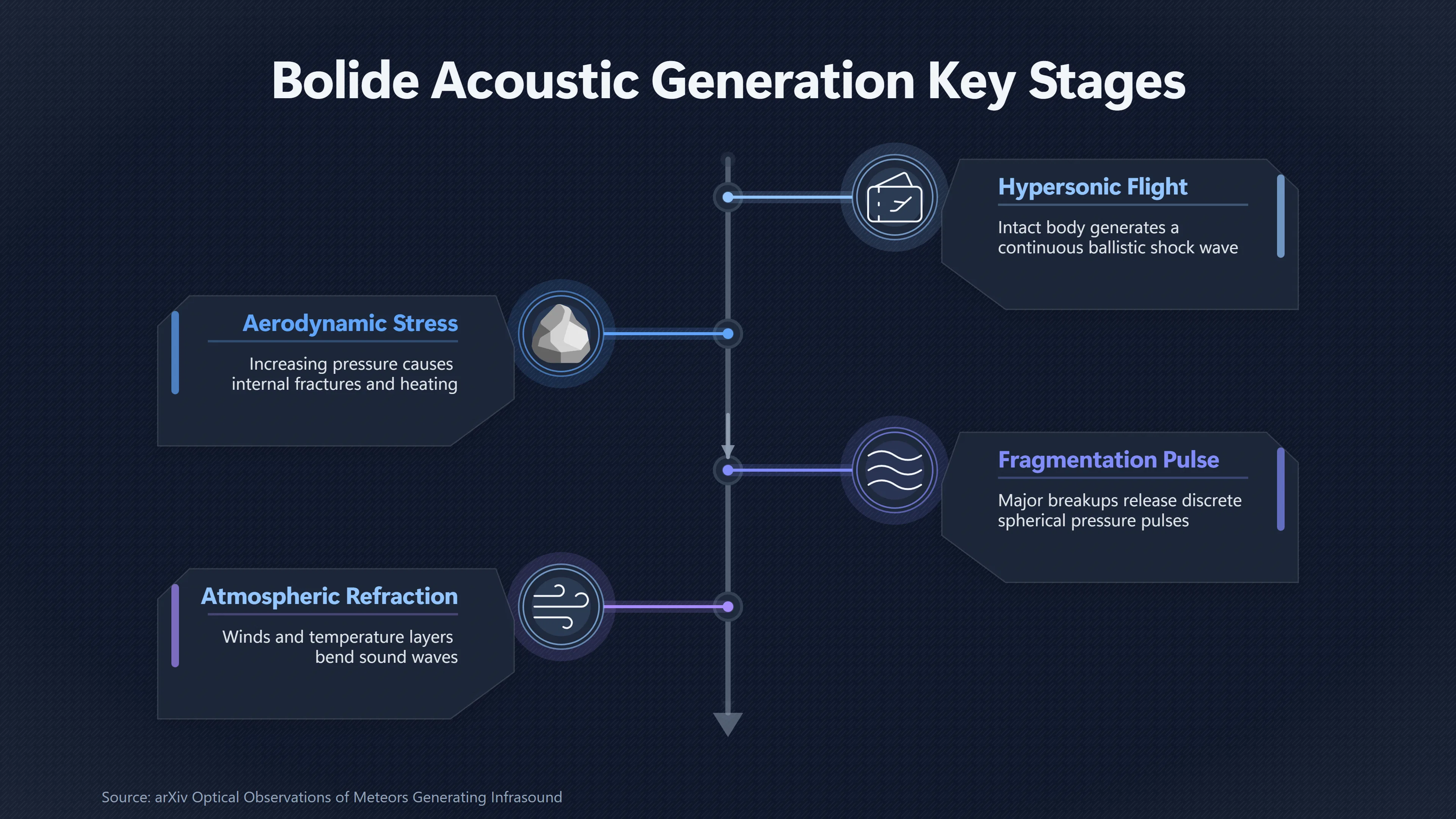
- The intact body generates a continuous ballistic shock throughout its visible flight.
- Increasing aerodynamic stress causes one or more fragmentation episodes.
- Each significant breakup releases an additional pressure pulse.
- Atmospheric winds and temperature layers refract the various sound waves differently before they reach listeners on the ground.
Consequently, witnesses spread across a wide region may report very different experiences despite observing the same event. One person may hear only a single sharp boom, another a crack followed by a heavier thump, while someone farther away may perceive several widely spaced explosions.
Recent modelling of meteor infrasound has shown that while atmospheric propagation can alter waveforms, clearly separated, high-amplitude multiple arrivals at relatively short ranges are most readily explained by separate fragmentation events rather than by atmospheric distortion alone.[arXiv]arxiv.orgMulti-Arrival Infrasound from Meteoroids: Fragmentation Signatures versus Propagation Effects in a Fine-Scale Layered AtmosphereFebr…
Which boom patterns fit the Kecksburg reports?
The historical reports surrounding the Kecksburg incident include descriptions of loud cracks, heavy thumps, window-rattling blasts and multiple explosion-like sounds across western Pennsylvania and neighbouring regions. Those reports are broadly consistent with the acoustic behaviour expected from a large bolide undergoing atmospheric breakup, although the original observations were not recorded with the dense microphone and infrasound networks available today.[American Meteor Society]amsmeteors.orgAmerican Meteor Society Fireball FAQsAmerican Meteor SocietyFireball FAQs - American Meteor Society…
Several features are particularly compatible with a combined ballistic-plus-fragmentation scenario:
- Delayed arrival of sound. Witnesses generally reported booms well after the brilliant fireball had passed, matching the expected travel time of atmospheric shock waves rather than an immediate local explosion.[American Meteor Society]amsmeteors.orgAmerican Meteor Society Fireball FAQsAmerican Meteor SocietyFireball FAQs - American Meteor Society…
- Reports of multiple explosions. Several distinct booms are easier to reconcile with one or more fragmentation episodes than with a single instantaneous detonation.
- Wide geographical distribution. A continuous ballistic shock extends over much of the object’s flight path, allowing observers separated by large distances to hear different portions of the same event.
- No unique acoustic focus on Kecksburg. Because both ballistic shocks and fragmentation pulses propagate over broad regions, hearing the loudest boom near a particular town does not demonstrate that the object landed there.
These acoustic characteristics therefore support the existence of a powerful hypersonic atmospheric event while remaining neutral on the more controversial claim that an intact object crashed at Kecksburg.
What the boom pattern can and cannot tell us
Modern meteor science allows investigators to extract considerable information from acoustic observations, but only when those observations are combined with accurate timing, trajectory measurements and instrumented recordings.
For the 1965 Kecksburg event, witness testimony strongly suggests that the fireball produced both continuous shock waves and one or more energetic fragmentation events. However, the available evidence is insufficient to identify the precise altitude, number or energy of those breakups. The reported boom sequence is entirely compatible with a large natural bolide, but it cannot by itself distinguish between a meteor that completely disintegrated, one that dropped meteorites farther along its path, or another hypersonic object without additional physical evidence. Modern studies therefore treat the reported sounds as evidence of atmospheric flight and fragmentation rather than proof of a crash site.[arXiv]arxiv.orgarXiv Optical Observations of Meteors Generating InfrasoundOptical Observations of Meteors Generating Infrasound - I: Acoustic Signal Identification and PhenomenologyJuly 23, 2014…
Amazon book picks
Further Reading
Books and field guides related to One Fireball, Several Different Kinds of Boom. Use these as the next step if you want deeper reading beyond the article.
The Science of Sound
Written for students without a background in mathematics or physics, this textbook provides an introduction to the study of acoustics. It...
Rocks from Space
Appendices A-C: Meteorite verification laboratories, Commercial meteorite dealers, Selected list of suspected impact craters worldwide.
Fundamentals of Acoustics
Dargestellt werden die physikalischen und mathematischen Konzepte zur Beschreibung der Erzeugung, Weiterleitung und Wahrnehmung von Schal...
eBay marketplace picks
Marketplace Samples
Live-tested eBay searches with available results related to this page.
Selected frommeteor poster oneBay.co.uk.

Endnotes
1.
Source: arxiv.org
Title: arXiv Optical Observations of Meteors Generating Infrasound
Link:https://arxiv.org/abs/1407.6331
Source snippet
Optical Observations of Meteors Generating Infrasound - I: Acoustic Signal Identification and PhenomenologyJuly 23, 2014...
Published: July 23, 2014
2.
Source: arxiv.org
Title: arXiv Optical Observations of Meteors Generating Infrasound
Link:https://arxiv.org/abs/1411.5406
Source snippet
Optical Observations of Meteors Generating Infrasound - II: Weak Shock Theory and Validation...
3.
Source: arxiv.org
Link:https://arxiv.org/abs/2602.15262
Source snippet
Multi-Arrival Infrasound from Meteoroids: Fragmentation Signatures versus Propagation Effects in a Fine-Scale Layered AtmosphereFebr...
4.
Source: amsmeteors.org
Title: American Meteor Society Fireball FAQs
Link:https://www.amsmeteors.org/fireballs/faqf/
Source snippet
American Meteor SocietyFireball FAQs - American Meteor Society...
5.
Source: amsmeteors.org
Title: American Meteor Society Fireballs
Link:https://www.amsmeteors.org/fireballs/
Source snippet
American Meteor SocietyFireballs - American Meteor Society...
6.
Source: amsmeteors.org
Title: AM S Fireball Stats Analysis
Link:https://amsmeteors.org/2013/03/ams-fireball-stats-analysis/
8.
Source: amsmeteors.org
Link:https://www.amsmeteors.org/fireballs/page/2/
9.
Source: amsmeteors.org
Link:https://amsmeteors.org/fireballs/page/7/
10.
Source: amsmeteors.org
Title: Fireball Logs
Link:https://www.amsmeteors.org/fireballs/fireball-report/page/6/
11.
Source: amsmeteors.org
Title: Fireball Logs
Link:https://www.amsmeteors.org/fireballs/fireball-report/
13.
Source: sciencedirect.com
Link:https://www.sciencedirect.com/science/article/abs/pii/S0019103526000734
Source snippet
May 15, 2026 — ICARUS Volume 450, 15 May 2026, 117007 MULTI-ARRIVAL INFRASOUND FROM METEOROIDS: FRAGMENTATION SIGNATURES VER...
Published: May 15, 2026
14.
Source: theguardian.com
Link:https://www.theguardian.com/science/2026/jun/01/meteor-massachusetts-sonic-boom
Source snippet
June 1, 2026 — Image: a satellite image of a meteor exploding [Input] This satellite image taken on Saturday shows a meteor exploding in...
Published: June 1, 2026
15.
Source: sciencedirect.com
Link:https://www.sciencedirect.com/science/article/abs/pii/S0019103526002502
Source snippet
SHOCK WAVE FORMATION IN THE THERMOSPHERE BY AN EARTHGRAZING FIREBALL: EMPIRICAL EVIDENCE FOR VOLATILE-ENHANCED H...
16.
Source: youtube.com
Title: Sonic Boom Explained: Breaking the Sound Barrier & Shock Waves
Link:https://www.youtube.com/watch?v=oDuun6z-5uI
Source snippet
What is a Sonic Boom and Why Do They Happen?...
17.
Source: youtube.com
Title: What is a Sonic Boom and Why Do They Happen?
Link:https://www.youtube.com/watch?v=7AIw_HSd1a8
Source snippet
'Spooky Meteor Noises' Reproduced and Explained by Scientists | Video...
18.
Source: sciencedirect.com
Link:https://www.sciencedirect.com/science/article/pii/S0019103526002605
Source snippet
The role of source geometry and atmospheric propagation in global bolide infrasound detectability - ScienceDirectNovember 1, 2026 — These...
Published: November 1, 2026
19.
Source: doi.org
Link:https://doi.org/10.1051/0004-6361/202141106
20.
Source: emeteornews.net
Link:https://www.emeteornews.net/2021/02/27/news-from-the-meteor-library-fireball-characteristics-from-acoustic-data/
21.
Source: sciencedirect.com
Link:https://www.sciencedirect.com/science/article/abs/pii/S1364682614001709
22.
Source: sciencedirect.com
Link:https://www.sciencedirect.com/science/article/pii/S1364682614001709