Within Space Debris
Why Radioactive Space Debris Was a Real Concern
By 1965, nuclear-powered satellites made radioactive contamination a credible precaution when unknown space debris reached Earth.
On this page
- Nuclear power sources already in orbit by 1965
- Why unknown fragments required radiation precautions
- What later satellite accidents demonstrated
Page outline Jump by section
Introduction
When an unidentified object fell from the sky during the Cold War, emergency planners had to consider more than impact damage. By late 1965, radioactive space hardware was already a real, if uncommon, possibility. The United States had placed nuclear-powered satellites into orbit, and military planners knew that future Soviet systems might do the same. Although there is no credible evidence that the object associated with the Kecksburg incident was radioactive, the existence of nuclear-powered spacecraft meant that responders could not dismiss the possibility before the object had been identified. Within the broader context of hazardous space debris response, radiation monitoring and restricted access would therefore have been prudent precautionary measures rather than extraordinary ones.[The Department of Energy's Energy.gov]energy.govThe Department of Energy's Energy.govThe History of Nuclear Power in Space | Department of EnergyJune 9, 2015…
Nuclear power sources were already in orbit by 1965
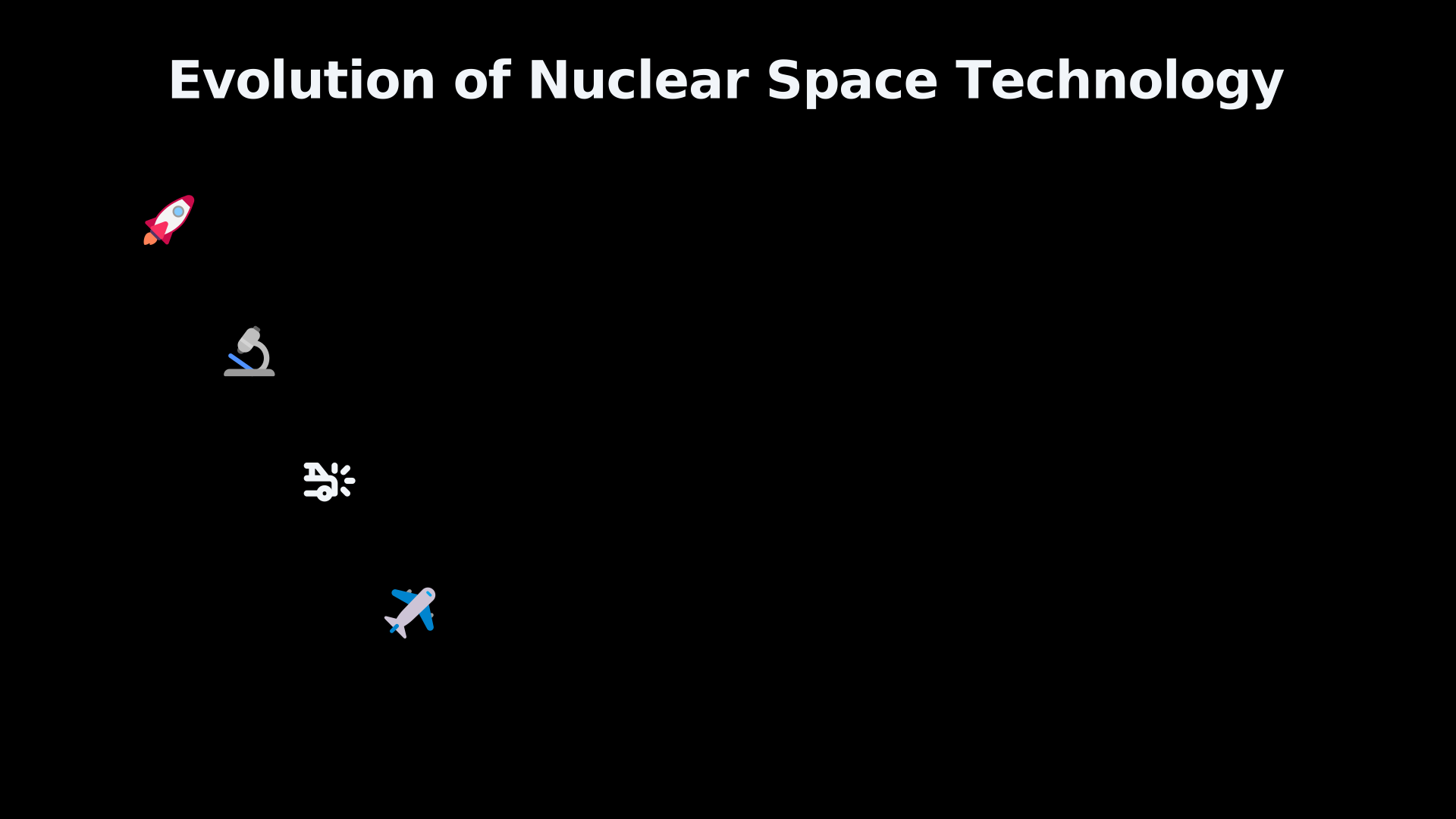
By the mid-1960s, nuclear technology had become an established part of space exploration. Solar panels could not always provide sufficient or reliable power, particularly for long-duration missions or spacecraft operating in environments with limited sunlight. Engineers therefore developed radioisotope thermoelectric generators (RTGs), which convert heat released by the natural decay of radioactive material into electricity.
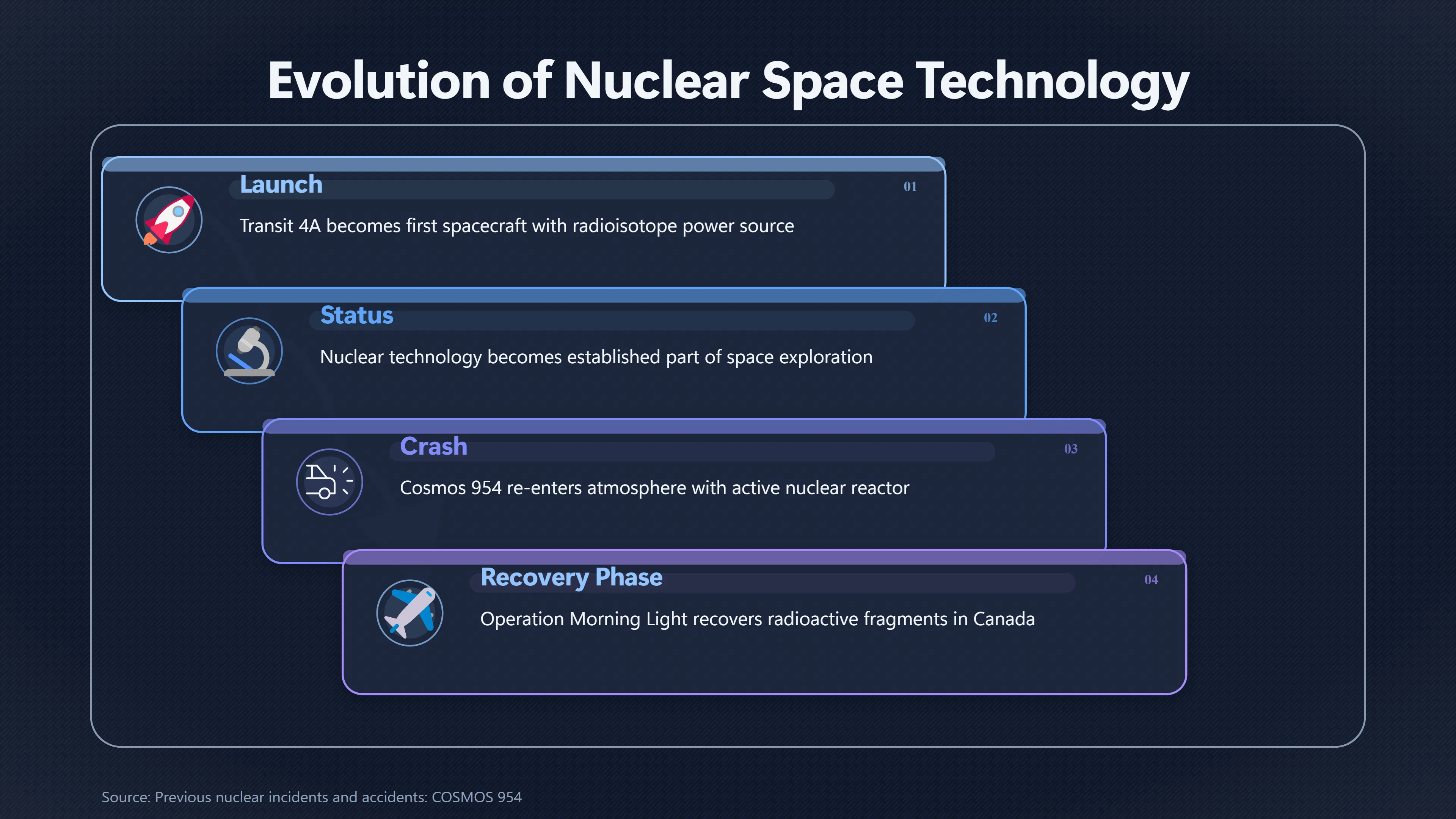
The first practical use came with the U.S. Navy’s Transit navigation satellites. Transit 4A, launched in 1961, became the first spacecraft powered by a radioisotope power source, demonstrating that radioactive material was no longer confined to laboratories or terrestrial reactors but was travelling in Earth orbit. By 1965, this was well known within aerospace and defence communities, even if the details were not widely appreciated by the public.[The Department of Energy's Energy.gov]energy.govThe Department of Energy's Energy.govThe History of Nuclear Power in Space | Department of EnergyJune 9, 2015…
It is important to distinguish between different nuclear technologies used in space:
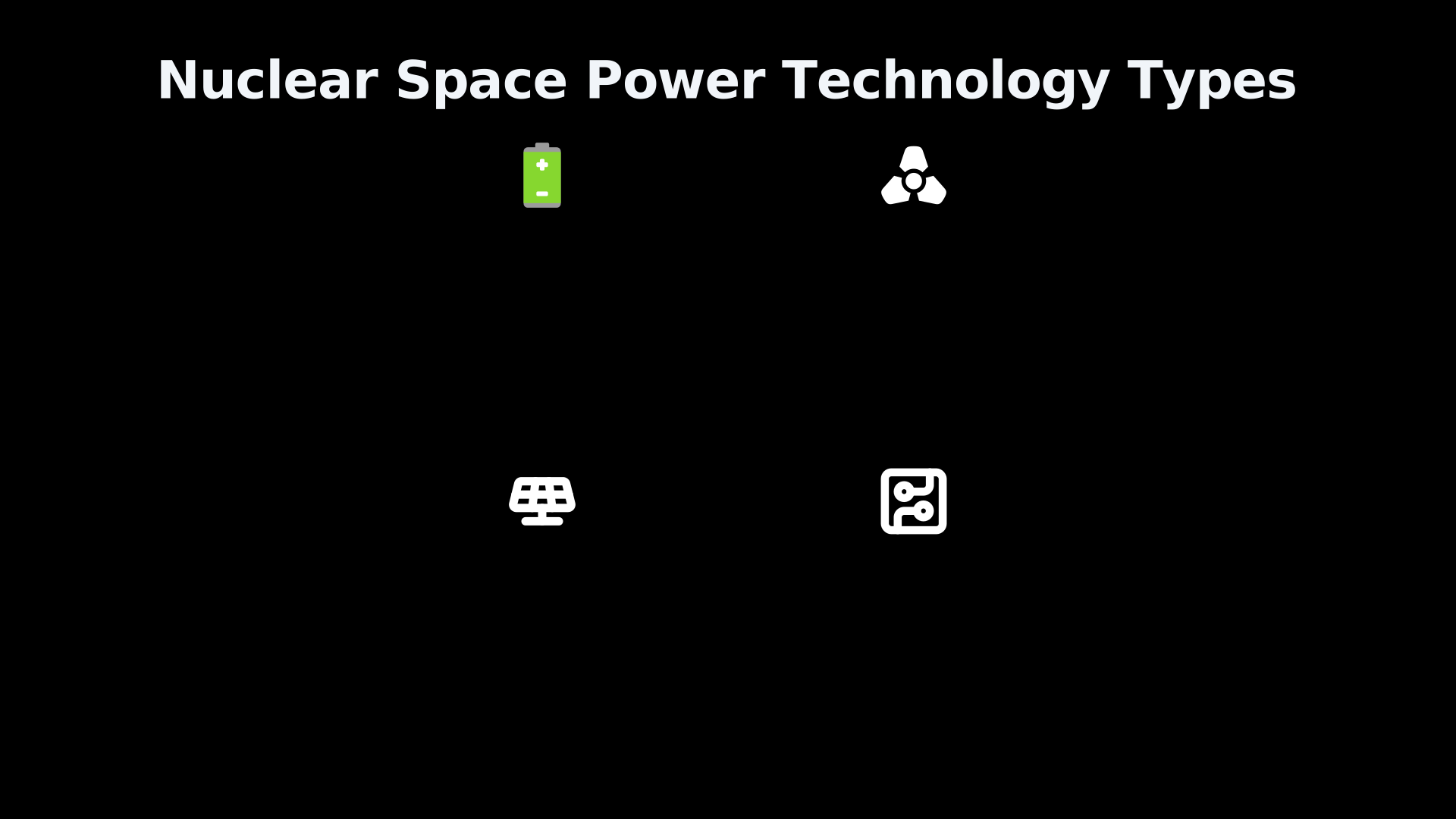
- Radioisotope thermoelectric generators (RTGs) used the steady decay of isotopes such as plutonium-238 to generate relatively small amounts of electrical power.
- Nuclear reactors, introduced later on some Soviet military satellites, produced far greater electrical output through controlled nuclear fission but also carried substantially larger radioactive inventories.
In December 1965, responders faced with unidentified debris could not immediately determine whether it originated from a conventional satellite, a classified military system, or an experimental spacecraft. That uncertainty alone justified considering radioactive contamination among several possible hazards.
Why unknown fragments required radiation precautions
Radiation cannot be detected by sight, smell or touch. For emergency responders, that made unidentified aerospace debris fundamentally different from ordinary wreckage. If an object had originated from a nuclear-powered spacecraft, even intact-looking fragments could potentially contain radioactive materials requiring specialised handling.
Cold War emergency procedures therefore favoured caution until experts could establish:
- whether the object contained radioactive components;
- whether shielding had been damaged during re-entry or impact;
- whether fragments had dispersed over the surrounding area;
- whether personnel required protective equipment and radiation monitoring.
These precautions did not imply that contamination was expected. Rather, they reflected standard hazardous-material practice: an unknown object should be treated according to its worst credible characteristics until examination ruled those hazards out.
The same logic applied to military recovery teams. Portable radiation detectors formed part of many Cold War response capabilities because unidentified military hardware, industrial sources and nuclear-related equipment all represented plausible contamination risks. A brief cordon while specialists conducted radiation surveys would therefore have been consistent with established emergency doctrine rather than evidence that radiation had actually been detected.
Why the concern seemed credible in 1965
From a modern perspective, it may appear unlikely that radioactive material could survive atmospheric re-entry. However, engineers in the 1960s were still developing reliable methods for ensuring the safe disposal of nuclear-powered spacecraft.
Several factors contributed to official concern:
- Limited operational experience. Spaceflight itself was only a few years old, and long-term behaviour during uncontrolled re-entry was not yet fully understood.
- Cold War secrecy. The United States and Soviet Union often concealed the capabilities of military satellites, making it difficult for responders to know what hardware might be involved.
- Incomplete tracking. Orbital prediction and space-surveillance systems were improving rapidly but remained less comprehensive than modern networks.
- Unknown design standards. An unidentified object might contain safety features—or lack them—in ways impossible to determine from visual inspection alone.
As a result, responders often had to assume that an unfamiliar object represented the highest plausible level of risk until technical specialists completed their assessment.
What later satellite accidents demonstrated
Events after 1965 showed that these precautions were not hypothetical. The most important example was the Soviet reconnaissance satellite Cosmos 954.
Cosmos 954 and Operation Morning Light
On 24 January 1978, Cosmos 954, powered by a compact nuclear reactor, re-entered the atmosphere after a malfunction prevented its reactor from being boosted into a disposal orbit. Instead of burning up completely, radioactive debris was scattered across roughly 124,000 square kilometres of northern Canada.
Canada and the United States launched Operation Morning Light, a major search and recovery effort involving aircraft equipped with gamma-ray detectors, military personnel and nuclear specialists. Teams recovered numerous radioactive fragments, although only a small fraction of the reactor’s fuel was ultimately found. The accident prompted international debate over the safety of nuclear-powered satellites and led to renewed work on international standards governing their use.[canada.ca]canada.caPrevious nuclear incidents and accidents: COSMOS 954Previous nuclear incidents and accidents: COSMOS 954 - Canada.caSeptember 3, 2019…
The significance of Cosmos 954 lies not in suggesting a connection with Kecksburg—there is none—but in demonstrating that the type of hazard imagined in 1965 later occurred in reality.

Lessons reinforced by later experience
Cosmos 954 confirmed several assumptions that Cold War planners had already been making:
- radioactive satellite debris could survive re-entry;
- contamination could extend across very large areas rather than remaining confined to an impact crater;
- specialised radiation surveys were essential because many fragments were visually indistinguishable from ordinary metal debris;
- military and civilian agencies required coordinated recovery procedures.
These lessons validated the conservative approach that emergency responders had already been encouraged to adopt when confronting unidentified aerospace debris.
What this means for understanding the Kecksburg response
Within the Kecksburg incident, radioactive contamination should be viewed as one element in a broader hazard assessment rather than as evidence supporting extraordinary claims. Responders in December 1965 faced genuine uncertainty. An unidentified object could theoretically have been a meteorite, aircraft wreckage, missile hardware, conventional satellite debris or, however unlikely, a component from a nuclear-powered spacecraft.
Because nuclear-powered satellites already existed, a temporary exclusion zone, specialist military involvement and radiation checks would all have been compatible with standard Cold War emergency procedures. None of those actions, by themselves, demonstrate that radioactive material was present or that the recovered object—if any—was of exotic origin.
The later experience of Cosmos 954 illustrates why such precautions were reasonable. Cold War officials did not need to believe an unknown object was radioactive; they merely needed to recognise that, by 1965, it had become a credible possibility that could not safely be ignored.[canada.ca]canada.caPrevious nuclear incidents and accidents: COSMOS 954Previous nuclear incidents and accidents: COSMOS 954 - Canada.caSeptember 3, 2019…
Amazon book picks
Further Reading
Books and field guides related to Why Radioactive Space Debris Was a Real Concern. Use these as the next step if you want deeper reading beyond the article.
Atomic Accidents: A History of Nuclear Meltdowns and Disasters
A gripping narrative of nuclear mishaps and meltdowns around the globe, all of which have proven pivotal to the advancement of nuclear sc...
Command and Control
From famed investigative journalist Eric Schlosser, author of Fast Food Nation, comes Command and Control a ground-breaking account of th...
Space Debris: Models and Risk Analysis
In Space Debris Models and Risk Analysis the authors will provide the reader with a comprehensive background to understand the various so...
Rocket Propulsion Elements
Rating: 4.5/5 from 11 Google Books ratings
Aerospace Engineering/Mechanical Engineering The definitive text on rocket propulsion-now completely revised to reflect rapid advancement...
eBay marketplace picks
Marketplace Samples
Live-tested eBay searches with available results related to this page.
Selected fromsatellite model oneBay.co.uk.

Endnotes
1.
Source: energy.gov
Link:https://www.energy.gov/articles/history-nuclear-power-space
Source snippet
The Department of Energy's Energy.govThe History of Nuclear Power in Space | Department of EnergyJune 9, 2015...
Published: June 9, 2015
2.
Source: canada.ca
Title: Previous nuclear incidents and accidents: COSMOS 954
Link:https://www.canada.ca/en/health-canada/services/health-risks-safety/radiation/radiological-nuclear-emergencies/previous-incidents-accidents/cosmos-954.html
Source snippet
Previous nuclear incidents and accidents: COSMOS 954 - Canada.caSeptember 3, 2019...
Published: September 3, 2019
3.
Source: science.gc.ca
Title: 123 operation morning light 1978
Link:https://science.gc.ca/site/science/en/educational-resources/history-geological-survey-canada-175-objects/123-operation-morning-light-1978
4.
Source: science.gc.ca
Title: 123 operation morning light 1978
Link:https://science.gc.ca/site/science/fr/ressources-pedagogiques/lhistoire-commission-geologique-canada-illustree-175-objets/123-operation-morning-light-1978
5.
Source: energy.gov
Link:https://www.energy.gov/history-space-nuclear-power
6.
Source: science.nasa.gov
Link:https://science.nasa.gov/planetary-science/programs/radioisotope-power-systems/safety/
Source snippet
Power Systems Safety and Reliability - NASA ScienceApril 3, 2025 — RADIOISOTOPE POWER SYSTEMS SAFETY AND RADIOISOTOPE POWER Safety is a c...
Published: April 3, 2025
7.
Source: canadacommons.ca
Title: Operation Morning Light: The Recovery of Cosmos 954 Debris | Canada Commons
Link:https://canadacommons.ca/artifacts/1203120/operation-morning-light/1756229/
8.
Source: niche-canada.org
Title: cosmos 954
Link:https://niche-canada.org/northernexposures/ne-about-and-projects-panel/postindustrialcontaminants/cosmos-954/
9.
Source: nwttimeline.ca
Title: Cosmos 954 and Operation Morning Light
Link:https://www.nwttimeline.ca/stories/cosmos-954-and-operation-morning-light/
10.
Source: flickr.com
Link:https://www.flickr.com/photos/60678966%40N02/albums/72157627138886443/
Additional References
11.
Source: thenorthernreview.ca
Link:https://thenorthernreview.ca/index.php/nr/article/view/754
Source snippet
Northern ReviewCleaning up Cosmos: Satellite Debris, Radioactive Risk, and the Politics of Knowledge in Operation Morning Light | Norther...
12.
Source: youtube.com
Title: A Brief History of: The [Kosmos 954]({{ ‘kosmos-954/’ | relative_url }}) Nuclear reactor Crash (Documentary)
Link:https://www.youtube.com/watch?v=YN7ifFam1Fk
Source snippet
The Soviet Nuclear Reactor That Crashed in North America... Until They Found It...
13.
Source: science.nasa.gov
Title: Science Radioisotope Power Systems Timeline
Link:https://science.nasa.gov/planetary-science/programs/radioisotope-power-systems/timeline/
Source snippet
NASA ScienceRadioisotope Power Systems Timeline - NASA Science...
14.
Source: youtube.com
Link:https://www.youtube.com/watch?v=hkqxjeFBXv0
Source snippet
FIRST NUCLEAR REACTOR IN SPACE SNAP-10A PROGRAM 1965 71502...
15.
Source: youtube.com
Title: The Soviet Nuclear Satellites
Link:https://www.youtube.com/watch?v=0lR-KyObLt0
Source snippet
Cosmos 954 Disintegrates - 1978 | Today In History | 24 Jan 19...
16.
Source: youtube.com
Link:https://www.youtube.com/watch?v=vFk6A-IdTV8
Source snippet
The Soviet Nuclear Satellites - The Story of Cosmos954 & Cosmos1402...
17.
Source: osti.gov
Link:https://www.osti.gov/biblio/20104491
18.
Source: space.skyrocket.de
Title: de Snapshot
Link:https://space.skyrocket.de/doc_sdat/snapshot.htm
Source snippet
2, 2025 — SNAPSHOT Snapshot [DoE] The Snapshot (Space Nuclear Auxiliary Power Shot) satellite was launched on April 3, 1965 a SNAP 10A nu...
Published: April 3, 1965
19.
Source: nationalacademies.org
Link:https://www.nationalacademies.org/read/13244/chapter/10
20.
Source: nationalacademies.org
Link:https://www.nationalacademies.org/read/11432/chapter/3