Within Visual Illusion
Why Fireball Light Can Feel Close to Home
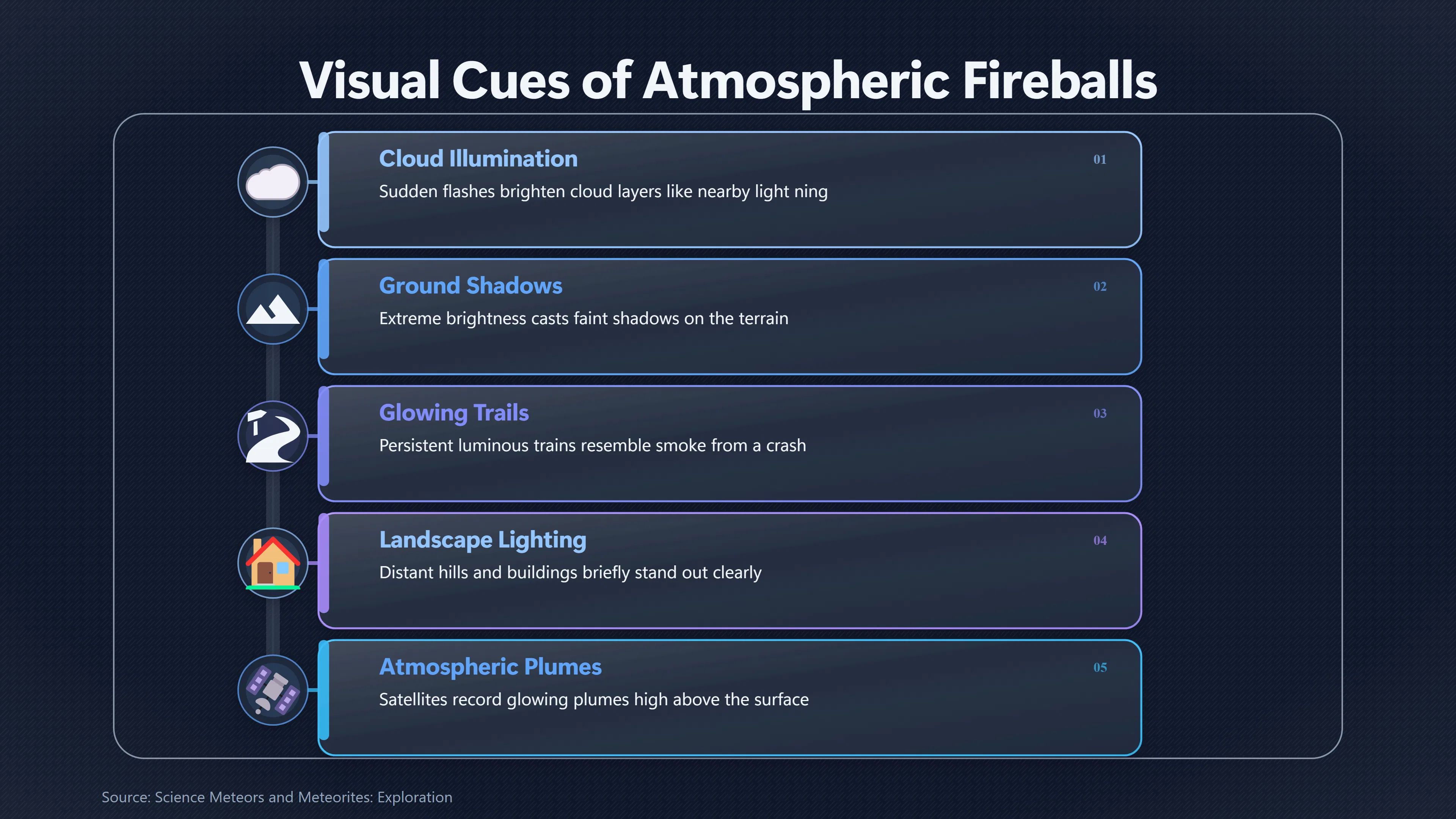
Lit clouds, shadows and glowing trains can feel local because they resemble lightning, fireworks or an aircraft emergency.
On this page
- How bright meteors illuminate clouds and landscapes
- Why familiar light effects imply a nearby source
- Separating brightness from actual distance
Page outline Jump by section
Introduction
A bright fireball can make an entire landscape appear suddenly local. Clouds may flash white, distant hills briefly stand out, shadows can appear on the ground, and a glowing trail may linger after the meteor itself has vanished. These effects are striking because they resemble familiar nearby events such as lightning, fireworks or an aircraft accident. Yet they reveal very little about where the meteor actually was. An exceptionally bright fireball can illuminate the atmosphere while still burning tens of kilometres above Earth, and its light may be visible across hundreds of kilometres. This distinction is important when considering reports surrounding the Kecksburg UFO incident, where vivid lighting effects contributed to sincere impressions that the object had descended into nearby woodland rather than remaining a distant atmospheric phenomenon.[nasa.gov]sma.nasa.govOpen source on nasa.gov.

How Bright Meteors Illuminate Clouds and Landscapes
Unlike ordinary meteors, fireballs produce enough light to affect the environment around the observer. Their brilliance is not simply a point of light against the sky; it can illuminate cloud layers, brighten the ground and create temporary shadows.
The International Meteor Organization notes that a fireball brighter than about magnitude -5 can begin casting faint shadows under very dark conditions, while substantially brighter events may illuminate the landscape almost as strongly as moonlight. Such brightness comes from the enormous amount of energy released as the meteoroid rapidly compresses and heats the surrounding atmosphere, not because it is flying close to the observer.[International Meteor Organization]imo.netInternational Meteor Organization Fireballs | IMOInternational Meteor Organization Fireballs | IMO
Modern observations demonstrate how extensive these lighting effects can be. After the 2018 Bering Sea fireball exploded roughly 26 kilometres above the surface, NASA’s Terra satellite recorded not only the glowing atmospheric plume but also the meteor trail casting a long shadow across cloud tops. This illustrates that an event occurring high in the atmosphere can visibly affect cloud layers over a wide region without approaching the ground nearby.[NASA]nasa.govInstruments Image Fireball over Bering SeaNASA Instruments Image Fireball over Bering Sea - NASAMarch 22, 2019…
Because clouds act as large reflective surfaces, even observers who never see the meteor directly may notice the sudden flash. Low cloud cover can therefore reinforce the impression that the light originated somewhere close, much as nearby lightning illuminates the underside of clouds.
Why Familiar Light Effects Suggest a Nearby Source
Human perception relies heavily on experience. When people see clouds brighten abruptly or trees and buildings momentarily illuminated at night, they instinctively compare the event with familiar local light sources.
Several common associations encourage this mistaken interpretation:
- Lightning: Sudden flashes that brighten clouds are usually produced by nearby storms.
- Fireworks: Rapid bursts of intense light often occur relatively close to spectators.
- Aircraft emergencies: Bright descending lights or glowing trails may resemble an aircraft on fire.
- Industrial explosions: Unexpected flashes that illuminate nearby terrain are commonly associated with accidents close to the observer.
A fireball can reproduce many of these visual cues despite occurring far above the atmosphere. Because the brain recognises the pattern before it can analyse the geometry, observers often develop a strong feeling that the source must have been only a few kilometres away. This is a normal feature of visual perception rather than evidence of the object’s actual distance.[SMA NASA]sma.nasa.govOpen source on nasa.gov.
Clouds can strengthen the illusion further. When their lower surfaces brighten evenly, they appear to behave like a ceiling illuminated from below, even though the light is actually arriving from a high-altitude meteor travelling above or through the cloud layer.
Why a Glowing Train Can Look Like Smoke from a Nearby Crash
Many bright fireballs leave a persistent luminous train after the main meteor disappears. To casual observers, this glowing feature may resemble smoke rising from an impact site or an aircraft trailing burning debris.
In reality, persistent trains form high in the upper atmosphere. They consist primarily of ionised gases and disturbed atmospheric material that continue glowing or reflecting sunlight after the meteoroid has fragmented. Winds at those altitudes can slowly twist and distort the trail over several minutes, producing shapes that appear to drift or expand.[International Meteor Organization]imo.netInternational Meteor Organization Fireballs | IMOInternational Meteor Organization Fireballs | IMO
Because the trail remains fixed against a familiar horizon, observers may incorrectly assume it marks the location of a crash. Instead, it usually marks where the meteor was brightest while still many tens of kilometres above the surface.
Separating Brightness from Actual Distance
The most important point is that brightness is not a reliable indicator of proximity.
A fireball may appear dazzling because:
- the meteoroid is releasing enormous energy while travelling at tens of kilometres per second;
- the light spreads across a very large area of sky;
- dark night conditions make even distant illumination appear dramatic;
- clouds and atmospheric particles scatter the light over a wide region.
None of these effects requires the meteor to be close to the observer. NASA defines a fireball by its exceptional brightness rather than by altitude or distance, and fireballs are routinely observed over areas hundreds of kilometres across.[NASA Science]science.nasa.govScience Meteors and Meteorites: ExplorationNASA ScienceMeteors and Meteorites: Exploration - NASA Science…
This explains why multiple communities frequently report that the same fireball passed directly overhead or landed nearby. Each location experiences convincing local lighting effects while viewing the same distant atmospheric event from a different perspective.
What This Means for the Kecksburg Context
Within the broader question of why the Kecksburg fireball seemed to descend into nearby woods, cloud illumination provides an important piece of the puzzle. Witnesses who saw clouds brighten, landscapes briefly illuminated or lingering glowing trains were observing genuine physical effects produced by an exceptionally bright meteor. Those observations are consistent with a high-altitude atmospheric fireball and do not, by themselves, identify a nearby landing site.
The visual experience was therefore both authentic and potentially misleading. Brilliant atmospheric illumination can make a distant fireball feel intensely local, even though the light reaching the observer carries little information about the object’s true distance or final location.
Amazon book picks
Further Reading
Books and field guides related to Why Fireball Light Can Feel Close to Home. Use these as the next step if you want deeper reading beyond the article.
Rocks from Space
Appendices A-C: Meteorite verification laboratories, Commercial meteorite dealers, Selected list of suspected impact craters worldwide.
Meteorites: The Story of Our Solar System
Contains several previously unpublished accounts of meteorite recoveries in Australia and provides deatails on many Australian contributi...
The Cambridge Encyclopedia of Meteorites
Beautifully illustrated with over 140 full colour images, The Cambridge Encyclopedia of Meteorites provides a thorough guide to these fas...
Light and Color in the Outdoors
All of science springs from the observation of nature. In this classic book, the late Marcel Minnaert accompanies the reader on a tour of...
eBay marketplace picks
Marketplace Samples
Live-tested eBay searches with available results related to this page.
Selected frommeteor art print oneBay.co.uk.

Endnotes
1.
Source: sma.nasa.gov
Link:https://sma.nasa.gov/news/articles/newsitem/2017/07/11/it-s-a-bird-it-s-a-plane-it-s-a-fireball
2.
Source: science.nasa.gov
Title: Science Meteors and Meteorites: Exploration
Link:https://science.nasa.gov/solar-system/meteors-meteorites/exploration/
Source snippet
NASA ScienceMeteors and Meteorites: Exploration - NASA Science...
3.
Source: nasa.gov
Title: Instruments Image Fireball over Bering Sea
Link:https://www.nasa.gov/centers-and-facilities/goddard/nasa-instruments-image-fireball-over-bering-sea/
Source snippet
NASA Instruments Image Fireball over Bering Sea - NASAMarch 22, 2019...
Published: March 22, 2019
4.
Source: jpl.nasa.gov
Link:https://www.jpl.nasa.gov/news/nasa-instruments-image-fireball-over-bering-sea/
Source snippet
NASA Jet Propulsion Laboratory (JPL)NASA Instruments Image Fireball over Bering Sea | NASA Jet Propulsion Laboratory (JPL)...
5.
Source: nasa.gov
Title: It’s Fireball Season!
Link:https://www.nasa.gov/blogs/watch-the-skies/2026/03/26/its-fireball-season-answering-your-meteor-questions/
Source snippet
Answering Your Meteor Questions - NASAMarch 26, 2026 — WATCH THE SKIES Image Janet Sudnik March 26, 2026 5:18PM CATEGORIES Marshall Space...
Published: March 26, 2026
6.
Source: nasa.gov
Title: All Sky Fireball Network
Link:https://www.nasa.gov/meteoroid-environment-office/all-sky-fireball-network/
Source snippet
October 23, 2023 — MEO: OUTREACH NASA All Sky Fireball Network | Shower Observations | Lunar Impact Monitoring NASA ALL SKY FIREBALL...
Published: October 23, 2023
7.
Source: apod.nasa.gov
Link:https://apod.nasa.gov/apod/ap211012.html
8.
Source: science.nasa.gov
Title: meteors great and small 148692
Link:https://science.nasa.gov/earth/earth-observatory/meteors-great-and-small-148692/
9.
Source: misr.jpl.nasa.gov
Title: misr images fireball over bering sea anaglyph
Link:https://misr.jpl.nasa.gov/gallery/misr-images-fireball-over-bering-sea-anaglyph/
10.
Source: jpl.nasa.gov
Title: meteor likely cause of southwest us light show
Link:https://www.jpl.nasa.gov/news/meteor-likely-cause-of-southwest-us-light-show/
11.
Source: imo.net
Title: International Meteor Organization Fireballs | IMO
Link:https://www.imo.net/observations/fireballs/fireballs/
12.
Source: fireball.imo.net
Link:https://fireball.imo.net/members/imo_view/report/69806
13.
Source: imo.net
Link:https://www.imo.net/resources/faq/
14.
Source: qsl.net
Link:https://www.qsl.net/w5www/kecksburg.html
Additional References
15.
Source: appalachianhistorian.org
Link:https://appalachianhistorian.org/the-kecksburg-ufo-incident-pennsylvanias-space-acorn-and-the-night-the-sky-fell-over-appalachia/
Source snippet
24, 2026 — THE KECKSBURG UFO INCIDENT: PENNSYLVANIA’S SPACE ACORN AND THE NIGHT THE SKY FELL OVER APPALACHIA By Alex Hall / June 24, 2026...
Published: June 24, 2026
16.
Source: enigmalabs.io
Title: Kecksburg Incident | Enigma Labs
Link:https://enigmalabs.io/library/f45bb19d-5803-4ab6-a373-8799f64095c0
Source snippet
December 10, 2024 — Kecksburg Incident Updated Dec 10, 2024 By Enigma Labs View on map Author Enigma Labs View on map Image Reconstructio...
Published: December 10, 2024
17.
Source: youtube.com
Link:https://www.youtube.com/watch?v=tU7WSHZye5w
Source snippet
The 1965 Kecksburg Incident: A UFO Crash the Government Hides to This Day...
18.
Source: youtube.com
Link:https://www.youtube.com/watch?v=HX_RrO7ZQaU
Source snippet
The Kecksburg Incident: What Really Happened Here?...
19.
Source: youtube.com
Link:https://www.youtube.com/watch?v=REsZcbglO3c
Source snippet
America's Other Roswell: the Kecksburg UFO | Conspiracy (S1, E13) | Full Episode | History...
20.
Source: youtube.com
Title: The Kecksburg Incident: What Really Happened Here?
Link:https://www.youtube.com/watch?v=BXh2zTD9Kug
Source snippet
Kecksburg UFO Crash: The Untold Story | The Government Lied! | Full Documentary | UFOTV®...
21.
Source: astronomyufo.com
Link:https://www.astronomyufo.com/UFO/crock.htm
22.
Source: youtube.com
Link:https://www.youtube.com/watch?v=ruKDXL13lk8
Source snippet
Kecksburg UFO Incident Investigation...
23.
Source: paradigmresearchgroup.org
Title: News Coverage Reprints Return to the Article Listing
Link:https://www.paradigmresearchgroup.org/News_Items-3.htm
24.
Source: dailykos.com
Title: Pennsylvania’s Roswell: The Kecksburg Flying Saucer
Link:https://www.dailykos.com/stories/2015/12/8/1454689/community/Pennsylvania-s-Roswell-The-Kecksburg-Flying-Saucer/