Within Meteor Case
Why Did the Fireball Seem to Land Nearby?
A distant fireball sinking toward the horizon could appear to land behind nearby woods even when its true path continued far away.
On this page
- How horizon perspective creates false endpoints
- Why unknown size distorts distance estimates
- How flares can resemble braking or manoeuvring
Page outline Jump by section
Introduction
One of the most persistent features of the Kecksburg UFO incident is the widespread belief that the brilliant fireball appeared to descend directly into the woods near the village. From a human perception standpoint, however, that impression is not unusual and does not by itself demonstrate that the object physically landed there. Bright meteors frequently create a powerful illusion that they are much closer than they really are, especially when they are viewed low on the horizon at dusk. Astronomers have long noted that witnesses often believe a distant fireball disappeared just beyond nearby trees or hills, even when trajectory reconstructions show it continued tens or hundreds of kilometres farther away.[Sky & Telescope]skyandtelescope.orgSky & Telescope About Meteors, Meteor Showers, Fireballs and More!Sky & TelescopeAbout Meteors, Meteor Showers, Fireballs and More!November 1, 2012…
Within the meteor explanation for the 9 December 1965 fireball, this perspective effect provides an important mechanism for understanding why many sincere observers concluded that the object had landed near Kecksburg. It explains how a spectacular atmospheric event could generate convincing local impressions without requiring the visible fireball itself to have struck the ground at that location.
Why Did the Fireball Seem to Land Nearby?
The human visual system is remarkably poor at estimating the distance of isolated lights in the sky. Unlike objects on the ground, a fireball offers almost no familiar size references. There are no buildings, trees or known landmarks surrounding it in three-dimensional space, leaving the brain to infer distance largely from brightness and apparent motion.
That inference is often wrong. A brilliant meteor may remain visible while still 50–100 kilometres above Earth’s surface, yet observers can easily interpret it as only a few kilometres away because it appears exceptionally bright. Sky & Telescope notes that even experienced observers—including airline pilots—have occasionally mistaken distant meteors for nearby hazards because their brightness creates a compelling illusion of proximity.[Sky & Telescope]skyandtelescope.orgSky & Telescope About Meteors, Meteor Showers, Fireballs and More!Sky & TelescopeAbout Meteors, Meteor Showers, Fireballs and More!November 1, 2012…
This effect becomes stronger when the meteor is approaching the horizon. As the luminous phase ends, the object appears to sink behind the landscape, encouraging the natural conclusion that it has landed just beyond the nearest ridge or woodland.
How Horizon Perspective Creates False Endpoints
The apparent “landing” of a meteor is usually a geometric illusion rather than evidence of impact.
When an observer watches a fireball descend towards the horizon:
- the line of sight becomes increasingly shallow;
- the meteor’s great distance becomes difficult to judge;
- nearby terrain provides a misleading visual reference;
- the disappearance of the light is interpreted as contact with the ground.
In reality, the meteor may simply have ceased glowing while still high in the atmosphere, beyond the observer’s line of sight. Once luminous flight ends, the object effectively becomes invisible, making its disappearance coincide with the horizon even though no impact has occurred there. Astronomical guidance on fireball observations stresses that determining a trajectory requires reports from many separated locations precisely because a single observer’s perspective is highly misleading.[International Meteor Organization]imo.netInternational Meteor Organization Fireballs | IMOInternational Meteor Organization Fireballs | IMO
This is particularly relevant to Kecksburg because many witnesses viewed the fireball from different directions across several states and provinces. Individual impressions of where it “came down” therefore cannot be treated as accurate indicators of its true endpoint without triangulation.
Why Unknown Size Distorts Distance Estimates
Another important source of error is the unknown physical size of the luminous object.
Observers do not actually see the meteoroid itself. Instead, they see an intensely glowing envelope of heated gas and vapour surrounding it. This luminous region can appear much larger than the solid body producing it, making the fireball seem enormous despite being extremely distant. NASA explains that even relatively small meteoroids can produce extraordinarily bright fireballs because the light comes from atmospheric heating rather than the visible size of the rock.[CNEOS]cneos.jpl.nasa.govOpen source on nasa.gov.
Without knowing the object’s true size, the brain subconsciously solves the ambiguity by assuming one of two possibilities:
- a small object nearby, or
- a large object far away.
Because people have little experience judging brilliant atmospheric phenomena, many naturally favour the first interpretation. This is one reason eyewitnesses often insist that a fireball landed only a short distance away, even when later trajectory analysis places it far beyond the perceived location.
The International Meteor Organization similarly notes that a fireball seen very low above the horizon can actually be hundreds of kilometres distant because its apparent brightness decreases dramatically with distance and atmospheric absorption.[International Meteor Organization]imo.netInternational Meteor Organization Fireballs | IMOInternational Meteor Organization Fireballs | IMO
How Flares Can Resemble Braking or Manoeuvring
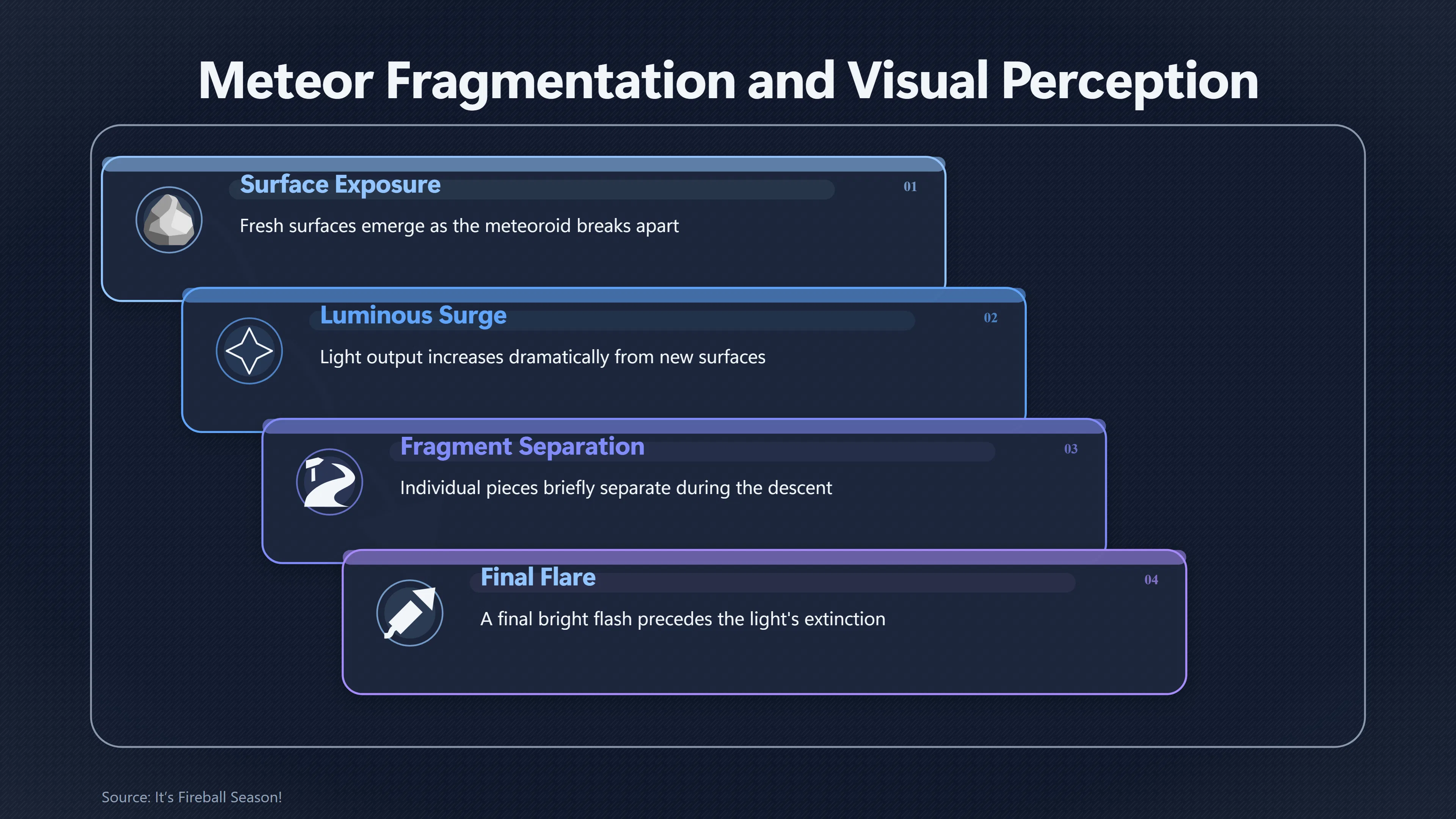
Many Kecksburg witnesses described changes in brightness, apparent slowing or unusual motion shortly before the object disappeared.
These impressions are consistent with known behaviour during meteor fragmentation.
As a meteoroid breaks apart:
- fresh surfaces are suddenly exposed;
- light output increases dramatically;
- individual fragments may briefly separate;
- brightness rises and falls rapidly.
To an observer lacking distance cues, these changes can resemble an object braking, hovering momentarily or deliberately altering course. In reality, the apparent reduction in speed often results from perspective. An object travelling partly towards or away from the observer projects less sideways motion across the sky, creating the impression that it has slowed even while continuing at many kilometres per second.[CNEOS]cneos.jpl.nasa.govOpen source on nasa.gov.
The final flare before extinction can reinforce the illusion of touchdown. If the meteor brightens just before disappearing behind the horizon, observers may perceive a controlled descent ending in an impact rather than the natural termination of luminous flight.

Why Independent Reconstructions Matter More Than Individual Impressions
Perspective errors are not evidence that witnesses were mistaken about seeing a brilliant fireball. Rather, they illustrate the limitations of interpreting a three-dimensional atmospheric event from a single viewing position.
Modern meteor investigations rely on multiple independent observations, photographs, videos and timing measurements to reconstruct trajectories. This approach overcomes the distance and perspective errors that affect even honest and attentive eyewitnesses. Fireball reporting organisations explicitly request observations from widely separated locations because only combined geometry can establish where a meteor actually travelled.[International Meteor Organization]imo.netInternational Meteor Organization Fireballs | IMOInternational Meteor Organization Fireballs | IMO
For the Kecksburg event, astronomical analyses using photographs and observations from across the region concluded that the fireball followed a long atmospheric path visible over multiple states. That broader reconstruction provides a more reliable indication of its trajectory than any single report of it disappearing behind nearby woods.
What This Means for the Kecksburg Interpretation
The apparent descent of the fireball towards the Kecksburg area is therefore not, by itself, strong evidence that the visible object physically landed there. Human depth perception is poorly suited to judging brilliant, isolated objects against the sky, particularly near the horizon at dusk.
Within the meteor explanation, the “landing” impression emerges naturally from three interacting factors:
- the absence of reliable distance cues;
- the tendency to use local terrain as a false reference point;
- the changing brightness and fragmentation behaviour of a bolide near the end of its luminous flight.
These well-documented perceptual effects explain why numerous sincere witnesses could independently conclude that the fireball landed nearby while still being consistent with a meteor that remained far from Kecksburg during its visible atmospheric passage.[skyandtelescope.org]skyandtelescope.orgSky & Telescope About Meteors, Meteor Showers, Fireballs and More!Sky & TelescopeAbout Meteors, Meteor Showers, Fireballs and More!November 1, 2012…
Amazon book picks
Further Reading
Books and field guides related to Why Did the Fireball Seem to Land Nearby?. Use these as the next step if you want deeper reading beyond the article.
The Invisible Gorilla: How Our Intuitions Deceive Us
NEW YORK TIMES BESTSELLER • Our minds don’t work the way we think they do. Two renowned psychologists explain how and why our intuitions...
Meteorite
Every rock has a story tell, and none more so than those which have fallen from the sky: meteorites. Originating in the Asteroid Belt bet...
Visual Intelligence: How We Create What We See
A unique, illustrated popular study reveals the way the human eye acts on the visual world not just to represent but to create the things...
eBay marketplace picks
Marketplace Samples
Live-tested eBay searches with available results related to this page.
Selected frommeteor poster oneBay.co.uk.


Endnotes
1.
Source: cneos.jpl.nasa.gov
Link:https://cneos.jpl.nasa.gov/fireballs/intro.html
2.
Source: sma.nasa.gov
Link:https://sma.nasa.gov/news/articles/newsitem/2017/07/11/it-s-a-bird-it-s-a-plane-it-s-a-fireball
3.
Source: nasa.gov
Title: It’s Fireball Season!
Link:https://www.nasa.gov/blogs/watch-the-skies/2026/03/26/its-fireball-season-answering-your-meteor-questions/
Source snippet
Answering Your Meteor Questions - NASAMarch 26, 2026 — WATCH THE SKIES Image Janet Sudnik March 26, 2026 5:18PM CATEGORIES Marshall Space...
Published: March 26, 2026
4.
Source: apod.nasa.gov
Link:https://apod.nasa.gov/apod/ap211012.html
5.
Source: science.nasa.gov
Title: meteors great and small 148692
Link:https://science.nasa.gov/earth/earth-observatory/meteors-great-and-small-148692/
6.
Source: skyandtelescope.org
Title: Sky & Telescope About Meteors, Meteor Showers, Fireballs and More!
Link:https://skyandtelescope.org/stargazing-and-observing/celestial-objects-to-watch/about-meteors/
Source snippet
Sky & TelescopeAbout Meteors, Meteor Showers, Fireballs and More!November 1, 2012...
Published: November 1, 2012
7.
Source: imo.net
Title: International Meteor Organization Fireballs | IMO
Link:https://www.imo.net/observations/fireballs/fireballs/
8.
Source: imo.net
Title: can a meteorite fall trigger a wildfire
Link:https://www.imo.net/can-a-meteorite-fall-trigger-a-wildfire/
9.
Source: curiosidadesmisterios.com
Title: Kecksburg UFO
Link:https://www.curiosidadesmisterios.com/2015/03/kecksburg-ufo-1965.html
10.
Source: decur.org
Title: Kecksburg UFO Incident
Link:https://decur.org/cases/kecksburg-1965
11.
Source: ufoencounters.co.uk
Link:https://www.ufoencounters.co.uk/kecksburg.html
12.
Source: wikidisc.org
Title: Kecksburg UFO incident | Wiki Disc
Link:https://www.wikidisc.org/wiki/Kecksburg_UFO_incident
Additional References
13.
Source: nature.com
Link:https://www.nature.com/articles/367624a0
Source snippet
The orbit and atmospheric trajectory of the Peekskill meteorite from video records | Nature...
14.
Source: theblackvault.com
Title: the vault files the 1965 kecksburg pennsylvania crash
Link:https://www.theblackvault.com/casefiles/the-vault-files-the-1965-kecksburg-pennsylvania-crash/
Source snippet
The Vault Files: The 1965 Kecksburg, Pennsylvania Crash - The Black Vault Case FilesAugust 1, 2025 — THE VAULT FILES: THE 1965 KECKSBURG...
Published: August 1, 2025
15.
Source: nationalgeographic.com
Title: Video shows fireball meteor explode in broad daylight
Link:https://www.nationalgeographic.com/science/article/fireball-meteors
Source snippet
How rare is this cosmic phenomenon? | National GeographicJune 27, 2025 — VIDEO SHOWS FIREBALL METEOR EXPLODE IN BROAD DAYLIGHT. HOW RARE...
Published: June 27, 2025
16.
Source: youtube.com
Title: Nearly 50 years later, Kecksburg UFO sighting remains mystery
Link:https://www.youtube.com/watch?v=VM68dQjp4-M
Source snippet
The Kecksburg UFO Mystery This video explores the 1965 Kecksburg event, examining how observers interpreted the bright fireball descendin...
17.
Source: youtube.com
Title: The Kecksburg UFO Mystery: Secrets, Witnesses and Vanished Evidence
Link:https://www.youtube.com/watch?v=vkZszbMzl3Q
Source snippet
The 1965 Kecksburg Incident: A UFO Crash the Government Hides to This Day...
18.
Source: youtube.com
Link:https://www.youtube.com/watch?v=ruKDXL13lk8
Source snippet
The Kecksburg Incident: What Really Happened Here?...
19.
Source: thecoldfile.com
Title: 1965 kecksburg
Link:https://www.thecoldfile.com/articles/1965-kecksburg/
Source snippet
The Acorn in the Woods: The 1965 Kecksburg Incident | The Cold FileMay 25, 2026 — UFO/UAP / Case file / Filed May 25, 2026 THE ACORN IN T...
Published: May 25, 2026
20.
Source: researchgate.net
Link:https://www.researchgate.net/publication/234395682_Video_observations_of_the_Peekskill_meteorite_fireball_Atmospheric_trajectory_and_orbit
21.
Source: sciencedirect.com
Link:https://www.sciencedirect.com/science/article/abs/pii/S0032063316302288
22.
Source: uapmurders.com
Link:https://uapmurders.com/uaps/Details/John_Murphy/