Within Search Failure
Why Huge Fireballs Can Leave Almost Nothing
A spectacular fireball can lose nearly all its mass before the surviving fragments ever reach the ground.
On this page
- How ablation and break up destroy incoming mass
- What Zdar nad Sazavou and Tagish Lake reveal
- Why missing large fragments do not disprove a meteor
Page outline Jump by section
Introduction
One of the most persistent misconceptions in meteorite hunting is that a spectacular fireball should leave behind a spectacular rock. In reality, the opposite is often true. The brilliant light that makes a fireball memorable usually marks the rapid destruction of the incoming object, not its survival. By the time the glowing flight ends, much of the original mass has been converted into vapour, molten droplets and tiny fragments, while any surviving meteorites may be scattered over a wide area and weigh only a few grams. This is an important consideration when assessing events such as the Kecksburg incident. The absence of a large recovered object does not, by itself, rule out a meteoritic origin, because modern observations show that even very bright fireballs can leave only small, difficult-to-find meteorites.[Wiley Online Library]onlinelibrary.wiley.comWiley Online LibraryThe Žďár nad Sázavou meteorite fall: Fireball trajectory, photometry, dynamics, fragmentation, orbit, and meteorite r…
How ablation and break-up destroy incoming mass
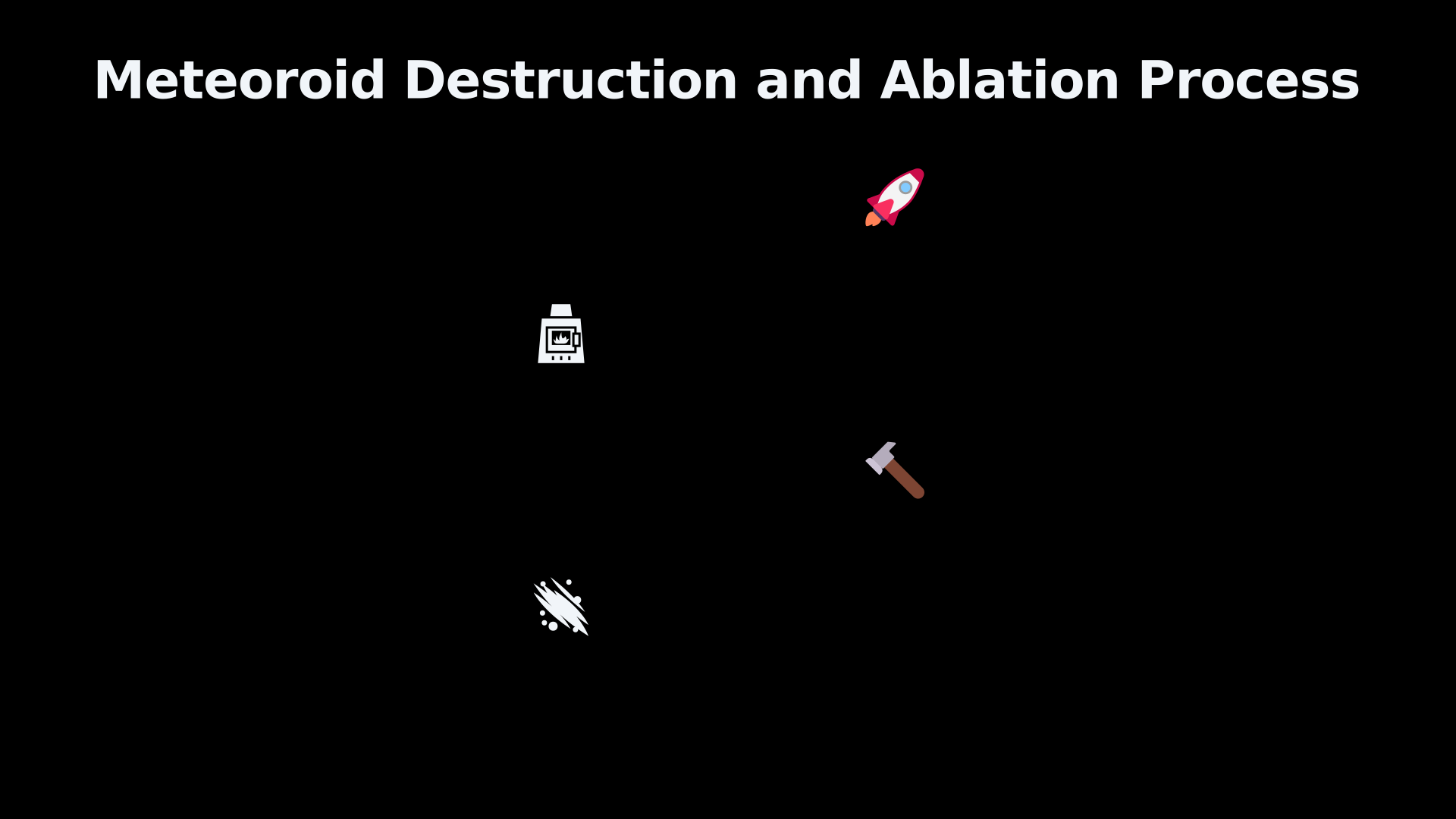
A meteoroid enters Earth’s atmosphere at several kilometres per second, compressing the air ahead of it to extremely high temperatures. Contrary to a common misconception, the object is not simply “burning”. Instead, intense heating causes its outer layers to melt and vaporise in a process known as ablation. The glowing plasma surrounding the body creates the visible fireball.
At the same time, aerodynamic forces increase dramatically as the atmosphere becomes denser. If the meteoroid contains fractures, pores or weakly bonded regions—as many do—the pressure can exceed its structural strength. Rather than remaining a single rock, it breaks apart into many smaller pieces.
This fragmentation accelerates destruction because:
- each new fragment exposes fresh surface area to heating;
- smaller fragments lose mass much more rapidly through ablation;
- repeated break-up creates cascades of ever smaller particles;
- some material is converted directly into vapour and microscopic dust rather than surviving as recoverable stone.
The brightness of a fireball therefore reflects the rate at which kinetic energy is being released, not the amount of rock that will ultimately reach the ground. An exceptionally bright event may simply indicate that the incoming body is being destroyed very efficiently.[Wiley Online Library]onlinelibrary.wiley.comWiley Online LibraryThe Žďár nad Sázavou meteorite fall: Fireball trajectory, photometry, dynamics, fragmentation, orbit, and meteorite r…
This distinction is especially important in historical investigations. Witnesses naturally associate a brilliant display with a massive impact, yet physics shows that the most visually impressive phase may coincide with the greatest loss of mass.
What Žďár nad Sázavou and Tagish Lake reveal
Instrumentally observed meteorite falls provide some of the clearest demonstrations that spectacular fireballs can leave remarkably little recoverable material.
Žďár nad Sázavou: a large incoming body, tiny recovered stones
The Czech fireball at Žďár nad Sázavou in December 2014 was recorded by multiple dedicated fireball cameras, allowing researchers to reconstruct its flight in exceptional detail.
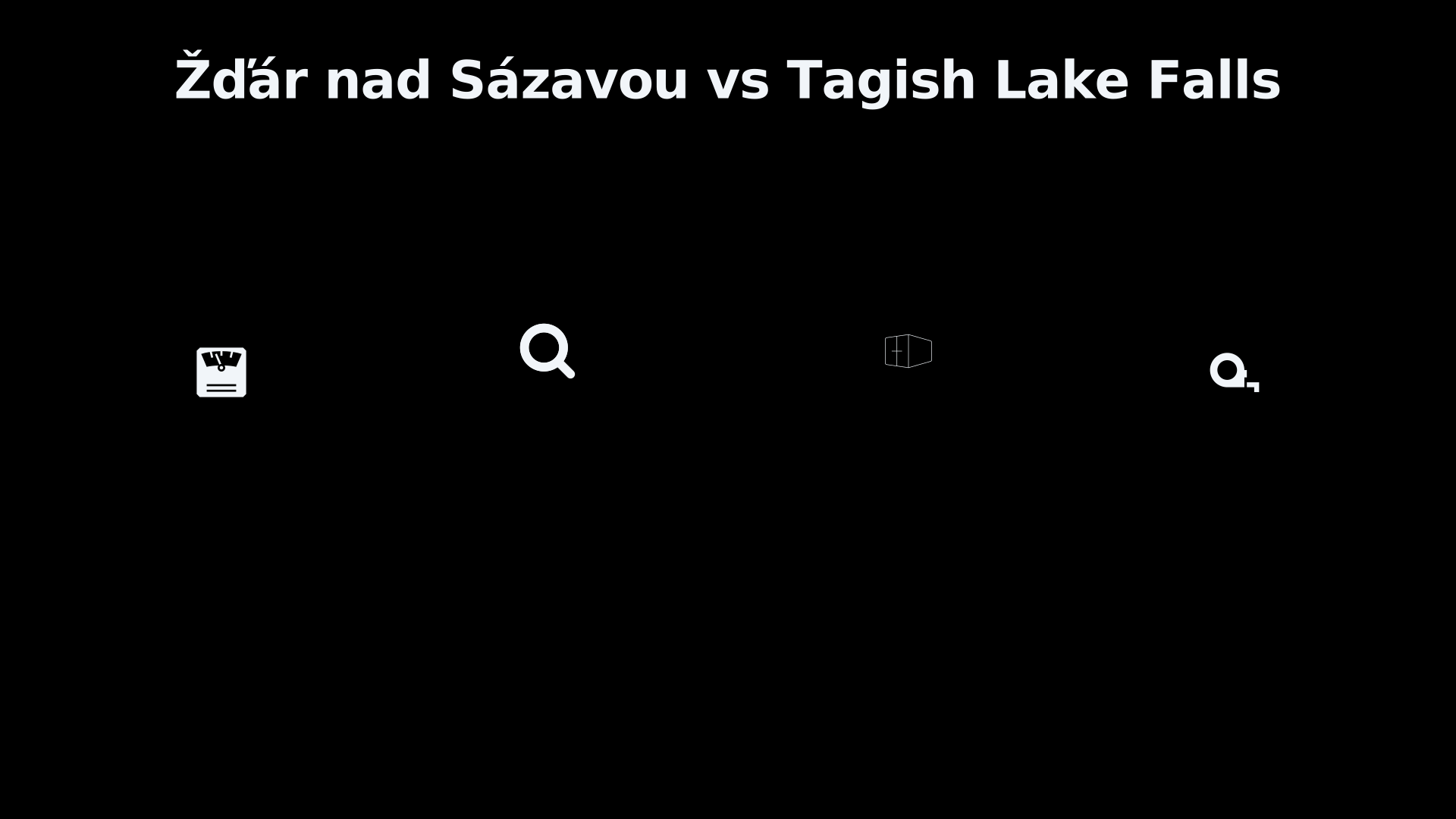
Analysis indicated an original meteoroid of about 150 kilograms. During atmospheric entry it fragmented repeatedly, beginning under surprisingly low aerodynamic pressure, and modelling showed extensive destruction before the luminous flight ended. Despite the size of the incoming object and the dramatic fireball, only three meteorites with a combined mass of 87 grams had been recovered when the study was published. Importantly, those small finds matched the predicted fall locations extremely well, showing that the modest recovery reflected genuine atmospheric destruction rather than a failed search.[Wiley Online Library]onlinelibrary.wiley.comWiley Online LibraryThe Žďár nad Sázavou meteorite fall: Fireball trajectory, photometry, dynamics, fragmentation, orbit, and meteorite r…
The researchers also noted that fragmentation models predicted numerous additional very small meteorites that would be increasingly difficult to locate, illustrating how quickly recoverable evidence becomes dispersed.[Wiley Online Library]onlinelibrary.wiley.comWiley Online LibraryThe Žďár nad Sázavou meteorite fall: Fireball trajectory, photometry, dynamics, fragmentation, orbit, and meteorite r…
Tagish Lake: enormous fireball, fragile survivors
The Tagish Lake fall in Canada provides an even more dramatic example.
The incoming object was estimated to have had a pre-atmospheric mass measured in tens of tonnes, producing an exceptionally bright fireball witnessed over a wide region. Yet the meteorite consisted of unusually fragile carbon-rich material that fragmented extensively. Although more than 10 kilograms of meteorites were eventually recovered, this represented only a minute fraction of the original mass. The fragments were spread across a strewn field at least 16 kilometres long, with many small pieces landing on frozen lake ice.[Wiley Online Library]onlinelibrary.wiley.comOnline Library The fall and recovery of the Tagish Lake meteoriteWiley Online LibraryThe fall and recovery of the Tagish Lake meteorite - Hildebrand - 2006 - Meteoritics & Planetary Science - Wiley Onli…
The first aerial searches found no obvious impact crater or large surviving object despite the spectacular atmospheric event. Only careful ground searches later recovered hundreds of relatively small meteorites.[Astrobiology NASA]astrobiology.nasa.govAstrobiology NASANASA Astrobiology InstituteJanuary 28, 2002…
Together, these cases demonstrate that there is no simple relationship between how impressive a fireball appears and the size of any meteorites eventually recovered.
Why missing large fragments do not disprove a meteor
When a search fails to uncover a large meteorite, it is tempting to conclude that no meteor ever reached the ground. Modern meteor science shows that this conclusion is not justified.
Several independent mechanisms reduce the likelihood of finding a large surviving body:
- Most of the original mass may never reach the surface, having been lost through ablation and vaporisation.
- Repeated fragmentation produces hundreds or thousands of small stones instead of one obvious object.
- Dark flight begins once fragments stop glowing, allowing winds to separate them before they land.
- Small meteorites are easily overlooked, especially in forests, fields, water, snow or rough terrain.
- Weak carbonaceous meteorites may fragment further on impact or weather rapidly after landing.[arxiv.org]arxiv.orgDarkflight estimates of meteorite fall positions: issues and a case study using the Murrili meteorite fallAugust 10, 2021…
For investigations such as the Kecksburg incident, this means that a negative meteorite search has limited evidential value by itself. It cannot establish that no meteoritic material reached the ground, nor does it require an alternative explanation such as the removal of a large intact object. Instead, it demonstrates a well-established feature of meteorite recovery: the most conspicuous event often leaves the least conspicuous physical evidence.
Understanding this mechanism helps explain why eyewitnesses may accurately report an exceptionally bright descending fireball while searchers later recover only tiny meteorites—or none at all—even when the atmospheric event itself is beyond dispute.[Wiley Online Library]onlinelibrary.wiley.comWiley Online LibraryThe Žďár nad Sázavou meteorite fall: Fireball trajectory, photometry, dynamics, fragmentation, orbit, and meteorite r…
Amazon book picks
Further Reading
Books and field guides related to Why Huge Fireballs Can Leave Almost Nothing. Use these as the next step if you want deeper reading beyond the article.
Field Guide to Meteors and Meteorites
What is unique about Richard Norton's book is that it is both a field guide to observing meteors, and also a field guide to locating, pre...
Meteorites and their Parent Planets
Thoroughly revised second edition of a highly successful book describing all aspects of meteorites.
Rocks from Space: Meteorites and Meteorite Hunters
Appendices A-C: Meteorite verification laboratories, Commercial meteorite dealers, Selected list of suspected impact craters worldwide.
Meteorites: Their Impact on Science and History
What are these strange rocks that fall from the sky? Where do they come from? Are they a threat? What are they made of? How common are th...
eBay marketplace picks
Marketplace Samples
Live-tested eBay searches with available results related to this page.
Selected frommeteorite display specimen oneBay.co.uk.


Endnotes
1.
Source: onlinelibrary.wiley.com
Link:https://onlinelibrary.wiley.com/doi/full/10.1111/maps.13444
Source snippet
Wiley Online LibraryThe Žďár nad Sázavou meteorite fall: Fireball [trajectory]({{ 'trajectory/' | relative_url }}), photometry, dynamics, fragmentation, orbit, and meteorite r...
2.
Source: agupubs.onlinelibrary.wiley.com
Link:https://agupubs.onlinelibrary.wiley.com/doi/full/10.1029/2025JE009392
Source snippet
AGU PublicationsDecameter‐Sized Earth Impactors—II: A Bayesian Inference Approach to Meteoroid Ablation Modeling - Chow - 2026 - Journal...
3.
Source: arxiv.org
Link:https://arxiv.org/abs/1912.11784
4.
Source: onlinelibrary.wiley.com
Link:https://onlinelibrary.wiley.com/doi/10.1111/maps.13444
Source snippet
Wiley Online LibraryThe Žďár nad Sázavou meteorite fall: Fireball trajectory, photometry, dynamics, fragmentation, orbit, and meteorite r...
5.
Source: onlinelibrary.wiley.com
Title: Online Library The fall and recovery of the Tagish Lake meteorite
Link:https://onlinelibrary.wiley.com/doi/10.1111/j.1945-5100.2006.tb00471.x
Source snippet
Wiley Online LibraryThe fall and recovery of the Tagish Lake meteorite - Hildebrand - 2006 - Meteoritics & Planetary Science - Wiley Onli...
6.
Source: astrobiology.nasa.gov
Title: Astrobiology NASANASA Astrobiology Institute
Link:https://astrobiology.nasa.gov/nai/articles/2002/1/28/the-tagish-lake-meteorite/index.html
Source snippet
January 28, 2002...
Published: January 28, 2002
7.
Source: arxiv.org
Link:https://arxiv.org/abs/2108.04397
Source snippet
Darkflight estimates of meteorite fall positions: issues and a case study using the Murrili meteorite fallAugust 10, 2021...
Published: August 10, 2021
8.
Source: agupubs.onlinelibrary.wiley.com
Link:https://agupubs.onlinelibrary.wiley.com/doi/abs/10.1029/2025JE009392
9.
Source: onlinelibrary.wiley.com
Link:https://onlinelibrary.wiley.com/doi/abs/10.1111/maps.13460
10.
Source: pnnl.gov
Link:https://www.pnnl.gov/publications/fall-and-recovery-tagish-lake-meteorite
Additional References
11.
Source: youtube.com
Title: Nearly 50 years later, Kecksburg UFO sighting remains mystery
Link:https://www.youtube.com/watch?v=VM68dQjp4-M
Source snippet
Why bright fireballs leave small meteorites ablation fragmentation Meteorite Impact Captured With Sound! #shorts #science #space #milkywa...
12.
Source: youtube.com
Link:https://www.youtube.com/watch?v=F-tvMjwXVJ0
Source snippet
What Happens When a Meteoroid Enters Earth's Atmosphere?: Space, Planets & Moons...
13.
Source: youtube.com
Link:https://www.youtube.com/watch?v=AmhEY4OgFmc
Source snippet
Nearly 50 years later, Kecksburg UFO sighting remains mystery...
14.
Source: youtube.com
Title: Atmospheric Science: The Journey of a Meteor Fireball
Link:https://www.youtube.com/watch?v=Id1V6Vs7pYw
Source snippet
Compositional analysis of meteorite ablation spectra using radiative transfer model (IMC 2025)...
15.
Source: youtube.com
Title: Why Do Only Some Space Rocks Survive Earth’s Atmosphere?
Link:https://www.youtube.com/watch?v=xhUZfbYJdtY
Source snippet
Atmospheric Science: The Journey of a Meteor Fireball...
16.
Source: renfrewshireastro.co.uk
Link:https://renfrewshireastro.co.uk/the-vzvdar-nad-sazavou-meteorite-fall-fireball-trajectory-photometry-dynamics-fragmentation-orbit-and-meteorite-recovery-arxiv1912-11784v1-astro-ph-ep
17.
Source: cosmochemistry-papers.com
Link:https://cosmochemistry-papers.com/2020/02/11/the-zdar-nad-sazavou-meteorite-fall-fireball-trajectory-photometry-dynamics-fragmentation-orbit-and-meteorite-recovery/
18.
Source: cir.nii.ac.jp
Title: nii.ac.jp The fall and recovery of the Tagish Lake meteorite | Ci Nii Research
Link:https://cir.nii.ac.jp/crid/1362544421236939648
19.
Source: lpi.usra.edu
Title: LPIMeteoritical Bulletin: Entry for Tagish Lake
Link:https://www.lpi.usra.edu/meteor/metbull.php?code=23782&lang=en