Within Shock Waves
How Today's Sensors Would Test the Kecksburg Story
Video, radar, infrasound and multiple seismic stations could separate flight-path shocks from fragmentation and test any claimed impact zone.
On this page
- What a modern fireball network would record
- How instruments separate trajectory from breakup
- Which Kecksburg claims could be tested more decisively
Page outline Jump by section
Introduction
If the Kecksburg fireball occurred today, investigators would have far more than eyewitness testimony and a single seismic trace. A modern reconstruction would combine all-sky camera networks, dashboard and security video, weather radar, infrasound arrays, seismic stations, satellite observations and detailed atmospheric modelling into a single trajectory solution. Rather than asking only whether something fell near Kecksburg, researchers could distinguish a continuous hypersonic flight from one or more fragmentation events, estimate the object’s speed and mass, calculate whether meteorites could have survived, and test any claimed impact location against multiple independent datasets. Modern fireball investigations increasingly rely on this multi-sensor approach because no single instrument provides a complete picture.[wiley.com]agupubs.onlinelibrary.wiley.comAGU PublicationsMulti‐Sensor Trajectory Reconstruction of the 24 April 2025 Alaska Fireball and Implications for Planetary Defense - Scam…
What a modern fireball network would record
A fireball comparable to the 9 December 1965 event would probably be observed simultaneously by numerous independent systems.
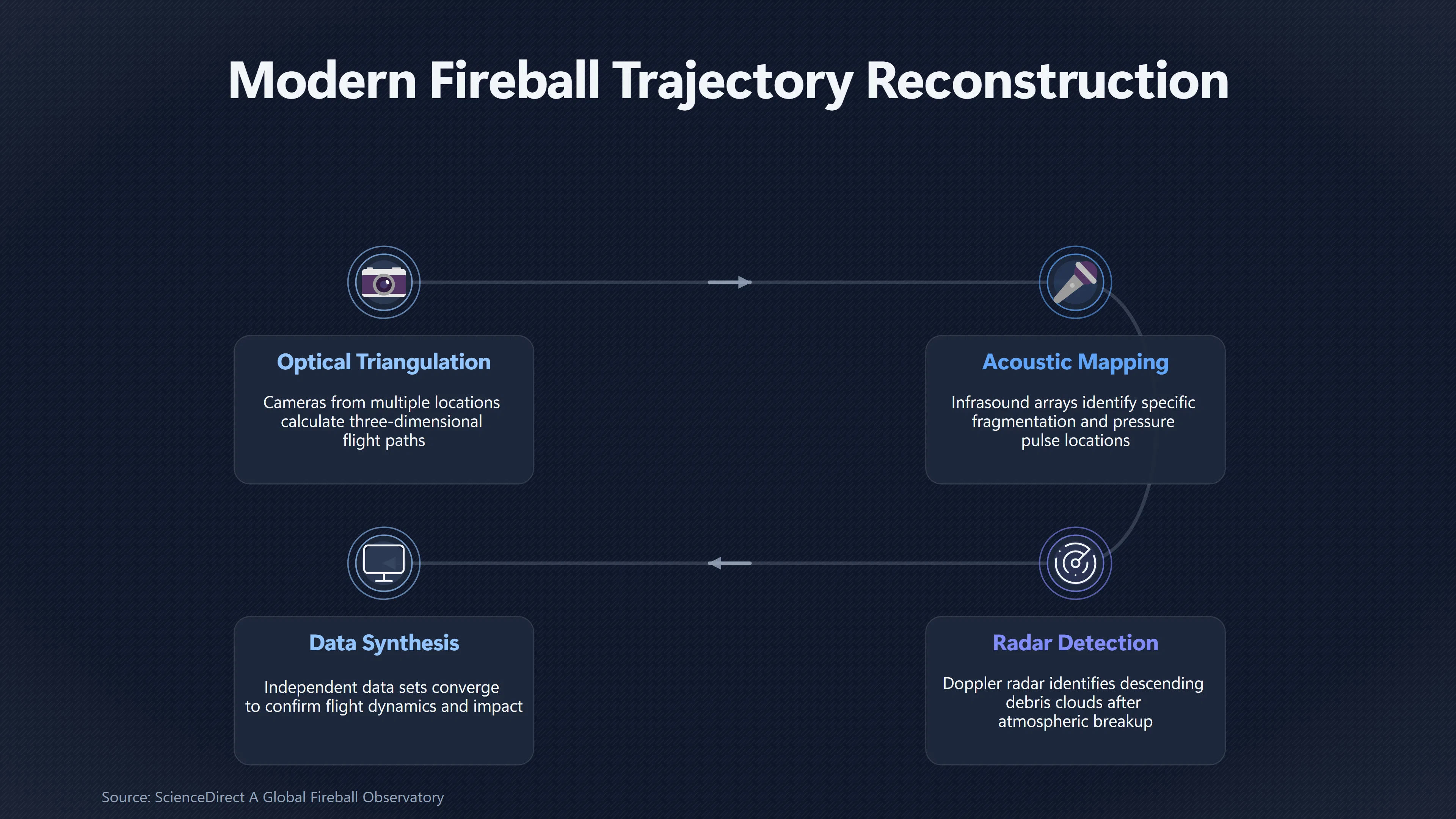
Optical networks would provide the backbone of the reconstruction. Dedicated fireball cameras, now deployed across many countries through organisations such as the Global Fireball Observatory, FRIPON and the UK Fireball Alliance, continuously monitor the sky from multiple locations. By triangulating the same fireball from different viewpoints, researchers can calculate its three-dimensional atmospheric path, entry angle, deceleration and probable pre-atmospheric orbit.[sciencedirect.com]sciencedirect.comScienceDirect A Global Fireball ObservatoryA Global Fireball Observatory - ScienceDirect…
Civilian recordings would add further constraints. Dashboard cameras, doorbell cameras, mobile phones and CCTV footage often capture bright fireballs unintentionally. Even if individual videos lack precise calibration, investigators can determine viewing geometry by comparing stars, buildings or landscape features with survey data. Modern meteorite recoveries increasingly use these opportunistic recordings alongside dedicated scientific instruments.[AGU Publications]agupubs.onlinelibrary.wiley.comAGU PublicationsMulti‐Sensor Trajectory Reconstruction of the 24 April 2025 Alaska Fireball and Implications for Planetary Defense - Scam…
Satellite observations would provide another independent check. Government and weather satellites frequently detect exceptionally bright bolides, allowing estimates of radiant energy, timing and approximate location. NASA’s Center for Near Earth Object Studies (CNEOS) maintains a public catalogue of many such events detected by U.S. Government sensors, although these data are often supplemented with ground observations for greater precision.[CNEOS]cneos.jpl.nasa.govOpen source on nasa.gov.
How instruments separate trajectory from breakup
One of the largest uncertainties in the original Kecksburg investigation concerns whether witnesses experienced a single object in flight, a major atmospheric breakup, or an actual ground impact. Modern sensor networks are specifically designed to distinguish between these possibilities.
Ballistic shock waves versus fragmentation
A hypersonic object continuously generates a ballistic shock wave along its flight path. When the object fragments, each major breakup can produce additional pressure pulses with different arrival times.
Dense infrasound arrays and seismic stations can detect these separate signals. By comparing arrival times at dozens of stations, researchers reconstruct where each acoustic source originated in the atmosphere rather than assuming every loud boom came from the same point. Recent work on the 2025 Alaska fireball demonstrated that multiple fragmentation locations could be mapped using more than 50 seismoacoustic instruments, producing a trajectory that closely matched independent video analysis.[AGU Publications]agupubs.onlinelibrary.wiley.comAGU PublicationsMulti‐Sensor Trajectory Reconstruction of the 24 April 2025 Alaska Fireball and Implications for Planetary Defense - Scam…
For Kecksburg, such analysis could answer questions that remained unresolved in 1965:
- whether reported explosions represented one continuous sonic boom or several fragmentation events;
- whether the strongest acoustic energy originated high in the atmosphere or close to the ground;
- whether witness reports from different towns referred to the same pressure wave reaching them at different times;
- whether any acoustic source was consistent with an actual impact near Kecksburg.
Coupling seismic and acoustic data
Modern investigations also distinguish genuine ground impacts from air-to-ground coupling.
A powerful atmospheric shock wave can produce measurable ground vibrations without any object striking the surface. By combining seismic records with infrasound and atmospheric propagation models, researchers determine whether recorded ground motion originated from an airborne pressure wave or from an impact.
The isolated Detroit-area seismograph available in 1965 provided only limited information. Today, a regional network containing hundreds of broadband seismic stations would allow the timing and direction of coupled acoustic arrivals to be modelled across a wide area, substantially reducing ambiguity.[AGU Publications]agupubs.onlinelibrary.wiley.comAGU PublicationsMulti‐Sensor Trajectory Reconstruction of the 24 April 2025 Alaska Fireball and Implications for Planetary Defense - Scam…
Radar would test whether meteorites survived
Weather radar has become an unexpectedly valuable meteorite recovery tool.[onlinelibrary.wiley.com]onlinelibrary.wiley.comOnline Library Doppler weather radar as a meteorite recovery toolWiley Online LibraryDoppler weather radar as a meteorite recovery tool - FRIES - 2010 - Meteoritics & Planetary Science - Wiley Online Li…
Although radar usually cannot observe the luminous fireball itself, it can sometimes detect slowly falling debris after fragmentation. Researchers have shown that Doppler weather radar can identify descending meteorite clouds, estimate where surviving fragments entered “dark flight” after becoming invisible, and significantly improve searches on the ground.[Wiley Online Library]onlinelibrary.wiley.comOnline Library Doppler weather radar as a meteorite recovery toolWiley Online LibraryDoppler weather radar as a meteorite recovery tool - FRIES - 2010 - Meteoritics & Planetary Science - Wiley Online Li…
In the Alaska 2025 event, researchers first reconstructed the atmospheric trajectory using seismic and infrasound observations, then used Doppler radar to identify the debris cloud independently. Agreement between radar, acoustic reconstruction and video observations strengthened confidence in the final solution.[AGU Publications]agupubs.onlinelibrary.wiley.comAGU PublicationsMulti‐Sensor Trajectory Reconstruction of the 24 April 2025 Alaska Fireball and Implications for Planetary Defense - Scam…
Had comparable radar coverage existed over western Pennsylvania in 1965, investigators could have examined whether any dense debris cloud descended near Kecksburg. A positive radar signature would have narrowed the search area substantially. The absence of such a signature would not necessarily rule out very small fragments, but it would weigh against claims of a large surviving object reaching the ground.
Which Kecksburg claims could be tested more decisively
Modern instrumentation would not automatically resolve every controversy, but it would allow several long-standing claims to be evaluated far more rigorously.
A contemporary investigation could determine with much greater confidence:
- the precise atmospheric trajectory, including whether it passed directly over Kecksburg or merely appeared to do so from local perspectives;
- where significant fragmentation occurred and how much kinetic energy was released;
- whether any surviving meteorites were physically capable of reaching the ground;
- whether an alleged impact location was compatible with reconstructed flight dynamics;
- whether witness-reported sonic booms matched expected arrival times from the reconstructed trajectory;
- whether independently collected optical, radar, seismic and acoustic datasets converged on the same explanation.
Importantly, these methods evaluate measurable physical evidence rather than relying primarily on recollections collected after the event.
What modern reconstruction could—and could not—resolve
Even today’s technology has limits. If no cameras happened to observe the event directly, investigators would rely more heavily on infrasound, seismic stations and satellite detections. Dense cloud cover, complex atmospheric winds or sparse regional sensor coverage can still increase uncertainty.
Nevertheless, recent fireball investigations demonstrate that combining multiple sensor types consistently produces far more reliable trajectory reconstructions than any single dataset alone. Modern planetary defence programmes increasingly treat optical imagery, infrasound, seismic observations, weather radar and atmospheric modelling as complementary rather than competing sources of evidence.[wiley.com]agupubs.onlinelibrary.wiley.comAGU PublicationsMulti‐Sensor Trajectory Reconstruction of the 24 April 2025 Alaska Fireball and Implications for Planetary Defense - Scam…
Applied retrospectively, this approach suggests that the central questions surrounding the Kecksburg fireball would today be investigated as a problem of integrated physical measurement rather than one dominated by witness testimony. While it could not recover missing evidence from 1965, it illustrates how current observational networks would sharply narrow the range of plausible explanations by independently testing trajectory, fragmentation and any claimed impact zone.
Amazon book picks
Further Reading
Books and field guides related to How Today's Sensors Would Test the Kecksburg Story. Use these as the next step if you want deeper reading beyond the article.
Rocks from Space
Appendices A-C: Meteorite verification laboratories, Commercial meteorite dealers, Selected list of suspected impact craters worldwide.
Meteorites
What is unique about Richard Norton's book is that it is both a field guide to observing meteors, and also a field guide to locating, pre...
The UFO Experience: A Scientific Inquiry
Cited by the New York Review of Books as "the best brief for visitation," this classic study presents an analysis of UFO reports and conc...
eBay marketplace picks
Marketplace Samples
Live-tested eBay searches with available results related to this page.
Selected frommeteor camera lens oneBay.co.uk.
Endnotes
1.
Source: agupubs.onlinelibrary.wiley.com
Link:https://agupubs.onlinelibrary.wiley.com/doi/10.1029/2025JE009440
Source snippet
AGU PublicationsMulti‐Sensor Trajectory Reconstruction of the 24 April 2025 Alaska Fireball and Implications for Planetary Defense - Scam...
Published: April 2025
2.
Source: sciencedirect.com
Title: ScienceDirect A Global Fireball Observatory
Link:https://www.sciencedirect.com/science/article/pii/S0032063319304477
Source snippet
A Global Fireball Observatory - ScienceDirect...
3.
Source: cneos.jpl.nasa.gov
Link:https://cneos.jpl.nasa.gov/fireballs/
4.
Source: fripon.org
Title: www.fripon.org Scientific Goals – www.fripon.org
Link:https://www.fripon.org/scientific-goals/
Source snippet
Goals – www.fripon.org...
5.
Source: onlinelibrary.wiley.com
Title: Online Library Doppler weather radar as a meteorite recovery tool
Link:https://onlinelibrary.wiley.com/doi/full/10.1111/j.1945-5100.2010.01115.x
Source snippet
Wiley Online LibraryDoppler weather radar as a meteorite recovery tool - FRIES - 2010 - Meteoritics & Planetary Science - Wiley Online Li...
6.
Source: agupubs.onlinelibrary.wiley.com
Link:https://agupubs.onlinelibrary.wiley.com/doi/10.1029/2025JE009440?af=R
7.
Source: agupubs.onlinelibrary.wiley.com
Link:https://agupubs.onlinelibrary.wiley.com/doi/full/10.1029/2025JE009440
8.
Source: sciencedirect.com
Title: A comparison of fireball luminous efficiency models using acoustic records
Link:https://www.sciencedirect.com/science/article/pii/S0019103524003105
9.
Source: ntrs.nasa.gov
Link:https://ntrs.nasa.gov/citations/20150009435
10.
Source: ntrs.nasa.gov
Link:https://ntrs.nasa.gov/archive/nasa/casi.ntrs.nasa.gov/20130013869.pdf
11.
Source: ntrs.nasa.gov
Link:https://ntrs.nasa.gov/citations/19880005158
12.
Source: ntrs.nasa.gov
Link:https://ntrs.nasa.gov/citations/19760043537
13.
Source: doi.org
Title: Doppler weather radar as a meteorite recovery tool
Link:https://doi.org/10.1111/j.1945-5100.2010.01115.x
Source snippet
FRIES - 2010 - Meteoritics & Planetary Science - Wiley Online Library...
Additional References
14.
Source: sandia.gov
Link:https://www.sandia.gov/labnews/2026/06/18/how-scientists-support-planetary-defense-by-reconstructing-a-fireballs-path-using-sound-waves/
Source snippet
Sandia National LaboratoriesHow scientists support planetary defense by reconstructing a fireball’s path using sound waves – LabNews...
15.
Source: seismica.library.mcgill.ca
Link:https://seismica.library.mcgill.ca/article/view/2551
Source snippet
mcgill.caSeismo-Acoustic Meteoroid Observation Recording Database (SMORD): A Global Dataset and Deep-Learning Phase Picker for Meteoroid...
16.
Source: neo.ssa.esa.int
Title: NEOEU-ESA Workshop on Meteor Observations for Planetary Defence
Link:https://neo.ssa.esa.int/en/-/eu-esa-workshop-on-meteor-observations-for-planetary-defence
Source snippet
esa.intEU-ESA Workshop on Meteor Observations for Planetary Defence - NEOJuly 22, 2026 — EU-ESA WORKSHOP ON METEOR OBSERVATIONS FOR PLANE...
Published: July 22, 2026
17.
Source: youtube.com
Title: Nearly 50 years later, Kecksburg UFO sighting remains mystery
Link:https://www.youtube.com/watch?v=VM68dQjp4-M
Source snippet
This video explains how scientists track atmospheric re-entries and falling meteors, which provides essential background context on how m...
18.
Source: newsreleases.sandia.gov
Link:https://newsreleases.sandia.gov/how-scientists-support-planetary-defense-by-reconstructing-a-fireballs-path-using-sound-waves/
19.
Source: researchgate.net
Link:https://www.researchgate.net/publication/403209906_Multi-Sensor_Trajectory_Reconstruction_of_the_24_April_2025_Alaska_Fireball_and_Implications_for_Planetary_Defense
Published: April 2025
20.
Source: research.curtin.edu.au
Link:https://research.curtin.edu.au/sstc/what-we-do/dfn/
21.
Source: youtube.com
Title: How To Recognize Space Rocks vs Satellites
Link:https://www.youtube.com/watch?v=y5bYAjCMcwM
Source snippet
The AllSky7 Fireball Network Germany - Sirko Molau...
22.
Source: youtube.com
Title: Fireball over the Netherlands
Link:https://www.youtube.com/watch?v=BLw5ngNRPGM
Source snippet
Nearly 50 years later, Kecksburg UFO sighting remains mystery...
23.
Source: youtube.com
Title: How Weather Radars Track Meteorites
Link:https://www.youtube.com/watch?v=EcC6IoqkjDQ
Source snippet
How To Recognize Space Rocks vs Satellites...