Within Visual Illusion
Can a Late Boom Point to the Wrong Place?
A boom heard after the flash can be linked to the wrong place because sound arrives much later than light.
On this page
- Why sound trails far behind the visible fireball
- How witnesses connect noise with local landmarks
- Using timing and geography to test boom reports
Page outline Jump by section
Introduction
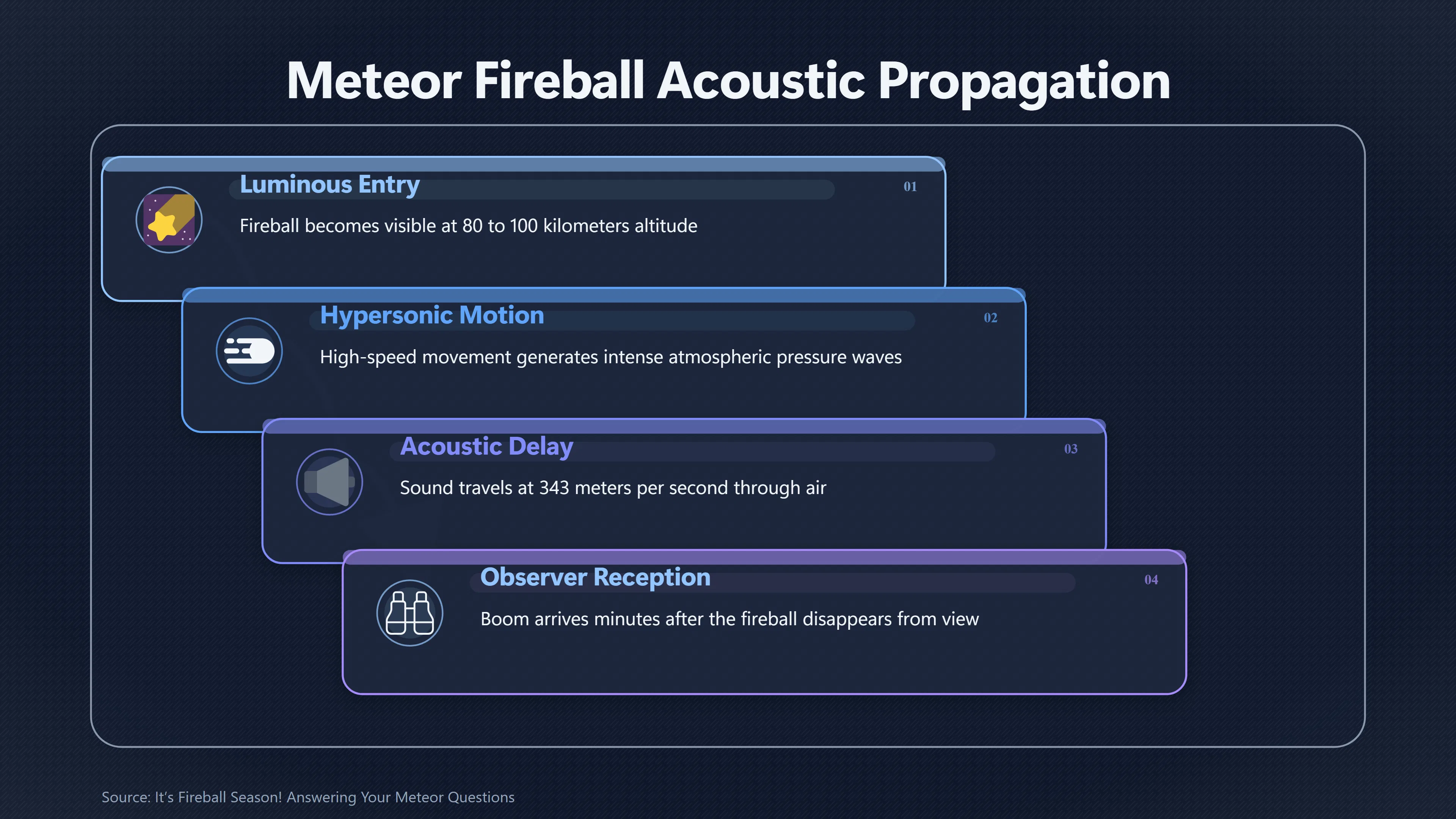
One reason bright fireballs are so often believed to have landed nearby is that the sound arrives long after the light. Light from a meteor reaches an observer effectively instantaneously, but the pressure wave generated by a large fireball travels at the speed of sound. Depending on the fireball’s altitude and distance, the boom may not arrive until tens of seconds or even several minutes after the object has disappeared from view.[NASA]nasa.govIt’s Fireball Season! Answering Your Meteor QuestionsIt’s Fireball Season! Answering Your Meteor Questions - NASAMarch 26, 2026…
In incidents such as the Kecksburg event, this delay can unintentionally reinforce a false impression that the object struck a particular hill, woodland or valley. Witnesses naturally associate the loud noise with the place where they last saw the fireball, even though the shock wave may have originated many kilometres away along the object’s atmospheric path rather than at an impact point.
Why Sound Trails Far Behind the Visible Fireball
A bright meteor typically becomes luminous at altitudes of roughly 80 to 100 kilometres and often ceases glowing while still tens of kilometres above the ground. Even after the visible flight ends, the pressure wave produced by its hypersonic motion and fragmentation must travel through the atmosphere before reaching observers.[NASA]nasa.govIt’s Fireball Season! Answering Your Meteor QuestionsIt’s Fireball Season! Answering Your Meteor Questions - NASAMarch 26, 2026…
Because sound travels at only about 343 metres per second under typical conditions, a witness located:
- 10 km from the source may hear the boom about 30 seconds later.
- 30 km away may wait around 90 seconds.
- 60 km away may not hear anything for nearly three minutes.
These figures vary with the geometry of the flight path, atmospheric temperature and wind, but they illustrate why a spectacular fireball can vanish completely before any sound is heard. The delay is therefore expected rather than unusual.[USGS]usgs.govSonic Booms | U.S. Geological SurveySonic Booms | U.S. Geological Survey…
For exceptionally energetic bolides, fragmentation can produce multiple pressure waves, leading witnesses to report a sequence of bangs, rumbles or house-shaking shocks rather than a single explosion.[NASA]nasa.govIt’s Fireball Season! Answering Your Meteor QuestionsIt’s Fireball Season! Answering Your Meteor Questions - NASAMarch 26, 2026…
Why Witnesses Connect the Boom to Nearby Landmarks
Human perception naturally combines events that occur close together in time. After watching a brilliant object disappear behind a ridge or into a patch of woodland, a witness who hears a loud boom moments later is likely to conclude that the sound came from that same location.
Several factors strengthen this mistaken association:
- The visible endpoint becomes mentally fixed. People remember where the fireball disappeared behind the landscape rather than where it actually was in three-dimensional space.
- The boom seems local. Low-frequency shock waves can rattle windows or shake buildings, creating the feeling that the source must have been nearby.
- The brain expects cause and effect. A disappearing object followed by a loud crash resembles familiar experiences such as fireworks or aircraft accidents.
None of these reactions requires inaccurate observation. The witness may accurately report both the visual disappearance and the later boom, yet still connect two events that originated in different places.
This is particularly important when reconstructing reports from historical cases such as Kecksburg, where many independent observers sincerely believed they knew where the object had come down despite viewing the same fireball from widely separated locations.
Why the Boom Does Not Identify the Impact Site
A meteor’s shock wave is produced throughout part of its atmospheric flight rather than exclusively at a final impact point. If fragmentation occurs high in the atmosphere, the strongest pressure wave may originate well before the object’s last visible position.
Atmospheric conditions complicate matters further. Temperature layers and wind can refract sound, allowing booms to travel unusually long distances or appear stronger in unexpected places. Some areas may hear nothing, while others much farther away experience powerful shocks. The USGS notes that atmospheric conditions such as temperature inversions can significantly affect how far sonic booms propagate.[USGS]usgs.govSonic Booms | U.S. Geological SurveySonic Booms | U.S. Geological Survey…
Consequently, a loud boom in one town does not imply that any surviving meteorites landed nearby.
Using Timing and Geography to Test Boom Reports
Investigators treat delayed sound as one piece of evidence rather than proof of an impact location. Several checks help determine whether a reported landing site is plausible.
Compare the delay. If witnesses describe hearing the boom one or two minutes after the fireball vanished, the source was almost certainly many kilometres away. An immediate explosion would suggest a much closer event.
Map independent observations. If observers in different towns each believed the object landed behind their own local ridge, the reports reveal a perspective effect rather than multiple impact sites.
Separate the visible endpoint from the acoustic source. Modern meteor investigations reconstruct trajectories using photographs, videos, satellite observations and calibrated witness reports. The resulting flight path frequently shows that the strongest sonic boom originated far from where many witnesses thought the object landed.
Check for physical evidence. Genuine meteorite falls produce consistent trajectory calculations and, when fragments survive, a predicted strewn field. A boom alone is insufficient evidence for an impact.

What This Means for the Kecksburg Incident
Within the broader question of why the Kecksburg fireball appeared to land near the village, delayed sonic booms provide an important caution. A loud report heard after the light disappeared is entirely consistent with a distant atmospheric fireball and does not by itself establish where, or even whether, an object reached the ground.
This does not determine every aspect of the Kecksburg incident, but it explains why sincere eyewitnesses could confidently associate a later boom with nearby woods even if the pressure wave originated high in the atmosphere and many kilometres away. Understanding the gap between the arrival of light and the arrival of sound helps separate genuine observations from the intuitive—but often misleading—inference that the boom marks the point of impact.
Amazon book picks
Further Reading
Books and field guides related to Can a Late Boom Point to the Wrong Place?. Use these as the next step if you want deeper reading beyond the article.
The Science of Sound
Written for students without a background in mathematics or physics, this textbook provides an introduction to the study of acoustics. It...
Rocks from Space
Appendices A-C: Meteorite verification laboratories, Commercial meteorite dealers, Selected list of suspected impact craters worldwide.
Fundamentals of Acoustics
Dargestellt werden die physikalischen und mathematischen Konzepte zur Beschreibung der Erzeugung, Weiterleitung und Wahrnehmung von Schal...
eBay marketplace picks
Marketplace Samples
Live-tested eBay searches with available results related to this page.
Selected frommeteor poster oneBay.co.uk.
Current eBay listing
Meteor Italian Locandina Poster Sean Connery Natalie Wood 1979

Current eBay listing
METEOR 1979 70s ORIGINAL MOVIE FILM ART CINEMA PRINT PREMIUM POSTER
Endnotes
1.
Source: nasa.gov
Title: It’s Fireball Season! Answering Your Meteor Questions
Link:https://www.nasa.gov/blogs/watch-the-skies/2026/03/26/its-fireball-season-answering-your-meteor-questions/
Source snippet
It’s Fireball Season! Answering Your Meteor Questions - NASAMarch 26, 2026...
Published: March 26, 2026
2.
Source: usgs.gov
Title: Sonic Booms | U.S. Geological Survey
Link:https://www.usgs.gov/programs/earthquake-hazards/sonic-booms
Source snippet
Sonic Booms | U.S. Geological Survey...
3.
Source: jpl.nasa.gov
Link:https://www.jpl.nasa.gov/news/wisconsin-fireball-caught-on-tape/
Source snippet
NASA Jet Propulsion Laboratory (JPL)Wisconsin Fireball Caught On Tape | NASA Jet Propulsion Laboratory (JPL)...
4.
Source: usgs.gov
Link:https://www.usgs.gov/faqs/how-does-usgs-tell-difference-between-earthquake-and-a-sonic-boom
Source snippet
How does the USGS tell the difference between an earthquake and a sonic boom? | U.S. Geological Survey...
5.
Source: earthquake.usgs.gov
Link:https://earthquake.usgs.gov/earthquakes/eventpage/us7000sp6m
Source snippet
Sonic Boom - 6 km NNE of Saint Andrews, South CarolinaMay 28, 2026 — M? SONIC BOOM - 6 KM NNE OF SAINT ANDREWS, SOUTH CAROLINA * 2026-05...
Published: May 28, 2026
6.
Source: science.nasa.gov
Link:https://science.nasa.gov/solar-system/meteors-meteorites/facts/
Source snippet
We call the objects that creates this brilliant effect by different names, depending on where it...
7.
Source: nasa.gov
Title: interesting fact of the month 2021
Link:https://www.nasa.gov/space-science-and-astrobiology-at-ames/interesting-fact-of-the-month-current/interesting-fact-of-the-month-2021/
8.
Source: usgs.gov
Link:https://www.usgs.gov/faqs/what-are-those-booms-i-sometimes-hear-or-during-earthquake
9.
Source: jpl.nasa.gov
Title: instruments image fireball over bering sea
Link:https://www.jpl.nasa.gov/news/nasa-instruments-image-fireball-over-bering-sea/
10.
Source: nasa.gov
Title: Five Years after the Chelyabinsk Meteor: NASA Leads Efforts in Planetary Defense
Link:https://www.nasa.gov/solar-system/five-years-after-the-chelyabinsk-meteor-nasa-leads-efforts-in-planetary-defense/
11.
Source: sma.nasa.gov
Link:https://sma.nasa.gov/news/articles/newsitem/2017/07/11/it-s-a-bird-it-s-a-plane-it-s-a-fireball
12.
Source: nasa.gov
Title: Fireball Lights Pre-Dawn Sky over Arizona
Link:https://www.nasa.gov/centers-and-facilities/marshall/fireball-lights-pre-dawn-sky-over-arizona/
13.
Source: science.nasa.gov
Title: meteor fragments blaze over the ural mountains
Link:https://science.nasa.gov/blogs/earth-matters/2013/02/15/meteor-fragments-blaze-over-the-ural-mountains/
14.
Source: jpl.nasa.gov
Title: additional details on the large feb 15 fireball over russia
Link:https://www.jpl.nasa.gov/news/additional-details-on-the-large-feb-15-fireball-over-russia/
15.
Source: jpl.nasa.gov
Title: fireball over californianevada how big was it
Link:https://www.jpl.nasa.gov/news/fireball-over-californianevada-how-big-was-it/
16.
Source: pubs.usgs.gov
Link:https://pubs.usgs.gov/publication/70048204
17.
Source: pubs.usgs.gov
Link:https://pubs.usgs.gov/publication/ofr9148
18.
Source: usgs.gov
Link:https://www.usgs.gov/programs/earthquake-hazards/earthquake-booms-seneca-guns-and-other-sounds
19.
Source: usgs.gov
Title: Earthquake Hazards
Link:https://www.usgs.gov/programs/earthquake-hazards/science/faqs?page=5
20.
Source: imo.net
Link:https://www.imo.net/observations/fireballs/fireballs/
Additional References
21.
Source: phys.org
Title: Sonic booms from meteors can release the energy of hundreds of tons of TNT
Link:https://phys.org/news/2026-06-sonic-booms-meteors-energy-hundreds.html
Source snippet
Here's how they workJune 20, 2026 — June 20, 2026 SONIC BOOMS FROM METEORS CAN RELEASE THE ENERGY OF HUNDREDS OF TONS OF TNT. HERE'S HOW...
Published: June 20, 2026
22.
Source: nationalgeographic.com
Title: Video shows fireball meteor explode in broad daylight
Link:https://www.nationalgeographic.com/science/article/fireball-meteors
Source snippet
How rare is this cosmic phenomenon? | National GeographicJune 27, 2025 — VIDEO SHOWS FIREBALL METEOR EXPLODE IN BROAD DAYLIGHT. HOW RARE...
Published: June 27, 2025
23.
Source: bostonglobe.com
Title: Meteor causes loud boom in Boston area
Link:https://www.bostonglobe.com/2026/05/30/metro/boom-greater-boston-police/
Source snippet
May 30, 2026 — SONIC BOOM CAUSED BY METEOR ROLLED ACROSS BOSTON AREA SATURDAY AFTERNOON Image: Satellite imagery picks up the density fla...
Published: May 30, 2026
24.
Source: youtube.com
Link:https://www.youtube.com/watch?v=tU7WSHZye5w
Source snippet
'I do believe something happened': Search for answers about Kecksburg UFO in Pennsylvania...
25.
Source: youtube.com
Link:https://www.youtube.com/watch?v=HX_RrO7ZQaU
Source snippet
The Kecksburg Incident: What Really Happened Here?...
26.
Source: youtube.com
Title: The Kecksburg Incident: What Really Happened Here?
Link:https://www.youtube.com/watch?v=BXh2zTD9Kug
Source snippet
Kecksburg UFO Crash: The Untold Story | The Government Lied! | Full Documentary | UFOTV®...
27.
Source: youtube.com
Link:https://www.youtube.com/watch?v=WOsruCpciRk
Source snippet
[Kecksburg UFO incident]({{ 'kecksburg-ufo-incident/' | relative_url }}) fireball sonic boom crash The Kecksburg UFO Incident Defitology...
28.
Source: youtube.com
Link:https://www.youtube.com/watch?v=REsZcbglO3c
Source snippet
The Mysterious Kecksburg UFO Crash Incident in 1965...
29.
Source: af.mil
Link:https://www.af.mil/About-Us/Fact-Sheets/Display/Article/104540/sonic-boom/
30.
Source: nesdis.noaa.gov
Title: earth orbit catching bolides
Link:https://www.nesdis.noaa.gov/news/earth-orbit-catching-bolides