Within Metal Reports
Do the Great Lakes Finds Fit One Fall?
The reported locations, materials and recovery histories do not align cleanly with the narrow pattern expected from one meteorite fall.
On this page
- How real meteorite strewn fields are distributed
- Mapping Livonia, Jackson, Battle Creek and Elyria
- Why inconsistent materials and coordinates weaken the pattern
Page outline Jump by section
Introduction
The reported metal and stone finds from around the Great Lakes do not fit the pattern expected of a single meteorite strewn field. Although a genuine bright fireball crossed the Detroit–Windsor region on 9 December 1965 and was witnessed across several states and Ontario, the subsequent reports of alleged debris from places such as Livonia, Jackson, Battle Creek and Elyria are spread over a much broader area, involve different kinds of materials, and lack the documented recovery chain that normally allows meteorite fragments to be linked to one fall. Modern meteorite recovery methods show that even complex fragmentation produces a physically coherent distribution shaped by the flight path, atmospheric winds and fragment masses, not isolated finds scattered across hundreds of kilometres.[DOI.org]doi.orgMarch 1, 2021…
Within the wider Kecksburg narrative, this distinction matters because regional eyewitnesses saw the same spectacular fireball, but seeing one object in the sky does not demonstrate that every later-reported fragment came from that object. The evidence supporting a single Great Lakes strewn field remains weak when compared with well-documented meteorite falls.
How real meteorite strewn fields are distributed
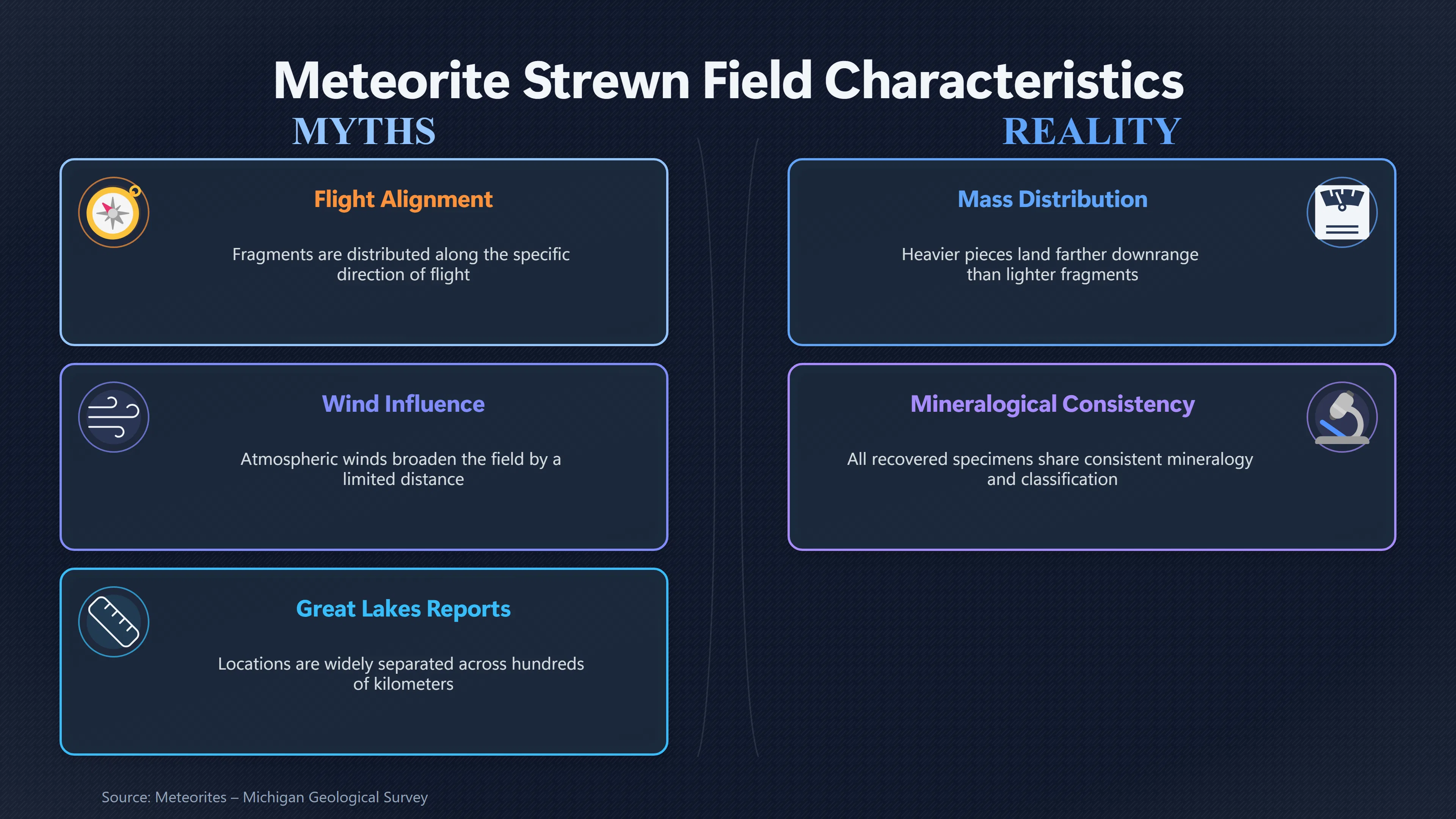
A meteorite strewn field is the area where fragments from one meteoroid reach the ground after breaking apart during atmospheric entry. These fields are not random collections of impact sites. Instead, they display recognisable physical characteristics:
- fragments are distributed along the direction of flight;
- heavier pieces generally land farther downrange than lighter fragments;
- atmospheric winds broaden the field, but normally by only a limited distance;
- all recovered specimens share consistent mineralogy and classification.
Modern recovery teams use fireball observations, atmospheric modelling and wind data to predict these landing zones. Contemporary Monte Carlo modelling demonstrates that while fragmentation can produce irregular clusters, the overall pattern remains geographically coherent. Even relatively complicated falls typically produce strewn fields measured in a few kilometres of width and tens of kilometres of length rather than isolated discoveries across an entire region.[doi.org]doi.orgMarch 1, 2021…
Importantly, recovered fragments from confirmed falls are expected to exhibit similar composition because they originated from the same parent body. Differences in weathering may occur after landing, but radically different reported materials require independent evidence before they can be treated as parts of one event.
Mapping Livonia, Jackson, Battle Creek and Elyria
The reported Great Lakes recoveries associated with the December 1965 fireball do not resemble a single mapped strewn field.
Livonia, Jackson and Battle Creek lie across southern Michigan, while Elyria is in northern Ohio. These reports emerged through different newspapers, different witnesses and different circumstances rather than through one coordinated recovery operation. Some involved alleged metallic fragments, others described stones, while still others centred on fires supposedly caused by falling material.
Several features distinguish these reports from documented meteorite recoveries:
- no continuous search corridor linking the reported locations has been reconstructed;
- no published trajectory predicts a strewn field extending through all of the reported sites;
- no catalogue of scientifically matched fragments connects the locations;
- no recovered specimens have been demonstrated to share identical mineralogical characteristics.
Instead, each report stands largely on its own. The fact that the same fireball was visible over an enormous area means multiple communities could naturally associate unrelated local discoveries with the spectacular event they had just witnessed.
Why inconsistent materials and coordinates weaken the pattern
The strongest difficulty is not simply the distance between reported finds but their inconsistency.
In a confirmed meteorite fall, researchers expect specimens from different parts of the strewn field to represent the same meteoritic material. Differences are normally limited to fragment size, weathering or surface damage. By contrast, the Great Lakes reports describe materials that vary considerably in appearance and circumstance, while many alleged specimens disappeared from public view or were never subjected to published laboratory examination.
Equally significant is the absence of documented provenance. Meteorite science places considerable weight on chain of custody because this establishes that an object was genuinely recovered immediately after a witnessed fall. For the reported Great Lakes fragments, there are generally no detailed field notes, photographed recovery locations, laboratory accession records or peer-reviewed analytical results linking individual objects to the December 1965 fireball.
Michigan’s geological authorities have also remained cautious. The state’s meteorite catalogues recognise only a small number of confirmed Michigan meteorites accumulated through more than a century of scientific documentation. Claims associated with the 1965 fireball have not become accepted additions to that record. The Michigan Geological Survey also notes that industrial slag and other terrestrial materials are frequently mistaken for meteorites, underscoring the need for laboratory confirmation rather than visual similarity alone.[mgs.wmich.edu]mgs.wmich.eduMeteorites – Michigan Geological SurveyMeteorites – Michigan Geological Survey
Comparing the reports with confirmed meteorite falls
Well-documented meteorite falls provide a useful comparison.[imo.net]imo.netSource details in endnotes.
In instrumentally observed modern recoveries, researchers combine camera observations, radar data, atmospheric modelling and field searches to predict landing areas with considerable precision. Once meteorites are recovered, laboratory classification confirms that the specimens belong to the same parent object. Even where modelling contains uncertainty, the recovered fragments reinforce a coherent physical explanation.[doi.org]doi.orgMarch 1, 2021…
The Great Lakes reports associated with the Kecksburg era show the opposite pattern:
CharacteristicConfirmed meteorite strewn fieldGreat Lakes reported findsReconstructed flight pathYesFireball observed, but no unified recovery modelCoherent landing zoneYesWidely separated reported locationsConsistent specimen compositionExpectedReported materials varyDocumented chain of custodyUsually presentGenerally absentLaboratory confirmationStandard practiceLargely unavailable or unpublished
This comparison does not prove that every reported fragment was unrelated to the fireball. It does show that the available evidence does not satisfy the normal scientific criteria for identifying one strewn field.
The most likely historical interpretation
The most economical explanation is that two separate realities became intertwined.
First, an exceptionally bright fireball genuinely crossed the Great Lakes region, attracting thousands of witnesses across Michigan, Ohio, Ontario and neighbouring states. Second, numerous local reports of unusual objects, fires and recovered materials emerged in the following hours and days. Once the event entered regional news coverage, disparate discoveries were naturally interpreted through the lens of the spectacular object everyone had seen overhead.
Without surviving specimens that can be chemically matched, precise recovery documentation, or a physically coherent distribution consistent with meteorite dynamics, the reported finds from Livonia, Jackson, Battle Creek and Elyria cannot presently be treated as components of a single meteorite strewn field. Instead, they remain separate historical claims connected by timing and public perception rather than by demonstrable physical evidence.
Amazon book picks
Further Reading
Books and field guides related to Do the Great Lakes Finds Fit One Fall?. Use these as the next step if you want deeper reading beyond the article.
Rocks from Space: Meteorites and Meteorite Hunters
Appendices A-C: Meteorite verification laboratories, Commercial meteorite dealers, Selected list of suspected impact craters worldwide.
Field Guide to Meteors and Meteorites
What is unique about Richard Norton's book is that it is both a field guide to observing meteors, and also a field guide to locating, pre...
Meteorites: The Story of Our Solar System
Meteorite tells the fascinating story of the stones from outer space scattered across our planet. From the impact that finished off the d...
Meteorite Craters and Impact Structures of the Earth
During its five-billion-year history, Earth has been hit countless times by asteroids and meteorites. Over 150 crater-producing events ha...
eBay marketplace picks
Marketplace Samples
Live-tested eBay searches with available results related to this page.
Selected fromGreat Lakes map print oneBay.co.uk.
Endnotes
1.
Source: doi.org
Link:https://doi.org/10.1093%2Fmnras%2Fstab586
Source snippet
March 1, 2021...
Published: March 1, 2021
2.
Source: academic.oup.com
Link:https://academic.oup.com/mnras/article/503/3/3337/6155056
Source snippet
OUP AcademicDetermination of strewn fields for meteorite falls | Monthly Notices of the Royal Astronomical Society | Oxford Academic...
3.
Source: doi.org
Link:https://doi.org/10.3847/PSJ/ad8b22
Source snippet
Telescope-to-Fireball Characterization of Earth Impactor 2022 WJ1 - IOPscience...
4.
Source: mgs.wmich.edu
Title: Meteorites – Michigan Geological Survey
Link:https://mgs.wmich.edu/education-and-outreach/michigan-geology/meteorites/
5.
Source: mgs.wmich.edu
Title: Meteorites FAQ – Michigan Geological Survey
Link:https://mgs.wmich.edu/education-and-outreach/michigan-geology/meteorites/meteorites-faq/
6.
Source: michigan.gov
Title: State of Michigan Bulletin 5
Link:https://www.michigan.gov/-/media/Project/Websites/egle/Documents/Programs/GRMD/Catalog/02/BU05.PDF?rev=548009b2455f47dbbd9514fdbcfe3176
7.
Source: academic.oup.com
Link:https://academic.oup.com/mnras/article/501/1/1215/5998250
Additional References
8.
Source: appalachianhistorian.org
Link:https://appalachianhistorian.org/the-[kecksburg-ufo-incident
Source snippet
24, 2026 — THE KECKSBURG UFO INCIDENT: PENNSYLVANIA’S SPACE ACORN AND THE NIGHT THE SKY FELL OVER APPALACHIA By Alex Hall / June 24, 2026...
Published: June 24, 2026
9.
Source: theblackvault.com
Title: the vault files the 1965 kecksburg pennsylvania crash
Link:https://www.theblackvault.com/casefiles/the-vault-files-the-1965-kecksburg-pennsylvania-crash/
Source snippet
In the absence of a definitive identification, the Kecksburg incident has invited numerous theories. Here are the leading hypotheses tha...
10.
Source: youtube.com
Link:https://www.youtube.com/watch?v=ruKDXL13lk8
Source snippet
The Kecksburg UFO Mystery: Secrets, Witnesses and Vanished Evidence...
11.
Source: youtube.com
Title: The Kecksburg UFO Mystery: Secrets, Witnesses and Vanished Evidence
Link:https://www.youtube.com/watch?v=vkZszbMzl3Q
Source snippet
Nearly 50 years later, Kecksburg UFO sighting remains mystery...
12.
Source: youtube.com
Title: Nearly 50 years later, Kecksburg UFO sighting remains mystery
Link:https://www.youtube.com/watch?v=VM68dQjp4-M
Source snippet
I FOUND the Meteorite That Exploded Over Salt Lake City...
13.
Source: thecoldfile.com
Title: 1965 kecksburg
Link:https://www.thecoldfile.com/articles/1965-kecksburg/
Source snippet
The Acorn in the Woods: The 1965 Kecksburg Incident | The Cold FileMay 25, 2026 — UFO/UAP / Case file / Filed May 25, 2026 THE ACORN IN T...
Published: May 25, 2026
14.
Source: usgs.gov
Title: I think I found a meteorite. How can I tell for sure? | U.S. Geological Survey
Link:https://www.usgs.gov/faqs/i-think-i-found-a-meteorite-how-can-i-tell-sure
15.
Source: usgs.gov
Title: Meteorites and craters of Campo del Cielo, Argentina | U.S. Geological Survey
Link:https://www.usgs.gov/publications/meteorites-and-craters-campo-del-cielo-argentina
16.
Source: imo.net
Link:https://www.imo.net/observations/fireballs/meteorites/
17.
Source: researchgate.net
Link:https://www.researchgate.net/publication/241472370_The_Dresden_Ontario_H6_Chondrite_Part_II_Classification_Estimated_Fireball_Trajectory_and_Possible_Origin