Within Kecksburg
Why Space Debris Would Trigger a Cordon
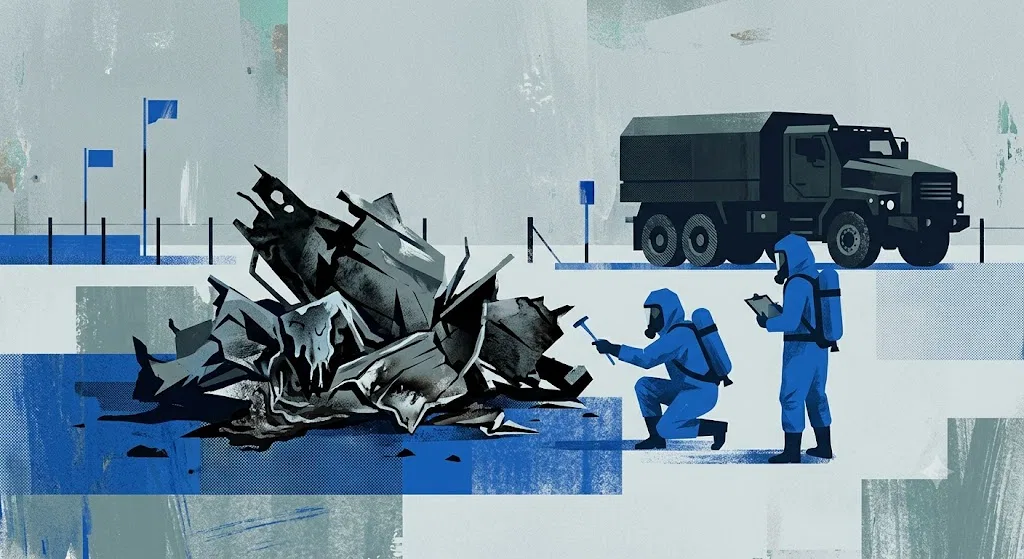
Unknown satellite debris could have carried toxic, explosive or radioactive hazards, making a rapid military response unsurprising.
On this page
- Common re entry hazards
- Military and civil response roles
- Why secrecy is not proof of alien origin
Page outline Jump by section
Introduction
A reported fall of an unknown object near Kecksburg on 9 December 1965 would have presented authorities with a practical safety problem before it became a UFO mystery. Until responders knew whether the object was a meteorite, an aircraft component, a missile part or foreign spacecraft debris, they could not safely assume that it was inert. Space hardware may contain toxic propellants, pressurised vessels, explosive devices, high-energy batteries or radioactive power sources. Restricting access, controlling witnesses, summoning military specialists and removing material for examination would therefore have been defensible precautions.
That does not prove that hazardous debris landed at Kecksburg, or even that an object was recovered there. The surviving evidence is too incomplete for that conclusion. It does mean, however, that reports of a cordon and rapid military interest are compatible with an ordinary Cold War response to an unidentified aerospace hazard. Secrecy would also have protected intelligence methods and potentially valuable foreign technology, not merely public safety.
Common re-entry hazards
Most spacecraft mass does not reach the ground intact. Atmospheric heating breaks up and consumes much of a returning vehicle, but dense or heat-resistant components can survive. Tanks, pressure vessels, engine parts and structural fittings made from titanium, stainless steel or other durable materials are among the items most likely to remain recognisable. Modern re-entry analysis therefore treats surviving fragments as a low-probability but real danger to people, buildings and aircraft. Research on uncontrolled rocket stages estimates that a meaningful proportion of their mass can survive atmospheric passage, although the amount varies greatly with design, trajectory and materials.[esa.int]technology.esa.intESA TechnologyRe-entry SafetyRe-entry Safety covers all aspects concerning human health and environment related to planned or unplanned r…
The more immediate concern for a ground responder is often not the fragment’s impact energy but what remains inside it. An apparently cold metal tank may still be pressurised. Damaged pyrotechnic mechanisms, separation charges or electrical systems may remain unstable. A vessel weakened by heating and impact can rupture when moved, while unfamiliar components may have sharp edges, contaminated surfaces or residues that are impossible to identify visually.
Toxic propellants
Hydrazine and related hypergolic propellants have long been used in spacecraft because they ignite reliably and can remain stored for extended periods. They are also highly toxic and chemically hazardous. NASA describes hydrazine as corrosive, toxic and potentially carcinogenic, with vapour hazards serious enough to require fully enclosed protective suits during normal spacecraft processing. NASA safety studies likewise consider whether hydrazine tanks might rupture during re-entry, disperse their contents in the atmosphere or carry residual propellant to the surface.[nasa.gov]ntrs.nasa.govHypergolic fuels include hydrazine. Per safety guidelines, the clothing should have been treated as hazardous waste…
This matters because a responder in 1965 could not determine the contents of an unknown space component by its shape. Smoke, vapour, scorched vegetation or an unusual smell might indicate harmless heating products, leaking fuel or another chemical reaction. Keeping residents and unprotected firefighters away until specialists arrived would therefore have been prudent even if no one knew precisely what had fallen.
The danger would not require a large spacecraft. A partially intact attitude-control tank or propulsion assembly could contain enough residue to justify isolation. Nor would the absence of flames prove safety: some propellants are most dangerous through inhalation or skin contact rather than spectacular combustion.
Pressure, batteries and explosive devices
Spacecraft also carry systems designed to operate under extreme conditions. Gas bottles, propellant tanks and sealed electronic assemblies may retain stored energy after a crash. Batteries damaged by heat or impact can short-circuit, vent or ignite. Pyrotechnic bolts and cutters used to separate stages, deploy parachutes or release instruments may remain unfired.
These hazards help explain why unidentified aerospace wreckage is not handled like an ordinary fallen tree or loose piece of scrap. A cautious response begins by establishing distance, preventing unnecessary contact and identifying the object remotely where possible. Current hazardous-material rules formalise this principle by treating an actual or threatened release of hazardous substances as an emergency regardless of where it occurs. The precise regulations have changed since 1965, but the underlying operational logic is longstanding: isolate first, identify second and disturb the object only with appropriate expertise.[OSHA]osha.gov1910.120 - Hazardous waste operations and emergency…Emergency response operations for releases of, or substantial threats of relea…
Radioactive power sources
Radioactive material was a particularly credible concern during the early space age. By 1965, the United States and Soviet Union had already developed radioisotope power units for satellites, and the United States had placed the first nuclear reactor in orbit that April aboard SNAP-10A. Nuclear power sources offered long-duration electricity where solar power was inadequate, but launch accidents or uncontrolled orbital decay could return radioactive material to Earth.[facebook.com]facebook.comon this day in 1965 the first satellite ️ powered by nuclear fission was launcheon this day in 1965 the first satellite ️ powered by nuclear fission was launche
Responders would not need evidence that a particular object carried a reactor before taking precautions. The problem was uncertainty. Foreign spacecraft specifications were often secret, tracking data could be incomplete, and debris might be fragmented beyond immediate recognition. International Atomic Energy Agency guidance developed after later incidents advises local authorities confronting suspected nuclear-powered satellite debris to control access, conduct radiation monitoring and avoid approaching or handling fragments without suitable precautions.[Nucleus]gnssn.iaea.orgOpen source on iaea.org.
The 1978 fall of the Soviet nuclear-powered Kosmos 954 satellite over northern Canada later demonstrated that this was not a theoretical scenario. Its re-entry dispersed radioactive debris across a vast region and prompted Operation Morning Light, a joint Canadian-American search and recovery mission. The episode occurred more than twelve years after Kecksburg, so it cannot establish what happened there, but it illustrates why an unidentified spacecraft fall could demand military aircraft, radiation teams, controlled search zones and careful removal procedures.[gwu.edu]nsarchive2.gwu.eduOpen source on gwu.edu.
Why a cordon would be the first move
A cordon serves several functions at once. It protects the public from physical and chemical hazards, preserves evidence, prevents souvenir hunting and gives specialists room to inspect the site. In the Kecksburg setting, wooded terrain and fading December light would have added further uncertainty: responders might not know whether they were dealing with a single object, scattered fragments, burning vegetation or unexploded components.
The sensible initial perimeter would therefore have been larger than the visible object alone. A re-entering spacecraft can fragment along its path, leaving small pieces beyond the principal impact point. Vapour or smoke may move downwind, and vehicles or boots can spread contamination. Even a meteorite fall might require site control if authorities suspected fire, damage or the presence of unfamiliar metallic material.
Contemporary reports and later witness accounts disagree over exactly who controlled the Kecksburg search area, how extensive any restriction was and whether anything was removed. Those disputes should not be resolved merely by assuming that a cordon proves a recovery. Restricting a suspected impact area is precisely what police, firefighters and military personnel would be expected to do while the object’s identity remained unknown.
Military and civil response roles
Local responders would normally arrive first because residents report the impact to police or fire services. Their tasks are immediate and practical: locate the suspected site, assist injured people, suppress fires, keep spectators back and pass observations up the chain of command. They are not expected to identify a foreign satellite or determine whether an unfamiliar pressure vessel contains toxic fuel.
State police can widen the perimeter, manage roads and control access. Public-health or radiation officials may be called when contamination is suspected. The military becomes relevant when the object could be connected to national defence, missile operations, classified American hardware or foreign technology.
During the Cold War, recovered aerospace material had intelligence value as well as safety implications. Declassified State Department and defence communications document American efforts under Project Moon Dust to locate and obtain foreign space debris that survived re-entry. Related arrangements supported the transport and technical examination of recovered material. National Archives records also show that the United States pursued the return of its own space debris when components landed abroad, demonstrating that fallen hardware could trigger diplomatic and intelligence action far beyond routine rubbish removal.[ufotransparency.com]ufotransparency.comOpen source on ufotransparency.com.
This historical machinery is relevant to Kecksburg, but only within limits. It shows that the United States had a genuine interest in recovering descended foreign space vehicles and analysing them at specialised facilities. It does not establish that a Moon Dust team operated at Kecksburg, that the reported object was Soviet or that anything was transported to Wright-Patterson Air Force Base. A known programme must not be converted into proof of involvement in a particular case without supporting records.

Why military personnel might withhold details
Technical uncertainty and secrecy can coexist. Field personnel may be told to secure an area without being told what intelligence analysts suspect. Police and firefighters may receive only the safety instructions necessary for their role. A vehicle carrying recovered material may travel under cover simply to prevent public contact, protect classified equipment or preserve custody of evidence.
Foreign debris presented an additional problem: publicly identifying it could reveal American tracking abilities. Officials might not wish to disclose how accurately they could follow a Soviet spacecraft, how quickly they could mobilise a recovery team or which components interested intelligence analysts. Even confirming that an object was American could expose a classified mission or an embarrassing malfunction.
Such compartmentalisation produces the conditions later associated with UFO stories. Witnesses see military vehicles, restricted roads and guarded material, yet receive no full explanation. Officials issue cautious or apparently contradictory statements because different agencies possess different information. The resulting secrecy may be real while the underlying object remains entirely human-made.
Was hazardous satellite debris likely at Kecksburg?
The hazardous-debris scenario explains why authorities might react quickly; it does not identify the source of the fireball. The failed Soviet Venus probe Kosmos 96 re-entered on 9 December 1965 and has often been proposed as the object involved. The date match is striking, but available trajectory analyses create serious difficulties. The Great Lakes fireball’s steep atmospheric path was reported as more consistent with a natural meteoroid, while tracking information indicates that Kosmos 96 may have decayed earlier than the widely observed event. Uncertainty in historical orbital data prevents every detail from being reconstructed, but the Soviet-probe explanation is not a settled solution.[Wikipedia]WikipediaOpen source on wikipedia.org.
No publicly verified fragment from Kecksburg has been tested and identified as spacecraft material. There is likewise no confirmed evidence that radioactive contamination, toxic propellant or an explosive device was found in the woods. Hazardous space debris should therefore be treated as an operational possibility that could explain precautionary behaviour, not as a proven description of the object.
That distinction is essential. A response can be rational even when the feared hazard turns out not to exist. Emergency decisions are made from the information available at the time, not from conclusions reached decades later. A bright fireball, reports of an impact, smoke in woodland and uncertainty over satellite re-entries would have been enough to justify escalating the search.
Why secrecy is not proof of alien origin
The popular argument often runs in reverse: because authorities allegedly restricted the area and concealed what they found, the object must have been extraordinary. In practice, each reported feature has a conventional explanation consistent with an unidentified aerospace incident.
A guarded perimeter protects people from fuel, pressure vessels, radiation and unstable wreckage. It also preserves a possible crash site.
Military transport is appropriate for classified American hardware or foreign technology requiring technical examination.
Covered cargo prevents exposure, unauthorised photography and loss of small components during movement.
Limited explanations protect intelligence sources and avoid premature claims while identification is incomplete.
Missing or fragmented records may result from routine disposal schedules, unclear agency responsibility or material being filed under a satellite, meteor, emergency-management or intelligence category rather than “Kecksburg UFO”.
None of these explanations proves that a spacecraft landed. They show why secrecy has limited value as evidence of extraterrestrial origin. The National Archives’ summary of Project Blue Book records states that the Air Force found no evidence that investigated unidentified sightings represented technology beyond contemporary scientific knowledge or extraterrestrial vehicles. That institutional conclusion does not settle every witness dispute, but it cautions against treating military interest itself as evidence of alien technology.[National Archives]archives.govNational Archives Project BLUE BOOKNational Archives Project BLUE BOOK
The strongest conclusion is narrower. An unknown object believed to have fallen near Kecksburg could reasonably have been treated as hazardous space debris until proven otherwise. Toxic propellants, explosive components, pressurised systems, radioactive power sources and intelligence-sensitive foreign hardware all offered conventional reasons for a rapid, controlled response. Those mechanisms make the reported cordon understandable without establishing that debris was actually recovered—and without requiring an extraterrestrial explanation.

Amazon book picks
Further Reading
Books and field guides related to Why Space Debris Would Trigger a Cordon. Use these as the next step if you want deeper reading beyond the article.
Ignition!: An Informal History of Liquid Rocket Propellants
John Clark tells here, with irreverent and eyewitness immediacy, the story of the search for a power packaging which could be trusted to...
Space Debris: Models and Risk Analysis
In Space Debris Models and Risk Analysis the authors will provide the reader with a comprehensive background to understand the various so...
Rocket Propulsion Elements
Rating: 4.5/5 from 11 Google Books ratings
Aerospace Engineering/Mechanical Engineering The definitive text on rocket propulsion-now completely revised to reflect rapid advancement...
Skunk Works
This classic history of America's high-stakes quest to dominate the skies is "a gripping technothriller in which the technology is real"...
eBay marketplace picks
Marketplace Samples
Live-tested eBay searches with available results related to this page.
Selected fromsatellite model oneBay.co.uk.

Current eBay listing
Space Satellite Base Building Block MOC Toy Model Set for Kids Gift
Current eBay listing
PROMOTIONAL MARCONI MARECS MARINE COASTAL SATELLITE DIORAMA MODEL
Endnotes
1.
Source: technology.esa.int
Link:https://technology.esa.int/page/re-entry-safety
Source snippet
ESA TechnologyRe-entry SafetyRe-entry Safety covers all aspects concerning human health and environment related to planned or unplanned r...
2.
Source: arxiv.org
Title: arXiv Unnecessary risks created by uncontrolled rocket reentries
Link:https://arxiv.org/abs/2210.02188
3.
Source: ntrs.nasa.gov
Link:https://ntrs.nasa.gov/api/citations/20120002794/downloads/20120002794.pdf
Source snippet
NASA Technical Reports ServerIAC-12-A6.2.18 USING THE DESIGN FOR DEMISE...by RL Kelley · 2012 · Cited by 20 — Since for many vehicles, a...
4.
Source: ntrs.nasa.gov
Link:https://ntrs.nasa.gov/api/citations/20100042352/downloads/20100042352.pdf
Source snippet
Hypergolic fuels include hydrazine. Per safety guidelines, the clothing should have been treated as hazardous waste...
5.
Source: netspublic.grc.nasa.gov
Title: GRC Netspace Description of Proposed Mission
Link:https://netspublic.grc.nasa.gov/main/Juno%20FIN%20NRP%20EA%20Pkg-9-4-08.pdf
Source snippet
0 264. Yes. Liquid hydrazine dispersed at-altitude. No. 0.01. All liquid hydrazine assumed.Read more...
6.
Source: nasa.gov
Title: 4.0 In-Space Propulsion
Link:https://www.nasa.gov/smallsat-institute/sst-soa/in-space_propulsion/
Source snippet
4.0 In-Space Propulsion - NASAExtensive Safety and Handling Requirements: Hydrazine and its derivatives are corrosive, toxic, and pot...
7.
Source: osha.gov
Link:https://www.osha.gov/laws-regs/regulations/standardnumber/1910/1910.120
Source snippet
1910.120 - Hazardous waste operations and emergency...Emergency response operations for releases of, or substantial threats of relea...
8.
Source: standards.nasa.gov
Title: Standard 871924 Annex Revision B 0
Link:https://standards.nasa.gov/sites/default/files/standards/NASA/B//Standard-871924-Annex-Revision-B_0.pdf
9.
Source: facebook.com
Title: on this day in 1965 the first satellite ️ powered by nuclear fission was launche
Link:https://www.facebook.com/iaeaorg/posts/on-this-day-in-1965-the-first-satellite-%EF%B8%8F-powered-by-nuclear-fission-was-launche/608045218031699/
10.
Source: conference.sdo.esoc.esa.int
Link:https://conference.sdo.esoc.esa.int/proceedings/sdc4/paper/42/SDC4-paper42.pdf
11.
Source: text-message.blogs.archives.gov
Title: give us back our junk space debris 1968
Link:https://text-message.blogs.archives.gov/2022/08/09/give-us-back-our-junk-space-debris-1968/
12.
Source: Wikipedia
Link:https://en.wikipedia.org/wiki/Kecksburg_UFO_incident
13.
Source: Wikipedia
Title: Kosmos 96
Link:https://en.wikipedia.org/wiki/Kosmos_96
14.
Source: archives.gov
Title: National Archives Project BLUE BOOK
Link:https://www.archives.gov/research/military/air-force/ufos
15.
Source: archives.gov
Title: Contact the Archival Recovery Program | National Archives
Link:https://www.archives.gov/research/recover/recover-documents-contact.html
16.
Source: archives.gov
Title: Space Exploration
Link:https://www.archives.gov/space
17.
Source: science.nasa.gov
Title: new moon duster will help clean nasa assets in space
Link:https://science.nasa.gov/science-research/science-enabling-technology/technology-highlights/new-moon-duster-will-help-clean-nasa-assets-in-space/
18.
Source: archives.gov
Title: Recovery Procedures | National Archives
Link:https://www.archives.gov/preservation/records-emergency/recovery
19.
Source: aerospace.org
Title: brief history space debris
Link:https://aerospace.org/article/brief-history-space-debris
20.
Source: aerospace.org
Link:https://aerospace.org/article/space-debris-101
21.
Source: bidenwhitehouse.archives.gov
Title: 07 2022 NATIONAL ORBITAL DEBRIS IMPLEMENTATION PLAN
Link:https://bidenwhitehouse.archives.gov/wp-content/uploads/2022/07/07-2022-NATIONAL-ORBITAL-DEBRIS-IMPLEMENTATION-PLAN.pdf
22.
Source: archives.gov
Title: nasa lunar lab
Link:https://www.archives.gov/publications/prologue/2001/winter/nasa-lunar-lab
23.
Source: archives.gov
Link:https://www.archives.gov/about/speeches/2019/one-giant-leap
24.
Source: archives.gov
Link:https://www.archives.gov/publications/prologue/2013/spring/nprc-burnt-in-memory
25.
Source: nasa.gov
Title: van allen probe a to re enter atmosphere
Link:https://www.nasa.gov/missions/van-allen-probes/nasa-van-allen-probe-a-to-re-enter-atmosphere/
26.
Source: orbitaldebris.jsc.nasa.gov
Link:https://orbitaldebris.jsc.nasa.gov/faq/
27.
Source: ntrs.nasa.gov
Link:https://ntrs.nasa.gov/api/citations/19990041784/downloads/19990041784.pdf
28.
Source: sma.nasa.gov
Title: nuclear flight safety
Link:https://sma.nasa.gov/sma-disciplines/nuclear-flight-safety
29.
Source: ntrs.nasa.gov
Link:https://ntrs.nasa.gov/api/citations/20130010239/downloads/20130010239.pdf
30.
Source: ntrs.nasa.gov
Link:https://ntrs.nasa.gov/api/citations/20090029348/downloads/20090029348.pdf
31.
Source: ntrs.nasa.gov
Link:https://ntrs.nasa.gov/api/citations/19930007531/downloads/19930007531.pdf
32.
Source: standards.nasa.gov
Title: JSC 67723 Propulsion Standard Basic Final (1) 0
Link:https://standards.nasa.gov/system/files/tmp/JSC-67723_Propulsion_Standard_Basic_Final%20%281%29_0.pdf
33.
Source: orbitaldebris.jsc.nasa.gov
Link:https://orbitaldebris.jsc.nasa.gov/quarterly-news/pdfs/odqnv17i1.pdf
34.
Source: facebook.com
Link:https://www.facebook.com/groups/spacehipsters/posts/24621613244123560/
35.
Source: facebook.com
Title: the risk of harm coming to anyone on earth is low approximately 1 in 4200 a 1323
Link:https://www.facebook.com/ABCNews/posts/the-risk-of-harm-coming-to-anyone-on-earth-is-low-approximately-1-in-4200-a-1323/1350404946946382/
36.
Source: facebook.com
Title: on aug 11 1960 part of the discoverer 13 satellite became the first human made o
Link:https://www.facebook.com/spacecom/posts/on-aug-11-1960-part-of-the-discoverer-13-satellite-became-the-first-human-made-o/1119519193372097/
37.
Source: facebook.com
Link:https://www.facebook.com/AshleighBanfield/posts/a-former-air-force-general-allegedly-admitted-to-retrieving-alien-spacecraft-and/1523367722484552/
38.
Source: facebook.com
Link:https://www.facebook.com/FOX35Orlando/posts/a-hazardous-materials-incident-prompted-an-emergency-response-at-the-pentagon-on/1584175466401516/
39.
Source: facebook.com
Link:https://www.facebook.com/historyoasis/posts/pennsylvanias-most-famous-ufo-incidentthe-[kecksburg-ufo-incident
40.
Source: facebook.com
Link:https://www.facebook.com/thewalrus/posts/when-cosmos-954a-soviet-satellite-carrying-radioactive-materialcrashed-in-canada/1452810023525474/
41.
Source: Wikipedia
Title: Project Moon Dust
Link:https://en.wikipedia.org/wiki/Project_Moon_Dust
42.
Source: Wikipedia
Title: Space debris
Link:https://en.wikipedia.org/wiki/Space_debris
43.
Source: Wikipedia
Title: Kosmos 954
Link:https://en.wikipedia.org/wiki/Kosmos_954
44.
Source: iaea.org
Title: ensuring safety on earth from nuclear sources in space
Link:https://www.iaea.org/newscenter/news/ensuring-safety-on-earth-from-nuclear-sources-in-space
45.
Source: gnssn.iaea.org
Link:https://gnssn.iaea.org/Superseded%20Safety%20Standards/Safety_Series_119_1996.pdf
46.
Source: nsarchive2.gwu.edu
Link:https://nsarchive2.gwu.edu/nukevault/ebb267/11.pdf
47.
Source: thenorthernreview.ca
Link:https://thenorthernreview.ca/index.php/nr/article/view/754/789
48.
Source: ufotransparency.com
Link:https://ufotransparency.com/files/1961-04-15-project-moon-dust-blue-fly-cables-project-moon-dust-blue-fly-cables
49.
Source: rense.com
Link:https://rense.com/ufo2/kecksburg.htm
50.
Source: cia.gov
Link:https://www.cia.gov/readingroom/document/06935701
51.
Source: nationalarchives.gov.uk
Link:https://www.nationalarchives.gov.uk/about/our-research-and-academic-collaboration/our-research-projects/open-access-research-from-our-staff/the-effectiveness-of-dust-mitigation-and-cleaning-strategies-at-the-national-archives-uk/
52.
Source: nationalarchives.gov.uk
Title: annual report and accounts 2024 25
Link:https://www.nationalarchives.gov.uk/about-us/how-we-work/plans-policies-performance-and-projects/annual-report-and-accounts-2024-25/
53.
Source: www-pub.iaea.org
Link:https://www-pub.iaea.org/MTCD/Publications/PDF/Pub1265web.pdf
54.
Source: iaea.org
Title: draft ds504
Link:https://www.iaea.org/sites/default/files/21/07/draft_ds504.pdf
55.
Source: iaea.org
Title: japan national report 8rm
Link:https://www.iaea.org/sites/default/files/2025-08/japan-national-report-8rm.pdf
56.
Source: gnssn.iaea.org
Link:https://gnssn.iaea.org/main/annur/Activity%20Documents%20%20Public/Regional%20Workshop%20on%20Nuclear%20and%20Radiological%20Emergency%20Preparedness%20and%20Response/Lecture%20D2-4%20US%20National%20Rad%20Emer%20Plan%20KINS%202014.pdf
57.
Source: iaea.org
Link:https://www.iaea.org/sites/default/files/2025-08/korea_rep_of-national-report-8rm.pdf
58.
Source: iaea.org
Link:https://www.iaea.org/inis/collection/NCLCollectionStore/_Public/18/086/18086454.pdf
59.
Source: iaea.org
Link:https://www.iaea.org/sites/default/files/2025-03/serbia-7rm.pdf
60.
Source: allthatsinteresting.com
Title: kecksburg ufo
Link:https://allthatsinteresting.com/kecksburg-ufo
61.
Source: lackenbauer.ca
Title: Operation Morning Light
Link:https://lackenbauer.ca/wp-content/uploads/2022/10/AOH3-OpMorningLight.pdf
62.
Source: qsl.net
Link:https://www.qsl.net/w5www/kecksburg.html
Additional References
63.
Source: youtube.com
Title: A Brief History of: The Kosmos 954 Nuclear Reactor Crash
Link:https://www.youtube.com/watch?v=YN7ifFam1Fk
Source snippet
Daily Space Debris Reentries: Assessing the Risks to Earth...
64.
Source: youtube.com
Title: Daily Space Debris Reentries: Assessing the Risks to Earth
Link:https://www.youtube.com/watch?v=_jqvXhHcRz4
Source snippet
The Kecksburg UFO Case: Finally Solved After 60 Years?...
65.
Source: nrt.org
Link:https://nrt.org/main/Resources.aspx?ResourceSection=2&ResourceType=Hazards+%28Oil%2C+Chemical%2C+Radiological%2C+etc%29
66.
Source: spacepage.be
Link:https://www.spacepage.be/artikelen/buitenaards-leven/ufo-waarnemingen/het-kecksburg-ufo-incident.html
67.
Source: reddit.com
Link:https://www.reddit.com/r/aliens/comments/mlf13o/kecksburg_ufo_incident_solved_it_was_potentially/
68.
Source: researchgate.net
Link:https://www.researchgate.net/publication/368961701_Emergency_management_and_the_final_frontier_Preparing_local_communities_for_falling_space_debris
69.
Source: sacred-texts.com
Link:https://sacred-texts.com/ufo/moondust.htm
70.
Source: lumebooks.co.uk
Link:https://www.lumebooks.co.uk/book/project-moon-dust/
71.
Source: reddit.com
Link:https://www.reddit.com/r/UFOs/comments/oa9mux/project_moon_dust_crashed_ufo_retrieval_program/
72.
Source: hsaj.org
Link:https://www.hsaj.org/articles/17891