Within Space Debris
Why Foreign Space Debris Attracted Military Recovery Teams
Cold War recovery teams sought foreign space hardware for both public safety and the intelligence value of unfamiliar technology.
On this page
- The aims of Project Moon Dust
- How safety and intelligence interests overlapped
- Transport and examination of recovered foreign hardware
Page outline Jump by section
Introduction
During the Cold War, the United States faced a practical problem whenever an unidentified object fell from the sky: before its origin could be established, it might represent both a public safety hazard and a valuable source of foreign technical intelligence. Project Moon Dust emerged from this environment as a classified U.S. Air Force programme dedicated to locating, recovering and exploiting foreign space hardware that survived atmospheric re-entry. Rather than being a UFO investigation programme in its primary purpose, Moon Dust was intended to recover Soviet or other foreign aerospace material that could reveal technological capabilities while ensuring that hazardous debris was handled safely. In the context of the Kecksburg incident, the existence of such a programme demonstrates that rapid military interest in unidentified aerospace debris would have been consistent with established Cold War practice, regardless of whether the recovered object proved to be ordinary space hardware, something foreign, or nothing unusual at all.[Cufon]cufon.orgMoon Dust ICGL4US Air Force Intelligence Guidance Collection Letter No. 4, 25 April 1961April 25, 1961…
The aims of Project Moon Dust
Project Moon Dust was established within the U.S. Air Force’s broader material exploitation programme. Declassified intelligence guidance defined its mission as locating, recovering and delivering “descended foreign space vehicles” for technical examination. Intelligence Collection Guidance Letter No. 4, issued in April 1961, instructed Air Force collection organisations worldwide to report expected foreign satellite re-entries and recover surviving components whenever possible.[Cufon]cufon.orgMoon Dust ICGL4US Air Force Intelligence Guidance Collection Letter No. 4, 25 April 1961April 25, 1961…
The programme served several strategic purposes simultaneously:
- Recover Soviet or other foreign spacecraft components before rival intelligence services could obtain them.
- Examine engineering techniques, manufacturing methods and materials.
- Assess advances in propulsion, guidance, communications and thermal protection.
- Confirm the identity of recovered objects through scientific analysis rather than speculation.
- Prevent potentially dangerous debris from remaining accessible to the public.
This mission reflected the rapid expansion of the Space Race. By the early 1960s, both superpowers were launching increasing numbers of satellites, probes and rocket stages. Although most re-entered harmlessly, some hardware survived atmospheric passage, creating opportunities for intelligence collection as well as safety concerns.[Cufon]cufon.orgMoon Dust ICGL4US Air Force Intelligence Guidance Collection Letter No. 4, 25 April 1961April 25, 1961…
How safety and intelligence interests overlapped
Project Moon Dust illustrates how emergency response and intelligence gathering frequently became the same operation.
When an unidentified object was reported, responders generally could not determine immediately whether it was:
- foreign satellite hardware;
- a missile component;
- experimental aerospace equipment;
- domestic space debris;[youtube.com]youtube.comProject Moon Dust foreign space debris recovery Podcast - Project MOON DUST: The UFO Recovery Team That Didn’t Exist Until It Did Author…
- or simply a meteorite.
Until specialists examined it, every possibility remained open.
From a safety perspective, spacecraft components could contain toxic propellants, pressurised tanks, pyrotechnic devices or radioactive sources. Restricting access protected emergency personnel and civilians from hazards that could not be identified visually.
From an intelligence perspective, every recovered fragment potentially revealed information about another nation’s technological capabilities. Even relatively mundane components—heat shields, alloys, wiring, electronics or pressure vessels—could provide insight into manufacturing quality, materials science and engineering practices. During the Cold War, such information had military as well as scientific value.[Cufon]cufon.orgMoon Dust ICGL4US Air Force Intelligence Guidance Collection Letter No. 4, 25 April 1961April 25, 1961…
Because these two interests aligned, a rapid military recovery did not necessarily imply extraordinary technology. The same security procedures could be justified whether the object ultimately proved to be Soviet hardware, American equipment that had re-entered unexpectedly, or an object whose origin remained uncertain during the initial response.
Transport and examination of recovered foreign hardware
Recovery represented only the beginning of the exploitation process.
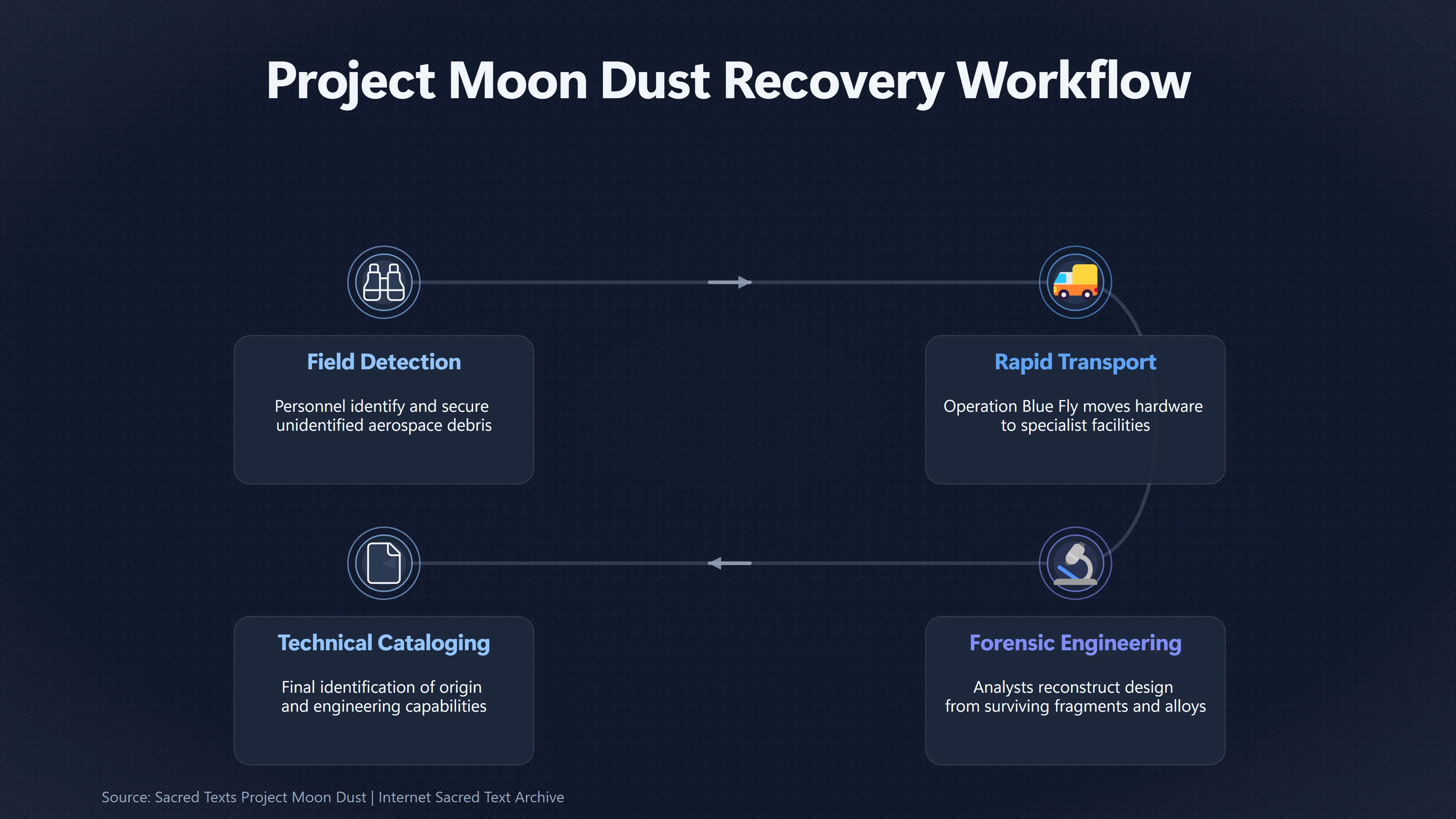
Declassified documents show that Operation Blue Fly functioned as the rapid transport element supporting Project Moon Dust. Once field personnel secured an object considered to possess significant technical intelligence value, Blue Fly’s role was to move it quickly to the Air Force Foreign Technology Division (FTD) at Wright-Patterson Air Force Base or another specialist facility for examination.[Sacred Texts]sacred-texts.comSacred Texts Project Moon Dust | Internet Sacred Text ArchiveSacred Texts Project Moon Dust | Internet Sacred Text Archive
The examination process typically sought to determine:
- the object’s country of origin;
- its intended mission;
- manufacturing techniques;
- structural materials;
- electronic systems;
- propulsion technology;
- and any intelligence value beyond simple identification.
This exploitation process resembled forensic engineering more than accident investigation. Analysts attempted to reconstruct the object’s design and function from surviving fragments while documenting every component that might reveal foreign technological capabilities. Objects of little intelligence value could be identified, catalogued and eventually returned or otherwise disposed of, whereas particularly significant finds received classified technical analysis.[UFO Transparency]ufotransparency.comUFO TransparencyProject Moon Dust / Project Blue Fly, State Department, USAF, and DIA Cables (1967–1972), U.S. Department of State / USAF…
Documented examples of Moon Dust recoveries
Declassified State Department, Air Force and Defence Intelligence Agency correspondence demonstrates that Moon Dust handled recoveries outside the United States as well as domestically.
Among documented examples are:
- Nepal (1968): Metallic fragments whose origin could not initially be identified prompted international diplomatic exchanges before examination determined their nature.
- Chiapas, Mexico (1967–1968): A recovered titanium pressure sphere generated intelligence interest until investigators concluded that it originated from U.S. Titan IIIC launch hardware rather than a foreign vehicle.
- Other international recoveries: Released cables document investigations into recovered aerospace debris across multiple countries whenever unidentified objects entered national territory and required technical assessment.[UFO Transparency]ufotransparency.comUFO TransparencyProject Moon Dust / Project Blue Fly, State Department, USAF, and DIA Cables (1967–1972), U.S. Department of State / USAF…
These cases illustrate an important point: the programme often investigated objects whose identities were initially uncertain but later proved entirely conventional. The classification surrounded the recovery process itself and the intelligence methods involved rather than necessarily implying an extraordinary origin.
What Project Moon Dust means for the Kecksburg incident
Within discussions of the Kecksburg incident, Project Moon Dust is frequently cited because it demonstrates that the U.S. military possessed an organised capability for recovering unidentified aerospace objects during the mid-1960s. That fact is historically well supported by declassified documents.
However, those documents do not establish that Moon Dust operated specifically at Kecksburg, nor do they prove that any object was recovered there. Although later writers have linked the incident to Moon Dust or Operation Blue Fly, publicly available documentary evidence has not confirmed such involvement.[cufon.org]cufon.orgMoon Dust ICGL4US Air Force Intelligence Guidance Collection Letter No. 4, 25 April 1961April 25, 1961…
The programme nevertheless provides an important framework for interpreting reports of military activity. If authorities believed an unidentified object might be foreign space hardware, standard procedures would have favoured:
- securing the impact area;
- restricting civilian access;
- notifying intelligence specialists;
- recovering any debris rapidly;
- transporting it for technical examination under controlled conditions.
Those actions would have been entirely consistent with Cold War policy whether the object ultimately proved to be Soviet space debris, American hardware, or something with a more mundane explanation.

Why Moon Dust remains significant
Project Moon Dust occupies an important place in Cold War history because it demonstrates how space exploration, military intelligence and public safety became closely intertwined. The programme institutionalised the recovery of foreign aerospace hardware at a time when every recovered fragment might yield strategic information.
For studies of hazardous space debris, Moon Dust shows that recovery teams were not responding solely to intelligence opportunities. Unknown spacecraft fragments also presented genuine risks from chemical contamination, stored energy and unfamiliar engineering. Managing those hazards while preserving valuable evidence required rapid, specialised recovery procedures.
In relation to the Kecksburg case, Project Moon Dust therefore provides historical context rather than proof. Its documented existence makes reports of prompt military interest in unidentified aerospace debris plausible within established Cold War practice, while leaving unanswered the central question of what, if anything, actually came down near Kecksburg.[cufon.org]cufon.orgMoon Dust ICGL4US Air Force Intelligence Guidance Collection Letter No. 4, 25 April 1961April 25, 1961…
Amazon book picks
Further Reading
Books and field guides related to Why Foreign Space Debris Attracted Military Recovery Teams. Use these as the next step if you want deeper reading beyond the article.
Deep Black: Space Espionage and National Security
Examines America's "black" space system of satellites that constitutes the nation's most expensive intelligence operation: space espionage.
Skunk Works
This classic history of America's high-stakes quest to dominate the skies is "a gripping technothriller in which the technology is real"...
Rocket Propulsion Elements
Rating: 4.5/5 from 11 Google Books ratings
Aerospace Engineering/Mechanical Engineering The definitive text on rocket propulsion-now completely revised to reflect rapid advancement...
The Wizards of Langley: Inside the CIA's Directorate of Scien...
This text provides a detailed look at the individuals, scientific innovation and bureaucratic warfare behind the scenes at the CIA's Dire...
eBay marketplace picks
Marketplace Samples
Live-tested eBay searches with available results related to this page.
Selected fromAir Force space patch oneBay.co.uk.
Endnotes
1.
Source: cufon.org
Title: Moon Dust ICGL4
Link:https://www.cufon.org/cufon/MoonDustICGL4.htm
Source snippet
US Air Force Intelligence Guidance Collection Letter No. 4, 25 April 1961April 25, 1961...
Published: April 25, 1961
2.
Source: sacred-texts.com
Title: Sacred Texts Project Moon Dust | Internet Sacred Text Archive
Link:https://sacred-texts.com/ufo/moondust.htm
3.
Source: cufon.org
Link:https://cufon.org/cufon/foia_009.htm
4.
Source: ufotransparency.com
Link:https://ufotransparency.com/files/1961-04-15-project-moon-dust-blue-fly-cables-project-moon-dust-blue-fly-cables
Source snippet
UFO TransparencyProject Moon Dust / Project Blue Fly, State Department, USAF, and DIA Cables (1967–1972), U.S. Department of State / USAF...
5.
Source: science.nasa.gov
Title: moon dust
Link:https://science.nasa.gov/moon/moon-dust/
6.
Source: rr0.org
Title: Moon dust
Link:https://rr0.org/org/us/dod/af/projet/MoonDust.html
Additional References
7.
Source: youtube.com
Link:https://www.youtube.com/watch?v=9HZl2Nl1h5U
Source snippet
Project Moon Dust foreign space debris recovery Podcast - Project MOON DUST: The UFO Recovery Team That Didn’t Exist Until It Did Author...
8.
Source: nasa.gov
Title: Views of the 60-foot
Link:https://www.nasa.gov/general/what-a-blast-nasa-langley-begins-plume-surface-interaction-tests/
Source snippet
NASA Begins Moon Mission Plume-Surface Interaction Tests - NASADecember 9, 2025 — 5 Min Read NASA BEGINS MOON MISSION PLUME-SURFACE INTER...
Published: December 9, 2025
9.
Source: youtube.com
Link:https://www.youtube.com/watch?v=0kll7kE91UY
Source snippet
Project Pounce and Moondust: The US Secret Programs Rumoured to Recover UFO Debris...
10.
Source: youtube.com
Link:https://www.youtube.com/watch?v=dnkJwNj7Ijw
Source snippet
Project Blue Fly, Moon Dust, and the Military's Secret UFO Retrieval Teams...
11.
Source: youtube.com
Title: The Kecksburg Incident: What Really Happened Here?
Link:https://www.youtube.com/watch?v=BXh2zTD9Kug
Source snippet
NASA Claim To Have “Lost” Important Wreckage From The [Kecksburg UFO Incident]({{ 'kecksburg-ufo-incident/' | relative_url }}) | UFO Witness...
12.
Source: techport.nasa.gov
Link:https://techport.nasa.gov/projects/106614
Source snippet
ProjectMay 6, 2026 — Flight Opportunities EXPLORING ELECTROSTATIC REGOLITH INTERACTIONS IN LOW-GRAVITY Updated 05/06/26 Comple...
Published: May 6, 2026
13.
Source: techport.nasa.gov
Link:https://techport.nasa.gov/projects/125511
Source snippet
ProjectJanuary 22, 2026 — EXPLORATION LABYRINTH DUST SEALS (XLIDS) Updated 01/22/26 Completed Technology Project 658 views PRO...
Published: January 22, 2026
14.
Source: techport.nasa.gov
Link:https://techport.nasa.gov/projects/154828
Source snippet
ProjectDecember 2, 2025 — EVA and Human Surface Mobility LUNAR DUST LEVEL SENSOR AND EFFECTS ON SURFACES (LDES) Updated 12/02/...
Published: December 2, 2025
15.
Source: techport.nasa.gov
Link:https://techport.nasa.gov/projects/184151
Source snippet
ProjectMay 5, 2026 — ELECTRON BEAM DUST MITIGATION TECHNOLOGY Updated 05/05/26 PROJECT DESCRIPTION [Input][Button: Info] Elect...
Published: May 5, 2026
16.
Source: youtube.com
Title: Project Blue Fly, Moon Dust, and the Military’s Secret UFO Retrieval Teams
Link:https://www.youtube.com/watch?v=vFoi_s001LM
Source snippet
The Kecksburg Incident: What Really Happened Here?...