Within Kecksburg
Why Cold War Secrecy Fuelled the Mystery
Military secrecy, Soviet space failures and classified US programmes made official denials unusually difficult for the public to trust.
On this page
- Space race secrecy
- Classified American programmes
- Why uncertainty encouraged cover up claims
Page outline Jump by section
Introduction
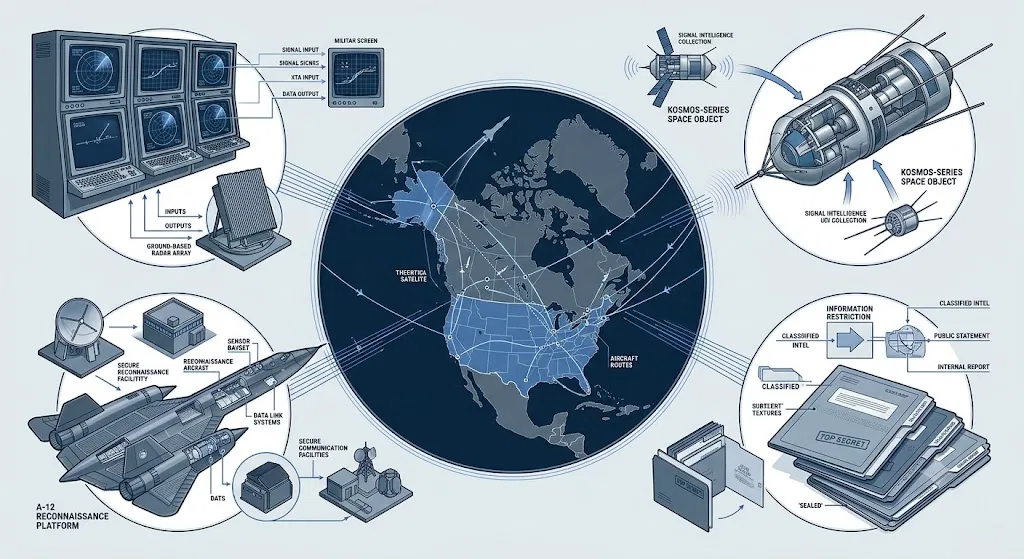
Cold War secrecy made the official response to the Kecksburg incident unusually difficult for many people to trust. When a brilliant fireball crossed the Great Lakes region on 9 December 1965, observers were living in an era of concealed missile tests, covert reconnaissance aircraft, secret satellite programmes and intense competition with the Soviet Union. Both superpowers routinely withheld information about aerospace failures, while American agencies sometimes issued incomplete or misleading public explanations to protect classified operations.[CIA]cia.govU-2 Aircraft "AQUATONE" (1/48 Scale ModelThe United States released an untenable cover story about a weather plane that had wandered off course and claimed that no deliberate att…
That history does not prove that authorities recovered a spacecraft at Kecksburg. It does, however, explain why a military search followed by an assurance that nothing had been found could appear suspicious. The public knew that governments possessed genuine reasons to secure fallen technology, yet had little ability to distinguish legitimate national-security secrecy from bureaucratic confusion or an alleged cover-up. Kecksburg’s enduring mystery grew within that gap.
Space-race secrecy obscured ordinary explanations
The most relevant Soviet connection was Kosmos 96, an unsuccessful probe intended for a Venus mission. Launched on 23 November 1965, it failed to leave low Earth orbit and re-entered the atmosphere on the same date as the Kecksburg fireball. Its unfortunate timing made it an obvious candidate for the object seen over North America, particularly because detailed information about failed Soviet missions was not readily available to the Western public in 1965.[Wikipedia]WikipediaKosmos 96Kosmos 96
The spacecraft’s neutral-sounding name was itself a product of Soviet information management. The broad Kosmos designation was used for missions with many different purposes, including military satellites and unsuccessful planetary attempts whose true objectives were not publicly advertised. Western analysts therefore had to reconstruct the identities and purposes of Soviet launches from tracking data, intercepted information and later disclosures. A designation such as “Kosmos 96” revealed far less than a transparent mission announcement would have done.[The Space Review]thespacereview.comThe Space ReviewLies, damned lies, and cover stories (page 1)20 Nov 2006 — On March 16, 1962, the Soviet Union launched Cosmos-1, and dec…
This secrecy encouraged two opposing interpretations of Kecksburg. To sceptics of the official account, an unidentified Soviet vehicle provided a plausible reason for American forces to secure a landing site and remove debris quietly. To astronomers and orbital analysts, however, the available trajectory evidence weakened that particular explanation. Tracking records indicate that Kosmos 96 decayed earlier than the widely observed fireball, while photographic studies suggested that the fireball followed a steep path more consistent with a natural meteoroid than an object descending from Earth orbit.[Wikipedia]WikipediaKosmos 96Kosmos 96
The important point is not that Kosmos 96 solves the case, but that incomplete information made it difficult to dismiss. A failed Soviet spacecraft really did re-enter on 9 December. Soviet authorities really did conceal or obscure failed missions. American officials really would have been interested in recoverable foreign technology. Those facts created a persuasive Cold War narrative even though the timing and trajectory do not establish that Kosmos 96 reached Kecksburg.
Secrecy also complicated the meaning of military activity on the ground. In a less tense period, soldiers searching woodland after a fireball might have been regarded simply as a safety response. In 1965, the same activity could suggest concern about a Soviet satellite, missile component, reconnaissance device or radioactive power source. The authorities could not necessarily explain such possibilities openly without revealing what they knew about Soviet technology or American tracking capabilities.
Classified American programmes made denial less persuasive
Public suspicion was strengthened by the existence of secret American aerospace projects that had already generated unexplained sightings. The Central Intelligence Agency’s U-2 reconnaissance aircraft began flying at altitudes far above normal commercial traffic in the 1950s. Later aircraft such as the A-12 and SR-71 also displayed unfamiliar appearances and flight characteristics. The CIA has acknowledged that sightings of these classified aircraft accounted for a substantial share of UFO reports during the late 1950s and much of the 1960s.[CIA]cia.govHow To Investigate a Flying SaucerIn his article, “CIA’s Role in the Study of UFOs, 1947-90,” Haines says that “while the Agency’s concern over UFOs was substantial until…
Officials investigating those reports could not reveal the real explanation without compromising valuable intelligence programmes. Witnesses might therefore be told that they had seen an astronomical object, an ordinary aircraft or something that could not be identified. Even when such statements protected legitimate secrets, they established a damaging precedent: an official denial could be technically false while serving a recognised national-security purpose.
The U-2 crisis of 1960 demonstrated this problem dramatically. After the Soviet Union shot down Francis Gary Powers, the United States initially presented the aircraft as a weather-research plane that had strayed off course. Soviet possession of the pilot and wreckage exposed that account as untenable. The episode showed the public that apparently authoritative aerospace explanations could be deliberately constructed and then collapse when contrary evidence emerged.[CIA]cia.govU-2 Aircraft "AQUATONE" (1/48 Scale ModelThe United States released an untenable cover story about a weather plane that had wandered off course and claimed that no deliberate att…
The United States also maintained arrangements for recovering foreign equipment and space debris. Project Moon Dust was concerned with locating and obtaining descended foreign space vehicles, while Operation Blue Fly supported the rapid transport of material judged to have technical-intelligence value. Their existence does not demonstrate that either programme recovered anything at Kecksburg, but it confirms that the basic idea behind the retrieval story was not inherently fantastical: Cold War agencies genuinely wanted fallen Soviet hardware and had procedures for securing it.[governmentattic.org]governmentattic.orgProjMoondust1967 1972Government AtticProjMoondust1967-1972.pdf3 Jun 2024 — Description of documents: Department of State (DOS) Communications Regarding. Recov…
This distinction is essential. Evidence that a government possessed a debris-recovery capability is not evidence that it used that capability in a particular case. Nevertheless, once witnesses reported military vehicles, restricted access and an object leaving under cover, the known logic of foreign-technology exploitation gave those claims a credible institutional setting. A meteor explanation had to compete not only with extraterrestrial speculation, but with a historically realistic possibility that officials might conceal the recovery of human-made hardware.
Project Blue Book added another layer of mistrust. The Air Force publicly investigated UFO reports while also operating within a defence establishment that could not disclose every classified aircraft, sensor or missile programme. Its stated conclusions were that UFO investigations had found no threat to national security and no evidence of extraterrestrial vehicles, but critics believed its limited public investigations could not account for everything known elsewhere in government.[Air Force]af.milOpen source on af.mil.
The result was a structural credibility problem. An agency could honestly conclude that a sighting presented no extraterrestrial mystery while still withholding the classified explanation. Alternatively, local officials might simply lack access to information held by another agency. To the public, however, both situations could look like coordinated concealment.
Why uncertainty encouraged cover-up claims
The Kecksburg controversy developed from the interaction of three different kinds of uncertainty: uncertainty about the aerial object, uncertainty about military activity and uncertainty about surviving records. None independently proves a cover-up, but together they made a simple official denial less satisfying than it might otherwise have been.
First, the fireball was real, dramatic and widely observed. Its brightness, sonic effects and apparent descent prompted reports across a large geographical area. Yet eyewitnesses viewing a fast-moving object from different locations could not reliably determine where it ended its flight. A genuine astronomical event therefore produced multiple possible “impact” locations and left room for a separate local occurrence to be connected to it.[Wikipedia]WikipediaOpen source on wikipedia.org.
Second, securing the area would have been compatible with several ordinary government responsibilities. Authorities might have feared an aircraft accident, explosive material, satellite debris or foreign technology. But the same precautions—roadblocks, uniformed personnel, restricted access and removal of material—resembled the actions expected during a secret recovery. Behaviour that was prudent from a security perspective could therefore become evidence of concealment in later retellings.
Third, the documentary trail proved frustrating. Journalist Leslie Kean filed a Freedom of Information Act request in 2003 seeking NASA material related to Kecksburg, including records associated with the agency’s analysis of recovered fragments. A federal court later found NASA’s account of its search inadequate for summary judgment, requiring a more satisfactory response to the request. The ruling concerned the sufficiency of NASA’s records search; it did not establish that the agency possessed an extraterrestrial craft or had concealed a Kecksburg recovery.[GovInfo]govinfo.govUSCOURTS dcd 1 03 cv 02509 1USCOURTS dcd 1 03 cv 02509 1
Even so, the dispute reinforced suspicion because poor records management and deliberate concealment can look similar from outside an institution. Missing files, inconsistent searches and uncertain archival transfers may result from ordinary administrative failures, especially decades after an event. For a public already aware of Cold War cover stories, however, the inability to produce a complete record appeared consistent with the very allegation being investigated.
The later search for documents therefore had an ambiguous effect. It established that citizens could challenge an agency’s Freedom of Information Act response and obtain judicial scrutiny, but it did not produce decisive evidence identifying an object recovered at Kecksburg. The absence of conclusive documentation neither validates the strongest retrieval claims nor fully resolves why some potentially relevant records were difficult to locate.
Secrecy explains the mystery better than it proves the claim
Cold War governance created ideal conditions for the Kecksburg story to endure. The Soviet Union concealed failed missions; the United States operated aircraft and intelligence programmes it could not publicly acknowledge; military units had genuine reasons to recover foreign debris; and official agencies sometimes relied on cover stories or narrowly worded denials. These were documented features of the period, not inventions of later UFO culture.[cia.gov]cia.govU-2 Aircraft "AQUATONE" (1/48 Scale ModelThe United States released an untenable cover story about a weather plane that had wandered off course and claimed that no deliberate att…
Yet that context must not be mistaken for case-specific proof. No publicly authenticated document shows that Project Moon Dust, Operation Blue Fly or another classified programme removed an object from Kecksburg. The proposed Kosmos 96 explanation is weakened by orbital timing and trajectory evidence, while the existence of secret American programmes demonstrates capability and motive for concealment, not that concealment occurred there.
The most defensible conclusion is therefore about trust rather than hardware. Officials asking the public to accept that nothing significant had been found were speaking from within a system that routinely withheld significant aerospace information. Local witnesses had no practical way to know whether the search concerned a meteor, a foreign spacecraft, a classified American object or simply an erroneous report. In that environment, uncertainty did not remain neutral. It became evidence in the public imagination, allowing every missing record, guarded road and inconsistent statement to be absorbed into a cover-up narrative.
Kecksburg’s Cold War setting does not establish what, if anything, reached the Pennsylvania woods. It explains why “nothing was found” never functioned as a complete answer.
Amazon book picks
Further Reading
Books and field guides related to Why Cold War Secrecy Fuelled the Mystery. Use these as the next step if you want deeper reading beyond the article.
Legacy of Ashes: The History of the CIA
All-powerful, brilliant, decisive, ruthlessly effective — this is the image of the CIA as portrayed in countless films and novels. It is...
Skunk Works: A Personal Memoir of My Years at Lockheed
The former head of Lockheed's SKUNK WORKS reveals the amazing story of the secret aircraft that changed the course of history - from the...
The Spy and the Traitor: The Greatest Espionage Story of the...
THE NO.1 SUNDAY TIMES BESTSELLER An exciting Cold War story about a KGB double agent, by one of Britain's greatest historians and the ult...
The Cold War: A New History
Rating: 4.0/5 from 10 Google Books ratings
Beginning with World War II and ending with the collapse of the Soviet Union, the author provides a thrilling account of the strategic dy...
eBay marketplace picks
Marketplace Samples
Live-tested eBay searches with available results related to this page.
Selected fromCold War aviation poster oneBay.co.uk.
Endnotes
1.
Source: cia.gov
Title: U-2 Aircraft “AQUATONE” (1/48 Scale Model)
Link:https://www.cia.gov/legacy/museum/artifact/u-2-aircraft-aquatone-1-48-scale-model/
Source snippet
The United States released an untenable cover story about a weather plane that had wandered off course and claimed that no deliberate att...
2.
Source: cia.gov
Title: How To Investigate a Flying Saucer
Link:https://www.cia.gov/stories/story/how-to-investigate-a-flying-saucer/
Source snippet
In his article, “CIA’s Role in the Study of UFOs, 1947-90,” Haines says that “while the Agency’s concern over UFOs was substantial until...
3.
Source: Wikipedia
Title: Kosmos 96
Link:https://en.wikipedia.org/wiki/Kosmos_96
4.
Source: Wikipedia
Title: Soviet space program
Link:https://en.wikipedia.org/wiki/Soviet_space_program
Source snippet
The Soviet space program was the state space program of the Soviet Union, active from 1951 until the dissolution of the Soviet Union in 1...
5.
Source: cia.gov
Title: DOC 0005517742
Link:https://www.cia.gov/readingroom/docs/DOC_0005517742.pdf
Source snippet
A Die-Hard IssueCIA’s Role in the Study of UFOs, 1947-90Gerald K. HainesAn extraordinary 95 percent of allUFO sightings to U-2... UFO...
6.
Source: cia.gov
Title: U-2 Model used by Francis Gary Powers
Link:https://www.cia.gov/legacy/museum/artifact/u-2-model-used-by-francis-gary-powers/
Source snippet
Between 1956 and 1960, covert U-2 reconnaissance missions enjoyed extraordinary success, yielding photographs of strategic targets across...
7.
Source: Wikipedia
Link:https://en.wikipedia.org/wiki/Project_Moon_Dust
8.
Source: Wikipedia
Link:https://en.wikipedia.org/wiki/Kecksburg_UFO_incident
9.
Source: govinfo.gov
Title: USCOURTS dcd 1 03 cv 02509 1
Link:https://www.govinfo.gov/content/pkg/USCOURTS-dcd-1_03-cv-02509/pdf/USCOURTS-dcd-1_03-cv-02509-1.pdf
10.
Source: cia.gov
Title: 10 Fascinating CIA Missions
Link:https://www.cia.gov/stories/story/ten-fascinating-cia-missions
11.
Source: svs.gsfc.nasa.gov
Link:https://svs.gsfc.nasa.gov/4754/
12.
Source: svs.gsfc.nasa.gov
Link:https://svs.gsfc.nasa.gov/12916
13.
Source: svs.gsfc.nasa.gov
Link:https://svs.gsfc.nasa.gov/20257
15.
Source: svs.gsfc.nasa.gov
Link:https://svs.gsfc.nasa.gov/2304/
16.
Source: svs.gsfc.nasa.gov
Link:https://svs.gsfc.nasa.gov/2314
17.
Source: cia.gov
Link:https://www.cia.gov/readingroom/docs/DOC_0000192682.pdf
18.
Source: cia.gov
Title: U-2 Film Canister
Link:https://www.cia.gov/legacy/museum/artifact/u-2-film-canister/
19.
Source: cia.gov
Title: Piece of Metal from U-2, Article 341
Link:https://www.cia.gov/legacy/museum/artifact/piece-of-metal-from-u-2-article-341/
20.
Source: cia.gov
Title: Agency Pilots in the U-2 Program
Link:https://www.cia.gov/legacy/honoring-heroes/heroes/agency-pilots-in-the-u-2-program/
21.
Source: cia.gov
Title: U-2 Pressure Suit and Helmet
Link:https://www.cia.gov/legacy/museum/artifact/u-2-pressure-suit-and-helmet/
22.
Source: cia.gov
Title: CORON A: America’s First Imaging Satellite Program
Link:https://www.cia.gov/legacy/museum/exhibit/corona-americas-first-imaging-satellite-program/
23.
Source: cia.gov
Title: The U-2 Spyplane: Toward the Unknown, A New History of the Early Years
Link:https://www.cia.gov/resources/csi/studies-in-intelligence/volume-46-no-2/the-u-2-spyplane-toward-the-unknown-a-new-history-of-the-early-years/
24.
Source: cia.gov
Title: the cias role in the study of ufos 1947 90
Link:https://www.cia.gov/resources/csi/studies-in-intelligence/archives/vol-40-no-5/the-cias-role-in-the-study-of-ufos-1947-90/
25.
Source: Wikipedia
Title: Robertson Panel
Link:https://en.wikipedia.org/wiki/Robertson_Panel
26.
Source: Wikipedia
Title: Project Blue Book
Link:https://en.wikipedia.org/wiki/Project_Blue_Book
27.
Source: Wikipedia
Title: UFO reports and disinformation
Link:https://en.wikipedia.org/wiki/UFO_reports_and_disinformation
28.
Source: Wikipedia
Title: Lockheed U 2
Link:https://en.wikipedia.org/wiki/Lockheed_U-2
29.
Source: history.com
Title: ufo sightings cia robertson condon
Link:https://www.history.com/articles/ufo-sightings-cia-robertson-condon
30.
Source: history.com
Title: u s air force closes the book on ufos 45 years ago
Link:https://www.history.com/articles/u-s-air-force-closes-the-book-on-ufos-45-years-ago
31.
Source: securefoia.nasa.gov
Link:https://securefoia.nasa.gov/
32.
Source: svs.gsfc.nasa.gov
Link:https://svs.gsfc.nasa.gov/vis/a000000/a000100/index.html
33.
Source: svs.gsfc.nasa.gov
Link:https://svs.gsfc.nasa.gov/vis/a000000/a003800/a003810/frames/730x730_1x1_60p/
34.
Source: svs.gsfc.nasa.gov
Title: script 33320 00
Link:https://svs.gsfc.nasa.gov/vis/a010000/a014100/a014195/script_33320_00.html
35.
Source: svs.gsfc.nasa.gov
Link:https://svs.gsfc.nasa.gov/search/?keywords=Archival+Footage
36.
Source: svs.gsfc.nasa.gov
Link:https://svs.gsfc.nasa.gov/search/?keywords=Geomagnetic+Field
37.
Source: svs.gsfc.nasa.gov
Link:https://svs.gsfc.nasa.gov/search/?search=Lightning
38.
Source: space.com
Title: 28256 ufo sightings cia u2 aircraft
Link:https://www.space.com/28256-ufo-sightings-cia-u2-aircraft.html
39.
Source: cia.gov
Title: U-2 PROCUREMENT AND LOSSES | CIA FOIA (foia.cia.gov)
Link:https://www.cia.gov/readingroom/document/cia-rdp75b00285r000200020047-7
40.
Source: thespacereview.com
Link:https://www.thespacereview.com/article/750/1
Source snippet
The Space ReviewLies, damned lies, and cover stories (page 1)20 Nov 2006 — On March 16, 1962, the Soviet Union launched Cosmos-1, and dec...
Published: March 16, 1962
41.
Source: governmentattic.org
Title: ProjMoondust1967 1972
Link:https://www.governmentattic.org/54docs/ProjMoondust1967-1972.pdf
Source snippet
Government AtticProjMoondust1967-1972.pdf3 Jun 2024 — Description of documents: Department of State (DOS) Communications Regarding. Recov...
42.
Source: af.mil
Link:https://www.af.mil/About-Us/Fact-Sheets/Display/Article/104590/unidentified-flying-objects-and-air-force-project-blue-book/
43.
Source: archives.gov
Title: Air Force Records | National Archives
Link:https://www.archives.gov/research/military/air-force
44.
Source: archives.gov
Title: Project BLUE BOOK
Link:https://www.archives.gov/foia/ufos.html
45.
Source: abcnews.go.com
Link:https://abcnews.go.com/Technology/story?id=3785376&page=1
46.
Source: archives.gov
Title: Project BLUE BOOK
Link:https://www.archives.gov/research/military/air-force/ufos
47.
Source: research-collection.ethz.ch
Link:https://www.research-collection.ethz.ch/server/api/core/bitstreams/d5458399-0bc0-4cd9-a5a4-f49503cb279f/content
Additional References
48.
Source: youtube.com
Title: The Kecksburg UFO Case: Finally Solved After 60 Years?
Link:https://www.youtube.com/watch?v=3Ka9dOx7ZWY
Source snippet
This video The Kecksburg Incident: What Really Happened Here? is directly relevant as it breaks down how Cold War secrecy, secret space h...
49.
Source: youtube.com
Link:https://www.youtube.com/watch?v=HX_RrO7ZQaU
Source snippet
The Kecksburg UFO Mystery + The Corporate Espionage Scandal Rocking Silicon Valley...
50.
Source: youtube.com
Link:https://www.youtube.com/watch?v=pjO6b79BChc
Source snippet
NASA Claim To Have “Lost” Important Wreckage From The [Kecksburg UFO Incident]({{ 'kecksburg-ufo-incident/' | relative_url }})...
51.
Source: youtube.com
Title: NASA Claim To Have “Lost” Important Wreckage From The Kecksburg UFO Incident
Link:https://www.youtube.com/watch?v=9HZl2Nl1h5U
Source snippet
The Kecksburg UFO Case: Finally Solved After 60 Years?...
52.
Source: youtube.com
Title: The Kecksburg Incident: What Really Happened Here?
Link:https://www.youtube.com/watch?v=BXh2zTD9Kug
Source snippet
America's Other Roswell: the Kecksburg UFO | Conspiracy (S1, E13) | Full Episode | History...
53.
Source: archives.gov
Link:https://www.archives.gov/research/catalog/catalog-bulk-downloads/uap-bulk-download
54.
Source: nsa.gov
Link:https://www.nsa.gov/Helpful-Links/NSA-FOIA/Declassification-Transparency-Initiatives/FOIA-Reports-and-Releases/
55.
Source: archives.gov
Link:https://www.archives.gov/research/topics/uaps/publications
56.
Source: archives.gov
Link:https://www.archives.gov/research/topics/uaps/moving-images-and-sound
57.
Source: archives.gov
Link:https://www.archives.gov/research/topics/uaps/photographs