Within Meteor Case
What Did the Detroit Seismograph Really Record?
The Detroit-area seismograph record shows that an energetic atmospheric event occurred without proving that anything struck the ground.
On this page
- How meteor shock waves reach the ground
- Why seismic detection does not prove impact
- How the timing matches pilot reports
Page outline Jump by section
Introduction
One of the lesser-known pieces of physical evidence associated with the 9 December 1965 fireball is a seismograph record from the Detroit area. The record is significant because it indicates that an energetic atmospheric event produced a pressure wave strong enough to couple into the ground and be detected by an instrument designed to measure seismic motion. That finding is consistent with the behaviour of large meteors, or bolides, and supports the view that the spectacular fireball generated a powerful atmospheric shock wave. At the same time, the seismograph does not demonstrate that a solid object struck the ground. Modern studies of bolides show that atmospheric shock waves can register on seismic instruments even when the meteoroid completely disintegrates at altitude.[wiley.com]agupubs.onlinelibrary.wiley.comAGU Publications Seismic ground motions from a bolide shock waveAGU PublicationsSeismic ground motions from a bolide shock wave - Langston - 2004 - Journal of Geophysical Research: Solid Earth - Wiley…
What Did the Detroit Seismograph Really Record?
The Detroit-area instrument did not record an earthquake in the conventional sense. Instead, it detected ground motion produced indirectly by an atmospheric pressure wave.
A large meteoroid travels through the atmosphere at many times the speed of sound, creating a continuous shock front similar in principle to the sonic boom from a supersonic aircraft, although usually much more energetic. As this pressure wave spreads downwards, part of its energy can be transferred into the Earth’s surface, producing weak seismic vibrations that sensitive instruments are capable of recording.[AGU Publications]agupubs.onlinelibrary.wiley.comAGU Publications Seismic ground motions from a bolide shock waveAGU PublicationsSeismic ground motions from a bolide shock wave - Langston - 2004 - Journal of Geophysical Research: Solid Earth - Wiley…
This distinction is important because the seismograph measures movement of the ground, not the object that caused the disturbance. A meteor can therefore leave a measurable seismic signature without ever reaching the surface.
How Meteor Shock Waves Reach the Ground
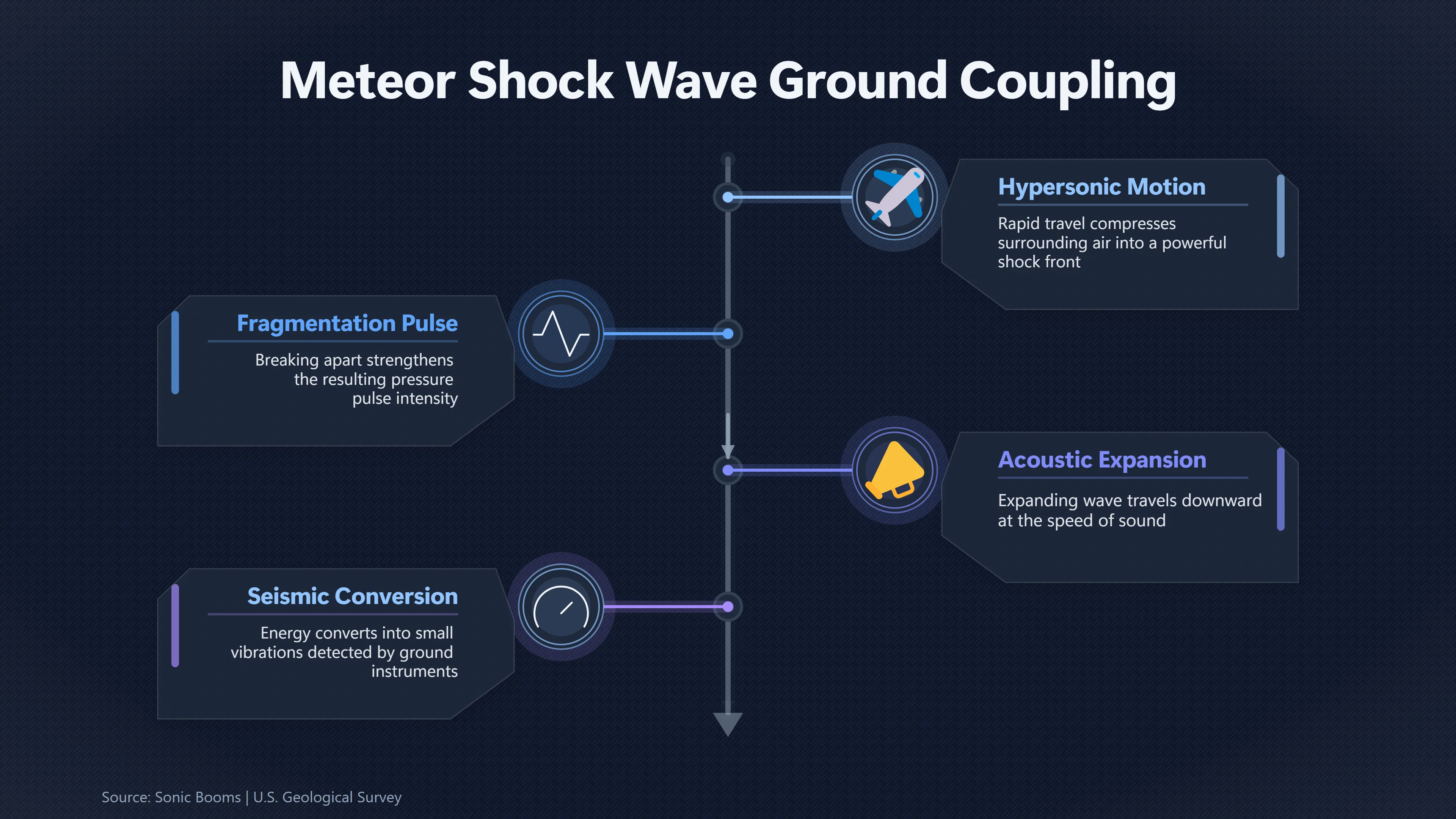
The physical mechanism is now well understood.
As a bright bolide descends through the atmosphere:
- its hypersonic motion compresses the surrounding air into a powerful shock wave;
- fragmentation episodes can strengthen the resulting pressure pulse;
- the expanding acoustic wave travels downward at approximately the speed of sound;
- when the wave reaches the surface, part of its energy is converted into small ground vibrations that seismometers detect.
Modern observations have documented this process repeatedly. Seismic arrays have recorded atmospheric shock waves from meteors in Canada, Europe and elsewhere, while trajectory reconstructions show that the signals arrive at times expected for an airwave rather than for seismic waves travelling through rock.[nature.com]nature.comMeteoroid sonic shock-wave-generated seismic signals observed at a seismic array | Nature…
Because only a small fraction of the atmospheric energy couples into the ground, such detections generally require an unusually bright and energetic fireball.
Why Seismic Detection Does Not Prove an Impact
A common misunderstanding is that any seismic record implies that something hit the ground. That is not how seismologists interpret these signals.
Modern guidance from the U.S. Geological Survey explains that atmospheric sources—including sonic booms, bolide explosions and other air-pressure events—can generate distinctive seismic records. These differ from ordinary earthquakes because they typically appear as short, high-frequency signals and lack the characteristic wave patterns expected from ruptures within the Earth’s crust. In cases where multiple stations are available, arrival times are also consistent with the speed of sound in air rather than the much faster propagation of seismic waves through rock.[USGS]usgs.govSonic Booms | U.S. Geological SurveySonic Booms | U.S. Geological Survey…
Consequently, the Detroit recording supports the existence of a powerful atmospheric disturbance but does not establish that a meteorite landed near the instrument, nor does it identify a crash location.
How the Timing Matches Pilot Reports
The timing of the seismic detection fits naturally within the broader meteor interpretation.
Numerous pilots, ground observers and radar operators reported a brilliant fireball crossing the Great Lakes region during the same general period. Unlike the visual phenomenon, however, the associated pressure wave would not reach the ground immediately. Because sound travels far more slowly than the meteor itself, observers can experience loud booms and vibrations several minutes after seeing the fireball. This delayed arrival is a well-established feature of bolide events and explains why witnesses often associate the sound with an incorrect point along the object’s apparent path.[AGU Publications]agupubs.onlinelibrary.wiley.comAGU Publications Seismic ground motions from a bolide shock waveAGU PublicationsSeismic ground motions from a bolide shock wave - Langston - 2004 - Journal of Geophysical Research: Solid Earth - Wiley…
The Detroit seismograph therefore complements the eyewitness reports by recording the delayed arrival of the atmospheric shock wave rather than the passage of the luminous object itself.

How Strong Is This Evidence?
Within the meteor explanation for the Kecksburg fireball, the Detroit seismograph provides valuable supporting evidence but not definitive proof on its own.
Its strengths include:
- independent instrumental confirmation that an energetic atmospheric event occurred;
- consistency with the expected behaviour of a large bolide producing a sonic shock wave;
- agreement with later scientific studies showing that meteor airbursts can generate measurable seismic signals.
Its limitations are equally important:
- the record cannot determine the exact flight path of the fireball by itself;
- it cannot distinguish whether the pressure wave came primarily from continuous hypersonic flight or from fragmentation;
- it does not demonstrate that debris reached the ground;
- it cannot resolve later claims concerning an alleged object recovered near Kecksburg.
Taken together with photographic evidence of the persistent meteor train and widespread pilot observations, however, the Detroit seismograph strengthens the case that the spectacular event involved a natural atmospheric fireball whose shock wave was energetic enough to leave a measurable seismic signature without requiring a ground impact.[wiley.com]agupubs.onlinelibrary.wiley.comAGU Publications Seismic ground motions from a bolide shock waveAGU PublicationsSeismic ground motions from a bolide shock wave - Langston - 2004 - Journal of Geophysical Research: Solid Earth - Wiley…
Amazon book picks
Further Reading
Books and field guides related to What Did the Detroit Seismograph Really Record?. Use these as the next step if you want deeper reading beyond the article.
Meteorite
Every rock has a story tell, and none more so than those which have fallen from the sky: meteorites. Originating in the Asteroid Belt bet...
The Cambridge Encyclopedia of Meteorites
Beautifully illustrated with over 140 full colour images, The Cambridge Encyclopedia of Meteorites provides a thorough guide to these fas...
Introduction to Seismology
A concise and accessible introduction to seismic theory, focusing on the mathematical fundamentals of global seismology. Aimed at advance...
Fundamentals of Geophysics
This second edition of Fundamentals of Geophysics has been completely revised and updated, and is the ideal geophysics textbook for under...
eBay marketplace picks
Marketplace Samples
Live-tested eBay searches with available results related to this page.
Selected frommeteor poster oneBay.co.uk.



Endnotes
1.
Source: nature.com
Link:https://www.nature.com/articles/328607a0
Source snippet
Meteoroid sonic shock-wave-generated seismic signals observed at a seismic array | Nature...
2.
Source: academic.oup.com
Link:https://academic.oup.com/mnras/article/506/3/3629/6329594
Source snippet
OUP AcademicReview of synergic meteor observations: linking the results from cameras, ionosondes, infrasound and seismic detectors | Mont...
3.
Source: usgs.gov
Title: Sonic Booms | U.S. Geological Survey
Link:https://www.usgs.gov/programs/earthquake-hazards/sonic-booms
Source snippet
Sonic Booms | U.S. Geological Survey...
4.
Source: usgs.gov
Link:https://www.usgs.gov/faqs/how-does-usgs-tell-difference-between-earthquake-and-a-sonic-boom
Source snippet
U.S. Geological SurveySeptember 5, 2024 — HOW DOES THE USGS TELL THE DIFFERENCE BETWEEN AN EARTHQUAKE AND A SONIC BOOM? Steps to identi...
Published: September 5, 2024
5.
Source: nature.com
Link:https://www.nature.com/articles/s41598-023-48396-8
6.
Source: usgs.gov
Title: Stishovite: Synthesis by shock wave | U.S. Geological Survey
Link:https://www.usgs.gov/publications/stishovite-synthesis-shock-wave
7.
Source: agupubs.onlinelibrary.wiley.com
Title: AGU Publications Seismic ground motions from a bolide shock wave
Link:https://agupubs.onlinelibrary.wiley.com/doi/10.1029/2004JB003167
Source snippet
AGU PublicationsSeismic ground motions from a bolide shock wave - Langston - 2004 - Journal of Geophysical Research: Solid Earth - Wiley...
8.
Source: agupubs.onlinelibrary.wiley.com
Link:https://agupubs.onlinelibrary.wiley.com/doi/10.1029/2005JB004254
Source snippet
AGU PublicationsSeismic and acoustic detection of a bolide airburst in the Gulf of Naples (southern Italy) - D'Auria - 2006 - Journa...
9.
Source: agupubs.onlinelibrary.wiley.com
Link:https://agupubs.onlinelibrary.wiley.com/doi/full/10.1029/2004JB003167
10.
Source: nyaspubs.onlinelibrary.wiley.com
Title: j.1749 6632.1997.tb48347.x
Link:https://nyaspubs.onlinelibrary.wiley.com/doi/abs/10.1111/j.1749-6632.1997.tb48347.x
11.
Source: doi.org
Title: Calculation of the shock wave from an underground nuclear explosion in granite
Link:https://doi.org/10.1029/JZ070i004p00885
Additional References
12.
Source: theblackvault.com
Title: the vault files the 1965 kecksburg pennsylvania crash
Link:https://www.theblackvault.com/casefiles/the-vault-files-the-1965-kecksburg-pennsylvania-crash/
Source snippet
The Vault Files: The 1965 Kecksburg, Pennsylvania Crash - The Black Vault Case FilesAugust 1, 2025 — THE VAULT FILES: THE 1965 KECKSBURG...
Published: August 1, 2025
13.
Source: youtube.com
Link:https://www.youtube.com/watch?v=3uenqRlk6vM
Source snippet
Seismo-acoustic signals of fireballs: Comparing natural objects to a man-made sample return capsule entry...
Published: November 2017
14.
Source: youtube.com
Title: The Kecksburg UFO Mystery: Secrets, Witnesses and Vanished Evidence
Link:https://www.youtube.com/watch?v=vkZszbMzl3Q
Source snippet
This collection provides direct scientific presentations and historical reporting on how atmospheric shock waves from meteor fireballs re...
15.
Source: youtube.com
Link:https://www.youtube.com/watch?v=-WIFItgZ_nc
Source snippet
Meteor Captured On Video In NZ (1999) 3News...
16.
Source: hero.epa.gov
Link:https://hero.epa.gov/reference/7686340/
17.
Source: youtube.com
Title: NASA spacecraft detect meteor strikes at Mars
Link:https://www.youtube.com/watch?v=odA6S-XR254
Source snippet
The Kecksburg UFO Mystery: Secrets, Witnesses and Vanished Evidence...
18.
Source: researchgate.net
Link:https://www.researchgate.net/publication/261286992_How_similar_are_a_bolide_and_an_earthquake_Geophysical_processes_associated_with_meteorite_falls
19.
Source: en-academic.com
Link:https://en-academic.com/dic.nsf/enwiki/244079
20.
Source: ntskeptics.org
Link:https://www.ntskeptics.org/1993/1993march/march1993.htm
21.
Source: dl1.en-us.nina.az
Link:https://www.dl1.en-us.nina.az/Kecksburg_UFO_incident.html