Within Kecksburg
Did the Fireball Actually Reach Kecksburg?
The reconstructed path points toward western Lake Erie rather than Pennsylvania, challenging a direct Kecksburg impact.
On this page
- How the trail was photographed
- The reconstructed terminal region
- Limits of linking sky and ground events
Page outline Jump by section
Introduction
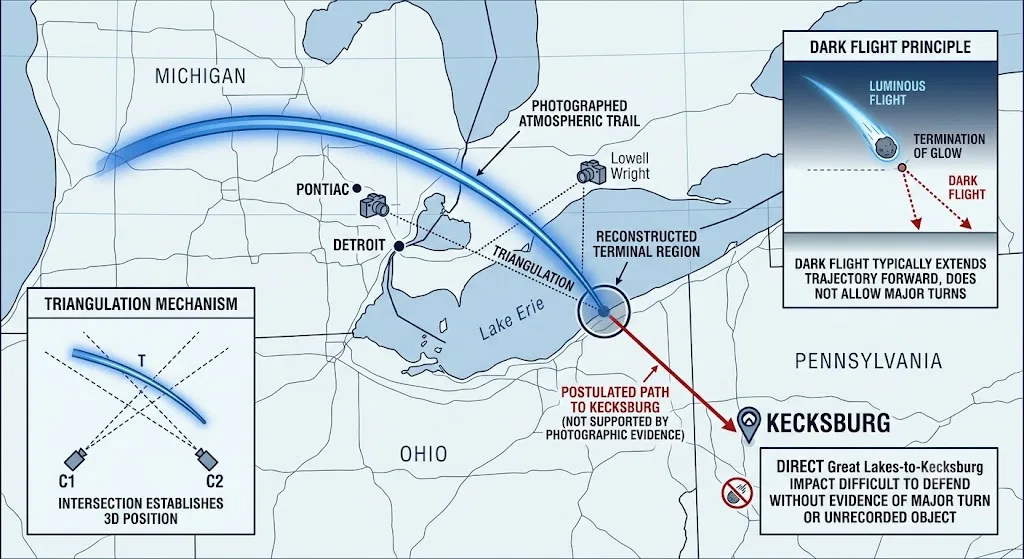
The strongest photographed evidence from 9 December 1965 does not point towards Kecksburg, Pennsylvania. Two images of the fireball’s lingering atmospheric trail, taken from separate positions in Michigan, allowed astronomers to reconstruct a steep path over the Detroit–Windsor region. Their solution placed the terminal part of the luminous trajectory near the western end of Lake Erie, roughly 200 miles north-west of Kecksburg, rather than continuing south-east across Ohio into Pennsylvania.[Astrophysics Data System]adsabs.harvard.eduAstrophysics Data SystemThe Fireball of December 9, 1965-Part Iby VD Chamberlain · 1967 · Cited by 6 — Photographs, taken from two locati…
That finding presents a serious challenge to the simplest version of the Kecksburg story: that one object was watched continuously from the Great Lakes until it struck woodland beside the village. It does not prove that nothing unusual happened at Kecksburg. The photographs did not monitor every fragment to the ground, and reconstructing a meteorite’s final fall requires assumptions that the 1960s evidence could not fully constrain. Even so, the photographed trajectory makes a direct Great Lakes-to-Kecksburg impact difficult to defend without proposing a major turn, an unrecorded secondary object or an error large enough to overturn the reconstruction.
How the trail was photographed
The cameras did not capture a clear, close-up image of a solid craft. They recorded the persistent train left behind after the fireball passed: a luminous or vapour-like trail suspended high in the atmosphere. One widely reproduced photograph was taken by Richard Champine about two miles east of Pontiac, Michigan, approximately 45 seconds after the event. Another observer, Lowell Wright, photographed the trail from the Orchard Lake area south-west of Pontiac.[debunker.com]debunker.comLocation: 2 miles east of Pontiac, Michigan, approx. 45 seconds after event…. (Witnesses typically greatly underestimate the distance…
This distinction matters. A single photograph of a glowing line shows the direction of sight from one camera, but not the trail’s distance or three-dimensional position. With photographs from two known locations, however, researchers can compare the apparent alignment of the same portions of the trail against the sky. Each camera defines a plane extending from the observing site through the photographed feature. The intersection of those planes gives an estimated spatial path — a process broadly known as triangulation.
Von Del Chamberlain and Ian Halliday published their analysis in the Journal of the Royal Astronomical Society of Canada in 1967. The journal’s index identifies the work as a “triangulation of the train”, and the paper also incorporated eyewitness reports and the timing derived from a seismograph south-west of Detroit.[Astrophysics Data System]adsabs.harvard.eduAstrophysics Data SystemThe Fireball of December 9, 1965-Part Iby VD Chamberlain · 1967 · Cited by 6 — Photographs, taken from two locati…
The method gave the photographs greater weight than ordinary visual estimates. Bright fireballs routinely produce errors in perceived distance: an object tens or hundreds of kilometres away can appear to descend behind a nearby ridge, building or tree line. Two geographically separated, calibrated photographs provide a geometric constraint that a witness’s impression of “where it went down” cannot provide by itself.
There were nevertheless important limitations:
- The pictures showed the residual train, not a continuously timed sequence of the moving body.
- The photographs were taken after the fireball had passed, allowing upper-atmospheric winds to begin deforming the trail.
- Matching corresponding points in an irregular, changing train introduces measurement judgement.
- The surviving record was not produced by a purpose-built fireball camera network with synchronised shutters, precise timing and modern astrometric calibration.
Those limitations justify caution about exact coordinates. They do not automatically erase the broad directional result.
Where the reconstructed path ended
The 1967 reconstruction described a steeply descending trajectory associated with the Detroit–Windsor fireball. Its projected terminal region lay near extreme south-western Ontario and the western or north-western part of Lake Erie. One later summary of the analysis describes the visible path as disappearing over land about 15 miles south-east of Windsor; contemporary astronomical reporting likewise placed the endpoint “in or near” western Lake Erie.[Enigma Labs | Report a UFO sighting]enigmalabs.ioKrause, the authors examined several reports of observations of the fireball, along with two photographs taken from separate locations th…
Investigators reportedly visited the photographers’ locations, made surveying or transit measurements based on the images, and checked the computed endpoint against residents near south-western Ontario. Accounts of that follow-up say local observations were consistent with the trail terminating overhead in that region.[hjkc.de]hjkc.deRaumfahrt+Astronomie-Blog von CENAPIt was fortunate that two photographers, Lowell Wright and Richard Champine, were able to photograph the debris trail in the evening sky…
This reconstructed geography is hard to reconcile with Kecksburg. The Pennsylvania village lies far to the south-east, beyond Lake Erie and much of Ohio. To connect the photographed fireball directly to the alleged Kecksburg impact, the object would have needed to continue for a substantial distance after the reconstructed luminous endpoint while departing markedly from the measured line.
A surviving meteorite can continue travelling after its visible light goes out. This unlit stage is called dark flight: once a fragment has slowed enough to stop glowing, gravity and winds carry it towards the surface. But dark flight normally extends a trajectory forwards and downwards; it does not permit a meteorite to make an enormous cross-country turn. Modern studies show that wind, fragment mass, density, shape and atmospheric modelling can shift a predicted fall zone significantly, sometimes by kilometres even in well-observed cases. They do not support unexplained deviations of hundreds of kilometres from the terminal direction.[arXiv]arxiv.orgOpen source on arxiv.org.
The photographed path therefore supports two narrower conclusions. First, the major Great Lakes fireball was most probably a steep natural meteoroid rather than an object making a shallow orbital re-entry. Second, any surviving pieces associated with its measured final flight would be expected in or around the western Lake Erie region, not near Kecksburg.[Wikipedia]WikipediaKosmos 96Kosmos 96
Could the reconstruction be wrong enough?
Critics of the Lake Erie conclusion have argued that errors in identifying the photographed trail, locating the cameras, modelling its deformation or extending the measured line could undermine the calculated endpoint. A Pennsylvania State University overview notes both sides of this dispute: trajectory analysis was used to call Kecksburg an impossible landing site, while a later error analysis was presented as discrediting that certainty.[Pennsylvania Authors]pabook.libraries.psu.eduAcorn from Space: The Kecksburg IncidentTrajectory analysis of the fireball deemed Kecksburg an impossible landing spot; then an error an…
The fairest reading is that the photographs are stronger at establishing a broad corridor than a precise impact point. Their value decreases as the analysis moves from the observed train to an exact ground location. Modern fireball research illustrates why: apparently straightforward straight-line solutions can diverge from dynamically modelled positions, and fall predictions depend heavily on fragmentation, deceleration and atmospheric conditions. In two instrumented meteorite-dropping events studied by the Desert Fireball Network, enforcing a straight trajectory produced deviations ranging from hundreds of metres to several kilometres.[arXiv]arxiv.orgar Xiv3D Meteoroid Trajectoriesar Xiv3D Meteoroid Trajectories
That is a reason not to treat “15 miles south-east of Windsor” as an infallible crash coordinate. It is not, by itself, a credible route to Kecksburg. The scale of uncertainty demonstrated in modern trajectory work is far smaller than the geographical gap between western Lake Erie and western Pennsylvania.
A more substantial challenge would require evidence that the photographed train was misidentified in a fundamental way: that the two cameras recorded different features, that the assumed locations or orientations were badly wrong, or that the Great Lakes fireball split into a major fragment following a sharply different path that was not represented in the images. Such possibilities can be proposed, but no comparable photographic reconstruction has been produced that traces a branch towards Kecksburg.
Claims that witnesses saw the object turn, slow or descend under control near Pennsylvania belong to a different class of evidence. Investigator Stan Gordon has argued that multiple witnesses described such manoeuvring, but those reports are largely retrospective and are not supported by timed photographs, radar plots or instrument records showing a turn from the Lake Erie corridor.[Space]space.com7589 case finally closed 1965 pennsylvania ufo mystery7589 case finally closed 1965 pennsylvania ufo mystery
Why sky and ground reports should not be fused automatically
The main analytical risk is assuming that events reported close together in time must share a single physical cause. On the evening of 9 December, thousands of people could see the Great Lakes fireball over an enormous area. Near Kecksburg, residents separately reported smoke, a vibration or thump and something apparently descending towards woodland. The coincidence is suggestive, but it does not establish an uninterrupted trajectory between the two locations.
Several mechanisms can create a false sky-to-ground link:
Perspective. A bright object moving towards the horizon appears to fall into the observer’s local landscape, even when it is many kilometres beyond it.
Delayed sound. Sonic booms arrive after the light because sound travels far more slowly. A thump heard near the time of a visual descent may be attributed to a nearby impact even when it originated along a distant atmospheric path.
Fragmentation. A fireball may shed numerous pieces, but each proposed fragment still requires a physically plausible continuation from the measured trajectory.
Coincidence. Smoke, a local fire, aircraft activity or an unrelated ground disturbance may be interpreted through the dramatic event visible in the sky.
Narrative compression. Later retellings can merge “a fireball was seen”, “something seemed to descend” and “officials searched the woods” into the stronger claim that observers watched one identifiable object all the way to the ground.
The photographed evidence most directly addresses the first part of the story: the major luminous fireball over the Great Lakes. It does not photograph the Kecksburg woods, identify what prompted the local search or determine whether an unrelated object was present there.
What the trajectory changes — and what it leaves open
The photographs shift the burden of proof. A direct Kecksburg impact should not be treated as the default endpoint of the documented fireball merely because the reports occurred on the same evening. The best geometric reconstruction points elsewhere, and no instrumented record has been published showing the fireball turning towards Pennsylvania.
Three interpretations remain logically distinct:
- One natural fireball, mislocated from Kecksburg. The Great Lakes meteor terminated near western Lake Erie, while perspective, sound and local confusion produced the impression of a nearby fall. This is the simplest fit to the photographed trajectory.
- A natural fireball plus an unrelated Kecksburg event. Something separate — mundane, military or unidentified — prompted the ground reports while the meteor supplied the dramatic sky background. The photographs neither prove nor exclude this scenario.
- A fragment or object departed from the reconstructed path. This requires positive evidence for a branch, turn or independently tracked body. Witness recollections alone do not presently establish the necessary geometry.
The result is not a complete solution to the Kecksburg incident. It is a constraint on one of its central assumptions. The photographed trail strongly challenges the claim that the well-documented Great Lakes fireball simply continued to Kecksburg and crashed there. What may have happened in the Pennsylvania woods must therefore be assessed through its own contemporary reports, physical evidence and records, rather than inferred from a trajectory whose measured direction points towards western Lake Erie.
Amazon book picks
Further Reading
Books and field guides related to Did the Fireball Actually Reach Kecksburg?. Use these as the next step if you want deeper reading beyond the article.
Meteorite
Every rock has a story tell, and none more so than those which have fallen from the sky: meteorites. Originating in the Asteroid Belt bet...
Rocks from Space: Meteorites and Meteorite Hunters
Appendices A-C: Meteorite verification laboratories, Commercial meteorite dealers, Selected list of suspected impact craters worldwide.
The Field Guide to Meteors and Meteorites
What is unique about Richard Norton's book is that it is both a field guide to observing meteors, and also a field guide to locating, pre...
The Cambridge Encyclopedia of Meteorites
Beautifully illustrated with over 140 full colour images, The Cambridge Encyclopedia of Meteorites provides a thorough guide to these fas...
eBay marketplace picks
Marketplace Samples
Live-tested eBay searches with available results related to this page.
Selected frommeteor poster oneBay.co.uk.
Current eBay listing
Meteor Italian Locandina Poster Sean Connery Natalie Wood 1979

Current eBay listing
METEOR MAN ONE SHEET ROLLED POSTER JAMES EARL JONES MARLA GIBBS 1993
Endnotes
1.
Source: enigmalabs.io
Link:https://enigmalabs.io/library/f45bb19d-5803-4ab6-a373-8799f64095c0
Source snippet
Krause, the authors examined several reports of observations of the fireball, along with two photographs taken from separate locations th...
2.
Source: debunker.com
Link:https://www.debunker.com/Kecksburg.html
Source snippet
Location: 2 miles east of Pontiac, Michigan, approx. 45 seconds after event.... (Witnesses typically greatly underestimate the distance...
3.
Source: astronomyufo.com
Link:https://www.astronomyufo.com/UFO/answer.html
Source snippet
Chamberlain suggested that fragments probably did reach the ground but reports they could not find any.This is not unusual involving brig...
4.
Source: hjkc.de
Title: Raumfahrt+Astronomie-Blog von CENAP
Link:https://www.hjkc.de/_blog/2014/05/15/2808-ufo-forschung—die-kecksburg-ufo-absturz-story—teil-2/
Source snippet
It was fortunate that two photographers, Lowell Wright and Richard Champine, were able to photograph the debris trail in the evening sky...
5.
Source: Wikipedia
Title: [Kecksburg UFO incident]({{ ‘kecksburg-ufo-incident/’ | relative_url }})
Link:https://en.wikipedia.org/wiki/Kecksburg_UFO_incident
6.
Source: arxiv.org
Link:https://arxiv.org/abs/2108.04397
7.
Source: arxiv.org
Title: ar Xiv3D Meteoroid Trajectories
Link:https://arxiv.org/abs/1802.02697
8.
Source: Wikipedia
Title: Kosmos 96
Link:https://en.wikipedia.org/wiki/Kosmos_96
9.
Source: pabook.libraries.psu.edu
Title: Pennsylvania Authors
Link:https://pabook.libraries.psu.edu/literary-cultural-heritage-map-pa/feature-articles/acorn-space-kecksburg-incident
Source snippet
Acorn from Space: The Kecksburg IncidentTrajectory analysis of the fireball deemed Kecksburg an impossible landing spot; then an error an...
10.
Source: arxiv.org
Title: arXiv A Dynamic Trajectory Fit to Multi-Sensor Fireball Observations
Link:https://arxiv.org/abs/1911.00816
11.
Source: space.com
Title: 7589 case finally closed 1965 pennsylvania ufo mystery
Link:https://www.space.com/7589-case-finally-closed-1965-pennsylvania-ufo-mystery.html
12.
Source: hjkc.de
Title: Raumfahrt+Astronomie-Blog von CENAP
Link:https://www.hjkc.de/_blog/2808-ufo-forschung—die-kecksburg-ufo-absturz-story—teil-2/
13.
Source: astronomyufo.com
Link:https://www.astronomyufo.com/UFO/December.htm
14.
Source: adsabs.harvard.edu
Link:https://adsabs.harvard.edu/full/1967JRASC..61..184C
Source snippet
Astrophysics Data SystemThe Fireball of December 9, 1965-Part Iby VD Chamberlain · 1967 · Cited by 6 — Photographs, taken from two locati...
Published: December 9, 1965
15.
Source: adsabs.harvard.edu
Link:https://adsabs.harvard.edu/abs_doc/whatsnew.html
16.
Source: adsabs.harvard.edu
Title: article help
Link:https://adsabs.harvard.edu/abs_doc/article_help.html
17.
Source: adsabs.harvard.edu
Title: article print
Link:https://adsabs.harvard.edu/abs_doc/article_print.html
18.
Source: ui.adsabs.harvard.edu
Link:https://ui.adsabs.harvard.edu/abs/2007M%26PS…42..185C/abstract
19.
Source: adsabs.harvard.edu
Title: bulletins service
Link:https://adsabs.harvard.edu/bulletins_service.html
20.
Source: adsabs.harvard.edu
Title: ads browse
Link:https://adsabs.harvard.edu/ads_browse.html
21.
Source: adsabs.harvard.edu
Title: article service
Link:https://adsabs.harvard.edu/article_service.html?nosetcookie=1
22.
Source: adsabs.harvard.edu
Title: access help
Link:https://adsabs.harvard.edu/abs_doc/access_help.html
23.
Source: adsabs.harvard.edu
Title: art browse
Link:https://adsabs.harvard.edu/abs_doc/help_pages/art_browse.html
24.
Source: ui.adsabs.harvard.edu
Link:https://ui.adsabs.harvard.edu/help/actions/
25.
Source: adsabs.harvard.edu
Title: ads ug
Link:https://www.adsabs.harvard.edu/abs_doc/ads_ug.html
26.
Source: adsabs.harvard.edu
Title: fulltext abbr
Link:https://adsabs.harvard.edu/abs_doc/fulltext_abbr.html
27.
Source: adsabs.harvard.edu
Title: art retrieve
Link:https://adsabs.harvard.edu/abs_doc/help_pages/art_retrieve.html
28.
Source: adsabs.harvard.edu
Title: abs help
Link:https://adsabs.harvard.edu/abs_doc/abs_help.html
29.
Source: adsabs.harvard.edu
Title: all conferences
Link:https://adsabs.harvard.edu/abs_doc/all_conferences.html
30.
Source: adsabs.harvard.edu
Link:https://adsabs.harvard.edu/abs_doc/refereed3.html
31.
Source: spacepage.be
Title: het kecksburg ufo incident
Link:https://www.spacepage.be/artikelen/buitenaards-leven/ufo-waarnemingen/het-kecksburg-ufo-incident.html
Additional References
32.
Source: rasc.ca
Link:https://www.rasc.ca/sites/default/files/IndexJRASC61-90.pdf
Source snippet
The Tektite Puzzle, Ian Halliday, 61, 86.... The Fireball of December 9, 1965 — Part I.... Triangulation of the Train, Von Del Chamberl...
Published: December 9, 1965
33.
Source: youtube.com
Title: Kecksburg UFO Shocks the World Actual Interview Footage (S1) | Conspiracy?
Link:https://www.youtube.com/watch?v=BYEh3JLrQbg
Source snippet
'I do believe something happened': Search for answers about Kecksburg UFO in Pennsylvania...
34.
Source: youtube.com
Link:https://www.youtube.com/watch?v=ruKDXL13lk8
Source snippet
The Kecksburg UFO Mystery: Secrets, Witnesses and Vanished Evidence...
35.
Source: youtube.com
Link:https://www.youtube.com/watch?v=REsZcbglO3c
Source snippet
The 1965 Kecksburg Incident: A UFO Crash the Government Hides to This Day...
36.
Source: nature.com
Link:https://www.nature.com/articles/nature01592
37.
Source: nature.com
Link:https://www.nature.com/articles/216148a0
38.
Source: nature.com
Link:https://www.nature.com/articles/214261b0.pdf
39.
Source: youtube.com
Title: The Kecksburg Incident: What Really Happened Here?
Link:https://www.youtube.com/watch?v=BXh2zTD9Kug
Source snippet
Kecksburg UFO Shocks the World Actual Interview Footage (S1) | Conspiracy?...
40.
Source: nature.com
Title: Gravity Shock Waves and Stratification in the Upper Atmosphere | Nature
Link:https://www.nature.com/articles/213576a0
41.
Source: researchgate.net
Link:https://www.researchgate.net/publication/230169441_Fragmentation_model_analysis_of_the_observed_atmospheric_trajectory_of_the_Tagish_Lake_fireball