Within Shock Waves
Why the Booms Seemed to Come From Kecksburg
Winds, temperature layers, hills and buildings can bend or reflect a pressure wave and make its apparent direction unreliable.
On this page
- Atmospheric refraction of fireball shock waves
- Echoes and reflections across hills and buildings
- Why apparent sound direction is weak location evidence
Page outline Jump by section
Introduction
Witnesses to the 9 December 1965 Kecksburg event frequently described heavy booms, sharp reports and vibrations that seemed to come from the vicinity of Kecksburg itself. At first glance, those accounts appear to support the idea that an object struck the ground nearby. However, acoustics and meteor science show that the apparent direction of a sonic boom is often a poor guide to its true source. Pressure waves from a high-speed fireball can be bent by changing air temperatures, redirected by winds, reflected from hillsides and buildings, and arrive after complex paths that differ from the object’s visible trajectory. These effects make eyewitness impressions of where a boom “came from” substantially less reliable than they may seem.[amsmeteors.org]amsmeteors.orgAmerican Meteor Society Fireball FAQsAmerican Meteor SocietyFireball FAQs - American Meteor Society…
For the Kecksburg incident, this does not prove that no object reached the ground, but it does weaken one specific argument often made in favour of a local impact: that because many people thought the explosions came from Kecksburg, the source must have been there. Modern understanding of atmospheric shock-wave propagation shows why that inference is unsafe.
Atmospheric refraction of fireball shock waves
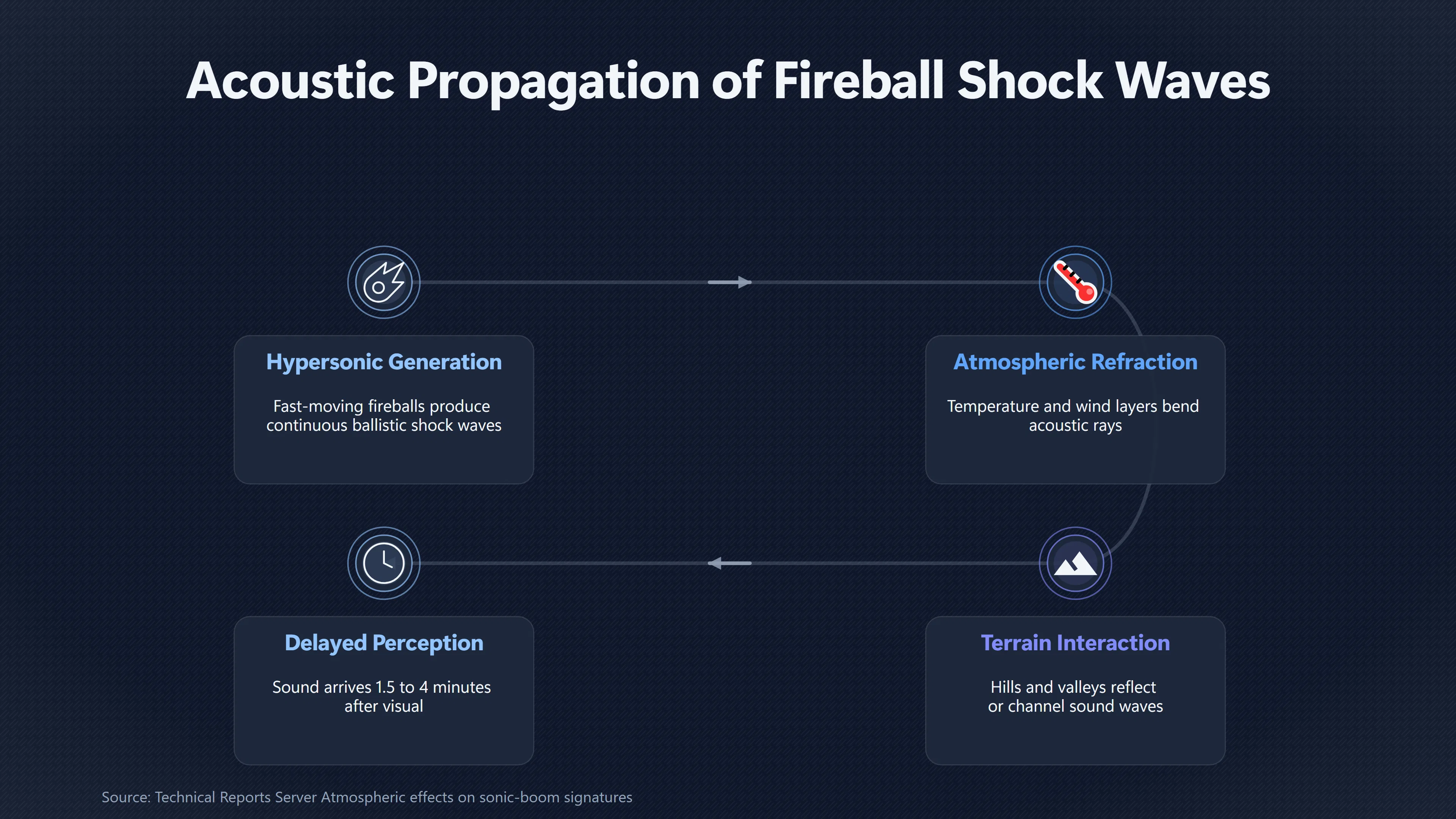
A fireball travelling at hypersonic speed produces a continuous shock wave along much of its flight. Unlike an ordinary point-source explosion, this pressure disturbance travels through many kilometres of atmosphere before reaching listeners on the ground. During that journey, the atmosphere is rarely uniform.
The speed of sound changes with air temperature, while winds at different altitudes can further bend acoustic rays. Together, these factors produce atmospheric refraction, causing sound to follow curved rather than straight paths. Under some conditions, portions of a shock wave are directed away from the ground, while in others they are bent downward and concentrated in places well away from the object’s actual position. NASA’s long-standing research into sonic-boom propagation demonstrates that atmospheric refraction significantly alters where pressure waves are heard and how strong they appear.[NASA Technical Reports Server]ntrs.nasa.govTechnical Reports Server Atmospheric effects on sonic-boom signaturesNASA Technical Reports ServerAtmospheric effects on sonic-boom signatures - NASA Technical Reports Server (NTRS)…
The practical consequence is important for Kecksburg. Even if observers correctly remembered hearing one or more loud booms, the direction from which those sounds appeared to arrive need not match the fireball’s actual position at the time the shock wave was generated. The American Meteor Society similarly notes that bright fireballs capable of producing sonic booms are commonly heard only after delays of roughly 1½ to 4 minutes, depending on geometry and atmospheric conditions.[American Meteor Society]amsmeteors.orgAmerican Meteor Society Fireball FAQsAmerican Meteor SocietyFireball FAQs - American Meteor Society…
Modern acoustic modelling of fireballs also shows that reconstructing trajectories from sound alone requires detailed atmospheric profiles because uncertainty in winds and temperature layers directly affects the calculated sound paths.[arXiv]arxiv.orgarXiv Fireball characteristics derivable from acoustic dataFireball characteristics derivable from acoustic dataFebruary 12, 2021…
Echoes and reflections across hills and buildings
Western Pennsylvania is not an acoustically simple landscape. The region surrounding Kecksburg consists of rolling ridges, wooded valleys and scattered settlements rather than broad, flat terrain.
Large pressure waves travelling across such landscapes can produce several effects that complicate perception:
- Hillsides may reflect portions of a passing shock wave.
- Valleys can channel sound along preferred directions.
- Buildings and other structures create secondary reflections.
- Multiple reflected arrivals may be interpreted as separate explosions.
- Different listeners may hear the strongest arrival from entirely different directions.
These effects are well known in acoustics. Human listeners generally identify a sound’s origin from the first strong wavefront reaching their ears, but reflected or refracted arrivals can alter that perception, particularly for low-frequency impulsive sounds such as sonic booms. NASA’s investigations of sonic-boom propagation found that grazing incidence, atmospheric structure and turbulence all modify the pressure signature experienced on the ground.[NASA Technical Reports Server]ntrs.nasa.govTechnical Reports Server Atmospheric effects on sonic-boom signaturesNASA Technical Reports ServerAtmospheric effects on sonic-boom signatures - NASA Technical Reports Server (NTRS)…
For witnesses in and around Kecksburg, the combination of delayed arrival, complex topography and multiple reflections means that an apparent boom “from the woods” or “from the hill” should not automatically be interpreted as evidence that the original source was physically located there.

Why multiple booms do not pinpoint a crash site
Several witness accounts mention more than one loud report rather than a single crack.
That pattern is consistent with how energetic fireballs behave. A hypersonic object continuously generates a ballistic shock wave, while fragmentation events higher in the atmosphere can create additional pressure pulses. Modern fireball acoustic studies distinguish these separate signals through timing analysis and atmospheric modelling, but doing so requires dense instrument networks rather than unaided human hearing.[arXiv]arxiv.orgarXiv Fireball characteristics derivable from acoustic dataFireball characteristics derivable from acoustic dataFebruary 12, 2021…
Consequently, hearing several explosions does not necessarily indicate multiple ground impacts or repeated explosions near Kecksburg. It may instead reflect:
- fragmentation at different points along the atmospheric path;
- separate arrivals of ballistic and fragmentation-generated shock waves;
- reflections from terrain; or
- different portions of the same pressure wave reaching the listener by different routes.
Without synchronised acoustic recordings, it is impossible to determine which mechanism dominated during the 1965 event.
Why apparent sound direction is weak location evidence
One of the recurring claims in discussions of the Kecksburg incident is that witnesses independently pointed towards roughly the same location when describing the booms. Even if those recollections are broadly accurate, acoustics places important limits on what they can establish.
Direction estimates based on hearing are especially vulnerable when:
- the sound arrives several minutes after the visual event;
- the source is tens of kilometres away;
- the wave has travelled through varying atmospheric layers;
- the terrain is uneven; and
- listeners experience only one brief impulse rather than a continuous sound.
Modern meteor investigations therefore combine eyewitness reports with instrumental evidence such as calibrated video, radar, infrasound arrays and seismic records rather than relying on perceived sound direction alone. Studies reconstructing fireball trajectories consistently incorporate atmospheric models because otherwise significant positional errors can result.[arXiv]arxiv.orgarXiv Fireball characteristics derivable from acoustic dataFireball characteristics derivable from acoustic dataFebruary 12, 2021…
This helps explain why the reported booms around Kecksburg cannot reliably identify a crash location by themselves.
What this means for interpreting the Kecksburg booms
The acoustic reports remain valuable evidence that an energetic atmospheric event occurred. They are consistent with a large fireball travelling at hypersonic speed and generating powerful shock waves that were heard over a wide region.
What they do not reliably demonstrate is that the sound originated exactly where witnesses believed it did. Weather conditions, temperature layering, upper-level winds, hills and local reflections all provide well-established mechanisms by which sonic booms can appear displaced from their true source. For that reason, the perceived direction of the Kecksburg booms is considerably weaker evidence for a local impact than it first appears. It is more appropriately treated as supporting evidence for a major atmospheric event than as a precise locator of where, if anywhere, an object reached the ground.[nasa.gov]ntrs.nasa.govTechnical Reports Server Atmospheric effects on sonic-boom signaturesNASA Technical Reports ServerAtmospheric effects on sonic-boom signatures - NASA Technical Reports Server (NTRS)…
Amazon book picks
Further Reading
Books and field guides related to Why the Booms Seemed to Come From Kecksburg. Use these as the next step if you want deeper reading beyond the article.
The Science of Sound
Written for students without a background in mathematics or physics, this textbook provides an introduction to the study of acoustics. It...
Fundamentals of Acoustics
Dargestellt werden die physikalischen und mathematischen Konzepte zur Beschreibung der Erzeugung, Weiterleitung und Wahrnehmung von Schal...
Acoustics: Sound Fields and Transducers
Long-awaited update and expansion of a widely recognised classic in the field by pioneering acoustics expert, Leo L. Beranek Builds upon...
eBay marketplace picks
Marketplace Samples
Live-tested eBay searches with available results related to this page.
Selected fromPennsylvania map print oneBay.co.uk.
Current eBay listing
Old Map of Plains, PA 1892 - Vintage Plains Pennsylvania Art
Current eBay listing
Old Map of Potter County, PA 1856 - Vintage Pennsylvania Art
Endnotes
1.
Source: ntrs.nasa.gov
Title: Technical Reports Server Atmospheric effects on sonic-boom signatures
Link:https://ntrs.nasa.gov/citations/19660020036
Source snippet
NASA Technical Reports ServerAtmospheric effects on sonic-boom signatures - NASA Technical Reports Server (NTRS)...
2.
Source: elib.dlr.de
Title: Electronic Libraryelectronic library
Link:https://elib.dlr.de/64178/
Source snippet
DLR Electronic Libraryelectronic library - Effect of Atmospheric Variability and Aircraft Flight Parameters on the Refraction of Sonic Booms...
3.
Source: arxiv.org
Title: arXiv Fireball characteristics derivable from acoustic data
Link:https://arxiv.org/abs/2102.06574
Source snippet
Fireball characteristics derivable from acoustic dataFebruary 12, 2021...
Published: February 12, 2021
4.
Source: usgs.gov
Title: Sonic Booms | U.S. Geological Survey
Link:https://www.usgs.gov/programs/earthquake-hazards/sonic-booms
Source snippet
Sonic Booms | U.S. Geological Survey...
5.
Source: ntrs.nasa.gov
Link:https://ntrs.nasa.gov/citations/19950008471
6.
Source: ntrs.nasa.gov
Link:https://ntrs.nasa.gov/citations/19760043780
7.
Source: ntrs.nasa.gov
Link:https://ntrs.nasa.gov/citations/19720038239
8.
Source: amsmeteors.org
Title: American Meteor Society Fireball FAQs
Link:https://www.amsmeteors.org/fireballs/faqf/
Source snippet
American Meteor SocietyFireball FAQs - American Meteor Society...
9.
Source: thecoldfile.com
Title: 1965 kecksburg
Link:https://www.thecoldfile.com/articles/1965-kecksburg/
10.
Source: amsmeteors.org
Title: ams q1 2026 fireball analysis
Link:https://www.amsmeteors.org/ams-q1-2026-fireball-analysis.html
11.
Source: amsmeteors.org
Title: Florida Fireball with Boom
Link:https://www.amsmeteors.org/2015/02/florida-fireball-with-boom/
13.
Source: amsmeteors.org
Title: Large AZ Fireball With Sonic Booms
Link:https://amsmeteors.org/2013/12/large-az-fireball-with-sonic-booms/
14.
Source: amsmeteors.org
Title: AM S Fireball Stats Analysis
Link:https://amsmeteors.org/2013/03/ams-fireball-stats-analysis/
15.
Source: amsmeteors.org
Title: [Search Results]({{ ‘search-results/’ | relative_url }}) sonic boom
Link:https://www.amsmeteors.org/search/sonic%2Bboom/?s=sonic+boom
16.
Source: amsmeteors.org
Title: Fireball Logs
Link:https://www.amsmeteors.org/fireballs/fireball-report/
18.
Source: newyorker.com
Title: Boom | The New Yorker
Link:https://www.newyorker.com/magazine/1962/05/19/boom-12
Additional References
19.
Source: sandia.gov
Link:https://www.sandia.gov/labnews/2026/06/18/how-scientists-support-planetary-defense-by-reconstructing-a-fireballs-path-using-sound-waves/
Source snippet
How scientists support planetary defense by reconstructing a fireball’s path using sound waves – LabNewsJune 18, 2026 — Sandia Lab News |...
Published: June 18, 2026
20.
Source: thestate.com
Title: Sonic boom mystery deepens in South Carolina as meteors hit US | The State
Link:https://www.thestate.com/news/local/environment/article315968801.html
Source snippet
June 2, 2026 — SONIC BOOM MYSTERY DEEPENS AS EXPERTS DEBATE WHAT SHOOK COLUMBIA LAST WEEK By Sammy Fretwell Updated June 2, 2026 2:25 PM...
Published: June 2, 2026
21.
Source: phys.org
Title: Sonic booms from meteors can release the energy of hundreds of tons of TNT
Link:https://phys.org/news/2026-06-sonic-booms-meteors-energy-hundreds.html
Source snippet
Here's how they workJune 20, 2026 — June 20, 2026 SONIC BOOMS FROM METEORS CAN RELEASE THE ENERGY OF HUNDREDS OF TONS OF TNT. HERE'S HOW...
Published: June 20, 2026
22.
Source: youtube.com
Link:https://www.youtube.com/watch?v=_W9dGb5Ap2g
Source snippet
This collection pairs investigative documentaries on the 1965 Kecksburg event with real-world weather service reports detailing how high...
23.
Source: youtube.com
Link:https://www.youtube.com/watch?v=HX_RrO7ZQaU
Source snippet
Kecksburg UFO Crash: The Untold Story | The Government Lied! | Full Documentary | UFOTV®...
24.
Source: youtube.com
Link:https://www.youtube.com/watch?v=tU7WSHZye5w
Source snippet
The Kecksburg UFO Case: Finally Solved After 60 Years?...
25.
Source: youtube.com
Title: Meteor explodes over Ohio
Link:https://www.youtube.com/watch?v=srExL-qyhNg
Source snippet
Meteor, satellite or something else? NWS reports 'loud boom' across western PA & eastern OH...
26.
Source: sciencedirect.com
Link:https://www.sciencedirect.com/science/article/abs/pii/S1364682614001709
27.
Source: sciencedirect.com
Link:https://www.sciencedirect.com/science/article/pii/S1364682614001709
28.
Source: af.mil
Link:https://www.af.mil/About-Us/Fact-Sheets/Display/article/104540/sonic-boom/