Within Space Debris
What Kosmos 954 Revealed About Space Debris Cleanup
The 1978 Kosmos 954 cleanup showed how radioactive satellite debris could require aircraft, controlled zones and multinational recovery teams.
On this page
- How radioactive debris spread across northern Canada
- Operation Morning Light search and recovery methods
- What the case clarifies about earlier response fears
Page outline Jump by section
Introduction
The 1978 re-entry of the Soviet reconnaissance satellite Kosmos 954 is one of the clearest documented examples of how governments respond when radioactive space hardware reaches the ground. Unlike many incidents involving unidentified aerial objects or suspected space debris, the hazard was real, measurable and extensively documented. The satellite’s onboard nuclear reactor failed to separate into its intended disposal orbit, causing radioactive fragments to scatter across a vast area of northern Canada. The subsequent recovery effort—Operation Morning Light—required military coordination, specialist radiation detection equipment, aircraft, controlled access to affected areas and months of field operations in severe Arctic conditions.[canada.ca]canada.caPrevious nuclear incidents and accidents: COSMOS 954Previous nuclear incidents and accidents: COSMOS 954 - Canada.caSeptember 3, 2019…
For readers considering official responses to incidents such as the Kecksburg event, Kosmos 954 provides an important point of comparison. It demonstrates that Cold War authorities already possessed procedures for treating unknown aerospace debris as a potential radiological emergency. While it does not imply that earlier unexplained incidents involved radioactive material, it shows that rapid military intervention, restricted access and specialist recovery teams were established responses when the possibility of hazardous space debris could not immediately be ruled out.
How radioactive debris spread across northern Canada
Kosmos 954 was launched by the Soviet Union in September 1977 as part of its Radar Ocean Reconnaissance Satellite (RORSAT) programme. These satellites used compact nuclear reactors because radar surveillance required far more electrical power than solar panels of the period could reliably provide.
After a malfunction prevented the reactor from being boosted into its intended high “disposal orbit”, the satellite gradually lost altitude. On 24 January 1978 it re-entered the atmosphere over Canada, breaking apart during descent. Although much of the spacecraft burned up, radioactive fragments survived and were dispersed across approximately 124,000 square kilometres of the Northwest Territories and parts of northern Alberta and Saskatchewan.[canada.ca]canada.caPrevious nuclear incidents and accidents: COSMOS 954Previous nuclear incidents and accidents: COSMOS 954 - Canada.caSeptember 3, 2019…
The debris field extended over hundreds of kilometres rather than forming a single impact site. This pattern reflected the normal behaviour of a large spacecraft breaking apart during atmospheric re-entry: components separated at different altitudes and continued along different ballistic paths before reaching the ground.
For emergency responders, this created several immediate challenges:
- the exact locations of radioactive fragments were unknown;
- some fragments were visually indistinguishable from ordinary metal debris;
- snow and frozen lakes concealed contamination;
- many impact points lay in remote wilderness accessible only by aircraft or winter travel.
The incident therefore became less like recovering a crashed aircraft and more like conducting a continent-scale hazardous materials search.
Operation Morning Light search and recovery methods
Canada and the United States rapidly organised Operation Morning Light, a joint search-and-recovery mission involving the Canadian Armed Forces, the Atomic Energy Control Board (predecessor to today’s Canadian Nuclear Safety Commission), scientific agencies and a United States Nuclear Emergency Search Team. Hundreds of personnel ultimately participated.[canada.ca]ised-isde.canada.ca123 operation morning light 1978ISED Canada123. Operation Morning Light (1978)…
The operation unfolded in two principal phases. Initial searches took place during the Arctic winter while snow cover and frozen lakes allowed relatively straightforward access to remote terrain. A second phase resumed after the spring thaw to locate additional fragments that had been hidden beneath snow or ice.[Collection Search]recherche-collection-search.bac-lac.gc.caOpen source on gc.ca.
Airborne radiation surveys
One of the most important technologies employed was airborne gamma-ray spectrometry.
Aircraft equipped with highly sensitive gamma-ray detectors flew systematic search patterns over the predicted debris corridor. Unlike ordinary radiation meters, these instruments could distinguish the characteristic energy signatures of artificial radioactive isotopes from naturally occurring background radiation found in rocks and soils.
Scientists from the Geological Survey of Canada adapted equipment originally designed for uranium exploration and geological mapping. Their instruments located the first confirmed radioactive fragment on the frozen surface of Great Slave Lake, demonstrating that aerial radiation surveys could efficiently identify small sources across enormous areas.[ISED Canada]ised-isde.canada.ca123 operation morning light 1978ISED Canada123. Operation Morning Light (1978)…
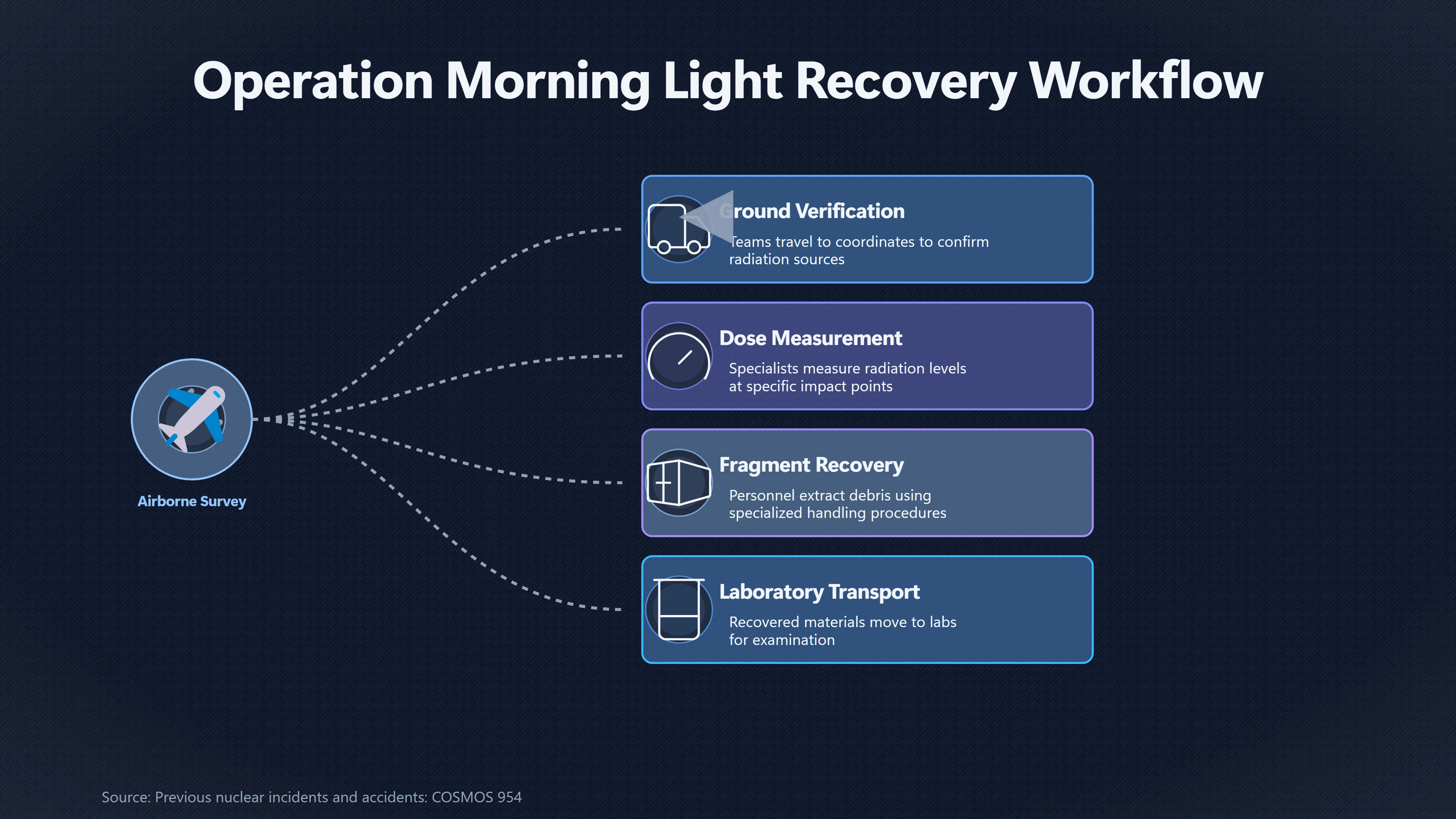
Once an airborne detection was made, ground teams travelled to the location to:
- confirm the radiation source;
- measure dose rates;
- document the fragment;
- recover it using specialised handling procedures;
- transport it safely for laboratory examination.
This combination of aerial screening followed by targeted ground recovery became the defining operational method of the mission.
Controlled recovery rather than mass evacuation
Despite understandable public concern, authorities did not attempt to evacuate the entire debris corridor. Instead, they focused on locating individual radioactive objects before members of the public encountered them.
Recovered fragments varied considerably in size and radioactivity. Some exhibited radiation levels high enough to require careful handling and shielding. By the end of the operation, investigators had recovered several significant radioactive pieces together with numerous non-radioactive components. Even so, only a very small fraction of the reactor’s nuclear fuel was ultimately recovered, illustrating both the effectiveness and the practical limits of large-scale debris searches.[canada.ca]canada.caPrevious nuclear incidents and accidents: COSMOS 954Previous nuclear incidents and accidents: COSMOS 954 - Canada.caSeptember 3, 2019…
What the case clarifies about earlier response fears
Kosmos 954 helps explain why Cold War authorities often reacted cautiously to unidentified objects reported on the ground.
Before responders know the origin of fallen aerospace debris, they cannot immediately determine whether it contains:
- radioactive material;
- toxic propellants;
- pressurised tanks;
- explosive separation devices;
- hazardous batteries or electrical systems.
The Canadian response to Kosmos 954 therefore illustrates that establishing security perimeters and limiting civilian access were standard public-safety measures rather than inherently evidence of secrecy surrounding extraordinary technology.
The incident also demonstrates that specialist military and scientific organisations already possessed the capability to investigate unusual aerospace recoveries. Radiation survey aircraft, nuclear emergency teams and controlled evidence handling were established operational tools by the late 1970s, reflecting capabilities that had been developing throughout the Cold War.[canada.ca]ised-isde.canada.ca123 operation morning light 1978ISED Canada123. Operation Morning Light (1978)…
International consequences
Kosmos 954 had consequences beyond the immediate cleanup.
Canada sought compensation from the Soviet Union under international space law, relying principally on the 1972 Convention on International Liability for Damage Caused by Space Objects. Although Canada claimed more than six million Canadian dollars in recovery costs, the Soviet Union ultimately paid three million following diplomatic negotiations. The incident became one of the earliest practical tests of international liability rules for damage caused by spacecraft re-entry.[Wikipedia]WikipediaKosmos 954Kosmos 954
The accident also renewed international debate over nuclear-powered satellites. Governments questioned whether reactor-equipped spacecraft should continue operating in Earth orbit, and discussions at the United Nations contributed to later work on principles governing the use of nuclear power sources in outer space.[Canada]canada.caPrevious nuclear incidents and accidents: COSMOS 954Previous nuclear incidents and accidents: COSMOS 954 - Canada.caSeptember 3, 2019…
Lessons for hazardous space debris response
Kosmos 954 remains the benchmark historical example of recovering radioactive space debris from populated territory. It showed that successful response depends less on dramatic recovery operations than on careful coordination between military units, scientific specialists and civil authorities.
Several enduring lessons emerged:
- Detection is the first priority. Radiation cannot be identified reliably by sight alone, making specialised instruments essential.
- Aircraft dramatically increase search efficiency. Airborne gamma-ray surveys allowed responders to narrow vast search areas before deploying ground teams.
- Recovery is slow and incomplete. Even a well-resourced multinational operation recovered only a small proportion of the reactor fuel, illustrating the difficulty of locating every fragment after atmospheric breakup.
- Public safety requires precaution under uncertainty. Establishing controlled zones before hazards are fully understood is a rational emergency response, not evidence that responders already know the object’s origin.
- International coordination matters. The operation combined military logistics, scientific expertise and diplomatic engagement, foreshadowing how modern governments would respond to any future re-entry involving radioactive spacecraft.
Within the broader history of hazardous space debris, Operation Morning Light stands as a documented demonstration that radioactive satellite re-entry demands specialised equipment, disciplined recovery procedures and sustained multinational cooperation rather than ad hoc collection of scattered wreckage.
Amazon book picks
Further Reading
Books and field guides related to What Kosmos 954 Revealed About Space Debris Cleanup. Use these as the next step if you want deeper reading beyond the article.
Atomic Accidents: A History of Nuclear Meltdowns and Disasters
A gripping narrative of nuclear mishaps and meltdowns around the globe, all of which have proven pivotal to the advancement of nuclear sc...
Space Debris: Models and Risk Analysis
In Space Debris Models and Risk Analysis the authors will provide the reader with a comprehensive background to understand the various so...
Rocket Propulsion Elements
Rating: 4.5/5 from 11 Google Books ratings
Aerospace Engineering/Mechanical Engineering The definitive text on rocket propulsion-now completely revised to reflect rapid advancement...
Midnight in Chernobyl
A New York Times Best Book of the Year A Time Best Book of the Year A Kirkus Reviews Best Nonfiction Book of the Year 2020 Andrew Carnegi...
eBay marketplace picks
Marketplace Samples
Live-tested eBay searches with available results related to this page.
Selected fromsatellite poster oneBay.co.uk.

Endnotes
1.
Source: canada.ca
Title: Previous nuclear incidents and accidents: COSMOS 954
Link:https://www.canada.ca/en/health-canada/services/health-risks-safety/radiation/radiological-nuclear-emergencies/previous-incidents-accidents/cosmos-954.html
Source snippet
Previous nuclear incidents and accidents: COSMOS 954 - Canada.caSeptember 3, 2019...
Published: September 3, 2019
2.
Source: ised-isde.canada.ca
Title: 123 operation morning light 1978
Link:https://ised-isde.canada.ca/site/science/en/educational-resources/history-geological-survey-canada-175-objects/123-operation-morning-light-1978
Source snippet
ISED Canada123. Operation Morning Light (1978)...
3.
Source: Wikipedia
Title: Kosmos 954
Link:https://en.wikipedia.org/wiki/Kosmos_954
4.
Source: canada.ca
Title: Incidents et accidents nucléaires antérieurs: COSMOS 954
Link:https://www.canada.ca/fr/sante-canada/services/securite-et-risque-pour-sante/radiation/urgences-radiologiques-nucleaires/incidents-accidents-anterieurs/cosmos-954.html
5.
Source: cnsc-ccsn.gc.ca
Title: Canadian Nuclear Safety Commission CNSC History
Link:https://www.cnsc-ccsn.gc.ca/eng/about-us/history/?pedisable=true
6.
Source: recherche-collection-search.bac-lac.gc.ca
Link:https://recherche-collection-search.bac-lac.gc.ca/eng/home/record?app=FonAndCol&idnumber=134643
7.
Source: cnsc-ccsn.gc.ca
Title: canadas nuclear history
Link:https://www.cnsc-ccsn.gc.ca/fra/resources/canadas-nuclear-history
Source snippet
Historique de la CCSNNovember 5, 2025 — LIENS CONNEXES * 1969: Questions fréquemment posées à propos du transport des substances nucléai...
Published: November 5, 2025
8.
Source: cnsc-ccsn.gc.ca
Link:https://www.cnsc-ccsn.gc.ca/fra/about-us/history/?pedisable=false
Source snippet
Prince (1975–1978) Alan T. Prince, Ph. D., préside la Commission de contrôle de l’énergie atomique (CCEA) de 1975 à 1978. Il obtient un b...
9.
Source: canadaehx.com
Title: Kosmos 954 – Canadian History Ehx
Link:https://canadaehx.com/2021/01/02/kosmos-954/amp/
10.
Source: canadacommons.ca
Title: Operation Morning Light: The Recovery of Cosmos 954 Debris | Canada Commons
Link:https://canadacommons.ca/artifacts/1203120/operation-morning-light/1756229/
11.
Source: theblackvault.com
Title: Operation Morning Light
Link:https://www.theblackvault.com/documentarchive/operation-morning-light/
12.
Source: science.gc.ca
Title: 123 operation morning light 1978
Link:https://science.gc.ca/site/science/fr/ressources-pedagogiques/lhistoire-commission-geologique-canada-illustree-175-objets/123-operation-morning-light-1978
13.
Source: rcinet.ca
Title: canada history jan 24 1978 soviet radiation across the arctic
Link:https://www.rcinet.ca/en/2017/01/24/canada-history-jan-24-1978-soviet-radiation-across-the-arctic/
14.
Source: recherche-collection-search.bac-lac.gc.ca
Link:https://recherche-collection-search.bac-lac.gc.ca/eng/Home/Record?IdNumber=134643&app=fonandcol
15.
Source: recherche-collection-search.bac-lac.gc.ca
Link:https://recherche-collection-search.bac-lac.gc.ca/fra/accueil/notice?app=fonandcol&ecopy=&idnumber=134643
16.
Source: recherche-collection-search.bac-lac.gc.ca
Link:https://recherche-collection-search.bac-lac.gc.ca/eng/home/record?IdNumber=336889&app=filvidandsou
Additional References
17.
Source: lawjournal.mcgill.ca
Link:https://lawjournal.mcgill.ca/article/after-the-fall-an-analysis-of-canadian-legal-claims-for-damage-caused-by-cosmos-954/
Source snippet
McGill Law JournalAfter the Fall: An Analysis of Canadian Legal Claims for Damage Caused by Cosmos 954 - McGill Law Journal...
18.
Source: youtube.com
Title: When a Soviet Nuclear Reactor Fell From Space | The Kosmos 954 Incident
Link:https://www.youtube.com/watch?v=c6GDb7HNn-I
Source snippet
Kosmos 954 Operation Morning Light Kosmos-954, 1978: The Soviet Reactor That Crashed in Canada Forgotten Fallout...
19.
Source: youtube.com
Title: How a Soviet satellite with a nuclear reactor in Canada fell. Kosmos-954
Link:https://www.youtube.com/watch?v=j0ZjjVnXN8E
Source snippet
When a Soviet Nuclear Reactor Fell From Space | The Kosmos 954 Incident...
20.
Source: youtube.com
Title: A Brief History of: The Kosmos 954 Nuclear reactor Crash (Documentary)
Link:https://www.youtube.com/watch?v=YN7ifFam1Fk
Source snippet
Kosmos-954, 1978: The Soviet Reactor That Crashed in Canada...
21.
Source: youtube.com
Link:https://www.youtube.com/watch?v=iSK6yJBnSag
Source snippet
How a Soviet satellite with a nuclear reactor in Canada fell. Kosmos-954...
22.
Source: nuclearheritage.com
Link:https://nuclearheritage.com/remembering-operation-morning-light/
23.
Source: youtube.com
Title: Recovery Operation Morning Light
Link:https://www.youtube.com/watch?v=drDPFs6j3U0
Source snippet
A Brief History of: The Kosmos 954 Nuclear reactor Crash (Documentary)...
24.
Source: publications.gc.ca
Link:https://publications.gc.ca/collections/collection_2017/rncan-nrcan/M44-78-1B-eng.pdf
Source snippet
* \ % c GEOLOGICAL SURVEY OF CANADA...
25.
Source: nwttimeline.ca
Title: Cosmos 954 and Operation Morning Light
Link:https://www.nwttimeline.ca/stories/cosmos-954-and-operation-morning-light/
26.
Source: world-nuclear-news.org
Title: IAE A webinar addresses space safety
Link:https://www.world-nuclear-news.org/Articles/IAEA-webinar-addresses-space-safety