Within Space Debris
Why Apparently Inert Space Debris Can Still Explode
Tanks, batteries and pyrotechnic devices can retain dangerous stored energy after surviving atmospheric breakup and impact.
On this page
- How pressure vessels survive re entry
- Battery and pyrotechnic failure hazards
- Why moving debris can trigger rupture or ignition
Page outline Jump by section
Introduction
Any unidentified object that survives atmospheric re-entry should be treated as though it still contains stored energy until specialists prove otherwise. Within the broader context of hazardous space debris response—and the uncertainty surrounding the reported Kecksburg incident—one of the least obvious dangers is that apparently lifeless metal hardware may still be pressurised, electrically charged or fitted with explosive devices that never operated as intended. These hazards are well recognised in modern spacecraft recovery planning and explain why emergency responders isolate debris rather than handling it immediately. The risk is not that every recovered object will explode, but that there is no reliable way to determine its condition by appearance alone. NASA, the European Space Agency (ESA) and international debris-mitigation standards all treat residual stored energy as a significant engineering and safety concern.[Orbital Debris Program Office]orbitaldebris.jsc.nasa.govOpen source on nasa.gov.
Why pressure vessels often survive re-entry
Atmospheric re-entry destroys much of a spacecraft, but it does not affect every component equally. Aluminium structures frequently melt or fragment high in the atmosphere, whereas dense components made from titanium, stainless steel or composite-wrapped materials can remain largely intact until they reach the ground. Among the most common surviving objects are pressure vessels originally designed to store helium, nitrogen or propellant pressurisation gas.[Orbital Debris Program Office]orbitaldebris.jsc.nasa.govOpen source on nasa.gov.
This survival is not accidental. Pressure vessels are engineered with exceptionally high safety margins because failure during flight would be catastrophic. Thick walls, strong alloys and spherical or cylindrical shapes distribute stress efficiently. Those same design features also make them unusually resistant to the heat and mechanical loads encountered during uncontrolled re-entry.
ESA’s catalogue of recovered orbital debris illustrates this pattern clearly. Pressure vessels are the single most frequently identified class of recovered space debris, with dozens of documented recoveries from rocket stages and satellites around the world over several decades. Their repeated appearance demonstrates that surviving tanks are an expected outcome of some re-entries rather than exceptional anomalies.[ESA Reentry Predictions]reentry.esoc.esa.intReentry Predictions ESA’s re-entry predictionsESA Reentry PredictionsESA’s re-entry predictions…
For responders, this means that an object resembling a scorched metal cylinder or sphere cannot safely be assumed to be empty simply because it has survived impact.
Why an intact tank may still be dangerous
A pressure vessel can remain hazardous even if it appears undamaged.
Several mechanisms create this risk:
- Residual internal pressure. Tanks may retain compressed gas if valves fail to vent before or during re-entry.
- Thermally weakened structure. Heating may reduce material strength without producing obvious external damage.
- Impact damage. Cracks or dents created during landing may leave the vessel close to rupture.
- Unpredictable internal conditions. Heating can alter internal pressures in ways impossible to judge visually.
The combination is particularly concerning because moving the object changes its mechanical loading. Rolling, lifting or striking a damaged pressure vessel can convert a stable crack into a sudden rupture.
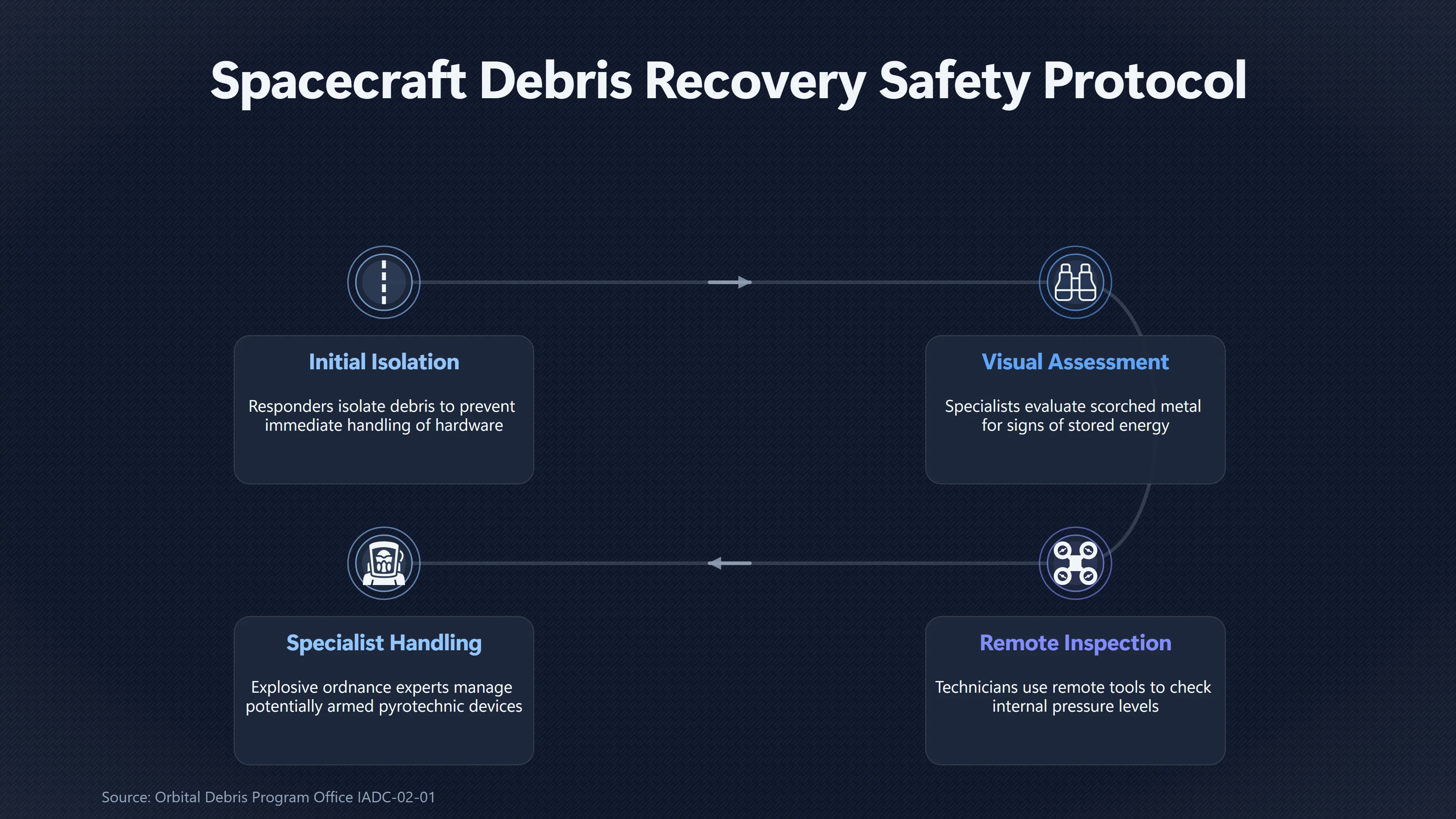
International debris-mitigation guidance reflects this concern even before re-entry occurs. The Inter-Agency Space Debris Coordination Committee (IADC) recommends venting high-pressure vessels, depleting pressurants and removing other stored energy at the end of a mission specifically to prevent accidental ruptures and explosions. The fact that these precautions are required illustrates that stored energy remains a recognised hazard if passivation is incomplete or unsuccessful.[Orbital Debris Program Office]orbitaldebris.jsc.nasa.govOrbital Debris Program Office IADCOrbital Debris Program Office IADC
Battery and pyrotechnic failure hazards
Pressure is only one form of stored energy. Spacecraft also carry electrical and explosive systems that can remain dangerous after a crash.
Batteries can remain electrically active
Spacecraft batteries are designed for reliability under severe environmental conditions. If they survive re-entry inside protective structures, damaged cells may still contain significant electrical energy.
Heat and impact can produce several delayed failure modes:
- internal short circuits;
- overheating after mechanical damage;[science.nasa.gov]science.nasa.govchapter11 4chapter11 4
- venting of hot gases;
- thermal runaway in some battery chemistries;
- ignition following disturbance during recovery.
Modern NASA orbital-debris guidance explicitly evaluates battery survivability during re-entry because certain protected battery assemblies may survive atmospheric passage. Engineers therefore consider both the probability of survival and the hazards posed by surviving cells when assessing spacecraft disposal.[NASA]nasa.govNational Aeronautics and Space AdministrationNational Aeronautics and Space AdministrationMay 11, 2026…

Pyrotechnic devices may never have fired
Many spacecraft rely on pyrotechnic mechanisms that operate only once during a mission. These include:
- explosive bolts used to separate stages;
- cable cutters;
- release mechanisms for antennas or solar arrays;
- deployment systems for parachutes or scientific equipment;
- emergency destruct or separation devices on launch systems.
If re-entry occurs before those devices are activated—or if the initiating sequence fails—they may remain armed but unfired. Although designed with multiple safety features, responders cannot determine their condition from external inspection.
An impact that crushes surrounding structure does not necessarily trigger every explosive component. Instead, damage may leave mechanisms partially compromised while their energetic material remains intact. This uncertainty is precisely why unfamiliar aerospace debris is handled by explosive ordnance specialists rather than general recovery personnel.
Why moving debris can trigger rupture or ignition
One of the most counter-intuitive hazards is that a fragment may remain stable until someone attempts to move it.
Several physical processes explain this behaviour:
- A dented pressure vessel may be held together only by friction around a crack.
- Twisting or lifting changes the stress distribution across damaged metal.
- Internal pressure can suddenly exploit a weakened section once external support changes.
- Battery packs can develop new internal short circuits after vibration or impact.
- Damaged wiring may reconnect briefly as components shift position.
- Crushed pyrotechnic assemblies may experience additional mechanical loading during handling.
For this reason, emergency procedures generally favour leaving debris undisturbed until specialists can assess it with appropriate protective equipment and remote inspection methods. Even apparently minor actions—turning an object over, dragging it or attempting to open it—may introduce forces that were absent immediately after impact.
Why responders assume the worst until identification
An unidentified object recovered after atmospheric re-entry presents a unique problem: its hazards cannot be inferred from appearance alone.
A scorched metal cylinder could represent:
- an empty structural component;
- a helium pressurant tank;
- a residual propellant vessel;
- a battery enclosure;
- a pyrotechnic deployment assembly;
- an entirely different aerospace system.
Until the object is positively identified, responders have little basis for selecting a less cautious approach. Modern orbital debris programmes therefore emphasise controlled recovery, restricted access and specialist assessment rather than immediate handling. NASA’s debris re-entry guidance similarly models which components survive re-entry precisely because those surviving parts present the greatest potential hazard on the ground.[Orbital Debris Program Office]orbitaldebris.jsc.nasa.govOpen source on nasa.gov.
Relevance to the Kecksburg incident
Within the Kecksburg case, reports of military cordons and restrictions on access do not demonstrate that a dangerous spacecraft component was recovered. The historical evidence remains incomplete, and no verified recovered object has been publicly established.
However, if officials in December 1965 genuinely believed that an unidentified aerospace object had reached the ground, treating it as though it contained hazardous stored energy would have been consistent with prudent Cold War recovery practice. An apparently inert object might still have contained compressed gas, charged batteries or unfired pyrotechnic devices capable of causing injury if disturbed. From a safety perspective alone, isolating the site until qualified personnel completed an assessment would have been a rational response irrespective of whether the object ultimately proved to be space hardware, military equipment or something else.
Amazon book picks
Further Reading
Books and field guides related to Why Apparently Inert Space Debris Can Still Explode. Use these as the next step if you want deeper reading beyond the article.
Ignition!: An Informal History of Liquid Rocket Propellants
John Clark tells here, with irreverent and eyewitness immediacy, the story of the search for a power packaging which could be trusted to...
Rocket Propulsion Elements
Rating: 4.5/5 from 11 Google Books ratings
Aerospace Engineering/Mechanical Engineering The definitive text on rocket propulsion-now completely revised to reflect rapid advancement...
Space Debris: Models and Risk Analysis
In Space Debris Models and Risk Analysis the authors will provide the reader with a comprehensive background to understand the various so...
Stuff Matters
An eye-opening adventure deep inside the everyday materials that surround us, from concrete and steel to denim and chocolate, packed with...
eBay marketplace picks
Marketplace Samples
Live-tested eBay searches with available results related to this page.
Selected fromrocket model oneBay.co.uk.
Endnotes
1.
Source: orbitaldebris.jsc.nasa.gov
Link:https://orbitaldebris.jsc.nasa.gov/reentry/index.html
2.
Source: orbitaldebris.jsc.nasa.gov
Title: Orbital Debris Program Office IADC-02-01
Link:https://orbitaldebris.jsc.nasa.gov/library/iadc-space-debris-guidelines-revision-2.pdf
3.
Source: technology.esa.int
Title: Technology Re-entry Safety
Link:https://technology.esa.int/page/re-entry-safety
Source snippet
ESA TechnologyRe-entry Safety...
4.
Source: reentry.esoc.esa.int
Title: Reentry Predictions ESA’s re-entry predictions
Link:https://reentry.esoc.esa.int/
Source snippet
ESA Reentry PredictionsESA’s re-entry predictions...
5.
Source: nasa.gov
Title: National Aeronautics and Space Administration
Link:https://www.nasa.gov/wp-content/uploads/2024/01/nasa-orbital-debris-mitigation-requirements-applied-to-batteries.pdf?emrc=66c14c98be1b9
Source snippet
National Aeronautics and Space AdministrationMay 11, 2026...
Published: May 11, 2026
6.
Source: ntrs.nasa.gov
Link:https://ntrs.nasa.gov/citations/20205008875
Source snippet
NASA Technical Reports ServerNASA Orbital Debris Mitigation Requirements Applied to Batteries - NASA Technical Reports Server (NTRS)...
7.
Source: sma.nasa.gov
Title: Nearly all of the systems store enough energy to cause costly damage, s
Link:https://sma.nasa.gov/sma-disciplines/pressure-vessels-and-systems
Source snippet
SystemsJune 8, 2026 — PRESSURE SYSTEMS There are approximately 10,000 ground-based Pressure Vessels and Pressurized Systems (PVS) across...
Published: June 8, 2026
8.
Source: sma.nasa.gov
Title: pyrotechnics and explosives safety
Link:https://sma.nasa.gov/sma-disciplines/pyrotechnics-and-explosives-safety
Source snippet
and Pyrotechnics SafetyJune 8, 2026 — EXPLOSIVES AND PYROTECHNICS SAFETY NASA’s Safety and Mission Assurance technical program for Explos...
Published: June 8, 2026
9.
Source: nasa.gov
Title: 13.0 Deorbit Systems
Link:https://www.nasa.gov/smallsat-institute/sst-soa/deorbit-systems/
Source snippet
May 7, 2026 — 13.0 DEORBIT SYSTEMS May 7, 2026 PDF (1.49 MB) CHAPTER CONTENTS * Chapter Glossary * 13.1 Introduction * 13.2 Orbital D...
Published: May 7, 2026
10.
Source: nasa.gov
Title: Orbital Debris
Link:https://www.nasa.gov/reference/jsc-orbital-debris/
Source snippet
January 22, 2026 — ORBITAL DEBRIS Orbital debris is critical in human spaceflight as its presence poses a significant threat to space...
Published: January 22, 2026
11.
Source: nasa.gov
Title: Hazardous Testing
Link:https://www.nasa.gov/reference/jsc-hazardous-testing/
12.
Source: nasa.gov
Title: Mechanical & Pyrotechnic Subsystems
Link:https://www.nasa.gov/reference/jsc-mechanical-pyrotechnic-subsystems/
13.
Source: science.nasa.gov
Title: chapter11 4
Link:https://science.nasa.gov/learn/basics-of-space-flight/chapter11-4/
14.
Source: nodis3.gsfc.nasa.gov
Title: display Dir.cfm
Link:https://nodis3.gsfc.nasa.gov/displayDir.cfm?Internal_ID=N_PR_8715006E&page_name=main
15.
Source: standards.nasa.gov
Title: MSFC SPEC 3635
Link:https://standards.nasa.gov/standard/MSFC/MSFC-SPEC-3635
16.
Source: standards.nasa.gov
Title: NASA STD 871912
Link:https://standards.nasa.gov/standard/NASA/NASA-STD-871912
17.
Source: esa.int
Link:https://www.esa.int/Space_Safety/Space_Debris/ESA_reentry_expertise
18.
Source: nasa.gov
Title: Pyrotechnic Device Evaluation
Link:https://www.nasa.gov/centers-and-facilities/white-sands/pyrotechnic-device-evaluation/
19.
Source: sma.nasa.gov
Title: orbital debris history of orbital debris
Link:https://sma.nasa.gov/sma-disciplines/orbital-debris/orbital-debris-history-of-orbital-debris
20.
Source: nodis3.gsfc.nasa.gov
Title: display All.cfm
Link:https://nodis3.gsfc.nasa.gov/displayAll.cfm?Internal_ID=N_PR_8715006A&page_name=all
21.
Source: orbitaldebris.jsc.nasa.gov
Link:https://orbitaldebris.jsc.nasa.gov/faq/
22.
Source: orbitaldebris.jsc.nasa.gov
Link:https://orbitaldebris.jsc.nasa.gov/
23.
Source: sma.nasa.gov
Title: orbital debris
Link:https://sma.nasa.gov/sma-disciplines/orbital-debris
24.
Source: esa.int
Link:https://www.esa.int/Space_Safety/Space_Debris/Space_Debris_FAQ_Frequently_asked_questions
Additional References
25.
Source: youtube.com
Title: How Do Spaceships Survive Reentry Without Burning Up?
Link:https://www.youtube.com/watch?v=7Oe6Tl9M9X8
Source snippet
A Brief History of: The [Kosmos 954]({{ 'kosmos-954/' | relative_url }}) Nuclear Reactor Crash...
26.
Source: youtube.com
Title: Mystery Space Junk Crashes in Australia, Police Find Burning Rocket Debris
Link:https://www.youtube.com/watch?v=6jGGHeuIAjs
Source snippet
ESA Reentry Expertise...
27.
Source: youtube.com
Title: ESA Reentry Expertise
Link:https://www.youtube.com/watch?v=x-nKA9fSFCk
Source snippet
Viewer Video of Falcon 9 Rocket Debris Over Washington...
28.
Source: youtube.com
Title: A Brief History of: The Kosmos 954 Nuclear Reactor Crash
Link:https://www.youtube.com/watch?v=YN7ifFam1Fk
Source snippet
Mystery Space Junk Crashes in Australia...