Within US Vehicle
Which Secret American Vehicle Best Fits Kecksburg?
Several secret American systems shared blunt-body shapes, but their missions, launch paths and recovery methods make them very different Kecksburg candidates.
On this page
- Warhead re entry vehicles
- Reconnaissance film return capsules
- Experimental lifting and manoeuvring craft
Page outline Jump by section
Introduction
One of the most persistent versions of the secret American explanation for the Kecksburg incident is that the object was a classified re-entry vehicle rather than anything extraterrestrial. The challenge is that several Cold War programmes produced blunt, heat-resistant vehicles that can appear superficially similar in photographs or witness sketches. Missile warheads, reconnaissance film-return capsules and experimental re-entry craft all shared the same basic engineering principle: a blunt shape that could survive atmospheric heating. Yet they were built for very different missions, flew different trajectories and were recovered in different ways.
Distinguishing between these vehicle types is essential because the strengths and weaknesses of the Kecksburg theory change depending on which class of hardware is proposed. Visual resemblance alone is not enough. Launch history, operational procedures, recovery methods and the known development timelines all have to fit the events reported in December 1965.
Warhead re-entry vehicles
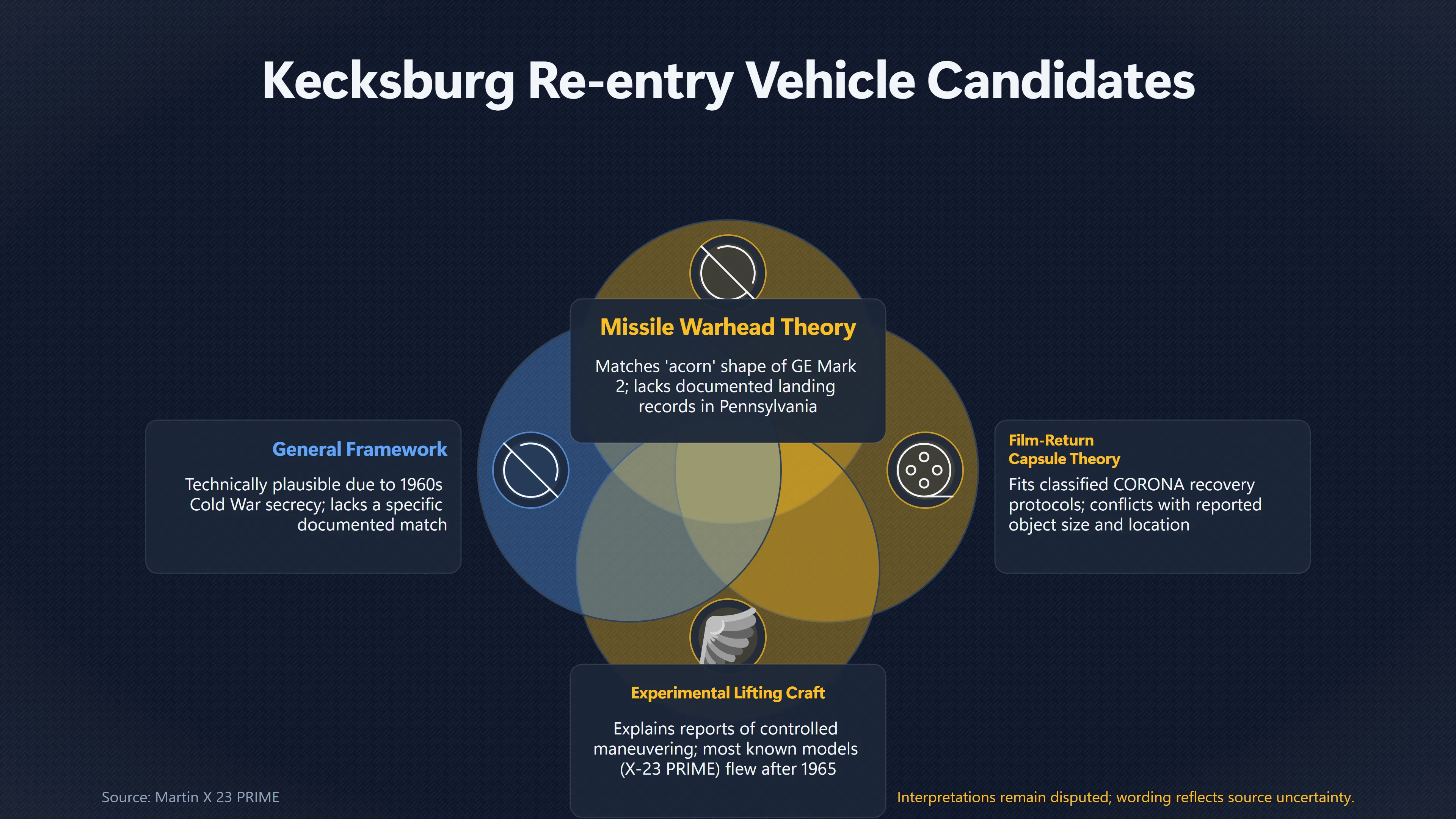
Among the American candidates, ballistic missile re-entry vehicles have attracted the greatest attention because many genuinely possessed the bell-shaped or “acorn-like” appearance described by some Kecksburg witnesses.
The frequently cited General Electric Mark 2 illustrates why. Developed for the Thor intermediate-range ballistic missile, it was a compact re-entry body designed to protect a nuclear payload during atmospheric descent. Its broad base, rounded upper section and heat-resistant construction resemble later artistic reconstructions of the Kecksburg object far more closely than most spacecraft do. Smithsonian collections preserve examples showing the distinctive blunt-body geometry characteristic of early American re-entry engineering.[Smithsonian Institution]si.eduOpen source on si.edu.
However, a warhead re-entry vehicle presents several practical difficulties as a Kecksburg candidate.
First, these vehicles were not independent spacecraft. They were the terminal portion of a ballistic missile and followed carefully calculated trajectories after separation. An unexpected landing deep inside Pennsylvania would require an extraordinary navigational error or an unusual classified test, neither of which has been documented publicly.
Second, military recovery priorities would have differed from those for ordinary space hardware. A nuclear-capable re-entry vehicle—even if unarmed during testing—would have represented highly sensitive technology. Rapid military security around a crash site would therefore be understandable, but no declassified launch records, missile tests or accident reports have emerged linking such hardware to Kecksburg.
Third, witness descriptions remain inconsistent. Some accounts describe a largely intact metallic object with unusual markings and little obvious fire damage. An operational ballistic re-entry vehicle returning at intercontinental speeds would normally experience intense heating, although ablative materials were specifically designed to protect the underlying structure during descent.
Consequently, the warhead theory gains its strength primarily from shape similarity and Cold War secrecy rather than from documented operational evidence.
Reconnaissance film-return capsules
A second category often confused with missile warheads consists of the recovery capsules used by American reconnaissance satellites, particularly the highly classified CORONA programme.
Unlike warheads, CORONA capsules had one purpose: bringing exposed photographic film safely back from orbit. After separation from their satellites, the capsules re-entered the atmosphere, deployed parachutes and were normally intercepted in mid-air by specially equipped Air Force aircraft, with ocean recovery as a backup. The system included thermal protection, attitude-control equipment and recovery hardware designed specifically for this mission.[Air & Space Forces Magazine]airandspaceforces.comAir & Space Forces MagazineCorona Comes in From the Cold | Air & Space Forces MagazineSeptember 1, 1995…
This makes film-return capsules attractive candidates for several reasons.
- They genuinely returned from orbit on scheduled recovery missions.
- Their recovery operations involved military aircraft and classified procedures.
- Their bucket-shaped geometry could resemble some reported witness sketches.
- Their classified status in 1965 would explain official secrecy.
Nevertheless, important differences remain.
The capsules were substantially smaller than many Kecksburg descriptions. While eyewitness estimates vary considerably—and are notoriously unreliable after unexpected events—many reports describe an object comparable in size to a small car, larger than a standard CORONA recovery capsule.
Recovery procedures also differ. CORONA missions aimed for carefully defined recovery corridors over the Pacific Ocean. A landing in western Pennsylvania would imply a major guidance failure that would almost certainly have affected tracking systems. Although classified missions occasionally experienced anomalies, no released documentation connects a CORONA recovery attempt with the Kecksburg incident.[Air & Space Forces Magazine]airandspaceforces.comAir & Space Forces MagazineCorona Comes in From the Cold | Air & Space Forces MagazineSeptember 1, 1995…
The film-capsule theory therefore fits the concept of a secret recovery operation better than many alternatives, but matches less well on reported size and intended recovery location.
Experimental lifting and manoeuvring craft
The third category includes experimental vehicles developed to investigate controlled atmospheric re-entry rather than simply surviving it.
During the 1960s the United States explored lifting bodies—vehicles capable of generating aerodynamic lift while descending from space. Instead of following a purely ballistic path, they could steer, alter cross-range distance and test future spacecraft technologies.
This category is frequently invoked because some Kecksburg witnesses reported an object changing direction rather than behaving like a simple meteor.
Why these craft seem attractive
Experimental vehicles could theoretically explain reports of an apparently controlled descent. Unlike ordinary ballistic bodies, lifting re-entry craft deliberately generated aerodynamic forces during hypersonic flight.
Projects such as ASSET and later the X-23 PRIME were specifically intended to investigate advanced re-entry behaviour, including manoeuvring, thermal protection and recovery systems.[The Space Review]thespacereview.comThe Space ReviewThe Space Review: Movements of fire and shadow: The X-23 PRIME reentry vehicle and American satellite reconnaissanceMarch…
The existence of these programmes demonstrates that controlled atmospheric manoeuvring was already an active research field during the Cold War rather than a later technological development.
The timeline problem
Despite these similarities, chronology creates the largest obstacle.
The Martin X-23 PRIME—the programme most often mentioned in Kecksburg discussions—did not conduct its first flight until 21 December 1966, more than a year after the Pennsylvania incident. Its subsequent missions demonstrated significant cross-range manoeuvres and used parachute-based recovery techniques over the Pacific, but they cannot account for an event in December 1965.[The Space Review]thespacereview.comThe Space ReviewThe Space Review: Movements of fire and shadow: The X-23 PRIME reentry vehicle and American satellite reconnaissanceMarch…
Earlier experimental projects such as ASSET did fly before Kecksburg, but they differed substantially in appearance, objectives and flight history. While they prove that advanced re-entry testing existed, they do not provide a documented match for the reported crash.
This distinction is often lost in popular retellings, where all manoeuvring re-entry research becomes merged into a single undefined “secret spacecraft” category.
Comparing the three candidate classes
When viewed side by side, the principal American candidates differ more than they initially appear.
Vehicle typeStrongest matchMain difficultyMissile warhead re-entry vehicleResembles many witness sketches; explains rapid military interest if sensitive technology were involvedNo documented missile event or recovery operation linked to PennsylvaniaReconnaissance film-return capsuleGenuine classified recovery hardware; military retrieval procedures fit Cold War secrecyIntended Pacific recovery zones and generally smaller physical sizeExperimental manoeuvring craftCould theoretically fit reports of controlled flightBest-known candidates, especially X-23 PRIME, flew after December 1965
The comparison highlights why no single American vehicle has emerged as a convincing identification. Each explains some reported features while conflicting with others.
What this comparison means for the Kecksburg theory
The broader secret American re-entry theory remains technically plausible because the United States genuinely operated several families of classified re-entry vehicles during the mid-1960s. Cold War secrecy, rapid military response and unfamiliar vehicle shapes are all historically consistent with that period.
The difficulty lies in moving from a plausible category to a documented object.
A missile warhead offers the closest visual resemblance but lacks supporting operational evidence. A CORONA film capsule matches known classified recovery practices but not its intended recovery geography or reported dimensions. Experimental lifting vehicles explain manoeuvring better than ballistic objects, yet the most frequently proposed examples either post-date the incident or differ substantially from witness accounts.
As a result, historians generally regard “secret American hardware” as a broad explanatory framework rather than a demonstrated identification. It remains a hypothesis built from genuine Cold War technologies, but no declassified programme has yet provided the documentary link needed to identify a specific American vehicle as the object reported at Kecksburg.
Amazon book picks
Further Reading
Books and field guides related to Which Secret American Vehicle Best Fits Kecksburg?. Use these as the next step if you want deeper reading beyond the article.
Skunk Works: A Personal Memoir of My Years at Lockheed
The former head of Lockheed's SKUNK WORKS reveals the amazing story of the secret aircraft that changed the course of history - from the...
Eye in the Sky: The Story of the Corona Spy Satellites
Presenting the full story of the CORONA spy satellites' origins, Eye in the Sky explores the Cold War technology and far-reaching effects...
Spies in the Sky: Surveillance Satellites in War and Peace
In this book, Patrick Norris responds to the 50th Anniversary of the dawn of the Space Age – the launch of Sputnik 1 – with a review of t...
Area 51: An Uncensored History of America's Top Secret Milita...
The explosive, untold story of the Cold War's biggest secret from the bestselling author of NUCLEAR WAR: A SCENARIO 'An extraordinary boo...
eBay marketplace picks
Marketplace Samples
Live-tested eBay searches with available results related to this page.
Selected fromCold War reconnaissance patch oneBay.co.uk.
Endnotes
1.
Source: si.edu
Link:https://www.si.edu/object/nasm_A19960016000
2.
Source: airandspaceforces.com
Link:https://www.airandspaceforces.com/article/0995corona/
Source snippet
Air & Space Forces MagazineCorona Comes in From the Cold | Air & Space Forces MagazineSeptember 1, 1995...
Published: September 1, 1995
3.
Source: si.edu
Link:https://www.si.edu/object/reentry-capsule-film-return-corona%3Anasm_A19950118000
4.
Source: thespacereview.com
Link:https://www.thespacereview.com/archive/3446-1.html
Source snippet
The Space ReviewThe Space Review: Movements of fire and shadow: The X-23 PRIME reentry vehicle and American satellite reconnaissanceMarch...
5.
Source: space.skyrocket.de
Link:https://space.skyrocket.de/doc_sdat/prime.htm
Source snippet
(SV-5D, X-23)July 11, 2025 — PRIME (SV-5D, X-23) Image PRIME (SV-5D, X-23) The Martin X-23 PRIME (Precision Recovery Including Maneuverin...
Published: July 11, 2025
6.
Source: thespacereview.com
Link:https://www.thespacereview.com/article/1410/2
7.
Source: military-history.fandom.com
Title: Martin X 23 PRIME
Link:https://military-history.fandom.com/wiki/Martin_X-23_PRIME
8.
Source: airandspace.si.edu
Link:https://airandspace.si.edu/collection-objects/model-corona-film-return-system/nasm_A19960016000
9.
Source: si.edu
Link:https://www.si.edu/object/parachute-cover-film-return-capsule-corona%3Anasm_A19950118001
10.
Source: si.edu
Link:https://www.si.edu/object/nasm_A19950117014
Additional References
11.
Source: theblackvault.com
Title: the vault files the 1965 kecksburg pennsylvania crash
Link:https://www.theblackvault.com/casefiles/the-vault-files-the-1965-kecksburg-pennsylvania-crash/
Source snippet
The Vault Files: The 1965 Kecksburg, Pennsylvania Crash - The Black Vault Case FilesAugust 1, 2025 — THE VAULT FILES: THE 1965 KECKSBURG...
Published: August 1, 2025
12.
Source: youtube.com
Title: A Point in Time The Corona Story
Link:https://www.youtube.com/watch?v=l2hnYFBzM1M
Source snippet
NASA DISCOVERER SATELLITE FILM C.I.A. CORONA SPY SATELLITE PROGRAM PAYLOAD ORBITAL RECOVERY 18044...
13.
Source: designation-systems.net
Link:https://www.designation-systems.net/dusrm/app3/ws-117l.html
Source snippet
WS-117LJune 16, 2025 — CORONA The first camera system for CORONA was developed by Itek and built by Fairchild, and designated simply as "...
Published: June 16, 2025
14.
Source: youtube.com
Link:https://www.youtube.com/watch?v=ZiUjI7Tz9rE
Source snippet
The Kecksburg UFO Mystery: Secrets, Witnesses and Vanished Evidence...
15.
Source: ntrs.nasa.gov
Title: Technical Reports Server An Inventory – X-1 to X-45
Link:https://ntrs.nasa.gov/api/citations/20010072175/downloads/20010072175.pdf?attachment=true
Source snippet
NASA Technical Reports ServerAn Inventory -- X-1 to X-45...
16.
Source: theufochronicles.com
Title: closing kecksburg ufo case pt2
Link:https://www.theufochronicles.com/2017/09/closing-kecksburg-ufo-case-pt2.html
Source snippet
Due to an anomaly of sorts, its recovery vehicle separated from the satellite earlier th...
17.
Source: youtube.com
Title: First Footage Taken in Space
Link:https://www.youtube.com/watch?v=-O99IH9kbPw
Source snippet
A Point in Time The Corona Story - Intelligence Satellite Launches, CIA, 1972, HD Remaster...
18.
Source: youtube.com
Link:https://www.youtube.com/watch?v=HX_RrO7ZQaU
Source snippet
First Footage Taken in Space - 1959...
19.
Source: cia.gov
Title: CORON A PROGRAM HISTORY VOLUME III CORONA CAMERAS | CIA FOIA (foia.cia.gov)
Link:https://www.cia.gov/readingroom/document/cia-rdp89b00980r000500090001-0
20.
Source: en-academic.com
Link:https://en-academic.com/dic.nsf/enwiki/11703154