Within Kecksburg
Was Kecksburg a Secret American Spacecraft?
A classified US re-entry vehicle could explain the shape and secrecy claims, but no public evidence ties one to Kecksburg.
On this page
- Cold War re entry vehicle designs
- Why the shape comparison appeals
- The missing launch and recovery trail
Page outline Jump by section
Introduction
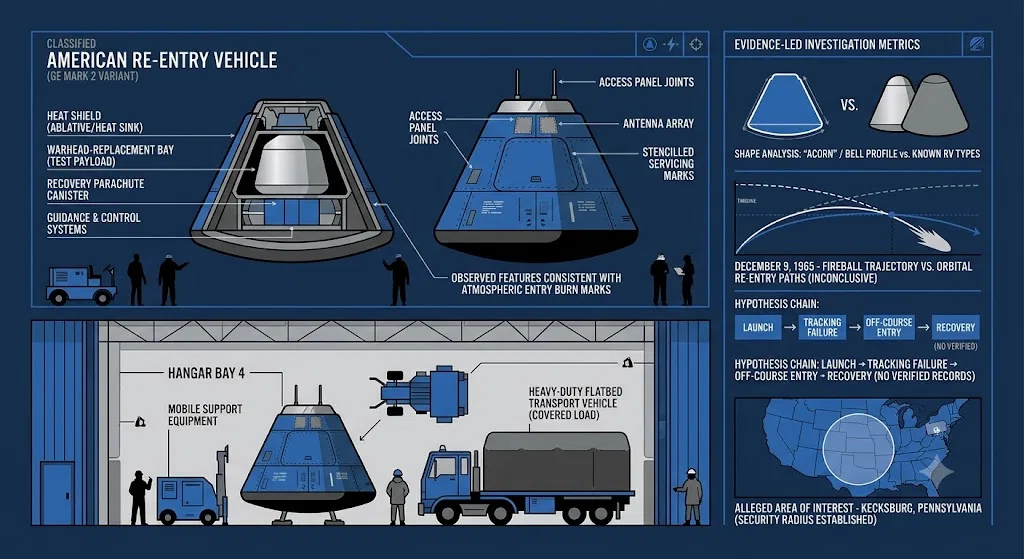
The secret American re-entry vehicle theory proposes that the object allegedly recovered near Kecksburg on 9 December 1965 was not extraterrestrial, but a classified United States missile or space-program payload that returned off course. It is a credible category of explanation: Cold War America was testing blunt, heat-resistant capsules, manoeuvrable warhead shapes and recoverable reconnaissance payloads, often under substantial secrecy. Some were broad enough to resemble the later “acorn” descriptions, and an unexpected landing could reasonably have prompted a rapid military response.
The difficulty is identification. No declassified launch record, test report, tracking document, recovery order or surviving hardware has been publicly connected to Kecksburg. The frequently named General Electric Mark 2 was a real re-entry vehicle, but the proposed match depends mainly on visual resemblance and retrospective witness claims. The theory therefore explains why officials might have acted discreetly without demonstrating that a particular American spacecraft actually came down in Pennsylvania.
Cold War vehicles that could resemble an “acorn”
By 1965, American engineers had spent years developing objects designed to survive atmospheric entry at several kilometres per second. Re-entry vehicles were commonly blunt rather than needle-shaped because a broad forward surface kept the hottest shock-heated air away from the vehicle itself. Heat-sink structures and ablative coverings—materials intended to char or erode while carrying heat away—allowed nuclear-warhead carriers, research capsules and satellite film containers to survive long enough to reach the lower atmosphere.[Centennial of Flight]centennialofflight.netCentennial of FlightAdvanced Reentry VehiclesEarly U.S. ballistic reentry vehicles had a low ballistic coefficient, or beta. The ballisti…
That engineering produced a family of shapes that could appear bell-like, conical or acorn-like when viewed upright. The strongest specific candidate advanced by supporters is General Electric’s Mark 2 re-entry vehicle, originally made for the Thor intermediate-range ballistic missile. The Smithsonian’s preserved example is approximately 5 feet high, just over 5 feet across and weighs about 1,800 pounds—roughly the scale of a large industrial capsule, although smaller than some later descriptions of the Kecksburg object as comparable to a Volkswagen.[Smithsonian Air and Space Museum]airandspace.si.eduSmithsonian Air and Space MuseumMissile, Reentry Vehicle, Mark 2Mark 2 reentry vehicle (RV) Made by General Electric, Dimensions Other: 5…
The Mark 2 was not a satellite or an independent spacecraft in the ordinary sense. It was the atmospheric-entry section of a ballistic missile, built to carry a nuclear warhead. That distinction matters because some retellings blur together several different technologies: warhead re-entry vehicles, recoverable photographic capsules, manoeuvring research craft and entire reconnaissance satellites. These systems could share blunt-body aerodynamics, but they had different launch profiles, destinations and recovery arrangements.[Smithsonian Air and Space Museum]airandspace.si.eduSmithsonian Air and Space MuseumMissile, Reentry Vehicle, Mark 2Mark 2 reentry vehicle (RV) Made by General Electric, Dimensions Other: 5…
Other American programmes show why the broader theory cannot be dismissed merely because the reported object looked unconventional. CORONA and later reconnaissance satellites returned exposed film inside protected capsules, while experimental vehicles investigated controlled or lifting re-entry. The X-23 PRIME, first flown after Kecksburg, demonstrated significant cross-range manoeuvring and was recovered over the Pacific by aircraft. Its existence confirms that guided re-entry was a serious American research field, but its later flight dates also mean that X-23 itself cannot explain the 1965 incident.[The Space Review]thespacereview.comThe reentry vehicles were similar in shape to the ones usedThe Space ReviewThe X-23 PRIME reentry vehicle and American satellite…5 Mar 2018 — The experimental spacecraft, known as the X-23 PRIM…
Why the shape comparison appeals
The theory gained a more definite identity in the 1990s, when Owen Eichler and John Ventre argued that the Kecksburg object could have been a General Electric Mark 2. Their comparison drew attention to four broad features: a bell or acorn profile, a lower rim, a size within the range of substantial re-entry hardware and the possibility of small control systems capable of altering a descent.[Clio]theclio.comClio Kecksburg UFO IncidentClioKecksburg UFO Incident - Clio19 Jul 2018 —… John Ventre and Owen Eichler created a new theory in 1991 that it was a GE Mark 2 re-e…
The visual argument has an immediate appeal. A blunt re-entry body displayed with its heat shield at the bottom can look much closer to the reported Kecksburg form than a conventional aircraft, meteorite or broken satellite panel. A scorched heat shield, access fittings, panel joints or stencilled servicing marks might also be remembered as a band of unfamiliar symbols—especially when recalled years later in darkness and under stressful conditions.
Yet resemblance is weak identification evidence. Many entry capsules use variations on cones, bells and rounded heat shields because the same aerodynamic and thermal problems constrain their design. Matching a basic outline does not establish manufacturer, mission or date. The Smithsonian Mark 2 also has identifiable proportions and surface features that do not cleanly reproduce every version of the Kecksburg description. Witness estimates range considerably, and the most elaborate accounts—including bronze colouring and “hieroglyphic” markings—became prominent long after the event.[si.edu]airandspace.si.eduSmithsonian Air and Space MuseumMissile, Reentry Vehicle, Mark 2Mark 2 reentry vehicle (RV) Made by General Electric, Dimensions Other: 5…
Claims that the object executed deliberate turns provide another apparent point of agreement. Advocates argue that course changes reported near Ohio and Pennsylvania are more consistent with a manoeuvring vehicle than with a meteor. Early American research did include vehicles able to generate lift or make limited trajectory corrections, and later systems demonstrated meaningful cross-range capability. But a ballistic re-entry vehicle’s control authority was not equivalent to that of an aircraft. Atmospheric winds, perspective effects and attempts to reconstruct a long track from geographically separated observations can also create the appearance of turns.[Secret Projects Forum]secretprojects.co.ukearly maneuverable reentry vehicle studies.8981early maneuverable reentry vehicle studies.8981
There is also a scale problem. A Mark 2-sized body might fit some descriptions, but not those portraying the recovered object as substantially larger than a car. Conversely, the larger the proposed craft becomes, the harder it is to reconcile with a standard warhead vehicle. The theory works best when applied loosely to an unknown experimental capsule, rather than when it insists that the object was a precise match for the museum example.
Secrecy would make sense—but proves little
A classified American payload would offer a straightforward reason for military control of the area. In 1965, a fallen re-entry vehicle might have contained sensitive heat-shield materials, guidance components, telemetry equipment, explosives or a warhead-related structure. Even an unarmed test article could reveal information about missile accuracy and survivability. Keeping civilians away and moving the wreckage rapidly would have been normal security and safety practice.
The historical setting strengthens that possibility. American missile and reconnaissance projects operated through tightly compartmented organisations, and the public descriptions of missions were sometimes incomplete or deliberately misleading. CORONA, for example, flew under the civilian-sounding Discoverer cover programme. The existence of such secrecy means that the absence of an immediate public explanation cannot, by itself, rule out military hardware.[The Space Review]thespacereview.comThe reentry vehicles were similar in shape to the ones usedThe Space ReviewThe X-23 PRIME reentry vehicle and American satellite…5 Mar 2018 — The experimental spacecraft, known as the X-23 PRIM…
However, secrecy is not evidence that a recovery occurred. Police and military personnel could have responded to reports of an aircraft accident, missile debris, radioactive material or an unidentified falling object and then found nothing of consequence. The alleged removal by flatbed truck comes chiefly from retrospective testimony rather than a contemporaneous manifest, photograph or official recovery document. Even the number, affiliation and activities of the uniformed personnel remain disputed.
The distinction is crucial: the theory can explain the reported behaviour of authorities only after accepting the disputed recovery story as substantially accurate. It does not independently verify that story. Military presence and official reticence make a classified vehicle psychologically plausible, but they cannot identify one without a technical or documentary link.
The missing launch and recovery trail
A genuine American re-entry vehicle requires a chain of events. It must have been launched by a missile or rocket, tracked during flight, recognised as off course and recovered through a military command structure. Such an accident would normally generate records across several organisations: launch-range logs, radar plots, telemetry reports, safety notifications, transport orders, contractor investigations and accountability records for the hardware.
No such chain has emerged publicly for Kecksburg. The publicly catalogued orbital launch on 9 December 1965 was a Thor-Agena mission from Vandenberg Air Force Base carrying a CORONA reconnaissance satellite. It lifted off at about 21:10 UTC, roughly 4.10 pm Eastern time, and its catalogued payload remained in orbit until later in December. That mission does not supply a known capsule returning over Pennsylvania at the time of the Kecksburg fireball.[OrbitalFocus]orbitalfocus.ukOpen source on orbitalfocus.uk.
This does not eliminate a suborbital or unlisted classified test. Missile re-entry trials were commonly launched from western ranges towards Pacific impact areas, and not every sensitive test would appear in an ordinary orbital catalogue. But replacing a missing record with an unspecified secret mission makes the proposal difficult to test. A candidate must account for how a vehicle intended for a Pacific range, or another controlled corridor, reached the eastern United States without producing a recognised range emergency.
The Mark 2 identification has an additional chronological weakness. It was established missile technology rather than an autonomous recoverable spacecraft whose normal mission involved landing intact on American soil. A warhead re-entry body would arrive at destructive speed unless equipped for a special recovery experiment. The theory therefore needs more than the existence of the Mark 2 shape: it needs evidence of a particular modified test article, launch vehicle, flight path and recovery system.
Public launch records also constrain claims that a capsule had simply “fallen from orbit”. An orbital object capable of reaching Pennsylvania would have possessed a track that military surveillance networks could follow. Its re-entry corridor would need to align with the observed fireball, and its speed and duration should resemble artificial re-entry rather than a natural bolide. No published orbital reconstruction has securely matched an American object to the full Great Lakes–Pennsylvania event.
What evidence would make the theory stronger?
The most persuasive discovery would be a dated primary document naming an American test vehicle lost or recovered in western Pennsylvania on 9 December 1965. A launch discrepancy report, radar trajectory, contractor memorandum or transport record identifying the destination of recovered hardware would turn the theory from analogy into a historical explanation.
Other useful evidence would include:
- photographs or film taken before the later television reconstruction fixed the “acorn” image in popular culture;
- contemporaneous witness descriptions precise enough to compare with known vehicle dimensions and fittings;
- physical fragments with traceable custody and materials consistent with a specific American heat shield;
- military unit records showing who travelled to Kecksburg, what equipment they carried and what they removed;
- a trajectory calculation connecting a documented launch or orbital object to the observed fireball and alleged landing site.
Freedom of Information Act litigation led NASA to conduct further searches for Kecksburg-related material, but the controversy over incomplete or missing records did not produce a document identifying a secret American vehicle. Missing files may justify continued caution about categorical official claims; they do not supply the absent launch-and-recovery trail.[WIRED]wired.comNASA Will Re-Open Kecksburg UFO FilesNASA Will Re-Open Kecksburg UFO Files
The best-supported judgement
A secret American re-entry vehicle is more technically grounded than theories involving alien machinery or an exotic wartime “bell”. The United States possessed appropriately shaped hardware, operated classified recovery programmes and had strong reasons to secure sensitive debris. The theory also offers a coherent explanation for the combination of an unusual object, military interest and subsequent silence—provided the later recovery testimony is accurate.
Its weakness is not technological impossibility but evidential incompleteness. The commonly proposed Mark 2 resembles the alleged object only at a broad level, was designed as a missile warhead carrier rather than a soft-landing craft, and has no documented mission connecting it to Pennsylvania. More advanced manoeuvring vehicles demonstrate relevant engineering, but known examples either flew later or operated on test routes far from Kecksburg.
The fairest conclusion is therefore that an unidentified classified American test article remains conceivable, while the specific Mark 2 claim is unproven. Without a launch record, trajectory, recovery order or verified fragment, “secret US vehicle” describes a plausible family of explanations rather than a solved identification.
Amazon book picks
Further Reading
Books and field guides related to Was Kecksburg a Secret American Spacecraft?. Use these as the next step if you want deeper reading beyond the article.
Area 51: An Uncensored History of America's Top Secret Milita...
The explosive, untold story of the Cold War's biggest secret from the bestselling author of NUCLEAR WAR: A SCENARIO 'An extraordinary boo...
Skunk Works: A Personal Memoir of My Years at Lockheed
The former head of Lockheed's SKUNK WORKS reveals the amazing story of the secret aircraft that changed the course of history - from the...
UFOs: Generals, Pilots, and Government Officials Go on the Re...
An in-depth investigation into UFO phenomena documents the author's survey of official extra-terrestrial encounters as experienced by sci...
eBay marketplace picks
Marketplace Samples
Live-tested eBay searches with available results related to this page.
Selected fromspace program patch oneBay.co.uk.




Endnotes
1.
Source: orbitalfocus.uk
Link:https://www.orbitalfocus.uk/Diaries/Launches/Launches.php?year=1965
2.
Source: wired.com
Title: NASA Will Re-Open Kecksburg UFO Files
Link:https://www.wired.com/2007/10/nasa-opens-keck
3.
Source: nasa.gov
Title: Project Gemini
Link:https://www.nasa.gov/history/SP-4002/p3a.htm
4.
Source: nasa.gov
Link:https://www.nasa.gov/wp-content/uploads/2023/03/sp-4407-etuv7.pdf
5.
Source: space.com
Title: 7589 case finally closed 1965 pennsylvania ufo mystery
Link:https://www.space.com/7589-case-finally-closed-1965-pennsylvania-ufo-mystery.html
6.
Source: centennialofflight.net
Link:https://www.centennialofflight.net/essay/Evolution_of_Technology/advanced_reentry/Tech20.htm
Source snippet
Centennial of FlightAdvanced Reentry VehiclesEarly U.S. ballistic reentry vehicles had a low ballistic coefficient, or beta. The ballisti...
7.
Source: airandspace.si.edu
Link:https://airandspace.si.edu/collection-objects/missile-reentry-vehicle-mark-2/nasm_A19751430000
Source snippet
Smithsonian Air and Space MuseumMissile, Reentry Vehicle, Mark 2Mark 2 reentry vehicle (RV) Made by General Electric, Dimensions Other: 5...
8.
Source: thespacereview.com
Title: The reentry vehicles were similar in shape to the ones used
Link:https://www.thespacereview.com/article/3446/1
Source snippet
The Space ReviewThe X-23 PRIME reentry vehicle and American satellite...5 Mar 2018 — The experimental spacecraft, known as the X-23 PRIM...
9.
Source: theclio.com
Title: Clio [Kecksburg UFO Incident]({{ ‘kecksburg-ufo-incident/’ | relative_url }})
Link:https://theclio.com/entry/63413
Source snippet
ClioKecksburg UFO Incident - Clio19 Jul 2018 —... John Ventre and Owen Eichler created a new theory in 1991 that it was a GE Mark 2 re-e...
10.
Source: atlasobscura.com
Title: space acorn
Link:https://www.atlasobscura.com/places/space-acorn
11.
Source: secretprojects.co.uk
Title: early maneuverable reentry vehicle studies.8981
Link:https://www.secretprojects.co.uk/threads/early-maneuverable-reentry-vehicle-studies.8981/
12.
Source: astronautix.com
Link:https://www.astronautix.com/v/vandenberg.html
Additional References
13.
Source: youtube.com
Link:https://www.youtube.com/watch?v=ruKDXL13lk8
Source snippet
This selection includes primary discussions on the GE Mark 2 re-entry vehicle hypothesis alongside original technical footage of the Gene...
14.
Source: futuretheater.com
Title: Was Kecksburg a GE Mark 2 Capsule 2
Link:https://www.futuretheater.com/assets/pdf/kecksburg-mark.pdf
Source snippet
By John Ventre and Owen Eichler. On December 9, 1965 at 4:47 pm, something navigated through our airspace and...Read more...
Published: December 9, 1965
15.
Source: archive.ll.mit.edu
Link:https://archive.ll.mit.edu/publications/journal/pdf/vol04_no2/4.2.2.earlyreentryphysics.pdf
Source snippet
nching ofreentry test vehicles by NASA...
16.
Source: reddit.com
Title: Kecksburg UFO
Link:https://www.reddit.com/r/UFOs/comments/16g4qb1/kecksburg_ufo_december_9_1965_was_most_likely_a/
Source snippet
Kecksburg UFO December 9, 1965 was most likely a...It made a turn and then crashed according to witnesses in Kecksburg. There was...
Published: December 9, 1965
17.
Source: youtube.com
Title: America’s Other Roswell: the Kecksburg UFO
Link:https://www.youtube.com/watch?v=HX_RrO7ZQaU
Source snippet
The 1965 Kecksburg Incident: A UFO Crash the Government Hides to This Day...
18.
Source: jimmychurchradio.com
Link:https://jimmychurchradio.com/has-a-top-5-ufo-case-been-solved/
19.
Source: aiaa.org
Link:https://aiaa.org/wp-content/uploads/2026/03/GE-ReEntry-Systems-Historic-Aerospace-Site-AIAAHistory-TC.pdf
20.
Source: enigmalabs.io
Link:https://enigmalabs.io/library/f45bb19d-5803-4ab6-a373-8799f64095c0
21.
Source: facebook.com
Link:https://www.facebook.com/groups/pennsylvaniaphotos/posts/3965626140374425/
22.
Source: reddit.com
Link:https://www.reddit.com/r/HighStrangeness/comments/1pj31iw/kecksburg_ufo_at_60_still_the_acorn_the/