Within Records Access
Could Better Recordkeeping Have Prevented the Gaps?
Federal preservation rules require agencies to report unlawful destruction, but compliance depends on records being identified before they vanish.
On this page
- Federal duties to preserve official records
- How unauthorized destruction is reported
- What the rules cannot recover decades later
Page outline Jump by section
Introduction
The missing or incomplete federal records associated with the 1965 Kecksburg incident are often presented as evidence of secrecy. A more cautious reading is that they also illustrate a longstanding challenge in US government recordkeeping. Modern federal law requires agencies to preserve official records, document their destruction through approved schedules, and report any unlawful loss to the National Archives and Records Administration (NARA). However, those safeguards work only if records are correctly identified, managed and still exist when questions arise. Once files have been lawfully destroyed under an approved retention schedule, accidentally lost, misfiled or never properly indexed, neither the Freedom of Information Act (FOIA) nor later archival reviews can reliably reconstruct them. This distinction is central to understanding why decades-old gaps in the Kecksburg documentary record remain unresolved.
Federal duties to preserve official records
Federal agencies are governed principally by the Federal Records Act, which requires them to create and maintain records documenting their activities and to manage those records according to schedules approved by the Archivist of the United States. Records may not simply be discarded at an employee’s discretion; destruction is permitted only under NARA-approved records schedules or applicable General Records Schedules. Agencies are also expected to train personnel, establish internal controls and prevent the unlawful or accidental destruction or removal of records.[Legal Information Institute]law.cornell.eduElectronic Code of Federal Regulations (e-CFR) | US Law | LII / Legal Information Institute…
These obligations matter when considering historical cases such as Kecksburg because they distinguish between several very different possibilities:
- a record was created and preserved;
- a record was created but later destroyed under an authorised schedule;
- a record was created but lost or destroyed improperly;
- a record was never created in the form later researchers expected.
FOIA can compel agencies to search for existing records, but it cannot require production of records that no longer exist or were never created. That legal limitation became especially relevant during later litigation over NASA’s searches relating to the Kecksburg incident.
How unauthorised destruction is supposed to be reported
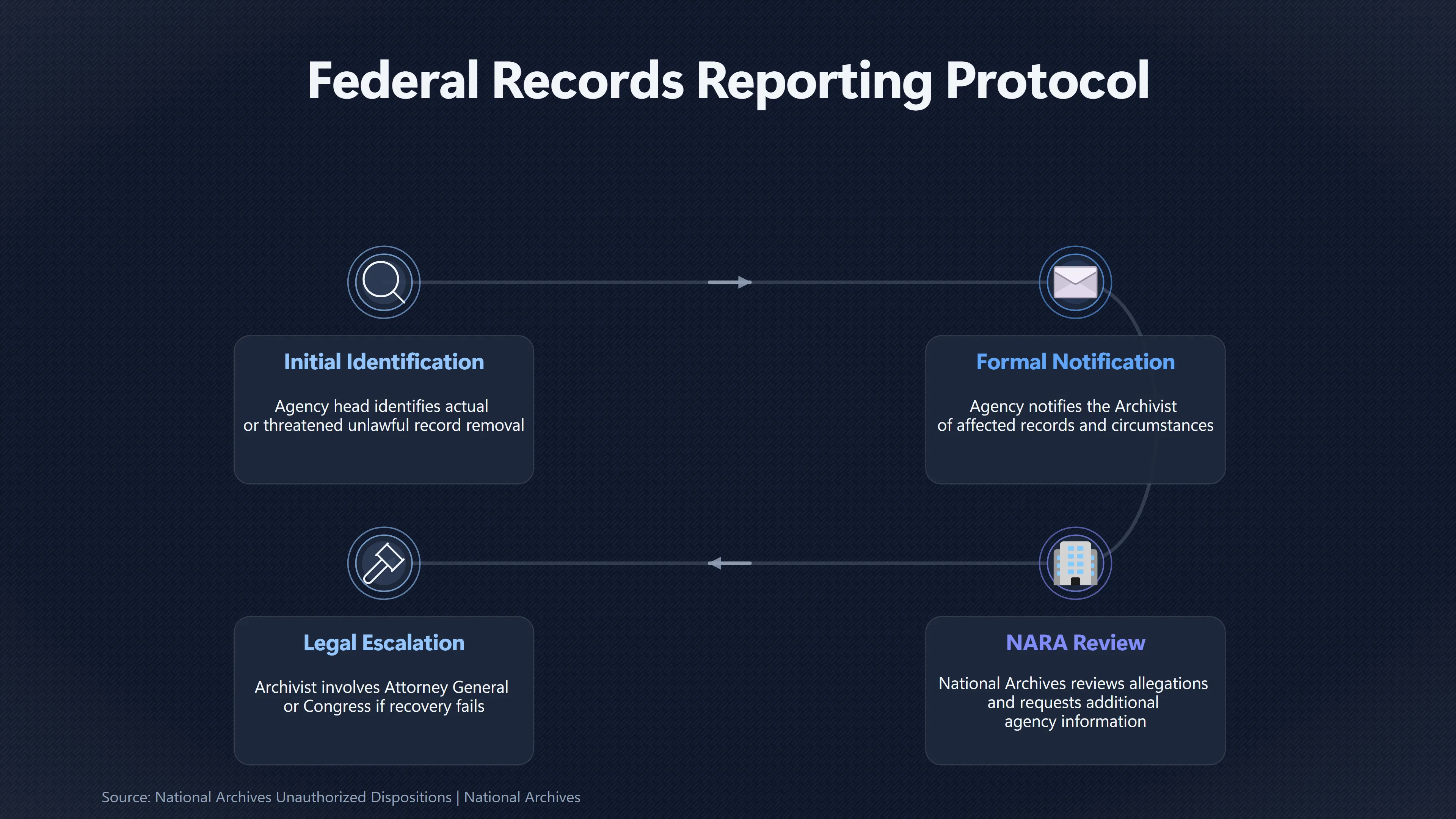
Current federal regulations impose a clear reporting process when records are believed to have been unlawfully or accidentally destroyed.
Under 44 U.S.C. §3106 and implementing regulations in 36 CFR Part 1230, an agency head must notify the Archivist of any actual, impending or threatened unlawful removal, alteration or destruction of records. The agency’s report must describe what records were affected, explain the circumstances, identify measures to prevent further loss and, where possible, outline efforts to recover or reconstruct the missing documentation.[house.gov]uscode.house.govU.S. CodeJuly 23, 2026…
NARA then reviews the allegation and requests information from the agency. If records appear to have been unlawfully removed and the agency fails to pursue recovery, the Archivist has authority to involve the Attorney General and notify Congress where appropriate.[Legal Information Institute]law.cornell.eduElectronic Code of Federal Regulations (e-CFR) | US Law | LII / Legal Information Institute…
These procedures are designed primarily to stop losses while they are occurring or shortly afterwards. They are far less effective when questions emerge many decades later, after staff have retired, offices have reorganised and paper files have passed through multiple storage systems.
Why Kecksburg falls into a difficult historical period
The Kecksburg incident occurred in December 1965, during an era when federal records were overwhelmingly paper-based and often managed independently by individual offices before eventual transfer to federal records centres or the National Archives.
Several characteristics of recordkeeping at the time complicate retrospective investigation:
- filing systems frequently depended on office-specific subject classifications rather than modern searchable databases;
- records relating to operations involving multiple agencies could be divided among separate filing systems;
- temporary operational files often had shorter authorised retention periods than policy records;
- documentation of routine administrative actions was sometimes considered disposable after a specified number of years.
Consequently, even where agencies complied with the rules in force at the time, later investigators may encounter incomplete documentary trails simply because temporary files were never intended for permanent preservation.
This does not prove that every missing Kecksburg-related document was lawfully destroyed. Rather, it explains why an incomplete archival record is compatible with ordinary federal records management practices as well as with more controversial interpretations.
What the NASA litigation actually revealed
The FOIA litigation brought by journalist Leslie Kean demonstrated weaknesses in NASA’s search process rather than proving that records had been intentionally destroyed.
During the case, NASA acknowledged that its initial searches had been inadequate, leading to a court-supervised settlement requiring broader searches across additional offices and repositories. The expanded review ultimately produced hundreds of additional pages concerning historical debris recovery activities and related subjects, but no definitive document establishing that NASA had recovered an unidentified craft at Kecksburg. At the same time, some categories of expected historical material could not be located, leaving unresolved questions about whether certain records had been lost, destroyed under approved schedules or never existed in the anticipated form.[National Archives]archives.govNational Archives Unauthorized Dispositions | National ArchivesNational ArchivesUnauthorized Dispositions | National ArchivesDecember 8, 2017…
From a recordkeeping perspective, this illustrates an important distinction:
- inadequate searches can be corrected through litigation;
- destroyed or missing records generally cannot be recreated through litigation.
A successful FOIA lawsuit therefore improves the search for surviving documents but cannot reverse historical record losses.
What modern recordkeeping rules cannot recover decades later
Even today’s stronger preservation framework has practical limits when applied to events from the 1960s.
Records must first be recognised as records
Preservation rules apply only to material identified as federal records. Working notes, duplicate copies, routine administrative papers and other categories may historically have been scheduled differently from permanent investigative files. If offices classified material inconsistently, later researchers may discover uneven survival across related collections.[National Archives]archives.govOpen source on archives.gov.
Reporting requirements are not retroactive investigations
Current requirements to report unlawful destruction are intended to address ongoing or recently discovered losses. They are not designed to reconstruct events after half a century has passed, particularly where there is no surviving evidence establishing when a document disappeared.
Reconstruction has practical limits
Regulations encourage agencies to salvage or reconstruct records where possible. In practice, reconstruction usually means locating duplicate copies, related correspondence or records held elsewhere—not recreating documents from memory decades after the original files have vanished.[Legal Information Institute]law.cornell.eduLegal Information Institute36 CFR § 1230.14 - How do agencies report incidents? | Electronic Code of Federal Regulations (e-CFR) | US Law…
Could better recordkeeping have prevented the gaps?
Modern records management practices would probably have reduced some of the uncertainty surrounding Kecksburg, although they could not have guaranteed complete documentation.
Compared with the systems available in 1965, today’s federal environment generally includes:
- centralised electronic records management;(#endnote-1 “Endnote 1”)[youtube.com]youtube.comFBI - Records Management Overview…
- standardised records schedules across agencies;
- stronger oversight by agency records officers;
- clearer reporting requirements for unauthorised destruction;
- improved audit trails for electronic records.
These developments increase the likelihood that records can later be located and that missing files leave an identifiable administrative trail. They do not eliminate every possibility of loss, particularly in complex multi-agency events.
The Kecksburg case therefore illustrates a broader lesson about government transparency. Missing historical records should not automatically be interpreted as evidence of concealment, but neither should they be dismissed as unimportant administrative errors. The Federal Records Act and related regulations have progressively strengthened preservation and accountability, yet those protections depend on records being correctly created, identified and retained before they disappear. Once a documentary gap has existed for decades, modern transparency laws can expose the gap more clearly than they can fill it.
Amazon book picks
Further Reading
Books and field guides related to Could Better Recordkeeping Have Prevented the Gaps?. Use these as the next step if you want deeper reading beyond the article.
Archives: Principles and Practices
This new and extensively revised second edition offers an international perspective on archives management, providing authoritative guida...
Records and Information Management
Benefiting LIS students and professionals alike, Franks presents complete coverage of the records and information lifecycle model.
The Theory and Craft of Digital Preservation
A guide to managing data in the digital age. Winner of the ALCTS Outstanding Publication Award by the Association for Library Collections...
The Art of Access: Strategies for Acquiring Public Records
NEW TO THIS EDITION: 40 additional experts and practitioners offer tips and record ideas for opening new doorways into FOI and open data....
eBay marketplace picks
Marketplace Samples
Live-tested eBay searches with available results related to this page.
Selected fromNational Archives poster oneBay.co.uk.


Endnotes
1.
Source: archives.gov
Link:https://www.archives.gov/about/laws/fed-agencies.html
2.
Source: archives.gov
Title: National Archives Unauthorized Dispositions | National Archives
Link:https://www.archives.gov/records-mgmt/resources/unauthorized-dispositions
Source snippet
National ArchivesUnauthorized Dispositions | National ArchivesDecember 8, 2017...
Published: December 8, 2017
3.
Source: nasa.gov
Title: FOI A Homepage
Link:https://www.nasa.gov/foia/
Source snippet
FOIA Homepage - NASAMay 20, 2026 — FOIA * FOIA Home * FOIA Contacts * FOIA Guidance * Access [NASA Records]({{ 'nasa-records/' | relative_url }}) * NASA FOIA Reports * FOIA E-Li...
Published: May 20, 2026
4.
Source: oig.nasa.gov
Title: foia requests
Link:https://oig.nasa.gov/foia-requests/
5.
Source: archives.gov
Title: Unauthorized Disposition of Federal Records | National Archives
Link:https://www.archives.gov/records-mgmt/resources/unauthorizeddispositionoffederalrecords
6.
Source: nasa.gov
Title: Chief FOIA Officer Reports
Link:https://www.nasa.gov/foia/foia-reports/chief-foia-officer-reports/
7.
Source: nasa.gov
Title: Headquarters FOIA Library
Link:https://www.nasa.gov/foia/nasa-e-libraries/headquarters-foia-library/
8.
Source: nasa.gov
Title: Annual FOIA Reports
Link:https://www.nasa.gov/foia/foia-reports/annual-foia-report/
9.
Source: nasa.gov
Title: FOI A Guidance
Link:https://www.nasa.gov/foia/foia-guidance/
10.
Source: archives.gov
Title: Related Disposition Matters | National Archives
Link:https://www.archives.gov/records-mgmt/scheduling/related
11.
Source: nodis3.gsfc.nasa.gov
Title: display Dir.cfm
Link:https://nodis3.gsfc.nasa.gov/displayDir.cfm?Internal_ID=N_PR_1441001E&page_name=AppendixF
12.
Source: nodis3.gsfc.nasa.gov
Title: display Dir.cfm
Link:https://nodis3.gsfc.nasa.gov/displayDir.cfm?Internal_ID=N_PR_1441001E&page_name=Chapter3
13.
Source: hq.nasa.gov
Title: chief officer report
Link:https://www.hq.nasa.gov/office/pao/FOIA/agency/chief_officer_report.html
14.
Source: www3.nasa.gov
Link:https://www3.nasa.gov/centers/kennedy/about/foia/guide.html
15.
Source: nodis3.gsfc.nasa.gov
Title: display All.cfm
Link:https://nodis3.gsfc.nasa.gov/displayAll.cfm?Internal_ID=N_PR_1441001D&page_name=ALL
16.
Source: archives.gov
Link:https://www.archives.gov/records-mgmt/policy/protecting-federal-records.html
17.
Source: securefoia.nasa.gov
Link:https://securefoia.nasa.gov/
18.
Source: youtube.com
Link:http://www.youtube.com/watch?v=3IFgQu-b9vw
Source snippet
National Archives Federal Records Act retention schedules recordkeeping FOIA Access Restrictions: Their Importance and Impact on the Tran...
19.
Source: law.cornell.edu
Link:https://www.law.cornell.edu/cfr/text/36/1230.10
Source snippet
Electronic Code of Federal Regulations (e-CFR) | US Law | LII / Legal Information Institute...
20.
Source: uscode.house.gov
Title: U.S. Code
Link:https://uscode.house.gov/view.xhtml?edition=prelim&req=granuleid%3AUSC-prelim-title44-section3106
Source snippet
July 23, 2026...
Published: July 23, 2026
21.
Source: law.cornell.edu
Link:https://www.law.cornell.edu/cfr/text/36/1230.14
Source snippet
Legal Information Institute36 CFR § 1230.14 - How do agencies report incidents? | Electronic Code of Federal Regulations (e-CFR) | US Law...
22.
Source: law.cornell.edu
Title: part 1230
Link:https://www.law.cornell.edu/cfr/text/36/part-1230
Source snippet
Legal Information Institute36 CFR Part 1230 - UNLAWFUL OR ACCIDENTAL REMOVAL, DEFACING, ALTERATION, OR DESTRUCTION OF RECORDS | Electroni...
23.
Source: law.cornell.edu
Link:https://www.law.cornell.edu/cfr/text/36/1230.16
Source snippet
Electronic Code of Federal Regulations (e-CFR) | US Law | LII / Legal Information Institute...
24.
Source: law.cornell.edu
Link:https://www.law.cornell.edu/cfr/text/14/1206.307
25.
Source: law.cornell.edu
Link:https://www.law.cornell.edu/cfr/text/36/1233.20
26.
Source: uscode.house.gov
Link:https://uscode.house.gov/view.xhtml?edition=2012&num=0&req=granuleid%3AUSC-2012-title44-section3106
27.
Source: law.cornell.edu
Link:https://www.law.cornell.edu/cfr/text/36/1254.40
28.
Source: law.cornell.edu
Link:https://www.law.cornell.edu/uscode/text/44/3106
29.
Source: uscode.house.gov
Link:https://uscode.house.gov/view.xhtml?edition=prelim&req=granuleid%3AUSC-prelim-title44-chapter31
30.
Source: uscode.house.gov
Link:https://uscode.house.gov/view.xhtml?edition=prelim&num=0&req=granuleid%3AUSC-prelim-title44-section3105
Additional References
31.
Source: youtube.com
Title: The Origins of Disclosure: Crashes, Archives, and Secrets with Leslie Kean
Link:http://www.youtube.com/watch?v=q8Y3uDBB24k
Source snippet
1965 Kecksburg PA, NASA's Fragology Files Leslie Kean + Sci-Fi lawsuit 2003...
32.
Source: youtube.com
Title: Finding the Gaps: Locating and Reporting Unscheduled Records
Link:http://www.youtube.com/watch?v=KBoka2U5huY
Source snippet
Access Restrictions: Their Importance and Impact on the Transfer of Permanent Records to NARA...
33.
Source: youtube.com
Link:http://www.youtube.com/watch?v=I3le9xHSuPs
Source snippet
Finding the Gaps: Locating and Reporting Unscheduled Records...
34.
Source: nsa.gov
Link:https://www.nsa.gov/Helpful-Links/NSA-FOIA/Declassification-Transparency-Initiatives/FOIA-Reports-and-Releases/
35.
Source: ecfr.io
Title: Section 1230.14
Link:https://ecfr.io/Title-36/Section-1230.14
Source snippet
5, 2026 — § 1230.14 HOW DO AGENCIES REPORT INCIDENTS? 36 CFR 1230.14 Citation 36 CFR 1230.14 Corpus Daily eCFR Displayed ed...
Published: June 5, 2026
36.
Source: ecfr.io
Title: Section 1230.10
Link:https://ecfr.io/Title-36/Section-1230.10
Source snippet
36 CFR 1230.10 | Who is responsible for… | eCFR.ioJune 26, 2026 — § 1230.10 WHO IS RESPONSIBLE FOR PREVENTING THE UNLAWFUL OR ACCIDENTAL...
Published: June 26, 2026
37.
Source: youtube.com
Link:http://www.youtube.com/watch?v=21-8o7AV560
Source snippet
FBI - Records Management Overview...
38.
Source: law.justia.com
Title: sec 3106
Link:https://law.justia.com/codes/us/title-44/chapter-31/sec-3106/