Within The Strongest Version Of The Kecksburg Crash Claim
Was Kosmos 96 the Kecksburg Object?
Timing and trajectory evidence weaken the Kosmos 96 explanation, but rejecting it does not establish that an unknown craft landed at Kecksburg.
On this page
- Why Soviet probe debris became a leading explanation
- The timing and trajectory conflicts in the reentry theory
- Why a failed explanation does not validate retrieval claims
Page outline Jump by section
Introduction
The suggestion that the Kecksburg object was the Soviet spacecraft Kosmos 96 became one of the most widely discussed conventional explanations for the 9 December 1965 incident because it appeared to offer a plausible Cold War alternative to claims of an unknown craft. Kosmos 96 was a failed Soviet Venus probe that never escaped Earth orbit and re-entered the atmosphere on the same day as the famous Great Lakes fireball. At first glance, the coincidence in date seemed compelling.
However, the strongest available tracking and trajectory evidence creates significant problems for this explanation. Orbital data indicate that Kosmos 96 decayed earlier than the widely observed fireball, while analyses of the fireball’s flight path suggest it behaved more like a natural meteor than an object returning from Earth orbit. These findings weaken the Kosmos 96 hypothesis, but they do not establish that an unidentified craft landed near Kecksburg. Instead, they illustrate an important principle in evaluating extraordinary claims: eliminating one explanation does not automatically validate another.[Wikipedia]WikipediaKosmos 96Kosmos 96
Why Soviet probe debris became a leading explanation
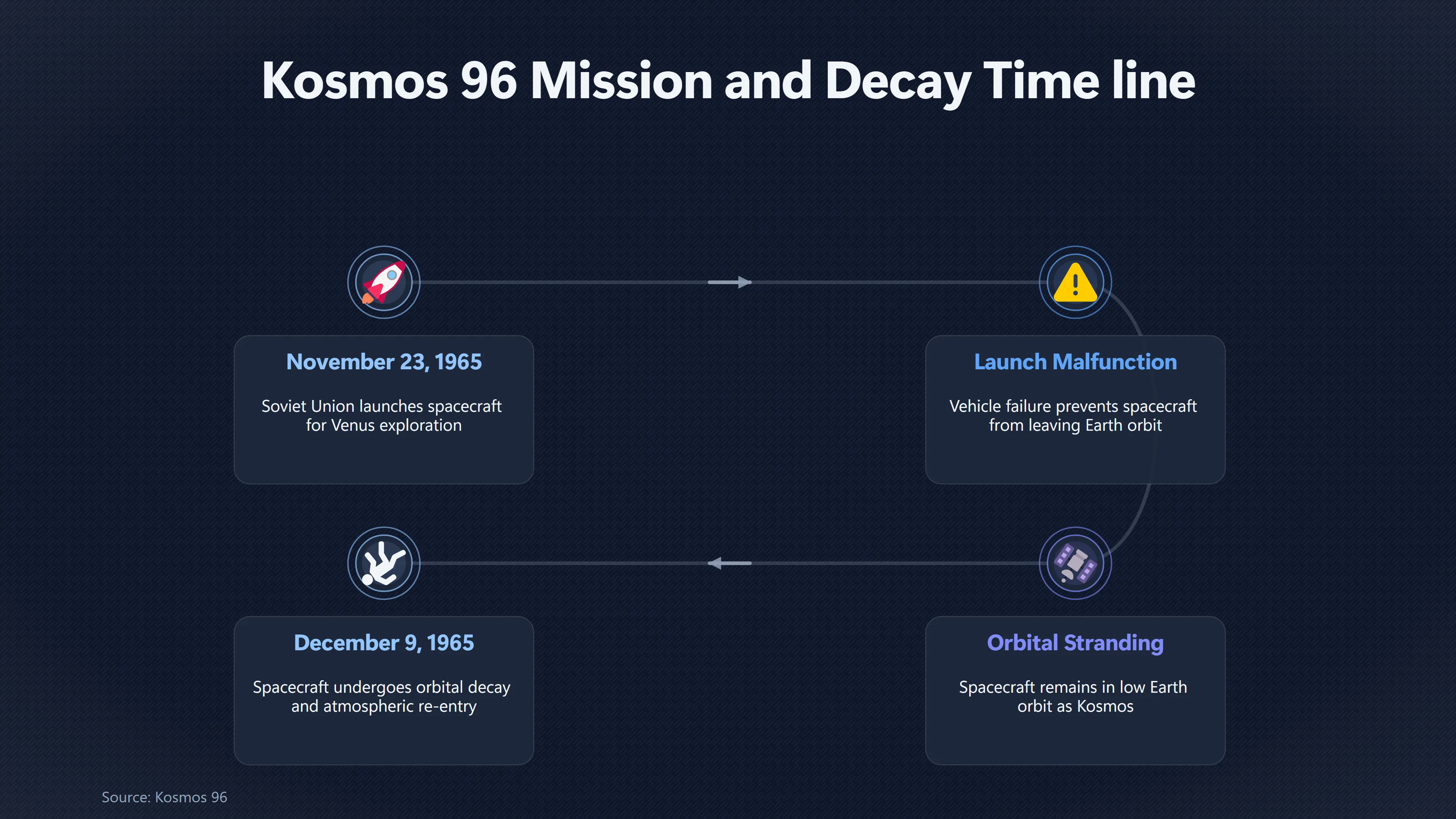
Kosmos 96 was launched by the Soviet Union on 23 November 1965 as part of the Venera programme intended to explore Venus. A malfunction in the launch vehicle prevented the spacecraft from leaving Earth orbit, and Soviet practice at the time was to rename unsuccessful planetary missions under the generic “Kosmos” designation. The stranded spacecraft remained in low Earth orbit until its orbital decay on 9 December 1965.[Wikipedia]WikipediaKosmos 96Kosmos 96
The coincidence that both Kosmos 96 and the Kecksburg fireball were associated with the same date made the spacecraft an attractive explanation for several reasons:
- It offered a known human-made object that was expected to re-enter the atmosphere.
- It explained why military personnel might have shown interest in recovering debris during the height of the Cold War.
- It avoided invoking an extraterrestrial spacecraft while still allowing for an unusual recovery operation.
During the 1990s, space historian James Oberg and others discussed the possibility that debris from Kosmos 96 could account for reports surrounding Kecksburg. NASA also referred to the possibility during later reviews of the case, helping establish it as the leading conventional hypothesis for many years.[Wikipedia]WikipediaJames ObergJames Oberg
The timing and trajectory conflicts in the re-entry theory
Although the hypothesis initially appeared attractive, it encounters two major technical difficulties.
Orbital tracking places re-entry earlier
The most significant problem concerns timing. U.S. Air Force space-tracking data indicate that Kosmos 96’s orbit decayed before the approximately 21:43 UTC fireball witnessed across the Great Lakes region. Some later discussions have suggested an even earlier decay, but regardless of the exact estimate, the available orbital tracking does not place the spacecraft over the observed fireball at the required time.[wikipedia.org]WikipediaKosmos 96Kosmos 96
Because orbital decay was monitored independently of eyewitness testimony, these tracking records carry considerable evidential weight. While uncertainties existed in 1960s orbital calculations, they are not generally regarded as large enough to reconcile the known tracking data with the reported timing of the fireball.
The observed flight resembled a meteor more than a spacecraft
Independent analyses of photographs and witness reports have also challenged the orbital re-entry interpretation.
Objects returning from Earth orbit typically enter the atmosphere along relatively shallow trajectories because they retain substantial horizontal velocity. Studies of the 9 December 1965 fireball concluded that its observed path was considerably steeper than expected for an orbital spacecraft. Instead, investigators argued that the object was more consistent with a natural meteoroid arriving from interplanetary space, possibly terminating over western Lake Erie rather than continuing to Kecksburg.[Wikipedia]WikipediaKosmos 96Kosmos 96
This distinction matters because the geometry of atmospheric entry is constrained by orbital mechanics. While eyewitnesses may disagree about where an object appeared to descend, a trajectory reconstructed from multiple observations provides a stronger basis for distinguishing between a meteor and orbital debris.
Uncertainty does not erase the mismatch
Supporters of the Kosmos 96 explanation sometimes argue that 1965 tracking data were imperfect or incomplete. That point is reasonable in itself: orbital determination was less precise than modern space surveillance.
However, acknowledging uncertainty is different from demonstrating compatibility. The available evidence has not shown that revised orbital calculations place Kosmos 96 at the right location and time. Instead, the existing tracking and trajectory analyses continue to point away from that conclusion.[Wikipedia]WikipediaKosmos 96Kosmos 96
Why a failed explanation does not validate retrieval claims
Rejecting the Kosmos 96 hypothesis leaves an important logical question: if it was not the Soviet spacecraft, does that mean an unknown craft landed near Kecksburg?
The answer is no.
The evidence addresses different questions:
- The Kosmos 96 hypothesis asks whether a specific known spacecraft matches the observed fireball.
- The crash-retrieval claim asks whether an intact manufactured object landed near Kecksburg and was secretly removed.
Disproving the first does not prove the second. Other possibilities—including a natural meteor, mistaken perceptions of the fireball’s endpoint, or an unrelated local event—remain available unless independently ruled out.
This distinction is frequently overlooked in discussions of the case. A failed conventional explanation simply removes one candidate; it does not provide positive evidence for a recovered exotic vehicle.

What the Kosmos 96 debate reveals about the Kecksburg case
The history of the Kosmos 96 theory illustrates how the Kecksburg incident should be evaluated more broadly.
Initially, the coincidence of dates encouraged an apparently straightforward explanation. As more detailed orbital analyses became available, that explanation proved increasingly difficult to reconcile with the technical evidence. Yet the collapse of one hypothesis did not resolve the larger mystery because the evidence supporting a recovered unknown craft remains largely testimonial rather than physical.
As a result, most careful historical assessments reach a more limited conclusion: Kosmos 96 is unlikely to account for the observed fireball as reconstructed from available tracking and trajectory data, but the rejection of that explanation does not establish that an extraordinary object landed in the Pennsylvania woods. The Kecksburg case therefore remains a dispute over the interpretation of incomplete evidence rather than a confirmed example of either Soviet space debris recovery or the recovery of an unknown craft.[wikipedia.org]WikipediaKosmos 96Kosmos 96
Amazon book picks
Further Reading
Books and field guides related to Was Kosmos 96 the Kecksburg Object?. Use these as the next step if you want deeper reading beyond the article.

Red Moon Rising: Sputnik and the Hidden Rivalries That Ignite...
The behind-the-scenes story of the fierce battles on earth that launched the superpowers into space. Khrushchev was frustrated at America...
The Soviet Space Race with Apollo
Winner of the Emme Award for Astronautical Literature, 2001 "The essential reference work for Soviet/Russian space history . . . for anyo...
Challenge to Apollo: The Soviet Union and the Space Race, 194...
The book received the Emme Award for Astronautical Literature at the March 20 2000 luncheon of the Goddard Memorial Symposium, sponsored...
eBay marketplace picks
Marketplace Samples
Live-tested eBay searches with available results related to this page.
Selected fromSoviet space memorabilia oneBay.co.uk.


Endnotes
1.
Source: Wikipedia
Title: Kosmos 96
Link:https://en.wikipedia.org/wiki/Kosmos_96
2.
Source: theblackvault.com
Title: the vault files the 1965 kecksburg pennsylvania crash
Link:https://www.theblackvault.com/casefiles/the-vault-files-the-1965-kecksburg-pennsylvania-crash/
Source snippet
The Vault Files: The 1965 Kecksburg, Pennsylvania Crash - The Black Vault Case Files...
3.
Source: assets.science.nasa.gov
Title: DSC monograph24
Link:https://assets.science.nasa.gov/content/dam/science/psd/solar/2023/09/d/DSC_monograph24.pdf?emrc=68668da1f166f
Source snippet
NASA Science AssetsDeep Space Chronicle: A Chronology of Deep Space and Planetary Probes 1958–2000...
4.
Source: Wikipedia
Title: James Oberg
Link:https://en.wikipedia.org/wiki/James_Oberg
5.
Source: nasa.gov
Title: Gemini III
Link:https://www.nasa.gov/mission/gemini-iii/
6.
Source: nasa.gov
Title: ST S-96
Link:https://www.nasa.gov/mission/sts-96/
7.
Source: reentry.arc.nasa.gov
Link:https://reentry.arc.nasa.gov/viewingforum.html
8.
Source: ntrs.nasa.gov
Link:https://ntrs.nasa.gov/citations/19660006867
9.
Source: wikidata.org
Title: Kosmos 96
Link:https://www.wikidata.org/wiki/Q1632091
10.
Source: enigmalabs.io
Title: Kecksburg Incident | Enigma Labs
Link:https://enigmalabs.io/library/f45bb19d-5803-4ab6-a373-8799f64095c0
11.
Source: ufodesigns3d.com
Link:https://ufodesigns3d.com/blogs/lore/the-kecksburg-incident-the-day-a-ufo-crashed-in-pennsylvania
Additional References
12.
Source: appalachianhistorian.org
Link:https://appalachianhistorian.org/the-[kecksburg-ufo-incident
Source snippet
24, 2026 — THE KECKSBURG UFO INCIDENT: PENNSYLVANIA’S SPACE ACORN AND THE NIGHT THE SKY FELL OVER APPALACHIA By Alex Hall / June 24, 2026...
Published: June 24, 2026
13.
Source: mirkosmosa.ru
Title: pub 7937 zagadka keksburga nlo upavshee s nebes 9 dekabrya 1965 goda
Link:https://mirkosmosa.ru/p/pub-7937-zagadka-keksburga-nlo-upavshee-s-nebes-9-dekabrya-1965-goda
Source snippet
Сразу после падения район был оцеплен полицией штата, а затем прибыли военные — армия и ВВС. По оценкам, на месте работало до 212 человек...
14.
Source: youtube.com
Link:https://www.youtube.com/watch?v=ssKW6l2je9E
Source snippet
The 1965 Kecksburg Incident: A UFO Crash the Government Hides to This Day...
15.
Source: handwiki.org
Title: Astronomy:Kosmos 96
Link:https://www.handwiki.org/wiki/Astronomy%3AKosmos_96
Source snippet
June 9, 2026 — ASTRONOMY:KOSMOS 96 From HandWiki [Input] Kosmos 96 Mission type | Venus flyby ^{[1]} Operator | OKB-1 COSPAR ID |...
Published: June 9, 2026
16.
Source: ufo-graph-map.pages.dev
Title: UFO.ai Kosmos 96 re-entry (Kecksburg prosaic explanation). — UFO.ai
Link:https://ufo-graph-map.pages.dev/node/kosmos96_reentry
Source snippet
96 re-entry (Kecksburg prosaic explanation). — UFO.ai...
17.
Source: youtube.com
Link:https://www.youtube.com/watch?v=ruKDXL13lk8
Source snippet
Search for answers about Kecksburg UFO in Pennsylvania...
18.
Source: thecoldfile.com
Title: 1965 kecksburg
Link:https://www.thecoldfile.com/articles/1965-kecksburg/
Source snippet
None has closed the case, and the speculation here is kept out of the account and the evidence above. A natural meteor or bolide (the off...
19.
Source: youtube.com
Title: America’s Other Roswell: the Kecksburg UFO
Link:https://www.youtube.com/watch?v=HX_RrO7ZQaU
Source snippet
Eyewitnesses To The Kecksburg UFO Incident Swear They Saw Alien Ship, Not A Meteor...
20.
Source: astronomyufo.com
Link:https://www.astronomyufo.com/UFO/earthly.htm
21.
Source: youtube.com
Title: Real UFO? The “Space Acorn” of Kecksburg Pennsylvania
Link:https://www.youtube.com/watch?v=lsHWrkQWiQs
Source snippet
America's Other Roswell: the Kecksburg UFO...