Within Cold War Context
Why the Kosmos Name Revealed So Little
The vague Kosmos naming system concealed mission purposes and made failed Soviet spacecraft harder for Western observers to identify with confidence.
On this page
- How the Soviet Union used the Kosmos designation
- Why failed planetary missions were publicly obscured
- How incomplete disclosure shaped Kecksburg speculation
Page outline Jump by section
Introduction
The Soviet Union’s use of the Kosmos (or Cosmos) designation was one of the defining information-management policies of the Cold War space race. Rather than identifying a spacecraft by its true mission, Soviet authorities frequently assigned the neutral “Kosmos” label to satellites with widely differing purposes, including military reconnaissance systems, scientific experiments and failed lunar or planetary probes. As a result, the designation revealed almost nothing about what had actually been launched.[The Space Review]thespacereview.comThe Space ReviewThe Space Review: Lies, damned lies, and cover stories (page 1)November 20, 2006…

This deliberate ambiguity became particularly relevant to the Kecksburg UFO incident because one failed Soviet Venus probe, Kosmos 96, re-entered Earth’s atmosphere on the same day as the famous Pennsylvania fireball of 9 December 1965. Although later orbital analysis casts doubt on Kosmos 96 being the object seen over Kecksburg, the Soviet naming system itself helped create lasting uncertainty. Western observers knew a Soviet spacecraft had failed, but not precisely what it was, why it had been launched or whether it could have reached the reported location.[Wikipedia]WikipediaKosmos 96Kosmos 96
How the Soviet Union used the Kosmos designation
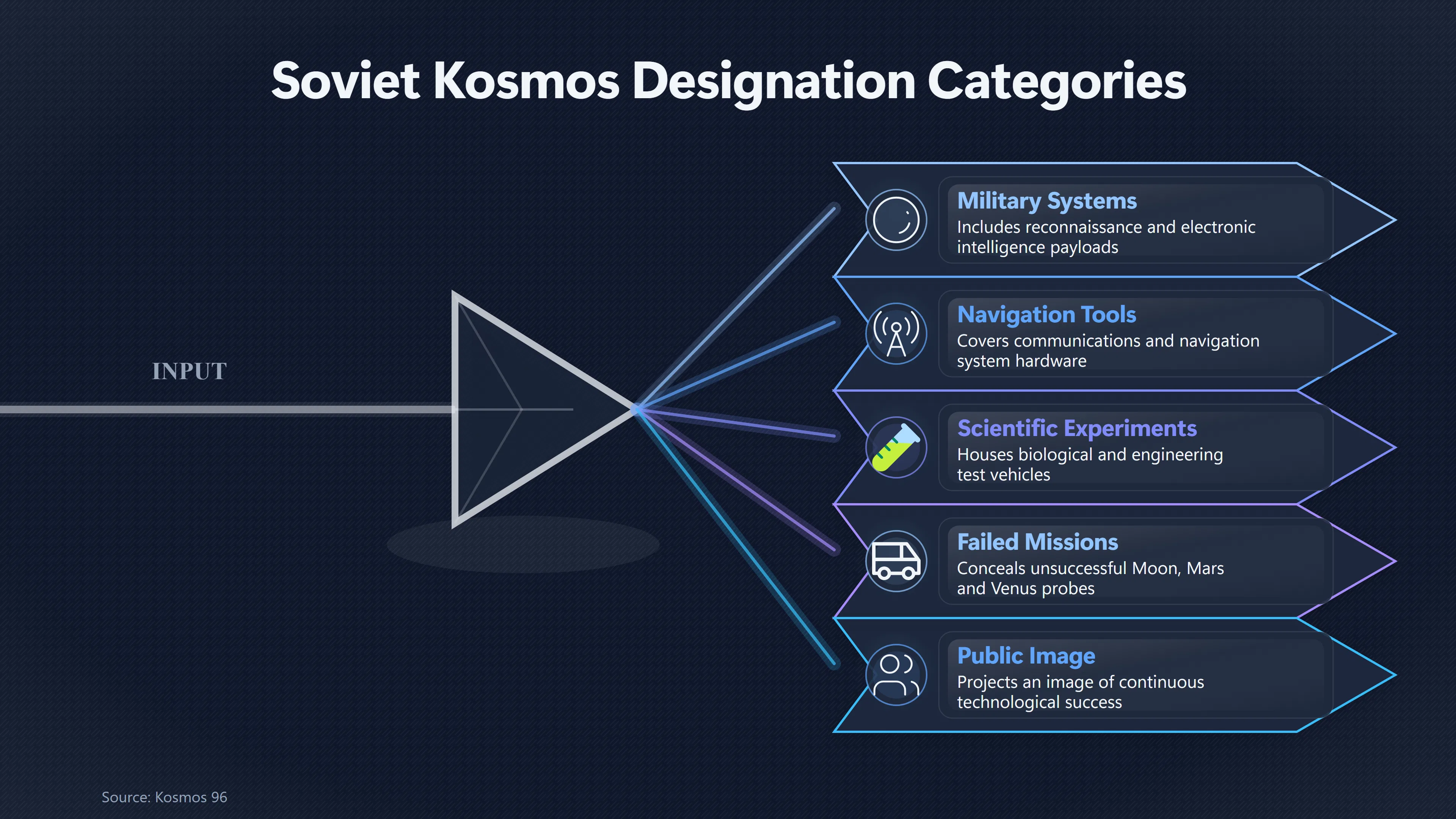
The Soviet government introduced the Kosmos series in 1962 as a deliberately broad public designation rather than a description of a spacecraft’s actual mission. Official announcements generally described these launches as scientific satellites conducting research in near-Earth space, even when the payload had entirely different objectives.[The Space Review]thespacereview.comThe Space ReviewThe Space Review: Lies, damned lies, and cover stories (page 1)November 20, 2006…
In reality, the label covered an extraordinary range of spacecraft, including:
- military reconnaissance satellites;
- navigation and communications systems;
- electronic intelligence payloads;
- biological and scientific experiments;
- engineering test vehicles; and
- unsuccessful Moon, Mars and Venus missions that never escaped Earth orbit.[The Space Review]thespacereview.comThe Space ReviewThe Space Review: Lies, damned lies, and cover stories (page 1)November 20, 2006…
A launch designated “Kosmos” therefore communicated almost no meaningful information to outside observers. Two spacecraft carrying consecutive numbers could have had completely unrelated purposes.
Historians of the Soviet space programme note that this was not accidental. The policy was intended to complicate foreign intelligence analysis by preventing outsiders from easily distinguishing military projects, technological failures and successful scientific missions. Although Western governments possessed radar, tracking stations and classified intelligence, even they often had to reconstruct Soviet activities from orbital data rather than official disclosure. Amateur organisations such as Britain’s Kettering Group became unexpectedly important by analysing radio transmissions and orbital characteristics to infer spacecraft identities.[The Space Review]thespacereview.comOpen source on thespacereview.com.
Why failed planetary missions were publicly obscured
The Kosmos system served another political purpose: it reduced the visibility of unsuccessful interplanetary missions.
During the early 1960s the Soviet Union competed intensely with the United States for prestige in space exploration. Publicly acknowledging repeated failures to reach the Moon, Mars or Venus would have weakened the image of continual technological success that Soviet propaganda sought to project. Instead, missions that failed before escaping Earth orbit frequently disappeared into the generic Kosmos catalogue.[The Space Review]thespacereview.comThe Space ReviewThe Space Review: …Try, try againApril 28, 2014…
This practice created an asymmetry in public knowledge:
- Successful missions usually received distinctive programme names such as Luna or Venera.
- Failures remaining in Earth orbit were often redesignated as Kosmos satellites.
- Official descriptions rarely acknowledged that the spacecraft had originally been intended for another destination.[The Space Review]thespacereview.comThe Space ReviewThe Space Review: …Try, try againApril 28, 2014…
Kosmos 96 illustrates the policy clearly. Internally, it was part of the Venera programme and intended to fly past Venus. After a launch vehicle malfunction prevented departure from Earth orbit, however, it entered public records only as “Kosmos 96” rather than as an unsuccessful Venus mission. Only after the Cold War did documentation become sufficiently available to reconstruct its intended objective with confidence.[Wikipedia]WikipediaKosmos 96Kosmos 96
The same approach had been used for earlier failed lunar and planetary probes, creating a long series of apparently ordinary “Kosmos” satellites that actually concealed ambitious but unsuccessful deep-space missions.[The Space Review]thespacereview.comThe Space ReviewThe Space Review: …Try, try againApril 28, 2014…

Why the name frustrated Western analysts
The Kosmos designation did not make Soviet launches invisible. Instead, it forced foreign analysts to become detectives.
Without reliable official information, researchers combined multiple indirect sources, including:
- radar tracking of orbital parameters;
- launch timing;
- amateur radio interception;
- photographic observations;
- intelligence reporting; and
- comparisons with known Soviet launch vehicles.[The Space Review]thespacereview.comOpen source on thespacereview.com.
Even when analysts correctly concluded that a particular Kosmos satellite represented a failed lunar or planetary mission, uncertainty often remained over its precise configuration, payload or intended destination.
This ambiguity had practical consequences. If an unidentified object later re-entered the atmosphere, observers could struggle to determine whether it represented an ordinary satellite, a military payload or part of a failed interplanetary spacecraft. Such uncertainty was especially significant during the Cold War, when recoverable technology might possess intelligence value.
How Kosmos secrecy influenced Kecksburg speculation
The Kecksburg incident occurred in exactly the sort of information environment that the Kosmos policy created.
When reports emerged of a brilliant fireball over the north-eastern United States, researchers quickly noted that Kosmos 96 had re-entered on the same date. Because Soviet announcements had never explained that Kosmos 96 was actually a failed Venus probe, the spacecraft’s identity remained poorly understood outside specialist tracking circles.[Wikipedia]WikipediaKosmos 96Kosmos 96
This encouraged several lines of speculation.
First, observers could reasonably imagine that the object might have been a Soviet spacecraft rather than a natural meteor because Soviet launches were genuinely difficult to identify from public information.
Second, reports of military interest around Kecksburg appeared consistent with Cold War priorities. If American authorities believed Soviet hardware had landed intact, securing it before public examination would have been an understandable intelligence objective.
Finally, the absence of transparent Soviet disclosure made later reconstruction considerably harder. Researchers had to piece together orbital histories from tracking records and declassified documentation rather than from contemporary Soviet mission reports.
Subsequent orbital analyses generally conclude that Kosmos 96 probably re-entered earlier than the Kecksburg fireball and that the observed trajectory is more consistent with a natural meteoroid than with an orbiting spacecraft. Nevertheless, those later conclusions depended on evidence that was unavailable—or inaccessible—to most observers in 1965.[Wikipedia]WikipediaKosmos 96Kosmos 96
Why the Kosmos policy mattered beyond one incident
The importance of the Kosmos designation lies less in any individual spacecraft than in the uncertainty it systematically created.
Rather than concealing launches altogether, Soviet authorities released just enough information to acknowledge that a satellite existed while withholding the details needed to understand its purpose. This approach complicated intelligence gathering, protected military programmes and softened the public impact of failed prestige missions.[The Space Review]thespacereview.comThe Space ReviewThe Space Review: Lies, damned lies, and cover stories (page 1)November 20, 2006…
In the context of Kecksburg, that secrecy did not prove that a Soviet spacecraft landed in Pennsylvania. Instead, it created an information gap into which competing interpretations naturally emerged. A genuine failed Soviet mission existed, its publicly assigned name concealed its true purpose, and Western observers lacked the official information needed to dismiss or confirm the connection quickly. That combination of authentic secrecy and incomplete knowledge became one of the enduring reasons the Kecksburg incident continued to attract speculation long after more detailed evidence became available.[wikipedia.org]WikipediaKosmos 96Kosmos 96
Amazon book picks
Further Reading
Books and field guides related to Why the Kosmos Name Revealed So Little. Use these as the next step if you want deeper reading beyond the article.

Red Moon Rising: Sputnik and the Hidden Rivalries That Ignite...
The behind-the-scenes story of the fierce battles on earth that launched the superpowers into space. Khrushchev was frustrated at America...
The Soviet Space Race with Apollo
Winner of the Emme Award for Astronautical Literature, 2001 "The essential reference work for Soviet/Russian space history . . . for anyo...
The Cold War
Rating: 4.0/5 from 10 Google Books ratings
Beginning with World War II and ending with the collapse of the Soviet Union, the author provides a thrilling account of the strategic dy...
The Cold War: A New History
Rating: 4.0/5 from 10 Google Books ratings
Beginning with World War II and ending with the collapse of the Soviet Union, the author provides a thrilling account of the strategic dy...
eBay marketplace picks
Marketplace Samples
Live-tested eBay searches with available results related to this page.
Selected fromSoviet space poster oneBay.co.uk.

Endnotes
1.
Source: Wikipedia
Title: Kosmos 96
Link:https://en.wikipedia.org/wiki/Kosmos_96
2.
Source: space.com
Link:https://www.space.com/space-exploration/launches-spacecraft/a-failed-soviet-venus-probe-from-the-70s-crashed-to-earth-in-may-why-was-it-so-hard-to-track
Source snippet
SpaceJune 23, 2025 — A FAILED SOVIET VENUS PROBE FROM THE '70S CRASHED TO EARTH IN MAY — WHY WAS IT SO HARD TO TRACK? News By Leonard D...
Published: June 23, 2025
3.
Source: thespacereview.com
Link:https://www.thespacereview.com/article/750/1
Source snippet
The Space ReviewThe Space Review: Lies, damned lies, and cover stories (page 1)November 20, 2006...
Published: November 20, 2006
4.
Source: thespacereview.com
Link:https://www.thespacereview.com/article/648/1
5.
Source: thespacereview.com
Link:https://thespacereview.com/article/2501/1
Source snippet
The Space ReviewThe Space Review: …Try, try againApril 28, 2014...
Published: April 28, 2014
6.
Source: thespacereview.com
Title: The Space Review: Thirty years later, Mars 96 has not been found
Link:https://www.thespacereview.com/article/5194/1
Source snippet
Mars 96 contained two surface landers, two surface penetrators, and an orbiter. At more than 6,500 kilograms, the payload wa...
7.
Source: thespacereview.com
Link:https://www.thespacereview.com/article/4384/1
8.
Source: thespacereview.com
Link:https://www.thespacereview.com/article/3991/1
9.
Source: imagine.gsfc.nasa.gov
Link:https://imagine.gsfc.nasa.gov/science/toolbox/missions/cosmos.html
11.
Source: thespacereview.com
Link:https://www.thespacereview.com/article/750/2
Additional References
12.
Source: spacevoyaging.com
Title: Kosmos 482: The Soviet Spacecraft that is Falling Back to Earth | Space Voyaging
Link:https://www.spacevoyaging.com/news/2025/05/03/kosmos-482-the-soviet-spaceccraft-that-is-falling-back-to-earth/
Source snippet
Credit: www.thespacereview.com * NewsSpace Agencies KOSMOS 482: THE SOVIET SPACECRAFT THAT IS FALLING BACK TO EARTH Kosmos 482 was meant...
13.
Source: bricksin.space
Title: Proton, Kosmos and the Soviet Workhorse Fleet » Bricks in Space
Link:https://bricksin.space/history-of-space-exploration/proton-kosmos-and-the-soviet-workhorse-fleet/
Source snippet
February 24, 2026 — KOSMOS: THE NAME THAT HID EVERYTHING If Proton was the Soviet Union’s heavy truck, the Kosmos designation was its fil...
Published: February 24, 2026
14.
Source: youtube.com
Link:https://www.youtube.com/watch?v=I7ne8uYngXk
Source snippet
The Soviet Nuclear Reactor That Crashed in North America... Until They Found It...
15.
Source: youtube.com
Link:https://www.youtube.com/watch?v=HX_RrO7ZQaU
Source snippet
Episode 184 Kecksburg Revisited with [Stan Gordon]({{ 'stan-gordon/' | relative_url }})...
16.
Source: youtube.com
Title: The Russian Kosmos Satellites
Link:https://www.youtube.com/watch?v=G7Rb7EB7wg8
Source snippet
NOVA: Russian Right Stuff – The Invisible Spaceman (1991) 🛰️ Behind the Soviet space program...
17.
Source: youtube.com
Title: Episode 184 Kecksburg Revisited with Stan Gordon
Link:https://www.youtube.com/watch?v=CKK66LtZ1Hs
Source snippet
The Russian Kosmos Satellites - Space Documentary...
18.
Source: modemworld.me
Link:https://modemworld.me/2025/05/12/
Source snippet
Credit: Geoffrey A. Landis The more fascinating part of these missions was the use of balloons. These...
19.
Source: youtube.com
Link:https://www.youtube.com/watch?v=hkqxjeFBXv0
20.
Source: svengrahn.pp.se
Link:https://www.svengrahn.pp.se/radioind/Spoof/Spoof.html
21.
Source: phys.org
Title: Spot failed Soviet Venus probe Kosmos 482 in Earth orbit
Link:https://phys.org/news/2019-03-soviet-venus-probe-kosmos-earth.html