Within US Vehicle
Could a Secret Capsule Really Steer to Kecksburg?
American research explored guided re-entry, but the ability to make limited corrections was far removed from aircraft-like turning over Ohio and Pennsylvania.
On this page
- How ballistic re entry trajectories worked
- What limited guidance could change
- Why reported turns may overstate manoeuvrability
Page outline Jump by section
Introduction
Some supporters of the secret American re-entry vehicle theory argue that the Kecksburg object appeared to alter course before descending, suggesting it was under control rather than following a simple ballistic path. The central technical question is whether an American re-entry vehicle available in late 1965 could have steered itself to a location such as Kecksburg. The short answer is that limited guidance was technically possible, but only within narrow aerodynamic and orbital constraints. Nothing publicly known from 1965 resembles an aircraft capable of making large, deliberate turns across Ohio and Pennsylvania during atmospheric flight. Instead, the best-supported American research involved modest trajectory corrections designed to improve landing accuracy or extend cross-range by controlled banking during hypersonic re-entry.[nasa.gov]nasa.govReentry andMay 5, 2026…
This distinction matters because witness descriptions are sometimes interpreted as evidence of an actively piloted craft. In reality, the engineering of the period points towards vehicles that could adjust an already established descent, not freely navigate across the landscape.
How ballistic re-entry trajectories worked
Most American re-entry vehicles in the early and mid-1960s followed what engineers describe as a ballistic trajectory. After separating from a missile or spacecraft, the vehicle largely coasted through space before entering the atmosphere at extremely high speed. Gravity, atmospheric drag and the vehicle’s aerodynamic shape determined almost all of the descent.
For a conventional ballistic re-entry vehicle such as the General Electric Mark 2, there was little opportunity to make major directional changes once atmospheric entry had begun. Designers concentrated on ensuring that the heat shield survived temperatures of several thousand degrees while keeping the payload intact. Stability was generally more important than manoeuvrability. Small differences in angle or centre of gravity could shift the landing point by tens of kilometres, but not transform the vehicle into something capable of prolonged turning flight.[nasa.gov]nasa.govReentry andMay 5, 2026…
This is one reason why comparisons between the Kecksburg object and ordinary missile re-entry vehicles face a technical limitation. A ballistic warhead was intended to reach a predetermined target, not search for a destination after entering the atmosphere.
What limited guidance could actually change
The picture becomes more nuanced when considering experimental American programmes. By the early 1960s, NASA and the US Air Force were actively investigating lifting re-entry, in which a carefully shaped body generated a small amount of aerodynamic lift instead of simply falling through the atmosphere.
Generating lift did not mean flying like an aeroplane. Rather, it allowed engineers to:
- slightly lengthen or shorten the descent path;
- shift the landing area sideways (known as cross-range);
- reduce landing errors caused by atmospheric variations;
- perform controlled banking manoeuvres while still travelling at hypersonic speed.
NASA technical studies from the period examined the mathematics of modulated-lift re-entry and methods for controlling such vehicles, showing that these ideas were well established in research long before the Space Shuttle.[NASA Technical Reports Server]ntrs.nasa.govNASA Technical Reports ServerEFFECTS OF PEAK DECELERATION ON RANGE SENSITIVITY FOR A MODULATEDLIFT REENTRY AT SUPERCIRCULAR SPEEDS - NASA…
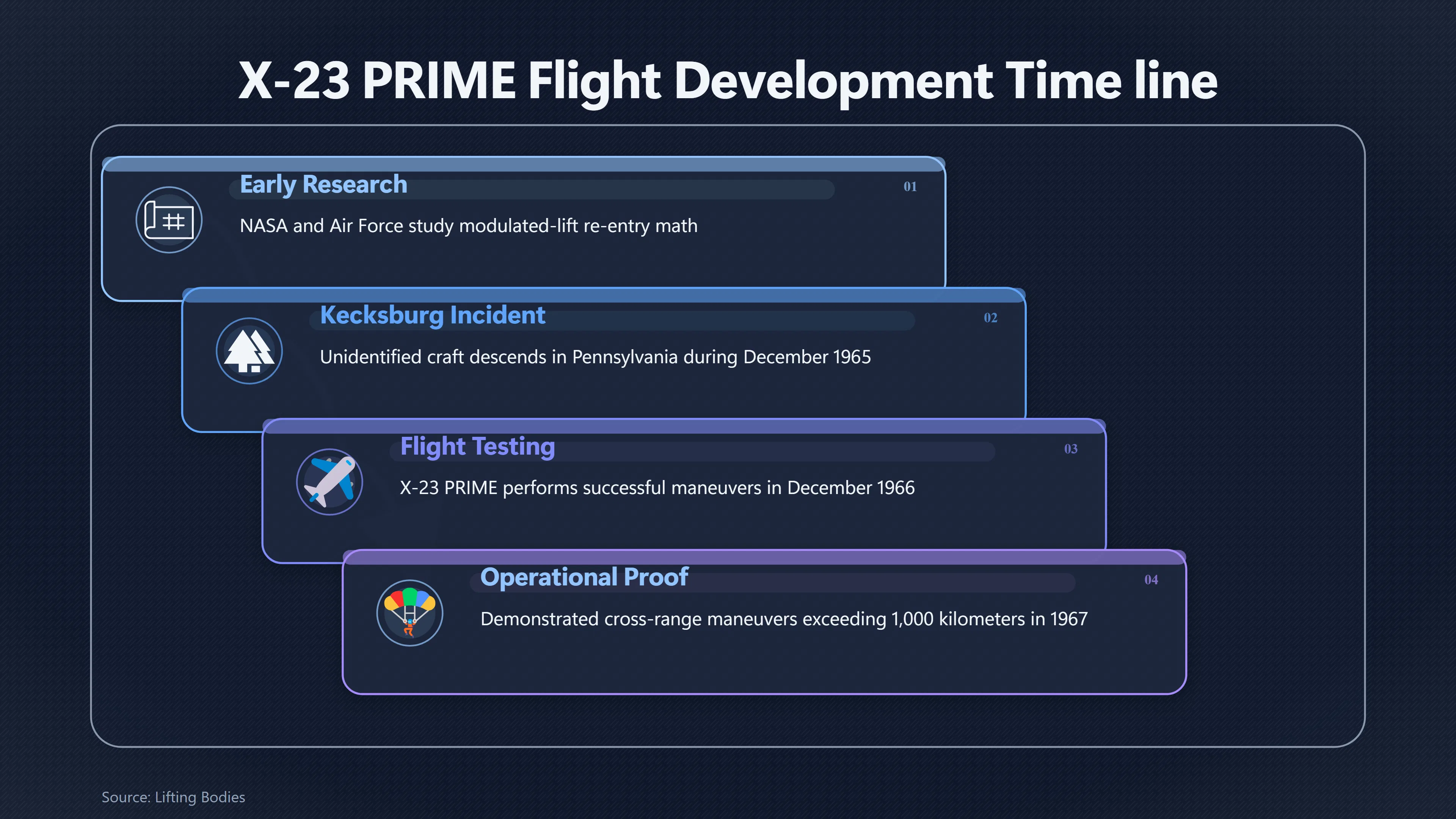
The best-known American demonstration was the X-23 PRIME (Precision Recovery Including Maneuvering Entry) programme. Although frequently mentioned in Kecksburg discussions, it first flew in December 1966—about one year after the Pennsylvania incident. Its successful 1967 flights demonstrated cross-range manoeuvres of over 1,000 kilometres using body flaps and lifting-body aerodynamics before descending under parachute.[NASA]nasa.govReentry andMay 5, 2026…
Those flights proved that manoeuvring re-entry was technically achievable. They also demonstrate an important chronological point: the publicly documented proof-of-concept came after Kecksburg, not before.
Why “steering” does not mean aircraft-like turning
One source of confusion is the everyday meaning of the word steer. In aerospace engineering, a vehicle can be described as steerable even if its ability to change direction is relatively modest.
A lifting re-entry vehicle generally “steered” by changing its bank angle and exploiting the small amount of lift generated by its shape. At hypersonic speed, even slight alterations accumulated into significant differences in where the vehicle eventually landed. The manoeuvre was gradual rather than abrupt, with the vehicle remaining committed to a high-speed descent throughout.[nasa.gov]nasa.govReentry andMay 5, 2026…
Similarly, reaction-control thrusters used outside the atmosphere or in the upper atmosphere primarily adjusted orientation rather than allowing free navigation. Once deeper in the atmosphere, aerodynamic forces dominated, limiting what those thrusters could accomplish.
Consequently, a technically steerable re-entry vehicle should not be imagined weaving between towns or making repeated visible course reversals.
Why reported turns may overstate manoeuvrability
Accounts of the Kecksburg object frequently mention apparent changes in direction observed across several states. Supporters of the American re-entry theory sometimes argue that these observations demonstrate a guided military vehicle rather than a meteor.
There are several reasons to be cautious before interpreting such reports as evidence of large manoeuvres.
First, eyewitnesses were spread over a wide geographical area and viewed the object from very different angles. Perspective can make a shallow descending trajectory appear to curve or change direction, particularly when observers compare recollections after the event rather than measurements made at the time.
Second, extremely bright fireballs often fragment, brighten and dim, or appear to slow because atmospheric deceleration becomes visible. These effects can create the impression of controlled movement even when the underlying trajectory remains largely ballistic.
Third, even if an experimental re-entry vehicle possessed limited lift, that capability would most likely have produced smooth, planned banking corrections rather than dramatic visible turns over populated areas. The engineering literature supports controlled adjustments, not aircraft-style manoeuvring.[NASA]nasa.govReentry andMay 5, 2026…

What this means for the secret American vehicle theory
The steering question neither proves nor disproves the secret American explanation, but it narrows the range of plausible candidates.
A purely ballistic missile warhead such as the General Electric Mark 2 would not be expected to execute conspicuous directional changes during atmospheric descent. More advanced lifting concepts capable of meaningful cross-range corrections certainly existed in research and development, yet the best-documented operational demonstrations occurred after December 1965.[NASA]nasa.govReentry andMay 5, 2026…
As a result, claims that the Kecksburg object “steered” should be interpreted carefully. The available evidence supports the existence of American work on guided re-entry, but it does not support the idea that a 1965 secret capsule could fly through the atmosphere with the freedom of an aircraft. The technology of the period allowed limited corrections to a re-entry path, not unrestricted navigation to an arbitrary landing site.
Amazon book picks
Further Reading
Books and field guides related to Could a Secret Capsule Really Steer to Kecksburg?. Use these as the next step if you want deeper reading beyond the article.
Introduction to Flight
Noted for its highly readable style, the new edition of this bestseller provides an updated overview of aeronautical and aerospace engine...
Fundamentals of Astrodynamics
Rating: 4.5/5 from 12 Google Books ratings
Teaching text developed by U.S. Air Force Academy and designed as a first course emphasizes the universal variable formulation. Develops...
Understanding Space: An Introduction to Astronautics
This is an introductory text in astronautics. It contains historical background and a discussion of space missions, space environment, or...
Spacecraft Systems Engineering
Following on from the hugely successful previous editions, the third edition of Spacecraft Systems Engineering incorporates the most rece...
eBay marketplace picks
Marketplace Samples
Live-tested eBay searches with available results related to this page.
Selected fromlifting body model oneBay.co.uk.



Endnotes
1.
Source: nasa.gov
Link:https://www.nasa.gov/wp-content/uploads/2015/04/695726main_cominghome-ebook.pdf
Source snippet
Reentry andMay 5, 2026...
Published: May 5, 2026
2.
Source: nasa.gov
Title: Lifting Bodies
Link:https://www.nasa.gov/aeronautics/nasa-aircraft/lifting-bodies/
Source snippet
Lifting Bodies - NASA...
3.
Source: ntrs.nasa.gov
Link:https://ntrs.nasa.gov/citations/19630011176
Source snippet
NASA Technical Reports ServerEFFECTS OF PEAK DECELERATION ON RANGE SENSITIVITY FOR A MODULATEDLIFT REENTRY AT SUPERCIRCULAR SPEEDS - NASA...
4.
Source: ntrs.nasa.gov
Link:https://ntrs.nasa.gov/citations/19630004027
Source snippet
NASA Technical Reports ServerSome Aerodynamic and Control Studies of Lifting Reentry Configurations at Angles of Attack Up to 90 Deg at a...
5.
Source: ntrs.nasa.gov
Title: Technical Reports Server Optimum reentry trajectories of a lifting vehicle
Link:https://ntrs.nasa.gov/citations/19800007820
Source snippet
NASA Technical Reports ServerOptimum reentry trajectories of a lifting vehicle - NASA Technical Reports Server (NTRS)...
6.
Source: nasa.gov
Title: gemini ii
Link:https://www.nasa.gov/mission/gemini-ii/
Source snippet
November 17, 2025 — GEMINI II Occurred 62 years ago Gemini II, the second mission of NASA’s Gemini program, was a suborbital uncrewed...
Published: November 17, 2025
7.
Source: nasa.gov
Title: Three Lifting Bodies on Lakebed
Link:https://www.nasa.gov/image-article/three-lifting-bodies-lakebed/
8.
Source: nasa.gov
Title: NAS A’s B-52 Air-Drops the M2-F3 Lifting Body
Link:https://www.nasa.gov/image-article/nasas-b-52-air-drops-m2-f3-lifting-body/
9.
Source: ntrs.nasa.gov
Link:https://ntrs.nasa.gov/archive/nasa/casi.ntrs.nasa.gov/19790013968.pdf
10.
Source: ntrs.nasa.gov
Link:https://ntrs.nasa.gov/citations/19650027172
11.
Source: ntrs.nasa.gov
Link:https://ntrs.nasa.gov/citations/19650016650
12.
Source: ntrs.nasa.gov
Link:https://ntrs.nasa.gov/citations/19640012526
13.
Source: thespacereview.com
Link:https://www.thespacereview.com/archive/3446-1.html
14.
Source: space.skyrocket.de
Link:https://space.skyrocket.de/doc_sdat/prime.htm
Additional References
15.
Source: projectconspiracy.com
Title: The Technical Genesis And Post-War Legacy Of Die Glocke
Link:https://projectconspiracy.com/research/1945-die-glocke/the-technical-genesis-and-post-war-legacy-of-die-glocke-a-comprehensive-analysis-of-nazi-experimental-propulsion-and-the-kecksburg-correlation
Source snippet
A Comprehensive Analysis Of Nazi Experimental Propulsion And The Kecksburg Correlation | Project ConspiracyApril 14, 2026 — 11†[11]Hans K...
Published: April 14, 2026
16.
Source: youtube.com
Title: [Stan Gordon]({{ ‘stan-gordon/’ | relative_url }}) on The [Kecksburg UFO Incident]({{ ‘kecksburg-ufo-incident/’ | relative_url }})
Link:https://www.youtube.com/watch?v=480eTCxWW2Q
Source snippet
Kecksburg UFO incident documentary Kecksburg UFO Crash: The Untold Story | The Government Lied! | Full Documentary | UFOTV® Sci-Fi Central...
17.
Source: youtube.com
Title: The Kecksburg UFO Incident: What Witnesses Saw That Day
Link:https://www.youtube.com/watch?v=0lT_eaS1P08
Source snippet
Fireman Jim Romansky talks witnessing the 1965 crashed UFO at Kecksburg...
18.
Source: ojp.gov
Link:https://www.ojp.gov/library/publications/national-institute-justices-evaluation-second-chance-act-adult-reentry-0
19.
Source: youtube.com
Link:https://www.youtube.com/watch?v=wIVIQ2IXWHY
Source snippet
Stan Gordon on The Kecksburg UFO Incident...
20.
Source: youtube.com
Link:https://www.youtube.com/watch?v=WOsruCpciRk
Source snippet
The Kecksburg UFO Incident: What Witnesses Saw That Day...
21.
Source: thecoldfile.com
Title: 1965 kecksburg
Link:https://www.thecoldfile.com/articles/1965-kecksburg/
Source snippet
The [NASA records]({{ 'nasa-records/' | relative_url }}) and the FOIA litigation. What is documented here is procedural. The journalist Leslie Kean, backed by t...
22.
Source: abbottaerospace.com
Link:https://www.abbottaerospace.com/downloads/nasa-tm-x-1809-operational-experiences-and-characteristics-of-the-m2-f2-lifting-body-flight-control-system/
23.
Source: post-gazette.com
Link:https://www.post-gazette.com/news/science/2015/12/06/50-years-later-the-kecksburg-westmoreland-county-ufo-is-identified-probably/stories/201512060146
24.
Source: youtube.com
Title: Kecksburg UFO Crash: The Untold Story
Link:https://www.youtube.com/watch?v=tU7WSHZye5w
Source snippet
The Mysterious Kecksburg UFO Crash Incident in 1965...