Within Space Debris
What Should Happen First When Space Debris Lands?
The safest first response is to keep people back, avoid touching fragments and identify hazards before moving anything.
On this page
- Setting a safe initial perimeter
- Observing debris without direct contact
- Escalating to chemical, radiation and military specialists
Page outline Jump by section
Introduction
When an unidentified object believed to be space debris reaches the ground, the safest first response is not to inspect or recover it but to isolate the area and treat the scene as a potential hazardous-material incident until specialists determine what has landed. This approach is directly relevant to discussions of the Kecksburg incident because, regardless of whether any recovered object was a meteorite, aircraft component, missile hardware or spacecraft debris, emergency responders would have had no reliable way to identify its hazards at first sight. Modern aerospace emergency procedures likewise emphasise restricting access, preserving the scene and involving technical experts before anyone attempts to move unfamiliar wreckage.[Federal Aviation Administration]faa.govFederal Aviation Administration Chapter 10. EmergenciesFederal Aviation Administration Chapter 10. Emergencies
Setting a Safe Initial Perimeter
The first priority is protecting people rather than identifying the object. Unknown aerospace debris can contain toxic propellants, pressurised vessels, damaged batteries or explosive separation devices. Some hazards cannot be recognised visually, meaning an object that appears inert may still pose a serious risk.
A practical first-response sequence includes:
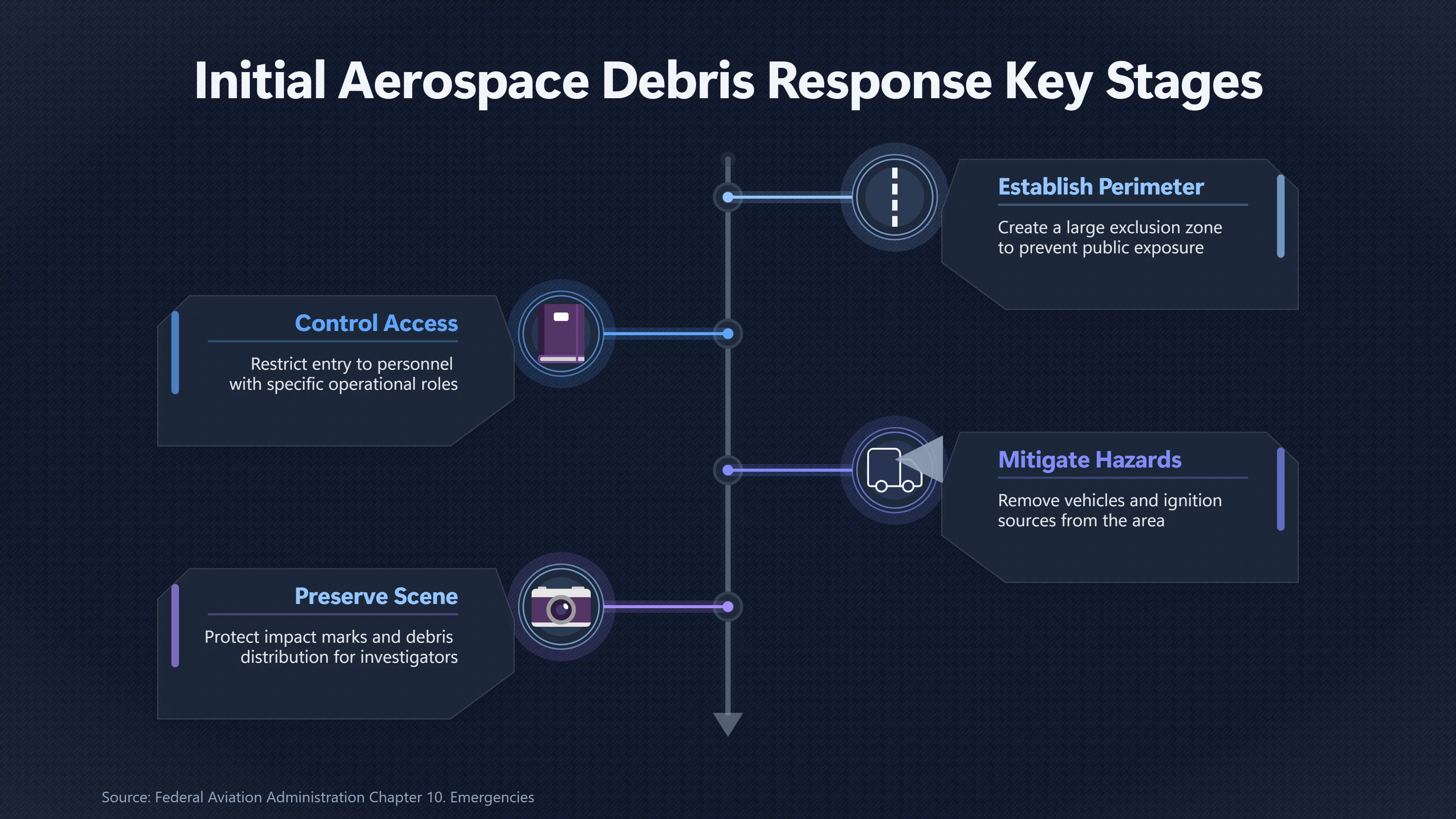
- Keep the public away. Establish a perimeter large enough to prevent unnecessary exposure while the object’s condition is assessed.
- Control access. Allow only personnel with an operational role inside the cordon and record who enters.
- Prevent secondary hazards. Keep vehicles, ignition sources and unnecessary equipment away until chemical and fire risks have been evaluated.
- Preserve the scene. Avoid disturbing impact marks, vegetation damage or debris distribution that may assist investigators.
The exact size of the exclusion zone depends on visible conditions, terrain and any signs of leaking materials. Responders generally expand rather than reduce the perimeter until the nature of the object becomes clearer.
This conservative approach also protects evidence. If the object ultimately proves to be military hardware, an aircraft component or a fragment of space hardware, the undisturbed scene may help establish its origin and explain how it reached the ground.
Observing Debris Without Direct Contact
The safest assessment begins with observation rather than handling.
Responders should look for indicators such as:
- smoke or vapour escaping from the object;
- liquid pooling beneath it;
- unusual odours;
- damaged tanks or pressure vessels;
- exposed wiring or batteries;
- scorched vegetation or signs of continuing heat;
- unstable positioning that could allow the object to roll or collapse.
None of these observations requires physical contact. Photographs, measurements and witness accounts can usually be gathered from outside the exclusion zone.
Equally important are actions that responders should avoid:
- Do not touch or move fragments.
- Do not open hatches, tanks or containers.
- Do not collect souvenirs or permit members of the public to remove debris.
- Do not assume that small fragments are harmless simply because they have cooled.
Modern investigations continue to emphasise evidence preservation alongside public safety because even apparently insignificant fragments may help identify the launch vehicle or spacecraft involved.[Federal Aviation Administration]faa.govFederal Aviation AdministrationCompliance, Enforcement & Mishap | Federal Aviation AdministrationJune 2, 2026…
When Specialist Support Should Be Requested
An unidentified aerospace object quickly exceeds the capabilities of routine emergency response.
Depending on the circumstances, incident commanders may request:
- Hazardous materials (HazMat) teams to evaluate possible toxic chemicals or propellant residues.
- Radiological specialists if there is any possibility of radioactive material or unexplained radiation alarms.
- Explosive ordnance specialists where pyrotechnic devices, pressure systems or military components may be present.
- Military or national aerospace authorities if the object could involve defence equipment, classified technology or foreign space hardware.
- Space agency or aviation investigators where a confirmed spacecraft or launch vehicle component is suspected.
These specialists possess detection equipment, protective clothing and technical knowledge that ordinary responders generally do not.
For historical incidents such as Kecksburg, reports of military personnel securing an area are therefore not inherently evidence of extraordinary technology. During the Cold War, rapid military involvement would also have been consistent with protecting the public while determining whether unidentified debris represented a missile component, classified aerospace hardware or another national-security concern.
Why Isolation Comes Before Identification
One common misconception is that responders should first determine what an object is before deciding how dangerous it may be. Modern emergency doctrine follows the opposite principle.
Because many aerospace hazards are invisible, responders initially classify the object according to uncertainty rather than appearance. A metallic cylinder could be an empty structural component—or a damaged pressure vessel containing hazardous chemicals. A scorched sphere could be harmless or could conceal residual energy sources.
Only after specialists have evaluated the object can the response shift from precautionary isolation to controlled recovery.
This precautionary model also explains why witnesses at historical incidents sometimes describe large security cordons despite the absence of obvious fire or explosions. Establishing a perimeter reflects uncertainty, not necessarily confirmation that an object is exceptionally dangerous or extraterrestrial.
Lessons for Understanding the Kecksburg Context
Within the broader discussion of the Kecksburg incident, first-response isolation should be understood as a standard safety measure rather than evidence for any particular explanation. If an unidentified aerospace object had genuinely reached the ground, responders following sound practice would have:
- established a secure perimeter;
- prevented public handling of debris;
- documented the scene before disturbing it;
- avoided direct contact with unfamiliar materials; and
- transferred responsibility to chemical, military or technical specialists as appropriate.
Those actions are consistent with modern hazardous space-debris response procedures and with longstanding emergency-management principles that prioritise protecting people until the object’s contents, origin and hazards can be identified.[Federal Aviation Administration]faa.govFederal Aviation Administration Chapter 10. EmergenciesFederal Aviation Administration Chapter 10. Emergencies

Amazon book picks
Further Reading
Books and field guides related to What Should Happen First When Space Debris Lands?. Use these as the next step if you want deeper reading beyond the article.
Ignition!: An Informal History of Liquid Rocket Propellants
John Clark tells here, with irreverent and eyewitness immediacy, the story of the search for a power packaging which could be trusted to...
Space Debris: Models and Risk Analysis
In Space Debris Models and Risk Analysis the authors will provide the reader with a comprehensive background to understand the various so...
Rocket Propulsion Elements
Rating: 4.5/5 from 11 Google Books ratings
Aerospace Engineering/Mechanical Engineering The definitive text on rocket propulsion-now completely revised to reflect rapid advancement...
The Unthinkable: Who Survives When Disaster Strikes—and Why
It was 8.46 a.m. on 9/11 when Elia Zedeño, who had worked in the World Trade Center for twenty-one years, heard a booming explosion and f...
eBay marketplace picks
Marketplace Samples
Live-tested eBay searches with available results related to this page.
Selected fromspacecraft model oneBay.co.uk.

Endnotes
1.
Source: faa.gov
Title: Federal Aviation Administration Chapter 10. Emergencies
Link:https://www.faa.gov/air_traffic/publications/atpubs/atc_html/chap10_section_5.html
2.
Source: faa.gov
Link:https://www.faa.gov/space/airspace_integration/debris_response_areas
3.
Source: faa.gov
Link:https://www.faa.gov/space/compliance_enforcement_mishap
Source snippet
Federal Aviation AdministrationCompliance, Enforcement & Mishap | Federal Aviation AdministrationJune 2, 2026...
Published: June 2, 2026
4.
Source: faa.gov
Link:https://www.faa.gov/hazmat/incident-reporting
5.
Source: faa.gov
Title: FA A General Statements | Federal Aviation Administration
Link:https://www.faa.gov/newsroom/statements/general-statements
Source snippet
FAA General Statements | Federal Aviation AdministrationJuly 9, 2026 — MAY 27, 2026 FAA Requires Mishap Investigation of SpaceX Starship...
Published: July 9, 2026
6.
Source: faa.gov
Link:https://www.faa.gov/hazmat/contact
Source snippet
For questions about our stakeholder engagement activities or general questions about dangerous goods (chem...
7.
Source: faa.gov
Title: Aircraft Safety | Federal Aviation Administration
Link:https://www.faa.gov/aircraft/safety
Source snippet
May 29, 2026 — AIRCRAFT SAFETY * Aircraft Safety Alerts * Cargo Safety * FAA Aviation Safety Outreach Initiative * Hazardous Materials Sa...
Published: May 29, 2026
Additional References
8.
Source: youtube.com
Title: Mystery Space Junk Crashes in Australia, Police Find Burning Rocket Debris
Link:https://www.youtube.com/watch?v=6jGGHeuIAjs
Source snippet
Space junk found on farm in Australia believed to be debris from Elon Musk's SpaceX mission...
9.
Source: youtube.com
Link:https://www.youtube.com/watch?v=UpIqLs7JxP0
Source snippet
Massive mysterious metal ring crashes into Kenyan village...
10.
Source: nasa.gov
Title: Orbital Debris
Link:https://www.nasa.gov/reference/jsc-orbital-debris/
Source snippet
January 22, 2026 — ORBITAL DEBRIS Orbital debris is critical in human spaceflight as its presence poses a significant threat to space...
Published: January 22, 2026
11.
Source: youtube.com
Title: Toxic space debris washes up on Queensland beach
Link:https://www.youtube.com/watch?v=13FvDQVfsiU
Source snippet
Mystery Space Junk Crashes in Australia, Police Find Burning Rocket Debris...
12.
Source: youtube.com
Title: Massive mysterious metal ring crashes into Kenyan village
Link:https://www.youtube.com/watch?v=DNvZTLUVdKw
Source snippet
Suspected space debris falls through roof of Florida home...
13.
Source: nasa.gov
Title: Space Debris: Understanding the Risks to NASA Spacecraft
Link:https://www.nasa.gov/centers-and-facilities/nesc/space-debris-understanding-the-risks-to-nasa-spacecraft/
14.
Source: sma.nasa.gov
Title: update to npr 8715 6 orbital debris mitigation
Link:https://sma.nasa.gov/news/articles/newsitem/2024/05/08/update-to-npr-8715-6-orbital-debris-mitigation
15.
Source: nasa.gov
Title: Micrometeoroids and Orbital Debris (MMOD)
Link:https://www.nasa.gov/centers-and-facilities/white-sands/micrometeoroids-and-orbital-debris-mmod/
16.
Source: nasa.gov
Title: NAS A Safety and Health Hazard Reporting
Link:https://www.nasa.gov/nasa-safety-and-health-hazard-reporting/
17.
Source: public.ksc.nasa.gov
Title: columbia recovery office
Link:https://public.ksc.nasa.gov/columbia/columbia-recovery-office/