Within Visual Illusion
Why Fireballs Seem to Vanish Behind Nearby Hills
A ridge or treeline can hide the final luminous path and make a distant fireball seem to strike nearby ground.
On this page
- How foreground terrain masks the final trajectory
- Why disappearance is mistaken for impact
- How viewpoints shift the apparent landing place
Page outline Jump by section
Introduction
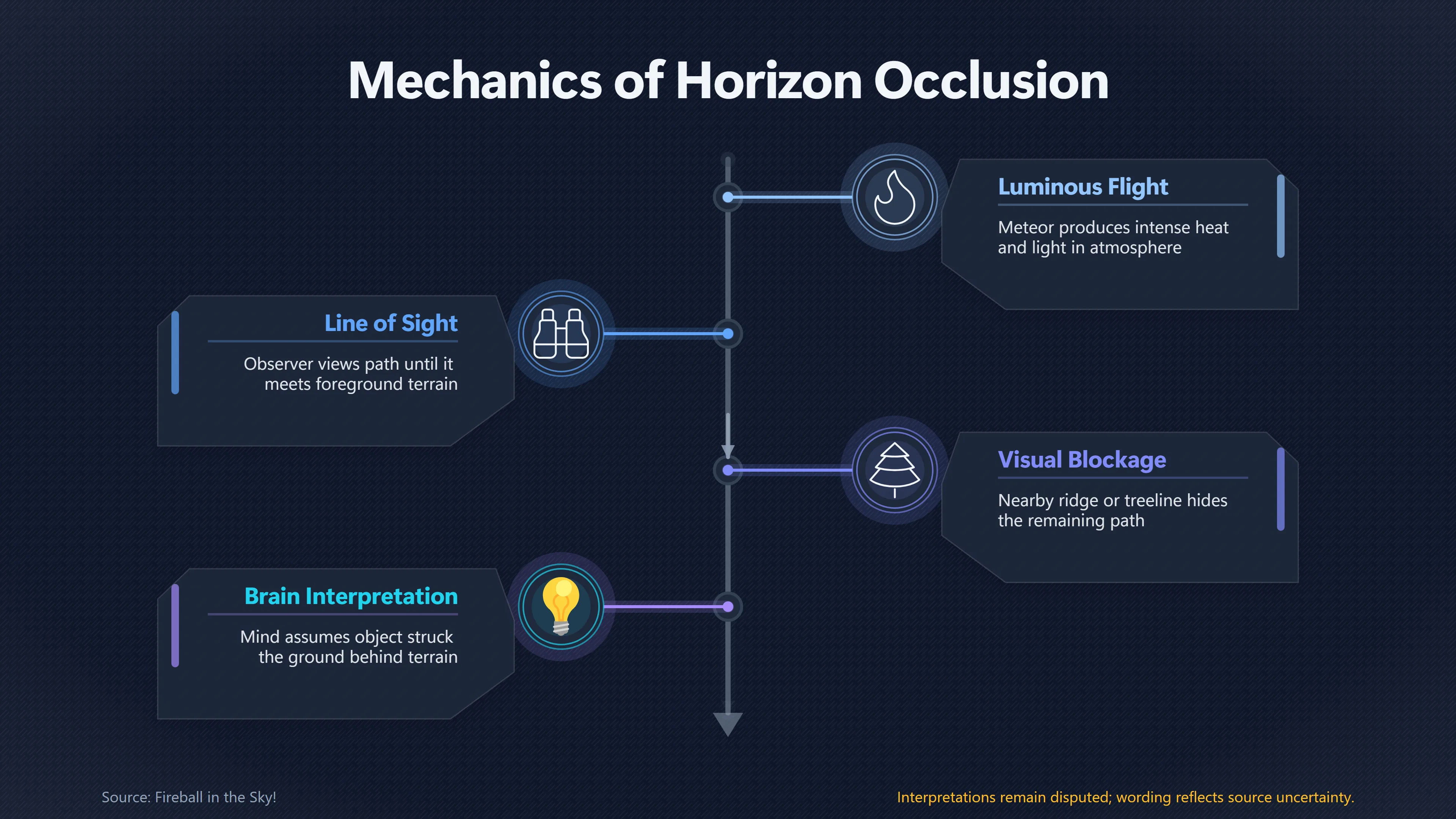
One of the strongest reasons a bright fireball appears to land “just beyond the hill” is a simple visual effect known as horizon occlusion. A distant meteor can remain tens of kilometres above the Earth’s surface while, from one observer’s viewpoint, its glowing path becomes hidden behind a nearby ridge, treeline or horizon. Because the light disappears exactly where it meets the foreground landscape, the brain often interprets that point as an impact site rather than as a line-of-sight overlap. This mechanism is especially relevant when considering eyewitness reports associated with the Kecksburg incident, where many observers sincerely believed they had seen an object descend into nearby woodland even though the broader trajectory of the Great Lakes fireball extended across a much larger region.[International Meteor Organization]imo.netInternational Meteor Organization Fireballs | IMOInternational Meteor Organization Fireballs | IMO
How Foreground Terrain Masks the Final Trajectory
The key mechanism is not that the fireball reaches the ground, but that the observer loses sight of it.
A meteor’s luminous flight usually ends high in the atmosphere as the object fragments, slows or ceases to produce enough heat to glow. If the final visible portion of that flight happens to align with a distant horizon, a nearby hill or forest blocks the observer’s remaining line of sight. The object has not necessarily descended behind that nearby terrain; it is simply no longer visible from that particular viewing position.[NASA]nasa.govFireball in the Sky!Fireball in the Sky! - NASA…
This effect becomes especially convincing when:
- the fireball is travelling at a shallow angle across the sky;
- the observer has an uninterrupted view until the final seconds;
- the horizon is formed by a distinct ridge or treeline rather than an open sky;
- the meteor extinguishes abruptly at almost the same moment it reaches the horizon from the observer’s perspective.
The visual system naturally combines these events into a single interpretation: the object disappeared because it struck the ground behind the hill.
Why Disappearance Is Mistaken for Impact
Human perception assumes that visible motion continues unless something physically blocks it. When a bright object moving downward suddenly vanishes behind a foreground feature, everyday experience suggests that it has gone behind that object.
For ordinary objects such as cars, birds or aircraft at low altitude, this assumption is usually correct. Fireballs are different because they occupy an enormous volume of sky at altitudes that are difficult to judge without multiple observation points.
Brightness further reinforces the illusion. A brilliant meteor may illuminate clouds, cast shadows or leave a glowing train, making it feel physically close. Yet even exceptionally bright fireballs often remain dozens of kilometres above the Earth’s surface throughout their visible flight. The International Meteor Organization notes that a fireball ending about 50 km above the ground can still be visible near the horizon from roughly 600 km away, illustrating how a seemingly low object may actually be extremely distant.[International Meteor Organization]imo.netInternational Meteor Organization Fireballs | IMOInternational Meteor Organization Fireballs | IMO

Why Different Witnesses Report Different Landing Places
One of the strongest indicators that apparent landing points are perceptual rather than physical is that they shift with the observer’s location.
Imagine two people separated by only a few kilometres:
- One watches the fireball disappear behind a wooded ridge to the west.
- Another sees the same fireball vanish behind a completely different hill.
- A third observer farther away may watch the meteor extinguish while it is still clearly above the horizon.
Each witness is accurately describing what they saw, but each has projected the disappearance onto a different foreground landmark.
This changing apparent endpoint is exactly what astronomers expect from perspective geometry. A genuine ground impact would produce a single physical location, whereas an atmospheric fireball observed over a wide region often generates numerous, incompatible reports of where it “came down”. Modern trajectory reconstruction therefore relies on observations from many locations rather than any single eyewitness account.[International Meteor Organization]imo.netInternational Meteor Organization Fireball Program | IMOInternational Meteor Organization Fireball Program | IMO
Why This Matters for the Kecksburg Incident
The Kecksburg reports illustrate how horizon occlusion can influence sincere eyewitness testimony without implying dishonesty or poor observation.
Many local observers reported seeing a brilliant object descend towards the wooded hills near the village. Within an individual field of view, that description was entirely consistent with what appeared to happen. However, numerous reports from much farther away showed a fireball travelling across several states and parts of Canada, indicating a much larger atmospheric event than a local vertical descent.
Horizon occlusion provides a straightforward explanation for how a regional fireball could produce many independent claims of a nearby landing. Each observer anchored the final visible point of the trajectory to the nearest ridge, forest or horizon visible from their own position. The result was a collection of confident but geographically inconsistent apparent impact sites rather than a single objectively observed landing location.[NASA]nasa.govFireball in the Sky!Fireball in the Sky! - NASA…
The Difference Between an Apparent Endpoint and a Real One
Astronomers distinguish carefully between where a meteor appears to end and where surviving material, if any, might actually reach the ground.
The visible fireball marks only the luminous phase of atmospheric entry. Any surviving fragments enter a non-luminous “dark flight” after they stop glowing, during which they fall under gravity while being carried by high-altitude winds. Consequently, even when meteorites are recovered, they are frequently found well beyond the point where observers thought the fireball disappeared. Precise recovery therefore depends on triangulated observations, calibrated cameras and atmospheric modelling rather than visual estimates alone.[arXiv]arxiv.orgDarkflight estimates of meteorite fall positions: issues and a case study using the Murrili meteorite fallAugust 10, 2021…
This distinction is crucial when evaluating reports linked to famous incidents. A bright object disappearing behind a nearby hill is compelling evidence that the observer lost sight of it at that point—not that the object physically struck the ground there.
Amazon book picks
Further Reading
Books and field guides related to Why Fireballs Seem to Vanish Behind Nearby Hills. Use these as the next step if you want deeper reading beyond the article.
The Ecological Approach to Visual Perception
This book, first published in 1979, is about how we see: the environment around us (its surfaces, their layout, and their colors and text...
Visual Intelligence: How We Create What We See
A unique, illustrated popular study reveals the way the human eye acts on the visual world not just to represent but to create the things...
Vision Science: Photons to Phenomenology
This textbook on vision reflects the integrated computational approach of modern research scientists, combining psychological, computatio...
Sensation and Perception
. Bruce Goldstein's SENSATION AND PERCEPTION, the best-seller which has helped over 150,000 students understand the ties between how we s...
eBay marketplace picks
Marketplace Samples
Live-tested eBay searches with available results related to this page.
Selected fromUFO model display oneBay.co.uk.
Current eBay listing
Belgium Wave UFO Model | 1989–90 UAP Display | Famous Sighting
Current eBay listing
UFO Model – Belgium Wave 1989 Triangular UAP Craft | Sci-Fi Display

Current eBay listing
Buga Sphere UFO Model With Display Stand | 15cm (5.9") Diameter UAP
Endnotes
1.
Source: nasa.gov
Title: Fireball in the Sky!
Link:https://www.nasa.gov/blogs/watch-the-skies/2010/10/04/fireball-in-the-sky-2/
Source snippet
Fireball in the Sky! - NASA...
2.
Source: nasa.gov
Title: Fireball Leaves Persistent Train over Western Skies
Link:https://www.nasa.gov/blogs/watch-the-skies/2018/12/20/fireball-leaves-persistent-train-over-western-skies/
Source snippet
Fireball Leaves Persistent Train over Western Skies - NASA...
3.
Source: arxiv.org
Link:https://arxiv.org/abs/2108.04397
Source snippet
Darkflight estimates of meteorite fall positions: issues and a case study using the Murrili meteorite fallAugust 10, 2021...
Published: August 10, 2021
4.
Source: nasa.gov
Title: It’s Fireball Season!
Link:https://www.nasa.gov/blogs/watch-the-skies/2026/03/26/its-fireball-season-answering-your-meteor-questions/
Source snippet
Answering Your Meteor Questions - NASAMarch 26, 2026 — WATCH THE SKIES Image Janet Sudnik March 26, 2026 5:18PM CATEGORIES Marshall Space...
Published: March 26, 2026
5.
Source: nasa.gov
Title: interesting fact of the month 2021
Link:https://www.nasa.gov/space-science-and-astrobiology-at-ames/interesting-fact-of-the-month-current/interesting-fact-of-the-month-2021/
6.
Source: science.nasa.gov
Title: looking for lightning finding fireballs 149381
Link:https://science.nasa.gov/earth/earth-observatory/looking-for-lightning-finding-fireballs-149381/
7.
Source: apod.nasa.gov
Link:https://apod.nasa.gov/apod/ap211012.html
8.
Source: apod.nasa.gov
Link:https://apod.nasa.gov/apod/ap210315.html
9.
Source: fireballs.ndc.nasa.gov
Link:https://fireballs.ndc.nasa.gov/skyfalls/events/20210204-020650
10.
Source: science.nasa.gov
Title: instruments image fireball over bering sea
Link:https://science.nasa.gov/missions/terra/nasa-instruments-image-fireball-over-bering-sea/
11.
Source: jpl.nasa.gov
Title: instruments image fireball over bering sea
Link:https://www.jpl.nasa.gov/news/nasa-instruments-image-fireball-over-bering-sea/
12.
Source: nasa.gov
Title: NAS A Instruments Image Fireball over Bering Sea
Link:https://www.nasa.gov/centers-and-facilities/goddard/nasa-instruments-image-fireball-over-bering-sea/
13.
Source: apod.nasa.gov
Link:https://apod.nasa.gov/apod/ap171117.html
14.
Source: jpl.nasa.gov
Title: fireball over californianevada how big was it
Link:https://www.jpl.nasa.gov/news/fireball-over-californianevada-how-big-was-it/
15.
Source: imo.net
Title: International Meteor Organization Fireballs | IMO
Link:https://www.imo.net/observations/fireballs/fireballs/
16.
Source: imo.net
Title: International Meteor Organization Fireball Program | IMO
Link:https://www.imo.net/observations/fireballs/fireball-report-program/
17.
Source: imo.net
Link:https://www.imo.net/observations/fireballs/rates/
Additional References
18.
Source: space.com
Link:https://www.space.com/stargazing/meteor-showers/when-is-a-double-fireball-not-a-double-fireball-wild-meteor-videos-explained-by-a-trick-of-the-light
Source snippet
WILD METEOR VIDEOS EXPLAINED BY A TRICK OF THE LIGHT News By Anthony Wood Published 22 October 2025 Footage appearing to show a number of...
Published: October 2025
19.
Source: nationalgeographic.com
Title: Video shows fireball meteor explode in broad daylight
Link:https://www.nationalgeographic.com/science/article/fireball-meteors
Source snippet
How rare is this cosmic phenomenon? | National GeographicJune 27, 2025 — VIDEO SHOWS FIREBALL METEOR EXPLODE IN BROAD DAYLIGHT. HOW RARE...
Published: June 27, 2025
20.
Source: youtube.com
Link:https://www.youtube.com/watch?v=tU7WSHZye5w
Source snippet
The 1965 Kecksburg Incident: A UFO Crash the Government Hides to This Day...
21.
Source: youtube.com
Link:https://www.youtube.com/watch?v=HX_RrO7ZQaU
Source snippet
The Kecksburg Incident: What Really Happened Here?...
22.
Source: youtube.com
Link:https://www.youtube.com/watch?v=REsZcbglO3c
Source snippet
America's Other Roswell: the Kecksburg UFO | Conspiracy (S1, E13) | Full Episode | History...
23.
Source: nature.com
Link:https://www.nature.com/articles/367624a0
24.
Source: youtube.com
Title: The Kecksburg Incident: What Really Happened Here?
Link:https://www.youtube.com/watch?v=BXh2zTD9Kug
Source snippet
Kecksburg UFO Crash: The Untold Story | The Government Lied! | Full Documentary | UFOTV®...
25.
Source: thecoldfile.com
Title: 1965 kecksburg
Link:https://www.thecoldfile.com/articles/1965-kecksburg/
Source snippet
The Acorn in the Woods: The 1965 Kecksburg Incident | The Cold FileMay 25, 2026 — UFO/UAP / Case file / Filed May 25, 2026 THE ACORN IN T...
Published: May 25, 2026
26.
Source: ntskeptics.org
Link:https://www.ntskeptics.org/1993/1993march/march1993.htm
27.
Source: aerolite.org
Title: Suspected Meteorite Education | Identify Your Space Rock
Link:https://aerolite.org/about/suspected-meteorite-education/