Within Witness Memory
How Community Talk Could Reshape Kecksburg Memories
Ordinary conversations after the event could have spread vivid details that later felt like independent personal memories.
On this page
- How post event information changes recall
- Why Kecksburg encouraged witness comparison
- When shared details resemble false corroboration
Page outline Jump by section
Introduction
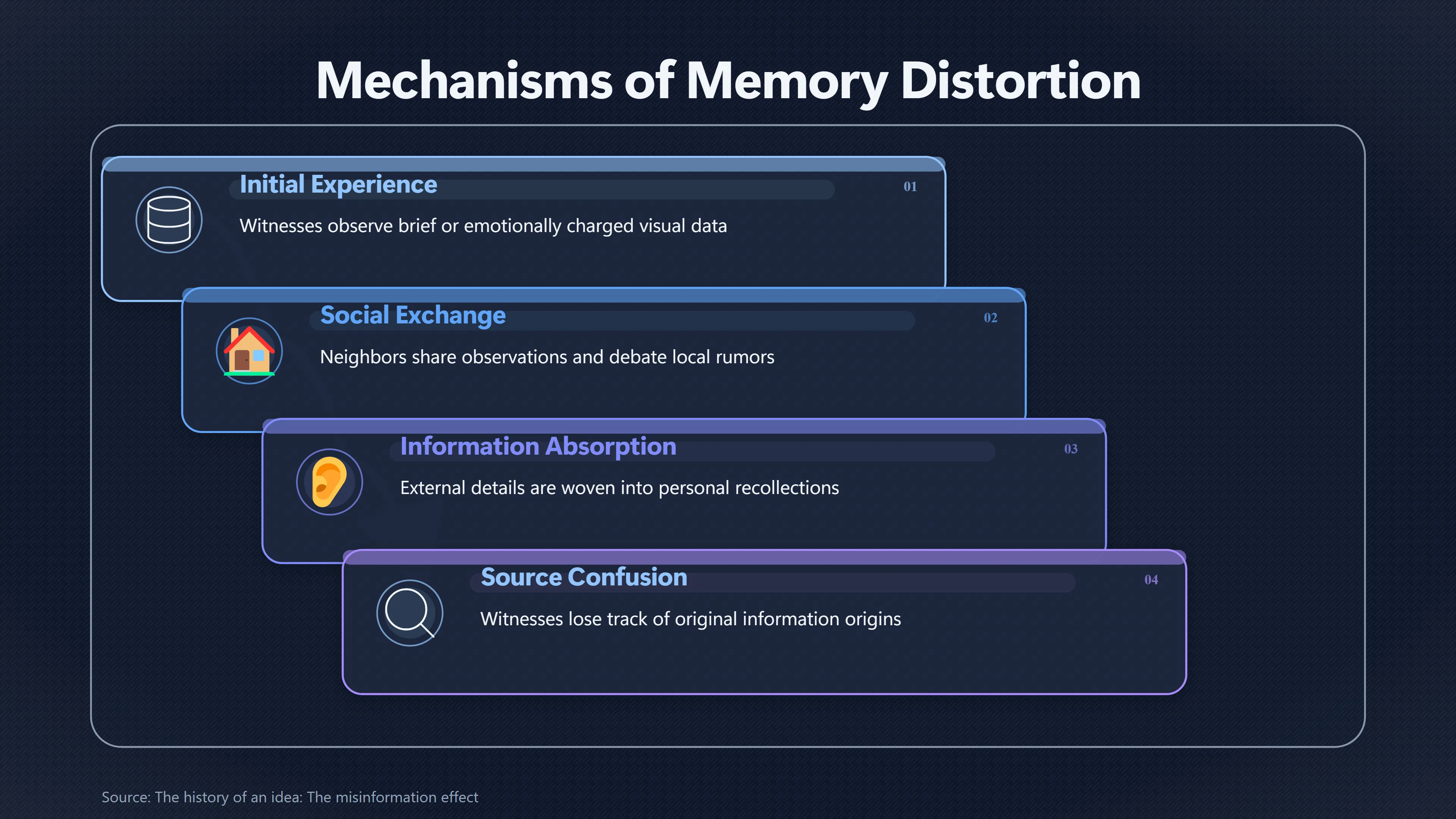
The idea that Kecksburg witnesses may have influenced one another does not require anyone to have fabricated a story. A more evidence-based explanation is that, after an unusual and widely discussed event, ordinary conversations helped shape how people later remembered it. Modern memory research shows that recollections are reconstructive rather than photographic. Details heard from neighbours, family members, reporters or other witnesses can become woven into an individual’s own memory, especially when the original experience was brief, confusing or emotionally charged.[DOI]doi.orgThe history of an idea: The misinformation effectThe history of an idea: The misinformation effect - Loftus - Legal and Criminological Psychology - Wiley Online LibraryDecember 24, 2025…
This perspective is particularly relevant to the Kecksburg UFO incident because many of the detailed witness interviews that define the modern narrative were recorded years or even decades after the event. During that time, residents had countless opportunities to compare stories, debate rumours and hear increasingly vivid descriptions of what others claimed to have seen. The result is not necessarily deliberate embellishment but a situation in which genuine memories and socially acquired information may have become difficult to separate.
How post-event conversations can alter memory
Psychologists describe the misinformation effect as the process by which information encountered after an event changes later recollection of that event. Although the classic studies often used misleading questions from researchers, later work demonstrated that ordinary conversations between witnesses can produce similar effects. People frequently absorb details mentioned by others and later report those details as though they remembered them independently.[doi.org]doi.orgThe history of an idea: The misinformation effectThe history of an idea: The misinformation effect - Loftus - Legal and Criminological Psychology - Wiley Online LibraryDecember 24, 2025…
Research on memory conformity extends this finding further. When two or more people discuss the same event, they often converge on a shared narrative. This can happen because:
- one witness appears more confident or authoritative;
- uncertain witnesses assume another person’s recollection is more accurate;
- repeated discussion makes certain details increasingly familiar;
- individuals gradually lose track of whether a detail came from direct perception or from conversation.
Experiments consistently show that witnesses may sincerely incorporate another person’s recollection into their own report without intending to mislead anyone.[researchgate.net]researchgate.netResearchGate(PDF) Can a witness report hearsay evidence unintentionally? The effects of discussion on eyewitness memoryFebruary 28, 2011…
For Kecksburg, this mechanism matters because the event unfolded in a small rural community where neighbours naturally talked to one another almost immediately after the reported descent of the fireball and the subsequent police and military activity.
Why Kecksburg encouraged witness comparison
Several features of the incident created unusually favourable conditions for shared memory formation.
First, very few residents witnessed exactly the same thing. Some observed the bright fireball from a distance. Others heard a loud impact or saw smoke. Some encountered roadblocks or emergency vehicles. A much smaller number later claimed to have seen an object in or near the woods. These were different experiences occurring at different places and times.
Second, uncertainty was exceptionally high. Newspapers initially reported a possible crash, while officials later stated that nothing had been recovered. The lack of a clear public explanation encouraged residents to exchange interpretations rather than simply recalling isolated observations.
Third, Kecksburg was a close-knit community. Conversations among neighbours, relatives, volunteer firefighters and local officials would have been an ordinary social response to an extraordinary evening. Such discussions are precisely the kind of post-event information exchange identified in eyewitness research as capable of influencing later recall.[PubMed Central (PMC)]pmc.ncbi.nlm.nih.govPubMed Central (PMC)Epistemic innocence and the production of false memory beliefs - PMC…
Unlike a controlled police investigation in which witnesses are interviewed separately, much of the Kecksburg story developed within an active social environment before many detailed accounts were formally documented.
When neighbours’ stories become personal memories
The most important psychological distinction is between believing a detail and remembering a detail.
Memory researchers have found that people often become convinced they remember something because the information feels familiar after repeated exposure. The source of that familiarity may be forgotten. Instead of recalling, “my neighbour told me there were strange markings,” a witness may later experience the impression that they personally saw unusual markings. This is known as a source-monitoring error—confusing where a remembered detail originated.[nih.gov]pubmed.ncbi.nlm.nih.govHow eyewitnesses resist misinformation: social postwarnings and the monitoring of memory characteristics - PubMed…
In the Kecksburg case, repeated references over many years to features such as:
- an acorn-shaped object;
- bronze or metallic colouring;
- unusual symbols or markings;
- military removal of a large object;
could gradually become integrated into some later witness narratives even if individual observers had originally experienced only part of that sequence.
This possibility does not prove that any specific detail was socially acquired. Rather, it highlights why confidence alone cannot establish that a memory remained unchanged over decades.
Why shared details are not always independent corroboration
One of the strongest arguments offered in support of extraordinary claims is that multiple witnesses describe similar details. However, similarity does not automatically demonstrate independent confirmation.
Psychologists distinguish between:
- independent corroboration, where witnesses report matching details before communicating with one another; and
- shared reconstruction, where witnesses gradually develop similar accounts through discussion and repeated retelling.
Without early, independently recorded statements, distinguishing between these possibilities becomes difficult.
This issue is especially important in Kecksburg because many detailed descriptions entered the public record years after the incident, by which time witnesses had potentially encountered newspaper articles, television documentaries, anniversary events and numerous conversations within the community.
Consequently, agreement among later interviews should not automatically be interpreted as evidence that every witness independently observed the same object.
The role of local rumour
Rumours are not necessarily false. They are attempts to explain uncertain events before reliable information becomes available.
The Kecksburg incident possessed nearly every characteristic known to encourage rumour formation:
- a dramatic event witnessed by many people from different locations;
- incomplete official information;
- reports of military activity;
- conflicting media accounts;
- intense local curiosity.
As rumours circulate, they often become more coherent than the original observations. Missing pieces are supplied, contradictions diminish and the overall narrative becomes easier to understand and retell. Individuals who genuinely experienced part of the event may subsequently integrate elements of this evolving communal story into their own recollections.
From a memory science perspective, this process represents normal human cognition rather than evidence of deception.[nspb.net]nspb.netOpen source on nspb.net.
A careful reading of the Kecksburg testimony
Applying eyewitness research to Kecksburg does not require rejecting witness testimony. Instead, it encourages weighing different kinds of evidence according to when and how they were recorded.
Near-contemporary reports generally deserve greater evidential weight because they were produced before prolonged community discussion could substantially reshape recollection. Later interviews remain valuable, particularly for documenting how individuals interpreted the experience, but they are more vulnerable to ordinary processes of memory reconstruction and source confusion identified across decades of psychological research.[doi.org]doi.orgThe history of an idea: The misinformation effectThe history of an idea: The misinformation effect - Loftus - Legal and Criminological Psychology - Wiley Online LibraryDecember 24, 2025…
Viewed through this lens, the Kecksburg incident illustrates an important principle in eyewitness psychology. A community can honestly arrive at a remarkably consistent story even if no single person originally witnessed every element of that narrative. Shared recollection may therefore reflect both authentic experience and the gradual influence of neighbourly conversation, making apparent corroboration more complex than it first appears.
Amazon book picks
Further Reading
Books and field guides related to How Community Talk Could Reshape Kecksburg Memories. Use these as the next step if you want deeper reading beyond the article.
The Seven Sins of Memory
Rating: 3.5/5 from 5 Google Books ratings
A New York Times Notable Book: A psychologist's "gripping and thought-provoking" look at how and why our brains sometimes fail us (Steven...
The Memory Illusion: Remembering, Forgetting, and the Science...
THE INTERNATIONAL BESTSELLER 'Truly fascinating.' Steve Wright, BBC Radio 2 - Have you ever forgotten the name of someone you’ve met doze...
The Seven Sins of Memory: How the Mind Forgets and Remembers
Rating: 3.5/5 from 5 Google Books ratings
A New York Times Notable Book: A psychologist's "gripping and thought-provoking" look at how and why our brains sometimes fail us (Steven...
The Science of False Memory
Printbegrænsninger: Der kan printes 1 kapitel eller op til 5% af teksten
eBay marketplace picks
Marketplace Samples
Live-tested eBay searches with available results related to this page.
Selected fromUFO wall art oneBay.co.uk.



Endnotes
1.
Source: doi.org
Title: The history of an idea: The misinformation effect
Link:https://doi.org/10.1111/lcrp.70020
Source snippet
The history of an idea: The misinformation effect - Loftus - Legal and Criminological Psychology - Wiley Online LibraryDecember 24, 2025...
Published: December 24, 2025
2.
Source: researchgate.net
Link:https://www.researchgate.net/publication/233464098_Can_a_witness_report_hearsay_evidence_unintentionally_The_effects_of_discussion_on_eyewitness_memory
Source snippet
ResearchGate(PDF) Can a witness report hearsay evidence unintentionally? The effects of discussion on eyewitness memoryFebruary 28, 2011...
Published: February 28, 2011
3.
Source: sciencedirect.com
Link:https://www.sciencedirect.com/science/article/abs/pii/S0001691807000893
Source snippet
ScienceDirect...
4.
Source: sciencedirect.com
Link:https://www.sciencedirect.com/science/article/pii/S0001691813002278
5.
Source: sciencedirect.com
Title: Misinformation Effect
Link:https://www.sciencedirect.com/topics/social-sciences/misinformation-effect
6.
Source: staff.washington.edu
Link:https://staff.washington.edu/eloftus/Articles/hoff.htm
Source snippet
UW Staff Web ServerMisinformation and Memory The Creation of New Memories (1989)...
7.
Source: pmc.ncbi.nlm.nih.gov
Link:https://pmc.ncbi.nlm.nih.gov/articles/PMC7618592/
Source snippet
PubMed Central (PMC)Epistemic innocence and the production of false memory beliefs - PMC...
8.
Source: pmc.ncbi.nlm.nih.gov
Link:https://pmc.ncbi.nlm.nih.gov/articles/PMC6762151/
Source snippet
PubMed Central (PMC)The effects of perceived memory ability on memory conformity for an event - PMC...
9.
Source: pubmed.ncbi.nlm.nih.gov
Link:https://pubmed.ncbi.nlm.nih.gov/16383166/
Source snippet
How eyewitnesses resist misinformation: social postwarnings and the monitoring of memory characteristics - PubMed...
10.
Source: nspb.net
Link:https://www.nspb.net/index.php/nspb/article/view/113
11.
Source: pmc.ncbi.nlm.nih.gov
Link:https://pmc.ncbi.nlm.nih.gov/articles/PMC11680610/
12.
Source: pmc.ncbi.nlm.nih.gov
Link:https://pmc.ncbi.nlm.nih.gov/articles/PMC10829763/
13.
Source: qsl.net
Link:https://www.qsl.net/w5www/kecksburg.html
Additional References
14.
Source: youtube.com
Link:https://www.youtube.com/watch?v=REsZcbglO3c
Source snippet
The videos provided above include psychological lectures and educational overviews on the misinformation effect and memory conformity (su...
15.
Source: ojp.gov
Link:https://ojp.gov/ncjrs/virtual-library/abstracts/reports-suggested-memories-do-people-truly-believe-them-adult
16.
Source: youtube.com
Title: Kecksburg UFO Crash: The Untold Story
Link:https://www.youtube.com/watch?v=tU7WSHZye5w
Source snippet
'I do believe something happened': Search for answers about Kecksburg UFO in Pennsylvania...
17.
Source: youtube.com
Title: Cognitive Biases
Link:https://www.youtube.com/watch?v=drO8h3rD1Pc
Source snippet
False Memories and the Misinformation Effect...
18.
Source: youtube.com
Title: How reliable is your memory?
Link:https://www.youtube.com/watch?v=PB2OegI6wvI
Source snippet
Cognitive Biases - The Misinformation Effect - False Memory...
19.
Source: tandfonline.com
Link:https://www.tandfonline.com/doi/full/10.1080/1068316X.2010.510117
20.
Source: frontiersin.org
Link:https://www.frontiersin.org/journals/psychology/articles/10.3389/fpsyg.2023.1239139/full
21.
Source: tandfonline.com
Link:https://www.tandfonline.com/doi/abs/10.1080/1068316X.2025.2598297
22.
Source: bibbase.org
Link:https://bibbase.org/network/publication/echterhoff-hirst-hussy-howeyewitnessesresistmisinformationsocialpostwarningsandthemonitoringofmemorycharacteristics-2005
23.
Source: jstor.org
Link:https://www.jstor.org/stable/j.ctv22jnmtx