Within Blue Book
Why Blue Book's Space Debris Claim Matters
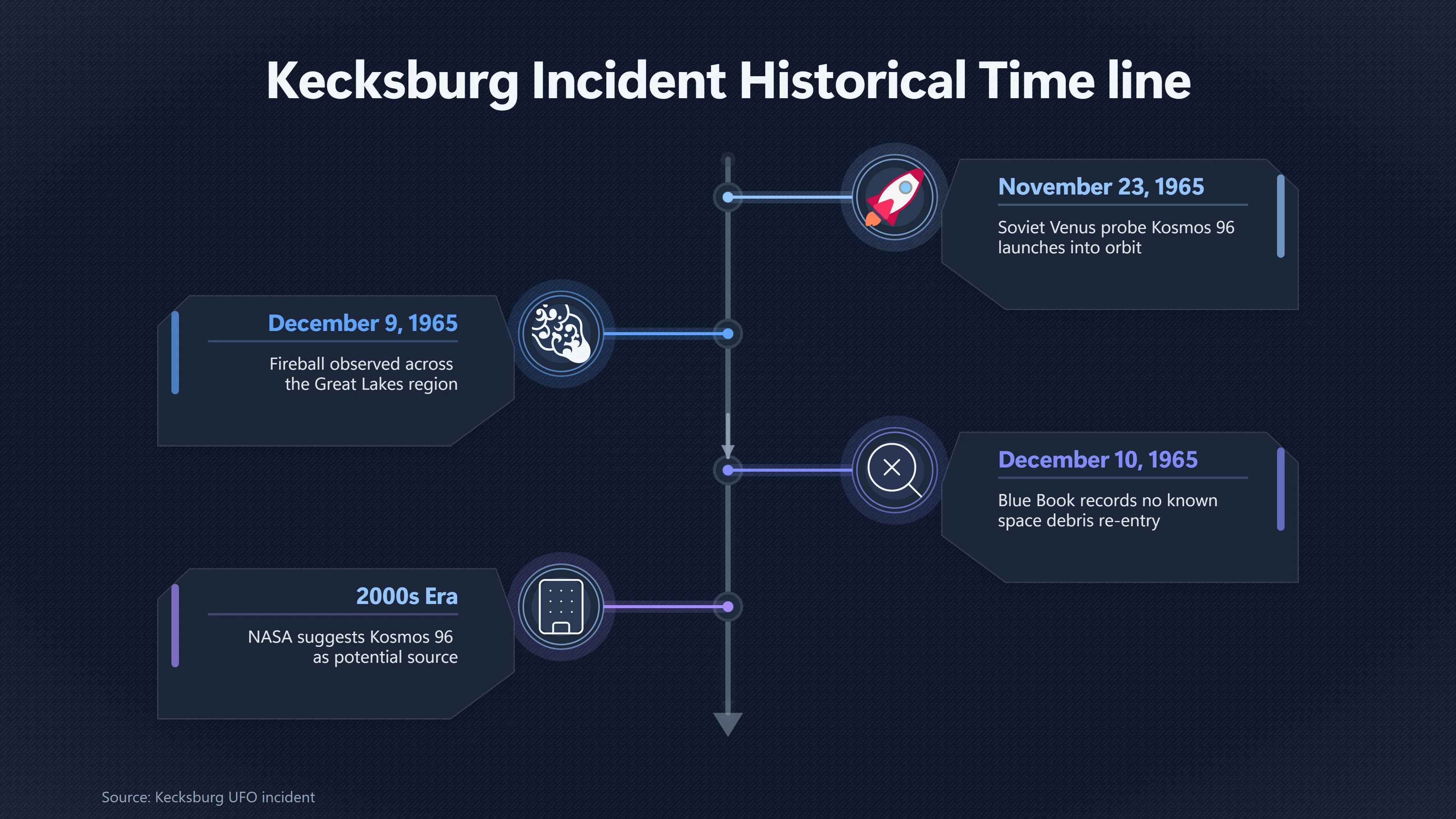
Blue Book said no known space debris re-entered that day, creating a direct conflict with later claims that Kosmos 96 caused the Kecksburg event.
On this page
- What the 10 December memo actually states
- How the later Kosmos 96 theory conflicts with it
- What the contradiction can and cannot establish
Page outline Jump by section
Introduction
One of the most persistent debates surrounding the Kecksburg incident is not simply whether the object was a meteor, a spacecraft or something else, but why Project Blue Book’s own paperwork appears to contradict one of the best-known later explanations. A surviving Air Force memorandum dated 10 December 1965 records that Blue Book had checked whether any known space debris had re-entered the atmosphere on the previous day and concluded that none had. Years later, however, NASA officials and several independent researchers suggested that the failed Soviet Venus probe Kosmos 96 may have been responsible for the fireball seen across the Great Lakes region.[Wikipedia]WikipediaKecksburg UFO incidentKecksburg UFO incident
This discrepancy does not automatically prove that either position was wrong. Instead, it highlights how official assessments changed over time as additional orbital data, historical research and alternative interpretations became available. The contradiction is therefore an important piece of evidence within the broader Project Blue Book record gap because it demonstrates that the surviving file cannot be read as the final or complete government position on the event.
What the 10 December memo actually states
The surviving Blue Book “Memo for the Record”, prepared on 10 December 1965, summarises telephone conversations held the day after the Kecksburg incident. Alongside its description of the unsuccessful search near Kecksburg, the memorandum includes a specific statement that investigators had checked with the Air Force organisation responsible for tracking artificial objects in orbit and found that no known space debris had re-entered on 9 December 1965.
Within the document, this was not presented as speculation. It was part of the information Blue Book believed could be released publicly while responding to enquiries from the Pentagon and the press. At that moment, the programme’s working position was that there was no identified satellite or spacecraft whose re-entry explained the reported fireball.
That statement matters because it establishes a clear contemporaneous baseline. It shows that Blue Book was not merely undecided between a meteor and a Soviet spacecraft. Rather, according to the surviving memo, it had already excluded any known re-entering space object from its immediate assessment.
How the later Kosmos 96 theory conflicts with it
The contradiction emerged decades later when researchers revisited Soviet space records after the Cold War.
Kosmos 96 was a Soviet Venus probe launched on 23 November 1965. A launch failure stranded it in low Earth orbit, where it remained until re-entering the atmosphere on 9 December 1965. Because its decay occurred on the same day as the Kecksburg event, several writers proposed that the two events were connected. NASA echoed that possibility in public statements issued during the 2000s, suggesting that recovered fragments may have belonged to the failed Soviet spacecraft, although the agency also acknowledged that records supporting that assessment could no longer be located.[Wikipedia]WikipediaKosmos 96Kosmos 96
At face value, this appears incompatible with the Blue Book memorandum:
- Blue Book (10 December 1965): no known space debris had re-entered that day.
- Later Kosmos 96 hypothesis: a known Soviet spacecraft did re-enter that day and may explain the fireball.
The disagreement is genuine rather than semantic. If Kosmos 96 had already been recognised as the source on 10 December, Blue Book’s statement should have reflected that.
Several explanations have been proposed for this inconsistency.
First, orbital tracking information available on 10 December 1965 may have been incomplete or preliminary. Tracking foreign spacecraft during the early Space Age involved rapidly evolving calculations, and initial decay predictions could later be revised.
Second, Blue Book depended on information supplied by other organisations rather than independently calculating satellite orbits. If the tracking network advised that no catalogued object had re-entered, Blue Book simply recorded that assessment.
Third, later researchers had access to Soviet mission histories and declassified orbital material unavailable to Air Force personnel in December 1965. The identification of Kosmos 96 therefore relied on historical evidence assembled years after the event rather than on Blue Book’s contemporaneous knowledge.[jamesoberg.com]jamesoberg.comJim Oberg on the “NASA lawsuit over Kecksburg UFO Documents”November 1, 2024…
Why the Kosmos 96 explanation remains disputed
The existence of Kosmos 96 does not resolve the Kecksburg case because another disagreement arose after the spacecraft itself was identified.
Orbital specialists have questioned whether the spacecraft’s trajectory matches the observed fireball. Analyses cited by NASA’s orbital-debris experts and by space historian James Oberg argue that the fireball’s steep atmospheric path resembled a natural meteor rather than the shallower geometry expected from an object decaying from Earth orbit. Some Air Force tracking data also place the spacecraft’s final decay hours earlier and significantly farther north than the reported Kecksburg observations.[jamesoberg.com]jamesoberg.comJim Oberg on the “NASA lawsuit over Kecksburg UFO Documents”November 1, 2024…
Consequently, even researchers who favour conventional explanations do not uniformly support the Kosmos 96 hypothesis. Instead, several regard it as an attractive coincidence—a spacecraft that certainly re-entered on the correct date but whose reconstructed trajectory does not convincingly match the observed fireball.
This secondary disagreement is important because it means the contradiction with Blue Book is not simply resolved by pointing to Kosmos 96. The proposed identification itself remains debated.
What the contradiction can and cannot establish
The conflict between the Blue Book memorandum and the later Kosmos 96 theory is significant because it demonstrates that official interpretations evolved over time. It also illustrates why isolated government documents should not automatically be treated as definitive accounts.
However, the contradiction has clear evidential limits.
It can establish that:
- Blue Book’s documented assessment on 10 December 1965 was that no known space debris had re-entered.
- Later investigators reached a different conclusion after additional historical research.
- The surviving documentary record contains an identifiable internal inconsistency that historians must explain.[Wikipedia]WikipediaKecksburg UFO incidentKecksburg UFO incident
It cannot establish that:
- Blue Book deliberately concealed knowledge of Kosmos 96.
- A military recovery of an unidentified craft occurred.
- Kosmos 96 definitely was, or definitely was not, the object associated with Kecksburg.
The documentary record supports only the narrower conclusion that the contemporaneous Blue Book file and the later Kosmos 96 explanation cannot both represent the same understanding of events. Whether that reflects incomplete information available in December 1965, later reinterpretation of orbital data, or continued uncertainty about the fireball’s true origin remains unresolved in the historical evidence.[jamesoberg.com]jamesoberg.comJim Oberg on the “NASA lawsuit over Kecksburg UFO Documents”November 1, 2024…
Amazon book picks
Further Reading
Books and field guides related to Why Blue Book's Space Debris Claim Matters. Use these as the next step if you want deeper reading beyond the article.
The Report on Unidentified Flying Objects
Regardless of whether or not one believes that the study of UFO reports has any merit it is a simple fact that such reports were studied...

Beyond Earth: A Chronicle of Deep Space Exploration, 1958–2016
This is a completely updated and revised version of a monograph published in 2002 by the NASA History Office under the original title Dee...
Challenge to Apollo: The Soviet Union and the Space Race, 194...
The book received the Emme Award for Astronautical Literature at the March 20 2000 luncheon of the Goddard Memorial Symposium, sponsored...
UFOs and Government: A Historical Inquiry
Governments around the world have had to deal with the UFO phenomenon for a good part of a century. How and why they did so is the subjec...
eBay marketplace picks
Marketplace Samples
Live-tested eBay searches with available results related to this page.
Selected fromSoviet spacecraft model oneBay.co.uk.


Endnotes
1.
Source: Wikipedia
Title: [Kecksburg UFO incident]({{ ‘kecksburg-ufo-incident/’ | relative_url }})
Link:https://en.wikipedia.org/wiki/Kecksburg_UFO_incident
2.
Source: Wikipedia
Title: Kosmos 96
Link:https://en.wikipedia.org/wiki/Kosmos_96
3.
Source: jamesoberg.com
Title: Jim Oberg on the “NASA lawsuit over Kecksburg UFO Documents”
Link:https://www.jamesoberg.com/statement_nasa_kecksburg.pdf
Source snippet
November 1, 2024...
Published: November 1, 2024
4.
Source: enigmalabs.io
Title: Kecksburg Incident | Enigma Labs
Link:https://enigmalabs.io/library/f45bb19d-5803-4ab6-a373-8799f64095c0
5.
Source: ufodesigns3d.com
Link:https://ufodesigns3d.com/blogs/lore/the-kecksburg-incident-the-day-a-ufo-crashed-in-pennsylvania
6.
Source: uapfiles.com
Link:https://uapfiles.com/analysis/rgBTMzFd-hg/people/book
Additional References
7.
Source: appalachianhistorian.org
Title: Journalist Leslie Kean, working with the Coalition f
Link:https://appalachianhistorian.org/the-kecksburg-ufo-incident-pennsylvanias-space-acorn-and-the-night-the-sky-fell-over-appalachia/
Source snippet
The Kecksburg UFO Incident: Pennsylvania’s Space Acorn and the Night the Sky Fell Over Appalachia - Appalachianhistorian.orgJune 24, 2026...
Published: June 24, 2026
8.
Source: theblackvault.com
Title: the vault files the 1965 kecksburg pennsylvania crash
Link:https://www.theblackvault.com/casefiles/the-vault-files-the-1965-kecksburg-pennsylvania-crash/
Source snippet
In the absence of a definitive identification, the Kecksburg incident has invited numerous theories. Here are the leading hypotheses tha...
9.
Source: uapedia.ai
Title: Contemporary scientific records describe a bolide
Link:https://www.uapedia.ai/wiki/kecksburg-uap-crash-1965/
Source snippet
Kecksburg UAP Crash (1965) - UAPediaOctober 14, 2025 — KECKSBURG UAP CRASH (1965) On the late afternoon of December 9, 1965, thousands ac...
Published: October 14, 2025
10.
Source: tfunkera.com
Title: The Kecksburg Incident – T Funk Era Case Files
Link:https://tfunkera.com/2026/07/08/the-kecksburg-incident/
Source snippet
July 8, 2026 — Official Archive Record Case File CF-0003 THE KECKSBURG INCIDENT UNSOLVED Image CF-0003 / Archive Photo Status UNSOLVED Cl...
Published: July 8, 2026
11.
Source: ufo-graph-map.pages.dev
Title: UFO.ai Kosmos 96 re-entry (Kecksburg prosaic explanation). — UFO.ai
Link:https://ufo-graph-map.pages.dev/node/kosmos96_reentry
Source snippet
96 re-entry (Kecksburg prosaic explanation). — UFO.ai...
12.
Source: youtube.com
Link:https://www.youtube.com/watch?v=uHBvKZW4LJU
Source snippet
Kecksburg UFO Kosmos 96 space debris Kecksburg: The UFO Crash the Government Still Won't Explain Buried History...
13.
Source: thecoldfile.com
Title: 1965 kecksburg
Link:https://www.thecoldfile.com/articles/1965-kecksburg/
Source snippet
None has closed the case, and the speculation here is kept out of the account and the evidence above. A natural meteor or bolide (the off...
14.
Source: youtube.com
Link:https://www.youtube.com/watch?v=XO8y3TjwVCE
Source snippet
The 1965 Kecksburg UFO Incident: What Really Happened?...
15.
Source: astronomyufo.com
Link:https://www.astronomyufo.com/UFO/earthly.htm
16.
Source: riseupparanormal.com
Link:https://www.riseupparanormal.com/ufotop10-2.htm