Within Kosmos 96
Why Soviet Space Debris Would Draw Military Attention
Even if Kosmos 96 missed Pennsylvania, the prospect of recoverable Soviet technology could explain why military units treated debris reports seriously.
On this page
- Cold War intelligence value
- What hardware analysts might seek
- Precautionary response versus confirmed recovery
Page outline Jump by section
Introduction
Within the debate over the Kosmos 96 re-entry theory, one point remains plausible even if the spacecraft itself did not reach Pennsylvania: reports of possible Soviet space debris would almost certainly have attracted serious military attention in 1965. During the Cold War, both the United States and the Soviet Union regarded foreign aerospace hardware as a valuable intelligence resource. A reported impact by a Soviet spacecraft or launch vehicle component would therefore have justified a rapid search, not because it confirmed an extraterrestrial event, but because it might offer an opportunity to recover and analyse advanced technology. This distinction is important for understanding the Kecksburg incident. A credible military search does not, by itself, demonstrate that a Soviet spacecraft crashed there; it merely shows why officials could have responded quickly to reports of falling debris.[Taylor & Francis Online]tandfonline.comOpen source on tandfonline.com.
Cold War intelligence made space debris strategically valuable
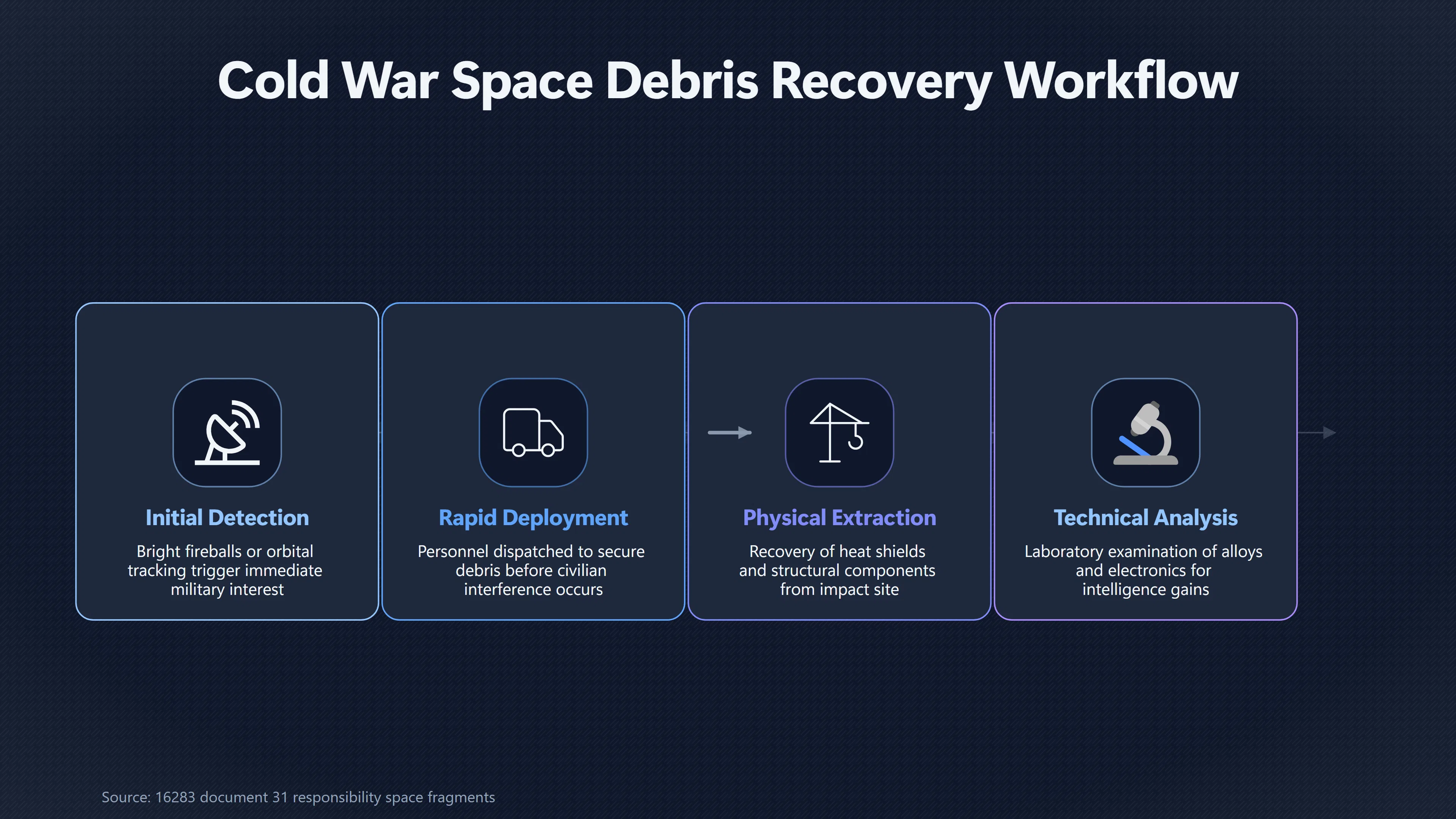
Throughout the Cold War, both superpowers devoted substantial resources to what intelligence agencies called foreign material exploitation—the recovery and technical examination of an opponent’s equipment. Analysts sought not only complete aircraft or missiles but also fragments from rockets, satellites and spacecraft that survived re-entry or accidents. Even damaged components could reveal manufacturing techniques, metallurgy, electronics, insulation materials or design philosophies unavailable through photography or signals intelligence alone.[National Security Archive]nsarchive.gwu.eduNational Security ArchiveScavenging for Intelligence: The U.S. Government’s Secret Search for Foreign Objects during the Cold War | Natio…
Recovered hardware complemented other intelligence sources. Reconnaissance satellites, intercepted telemetry and aerial photography could reveal what a Soviet system looked like or how it performed, but physical examination could answer different questions:
- What alloys and heat-resistant materials had been used?
- How sophisticated were guidance electronics and manufacturing methods?
- Which communications components or radio systems were installed?
- How advanced were propulsion or thermal-protection technologies?
These questions had direct military significance because Soviet civilian and military space programmes shared launch vehicles, engineering practices and industrial suppliers. Knowledge gained from one programme could improve understanding of the other.[National Security Archive]nsarchive.gwu.eduNational Security ArchiveScavenging for Intelligence: The U.S. Government’s Secret Search for Foreign Objects during the Cold War | Natio…
What analysts would have hoped to recover
If a Soviet spacecraft had genuinely fallen on North American territory, intelligence specialists would not have expected an intact vehicle. Re-entry typically destroys most structures. Nevertheless, several categories of hardware could survive sufficiently to warrant recovery.
Potentially valuable items included:
- Heat-shield materials, which revealed manufacturing methods and thermal-protection capabilities.
- Structural components, whose alloys and fabrication techniques could indicate industrial standards and engineering priorities.
- Guidance and control equipment, including gyroscopes, sensors or wiring layouts that shed light on navigation technology.
- Radio and communications hardware, useful for understanding frequencies, antenna designs and electronic architecture.
- Propulsion or pressure-system components, which could provide clues about fuel systems and spacecraft engineering.
Even fragments with no immediate operational use could contribute to broader scientific and technical intelligence when compared with classified information obtained from other collection methods.[National Security Archive]nsarchive.gwu.eduNational Security ArchiveScavenging for Intelligence: The U.S. Government’s Secret Search for Foreign Objects during the Cold War | Natio…
The value of such recoveries was demonstrated repeatedly during the Cold War. Declassified historical studies show that the United States organised programmes specifically to locate foreign aerospace hardware and similarly worked to recover American equipment before foreign governments could examine it.[National Security Archive]nsarchive.gwu.eduNational Security ArchiveScavenging for Intelligence: The U.S. Government’s Secret Search for Foreign Objects during the Cold War | Natio…

Why reports of a fireball would justify a rapid response
Against this background, a bright fireball accompanied by reports of debris would naturally trigger military interest, particularly if orbital tracking suggested that a Soviet object might be re-entering around the same period.
Officials would have faced several uncertainties simultaneously:
- Initial eyewitness reports are often incomplete or contradictory.
- Radar and orbital tracking data in 1965 could require time to verify.
- Potential impact locations might be uncertain over many kilometres.
- Valuable debris, if present, could quickly be disturbed by weather, civilians or souvenir hunters.
From an operational standpoint, the safest course was to investigate first and determine later whether the object was actually connected to a Soviet spacecraft. Such a precautionary search would be entirely consistent with Cold War intelligence practices and does not require assuming that the military already knew a spacecraft had crashed.[Taylor & Francis Online]tandfonline.comOpen source on tandfonline.com.

Precautionary search does not equal confirmed recovery
One of the most common misunderstandings in discussions of Kecksburg is the assumption that a military presence necessarily proves the recovery of extraordinary hardware. Historically, that conclusion does not follow.
Military or government personnel could have been dispatched for several routine reasons:
- to determine whether debris posed a public safety hazard;
- to secure any potentially sensitive foreign technology;
- to document the impact area before evidence was disturbed;
- to establish whether eyewitness reports matched known satellite or aircraft events.
These objectives required only the possibility of recoverable Soviet hardware, not confirmation that such hardware actually existed. A search could therefore be genuine even if investigators ultimately found nothing significant or concluded that the reported object was unrelated to Kosmos 96.[National Security Archive]nsarchive.gwu.eduNational Security ArchiveScavenging for Intelligence: The U.S. Government’s Secret Search for Foreign Objects during the Cold War | Natio…
Later examples show why governments valued recovered space hardware
Subsequent Cold War incidents illustrate how seriously governments treated recoverable spacecraft components. After the Soviet nuclear-powered satellite Kosmos 954 broke up over Canada in 1978, Canadian and American authorities mounted the extensive Operation Morning Light to locate radioactive debris. While public safety was the immediate priority, recovered components also provided intelligence analysts with valuable information about Soviet engineering, including unexpected design features that could not have been inferred from remote observation alone.[The National Interest]nationalinterest.orgThe National InterestOperation Morning Light: The Nuclear Satellite That Almost Decimated America - The National InterestNovember 23, 2015…
Although Kosmos 954 involved radioactive contamination and occurred more than a decade after Kecksburg, it demonstrates an established principle: Soviet spacecraft debris was considered strategically important, and governments invested considerable resources in recovering and analysing it whenever possible. That broader intelligence practice lends credibility to the idea that military units in December 1965 would have treated reports of possible Soviet debris seriously.
What this means for the Kosmos 96 theory
The intelligence value of Soviet spacecraft hardware strengthens only one part of the Kosmos 96 hypothesis. It provides a reasonable explanation for why military authorities might have responded quickly to reports of a fireball or possible impact during the Cold War.
It does not, however, establish that Kosmos 96 reached Pennsylvania. Independent orbital analyses place the spacecraft’s decay over Canada hours before the Kecksburg observations, and astronomical reconstructions indicate that the widely observed fireball followed a trajectory more consistent with a natural meteor than with a decaying low-Earth-orbit spacecraft. Consequently, the prospect of recovering valuable Soviet technology offers a plausible explanation for official interest while remaining separate from the much stronger evidence that Kosmos 96 itself was not the object seen over Kecksburg.[Taylor & Francis Online]tandfonline.comOpen source on tandfonline.com.
Amazon book picks
Further Reading
Books and field guides related to Why Soviet Space Debris Would Draw Military Attention. Use these as the next step if you want deeper reading beyond the article.
Blind Man's Bluff: The Untold Story of American Submarine Esp...
Includes a new afterword describing submariners' responses and reactions and a new appendix of all award-winning subs honored for service...
Skunk Works: A Personal Memoir of My Years at Lockheed
The former head of Lockheed's SKUNK WORKS reveals the amazing story of the secret aircraft that changed the course of history - from the...
The Wizards of Langley: Inside the CIA's Directorate of Scien...
This text provides a detailed look at the individuals, scientific innovation and bureaucratic warfare behind the scenes at the CIA's Dire...
Area 51: An Uncensored History of America's Top Secret Milita...
The explosive, untold story of the Cold War's biggest secret from the bestselling author of NUCLEAR WAR: A SCENARIO 'An extraordinary boo...
eBay marketplace picks
Marketplace Samples
Live-tested eBay searches with available results related to this page.
Selected fromSoviet space memorabilia oneBay.co.uk.


Endnotes
1.
Source: tandfonline.com
Link:https://www.tandfonline.com/doi/abs/10.1080/14777620590933584
2.
Source: nsarchive.gwu.edu
Link:https://nsarchive.gwu.edu/briefing-book/intelligence/2018-01-31/scavenging-intelligence-us-governments-secret-search-foreign-objects-during-cold-war
Source snippet
National Security ArchiveScavenging for Intelligence: The U.S. Government’s Secret Search for Foreign Objects during the Cold War | Natio...
3.
Source: nationalinterest.org
Link:https://nationalinterest.org/feature/operation-morning-light-the-nuclear-satellite-almost-14411
Source snippet
The National InterestOperation Morning Light: The Nuclear Satellite That Almost Decimated America - The National InterestNovember 23, 2015...
Published: November 23, 2015
4.
Source: nsarchive.gwu.edu
Title: 16283 document 31 responsibility space fragments
Link:https://nsarchive.gwu.edu/index.php/document/16283-document-31-responsibility-space-fragments
5.
Source: nsarchive.gwu.edu
Title: 16267 document 15 lunik spacecraft sydney wesley finer
Link:https://nsarchive.gwu.edu/document/16267-document-15-lunik-spacecraft-sydney-wesley-finer
Additional References
6.
Source: nasa.gov
Title: Roscosmos Progress 93 Cargo Spacecraft Departs Station
Link:https://www.nasa.gov/blogs/spacestation/2026/04/20/roscosmos-progress-93-cargo-spacecraft-departs-station/
Source snippet
Garcia April 20, 2026 6:15PM CATEGORIES Expedition 74International Space Station (ISS)ISS Research ROSCOSMOS PROGRESS 93 CARGO SPACECRAFT...
Published: April 20, 2026
7.
Source: nasa.gov
Title: Roscosmos Progress 96
Link:https://www.nasa.gov/event/roscosmos-progress-96/
Source snippet
February 23, 2026 — Launch Schedule ROSCOSMOS PROGRESS 96 WHEN No Earlier Than Fall 2026 Select Your Location or Timezone:[Select] [B...
Published: February 23, 2026
8.
Source: nasa.gov
Title: 13.0 Deorbit Systems
Link:https://www.nasa.gov/smallsat-institute/sst-soa/deorbit-systems/
Source snippet
May 7, 2026 — 13.0 DEORBIT SYSTEMS May 7, 2026 PDF (1.49 MB) CHAPTER CONTENTS * Chapter Glossary * 13.1 Introduction * 13.2 Orbital D...
Published: May 7, 2026
9.
Source: youtube.com
Title: Episode 184 Kecksburg Revisited with [Stan Gordon]({{ ‘stan-gordon/’ | relative_url }})
Link:https://www.youtube.com/watch?v=CKK66LtZ1Hs
Source snippet
This list provides documented historical analysis and expert discussions surrounding the 1965 Kecksburg crash and the Cold War theory inv...
10.
Source: youtube.com
Title: The Truth About The Kecksburg UFO Crash: A Soviet Satellite Or Alien Ship?
Link:https://www.youtube.com/watch?v=PgVIuew8eoI
Source snippet
The Kecksburg Incident: What Really Happened Here?...
11.
Source: youtube.com
Link:https://www.youtube.com/watch?v=ruKDXL13lk8
Source snippet
Episode 184 Kecksburg Revisited with Stan Gordon...
12.
Source: cia.gov
Link:https://www.cia.gov/readingroom/document/cia-rdp84t00926r000100170006-0
13.
Source: youtube.com
Title: The Kecksburg Incident: What Really Happened Here?
Link:https://www.youtube.com/watch?v=BXh2zTD9Kug
Source snippet
The 1965 Kecksburg Incident: A UFO Crash the Government Hides to This Day...
14.
Source: thecoldfile.com
Title: 1965 kecksburg
Link:https://www.thecoldfile.com/articles/1965-kecksburg/
Source snippet
None has closed the case, and the speculation here is kept out of the account and the evidence above. A natural meteor or bolide (the off...
15.
Source: theblackvault.com
Title: One candidate
Link:https://www.theblackvault.com/casefiles/the-vault-files-the-1965-kecksburg-pennsylvania-crash/
Source snippet
The Vault Files: The 1965 Kecksburg, Pennsylvania Crash - The Black Vault Case FilesAugust 1, 2025 — * Soviet Spacecraft Debris (Kosmos 9...
Published: August 1, 2025