Within Area Cordon
Could Ordinary Space Debris Be Dangerous?
An unknown object could contain hot metal, toxic propellant, pressurised tanks or unstable components that made civilian access unsafe.
On this page
- Heat, sharp fragments and fire risks
- Toxic propellants and pressurised components
- Why visual inspection had to come first
Page outline Jump by section
Introduction
One practical reason for restricting access to the reported impact area near Kecksburg was that nobody initially knew whether the descending object was harmless, a conventional spacecraft component, a missile fragment or an aircraft part. Until specialists could identify it, officials had to assume it might contain dangerous materials or unstable hardware. That precaution was entirely consistent with established aerospace safety practice and does not, by itself, indicate that the object was extraordinary or extraterrestrial. Modern re-entry safety guidance still treats unidentified space hardware as a potential source of thermal, chemical and explosive hazards until it has been examined by trained personnel.[aerospace.org]aerospace.orgCorporation SSI: Launch and Reentry Safety | The Aerospace CorporationAerospace CorporationSSI: Launch and Reentry Safety | The Aerospace Corporation…
Could Ordinary Space Debris Be Dangerous?
Objects that survive atmospheric re-entry often appear deceptively inert. Although much of a spacecraft burns away before reaching the ground, dense components such as titanium pressure vessels, stainless-steel fuel tanks, engine parts and structural fittings can survive largely intact. Engineers model which components are likely to reach the surface precisely because some materials resist the intense heating of re-entry.[nasa.gov]ntrs.nasa.govNASA Technical Reports ServerEvaluating and Addressing Potential Hazards of Fuel Tanks Surviving Atmospheric Reentry - NASA Technical Rep…
From the perspective of emergency responders, the problem is uncertainty. A metal object lying in woodland may no longer be moving, yet it could still contain hazardous chemicals, trapped pressure or damaged electrical systems. Without knowing the object’s origin, responders cannot safely assume that it is merely scrap metal.
This helps explain why authorities investigating an unidentified impact would typically prevent curious members of the public from approaching the site until specialists completed an initial inspection.
Heat, Sharp Fragments and Fire Risks
Contrary to popular belief, surviving debris is not always glowing red-hot when discovered. During descent, some fragments cool rapidly while others retain significant internal heat depending on their size, composition and how recently they landed. Even when no longer visibly hot, heavy metal components may remain capable of causing burns immediately after impact.[Aerospace Corporation]aerospace.orgCorporation SSI: Launch and Reentry Safety | The Aerospace CorporationAerospace CorporationSSI: Launch and Reentry Safety | The Aerospace Corporation…
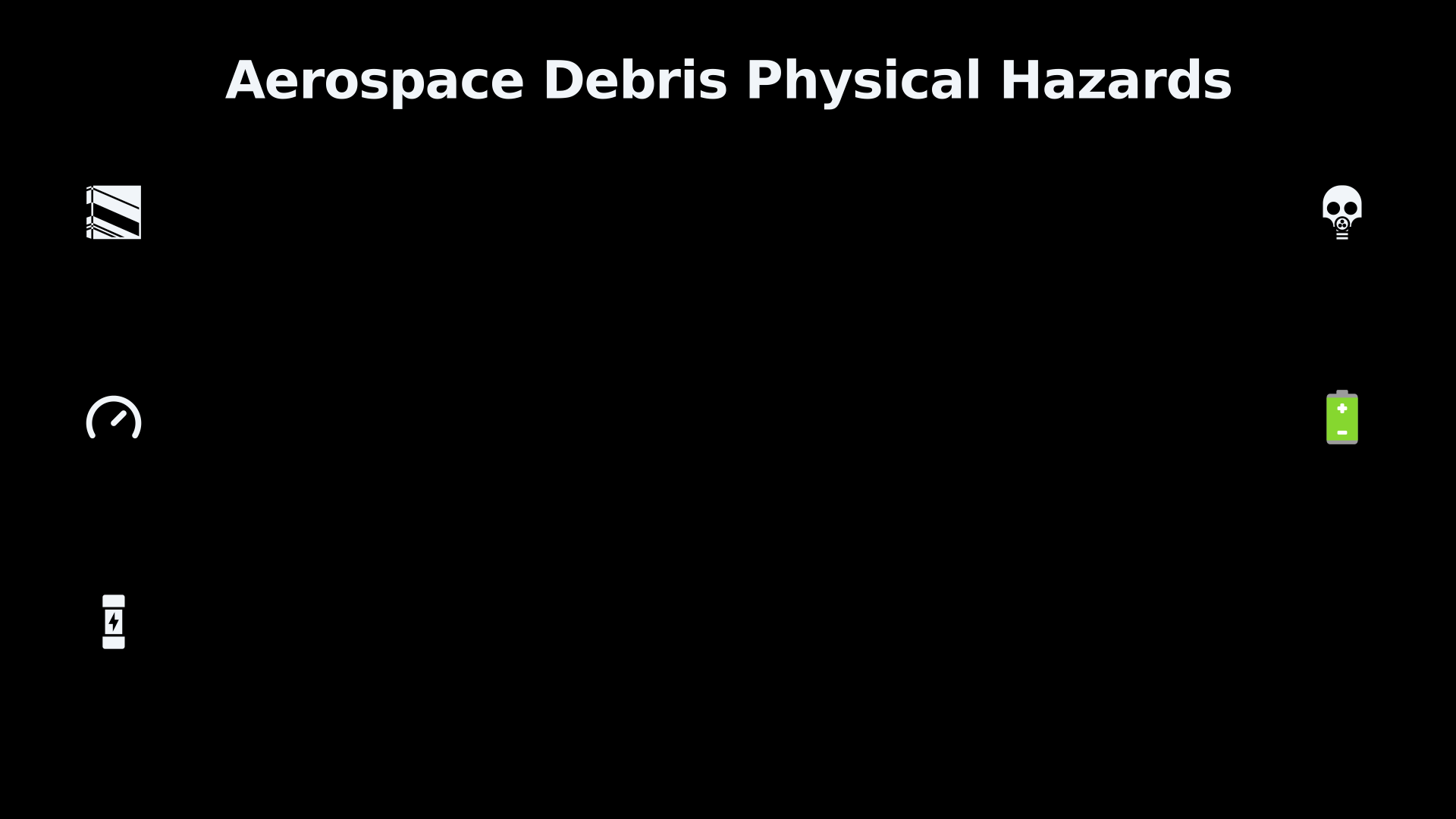
Additional physical hazards include:
- Sharp fractured metal, capable of causing serious injuries.
- Heavy components, which may shift unexpectedly if disturbed.
- Small debris fields, where fragments are scattered beyond the obvious impact point.
- Localised vegetation fires, especially if hot fragments land in dry woodland.
For investigators arriving before daylight—as reportedly occurred around Kecksburg—these risks become more difficult to assess. Poor visibility makes it harder to distinguish harmless debris from unstable components or concealed fragments.
Toxic Propellants and Pressurised Components
The greatest concern with unidentified aerospace debris is often not heat but chemistry.[aerospace.org]aerospace.orgSource details in endnotes.
Many satellites, upper rocket stages and military vehicles have historically used highly toxic propellants, including hydrazine and nitrogen tetroxide. These chemicals are extremely hazardous if inhaled or absorbed through the skin, and damaged tanks may leak invisible vapours. For this reason, fuel tanks receive particular attention during re-entry hazard analysis because they are both relatively likely to survive atmospheric heating and potentially capable of retaining dangerous residues.[NASA Technical Reports Server]ntrs.nasa.govNASA Technical Reports ServerEvaluating and Addressing Potential Hazards of Fuel Tanks Surviving Atmospheric Reentry - NASA Technical Rep…
Even if propellant has been consumed, other hazardous components may remain, including:
- pressurised gas bottles used for spacecraft control systems;
- batteries capable of thermal runaway if damaged;
- pyrotechnic separation devices that may not have fully activated;
- residual hydraulic or cooling fluids.
NASA’s orbital debris testing facilities are specifically designed to evaluate impacts involving toxic materials, pressurised vessels, batteries and pyrotechnic components because these represent recognised aerospace hazards rather than unusual edge cases.[NASA]nasa.govOrbital DebrisOrbital Debris - NASAJanuary 22, 2026…
The possibility of pressurised hardware is particularly important. A tank weakened by impact can rupture unpredictably if handled improperly, creating an explosion hazard even though the object appears motionless.
Why Visual Inspection Had to Come First
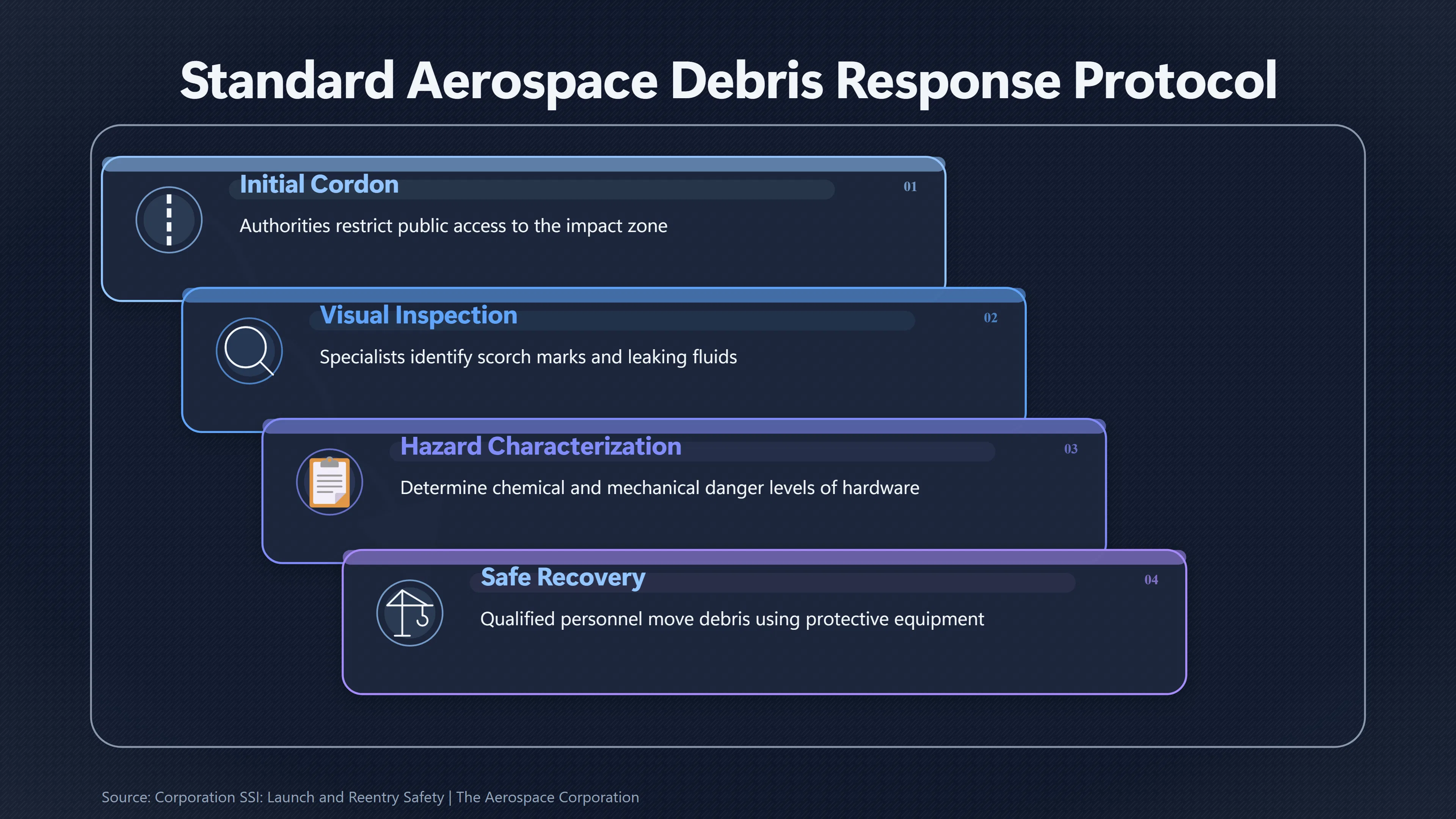
Before any debris can be moved safely, investigators must determine three basic questions:
- What is it?
- Is it chemically or mechanically dangerous?
- Can it be approached without protective equipment?
Visual inspection is therefore the first stage of any response. Specialists look for scorch marks, leaking fluids, unusual odours, damaged valves, pressure vessels and evidence of unstable components before anyone attempts recovery.
Modern launch and re-entry safety procedures continue to emphasise controlling access until hazards are characterised. Aviation authorities may even establish temporary debris response areas following unexpected re-entry events to keep aircraft and the public away until the nature of the debris is understood.[Federal Aviation Administration]faa.govOpen source on faa.gov.
Applied to Kecksburg, this means that a temporary cordon is compatible with standard emergency management. Officials did not need prior knowledge of an exotic craft to justify restricting access; uncertainty alone was sufficient.
What This Means for the Kecksburg Incident
The reported military and police response has often been interpreted as evidence that authorities knew they had recovered something extraordinary. However, the presence of a security perimeter is equally consistent with ordinary aerospace safety practice.
In late 1965, responders confronting reports of an unidentified object descending through the atmosphere could not immediately exclude possibilities such as:
- spacecraft debris containing toxic propellant;
- missile hardware with pressurised systems;
- aircraft wreckage with fire or explosion hazards;[sciencedirect.com]sciencedirect.comHazards associated with reentryHazards associated with reentry
- unidentified government equipment requiring technical assessment.
Because these possibilities involve genuine risks to responders and civilians alike, restricting access until qualified personnel completed an initial inspection would have been a routine precaution rather than evidence, by itself, of a concealed extraterrestrial recovery. The continuing debate over what actually fell near Kecksburg concerns the object’s identity, not the basic logic behind establishing a temporary safety perimeter.[aerospace.org]aerospace.orgCorporation SSI: Launch and Reentry Safety | The Aerospace CorporationAerospace CorporationSSI: Launch and Reentry Safety | The Aerospace Corporation…
Amazon book picks
Further Reading
Books and field guides related to Could Ordinary Space Debris Be Dangerous?. Use these as the next step if you want deeper reading beyond the article.
Orbital Mechanics for Engineering Students
Orbital Mechanics for Engineering Students, Second Edition, provides an introduction to the basic concepts of space mechanics. These incl...
Space Debris: Models and Risk Analysis
In Space Debris Models and Risk Analysis the authors will provide the reader with a comprehensive background to understand the various so...
Spacecraft Systems Engineering
Following on from the hugely successful previous editions, the third edition of Spacecraft Systems Engineering incorporates the most rece...
Introduction to Emergency Management
Introduction to Emergency Management, Fourth Edition, offers a practical guide to the discipline of emergency management. It focuses on t...
eBay marketplace picks
Marketplace Samples
Live-tested eBay searches with available results related to this page.
Selected fromspace mission patch oneBay.co.uk.

Endnotes
1.
Source: aerospace.org
Title: Corporation SSI: Launch and Reentry Safety | The Aerospace Corporation
Link:https://aerospace.org/ssi-launch-and-reentry-safety
Source snippet
Aerospace CorporationSSI: Launch and Reentry Safety | The Aerospace Corporation...
2.
Source: ntrs.nasa.gov
Link:https://ntrs.nasa.gov/search.jsp?R=20110008637
Source snippet
NASA Technical Reports ServerEvaluating and Addressing Potential Hazards of Fuel Tanks Surviving Atmospheric Reentry - NASA Technical Rep...
3.
Source: orbitaldebris.jsc.nasa.gov
Title: Orbital Debris Program Office ARES | Orbital Debris Program Office
Link:https://orbitaldebris.jsc.nasa.gov/
4.
Source: nasa.gov
Title: Orbital Debris
Link:https://www.nasa.gov/reference/jsc-orbital-debris/
Source snippet
Orbital Debris - NASAJanuary 22, 2026...
Published: January 22, 2026
5.
Source: nodis3.gsfc.nasa.gov
Title: display Dir.cfm
Link:https://nodis3.gsfc.nasa.gov/displayDir.cfm?Internal_ID=N_PR_8715006E&page_name=Chapter1
6.
Source: aerospace.org
Title: Long March 5B Rocket Debris | The Aerospace Corporation
Link:https://aerospace.org/article/long-march-5b-rocket-debris
7.
Source: oig.nasa.gov
Link:https://oig.nasa.gov/office-of-inspector-general-oig/ig-21-011/
8.
Source: csps.aerospace.org
Title: large constellation disposal hazards
Link:https://csps.aerospace.org/papers/large-constellation-disposal-hazards
9.
Source: nasa.gov
Title: [Space Debris]({{ ‘space-debris/’ | relative_url }}): Understanding the Risks to NASA Spacecraft
Link:https://www.nasa.gov/centers-and-facilities/nesc/space-debris-understanding-the-risks-to-nasa-spacecraft/
10.
Source: nasa.gov
Title: Micrometeoroids and Orbital Debris (MMOD)
Link:https://www.nasa.gov/centers-and-facilities/white-sands/micrometeoroids-and-orbital-debris-mmod/
11.
Source: ntrs.nasa.gov
Link:https://ntrs.nasa.gov/citations/20080014828
12.
Source: ntrs.nasa.gov
Link:https://ntrs.nasa.gov/citations/19870016693
13.
Source: aerospace.org
Link:https://aerospace.org/space-debris
14.
Source: aerospace.org
Link:https://aerospace.org/cords
15.
Source: aerospace.org
Link:https://aerospace.org/resilient-space
16.
Source: aerospace.org
Link:https://aerospace.org/ssi-space-operations-assurance
17.
Source: orbitaldebris.jsc.nasa.gov
Link:https://orbitaldebris.jsc.nasa.gov/reentry/
18.
Source: sma.nasa.gov
Title: orbital debris
Link:https://sma.nasa.gov/sma-disciplines/orbital-debris
19.
Source: orbitaldebris.jsc.nasa.gov
Link:https://orbitaldebris.jsc.nasa.gov/faq/
20.
Source: faa.gov
Link:https://www.faa.gov/space/airspace_integration/debris_response_areas
21.
Source: faa.gov
Title: Compliance, Enforcement & Mishap | Federal Aviation Administration
Link:https://www.faa.gov/space/compliance_enforcement_mishap
Source snippet
The FAA’s Office of Commercial Space Transportation (AST), Office of Operational Safety, Safety As...
22.
Source: faa.gov
Title: Human Space Flight | Federal Aviation Administration
Link:https://www.faa.gov/space/human_spaceflight
Source snippet
What once was an exclusive government-led activity is now open to commercial space operators and private individuals. Image: photo of Spa...
23.
Source: faa.gov
Link:https://www.faa.gov/blog/clearedfortakeoff/facts-about-faa-commercial-space-oversight
Source snippet
The Facts About FAA Commercial Space Oversight | Federal Aviation AdministrationSeptember 9, 2025 — THE FACTS ABOUT FAA COMMERCIAL SPACE...
Published: September 9, 2025
24.
Source: faa.gov
Title: airspace system, the busiest and most complex in the world
Link:https://www.faa.gov/space/airspace_integration
Source snippet
Airspace Integration | Federal Aviation AdministrationSeptember 5, 2025 — AIRSPACE INTEGRATION YouTube video player The FAA is responsibl...
Published: September 5, 2025
25.
Source: faa.gov
Title: Commercial Space Transportation on Airports | Federal Aviation Administration
Link:https://www.faa.gov/airports/new_entrants/commercial_space
26.
Source: faa.gov
Title: Commercial Space Transportation Activities | Federal Aviation Administration
Link:https://www.faa.gov/newsroom/commercial-space-transportation-activities
27.
Source: faa.gov
Link:https://www.faa.gov/newsroom/faa-proposed-rule-would-reduce-growth-debris-commercial-space-vehicles
28.
Source: aero-spacecorp.com
Title: Satellite Reentry: Manipulating the Plunge | The Aerospace Corporation
Link:https://www.aero-spacecorp.com/article/satellite-reentry-manipulating-plunge.html
Additional References
29.
Source: youtube.com
Title: Space Debris: The Potential Impact on the Ozone Layer and Earth’s Climate
Link:https://www.youtube.com/watch?v=rGi_ibo9EQg
Source snippet
[Kosmos-954]({{ 'kosmos-954/' | relative_url }}), 1978: The Soviet Reactor That Crashed in Canada...
30.
Source: youtube.com
Title: Toxic Propellant Hazards
Link:https://www.youtube.com/watch?v=Zha9DyS-PPA
Source snippet
Toxic space debris washes up on Queensland beach hydrazine Toxic space debris washes up on Queensland beach | 7NEWS 7NEWS Australia...
31.
Source: youtube.com
Title: Space Debris Is Crashing Into Earth. Should You Worry? | WSJ
Link:https://www.youtube.com/watch?v=drRaLMI0SI4
Source snippet
Space Debris: The Potential Impact on the Ozone Layer and Earth’s Climate...
32.
Source: youtube.com
Title: Toxic space debris washes up on Queensland beach | 7NEWS
Link:https://www.youtube.com/watch?v=13FvDQVfsiU
Source snippet
Space Debris Is Crashing Into Earth. Should You Worry? | WSJ...
33.
Source: sciencedirect.com
Link:https://www.sciencedirect.com/science/article/pii/S246889672500028X
34.
Source: dl.iafastro.directory
Link:https://dl.iafastro.directory/event/IAC-2024/paper/89694/
35.
Source: space-flight.org
Link:https://www.space-flight.org/AAS_meetings/1998_winter/abstracts/98-174.html
36.
Source: youtube.com
Link:https://www.youtube.com/watch?v=iSK6yJBnSag
Source snippet
Toxic Propellant Hazards...
37.
Source: sciencedirect.com
Title: Hazards associated with reentry
Link:https://www.sciencedirect.com/science/article/abs/pii/S0094576524006143
38.
Source: law.cornell.edu
Title: edu14 CFR § 435.35
Link:https://www.law.cornell.edu/cfr/text/14/435.35