Within Witness Memory
Why Kecksburg Stories Grew More Certain
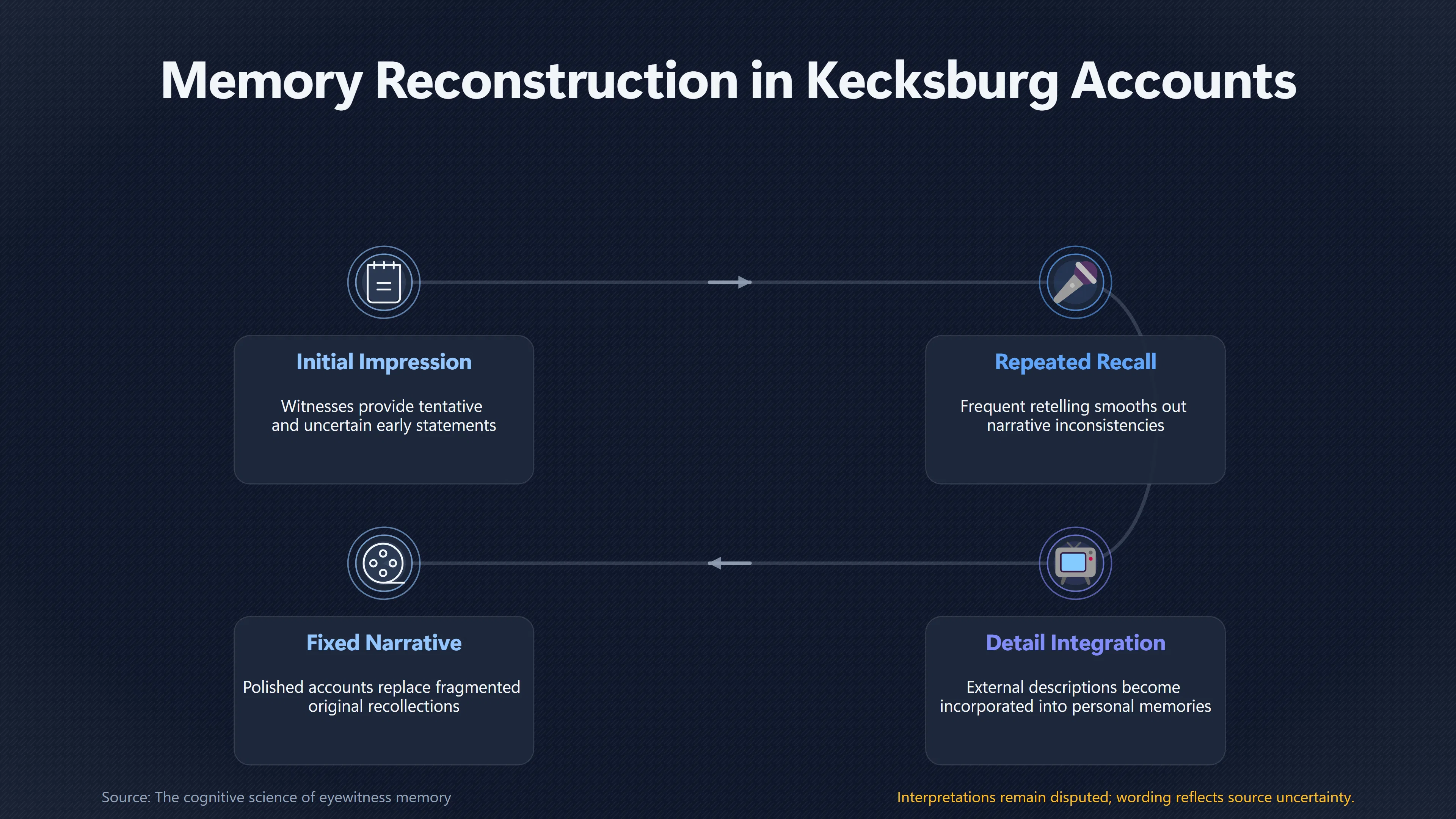
Each retelling can strengthen a polished version of an event, even when its added precision does not reflect better historical accuracy.
On this page
- How repeated recall stabilises a story
- From tentative impressions to fixed details
- Why confidence is not proof of accuracy
Page outline Jump by section
Introduction
One of the most important lessons from the Kecksburg UFO incident is that a witness can become more certain of a story over time without becoming more historically accurate. Many of the best-known Kecksburg accounts were recorded years or even decades after the events of 9 December 1965, following repeated interviews, documentaries, anniversary commemorations and conversations within the local community. As stories are recalled repeatedly, they often become smoother, more internally consistent and easier to tell. That increased confidence can make an account sound stronger, but psychological research shows that confidence and historical accuracy are not the same thing.[PubMed]pubmed.ncbi.nlm.nih.govLost but not forgotten details: repeated eyewitness recall leads to reminiscence but not hypermnesia - PubMed…
This distinction is especially relevant to Kecksburg because later testimony often contains greater descriptive certainty than the earliest surviving reports. That pattern does not prove fabrication, nor does it prove that the later versions are accurate. Instead, it illustrates a well-established feature of human memory: repeated recall changes memory itself.
How repeated recall stabilises a story
Memory is not replayed like a recording. Each act of remembering reconstructs an event from stored fragments together with existing beliefs, later information and the current context. Once a particular reconstruction is expressed, it can become the version most readily available the next time the witness recalls the event.[PubMed]pubmed.ncbi.nlm.nih.govThe dark side of testing memory: repeated retrieval can enhance eyewitness suggestibility - PubMed…
In the Kecksburg case, many witnesses described their experiences repeatedly across:
- newspaper interviews and local discussions;
- television documentaries;
- UFO conferences and anniversary events;
- books and magazine articles;
- conversations with investigators and other witnesses.
Each retelling provided an opportunity for the narrative to become more coherent. Small uncertainties that may have existed in 1965 could gradually disappear, not necessarily because the witness remembered more, but because the most frequently rehearsed version became the easiest one to retrieve.
Laboratory studies of eyewitness memory show a similar process. Repeated recall can make people more fluent in recounting an event, while also allowing later information to become integrated into what feels like an original memory.[PubMed]pubmed.ncbi.nlm.nih.govThe dark side of testing memory: repeated retrieval can enhance eyewitness suggestibility - PubMed…
From tentative impressions to fixed details
Many extraordinary-event narratives evolve in a characteristic way. Initial statements often contain uncertainty:
- “I think…”
- “It looked something like…”
- “I’m not sure…”
- “From where I was standing…”
Years later, the same experience may be described with far greater precision.
Within Kecksburg, details such as an acorn-like shape, bronze colouring, estimated dimensions and unusual symbols became increasingly familiar through repeated public discussion. Whether any particular witness genuinely observed every one of those characteristics is a separate question. The important point is that repeated exposure to these descriptions could influence later recollections, especially when witnesses sincerely attempted to reconstruct an unusual event from decades earlier.
Psychological research has repeatedly demonstrated that post-event information can become incorporated into eyewitness memory. Repeated exposure to a detail makes it more familiar, and familiarity is often mistaken for evidence that the detail was personally observed.[ScienceDirect]sciencedirect.comRepetition, not number of sources, increases both susceptibility to misinformation and confidence in the accuracy of eyewitn…
Why confidence increases even when accuracy does not
A common misunderstanding is that confidence naturally tracks truth. In reality, the relationship is much more complicated.
Confidence tends to increase when:
- a story has been rehearsed many times;
- the witness receives positive feedback;
- the account becomes socially accepted;
- inconsistencies are gradually removed;
- recalling the story becomes easier.
None of these factors necessarily improve the historical accuracy of the memory itself.
Experimental research shows that repetition can increase confidence in remembered information, including misleading information. People often judge repeated claims as more believable simply because they have become familiar. In eyewitness settings, repetition has been shown to increase both susceptibility to misinformation and confidence in remembered details.[ScienceDirect]sciencedirect.comRepetition, not number of sources, increases both susceptibility to misinformation and confidence in the accuracy of eyewitn…
This helps explain why a witness interviewed forty years after Kecksburg may sound more certain than they would have sounded on the night itself.
Why polished testimony can appear especially persuasive
Later Kecksburg interviews frequently present witnesses telling an organised narrative with a clear beginning, middle and end. Such accounts naturally appear more convincing than fragmented early recollections.
Several ordinary psychological processes contribute to this effect:
- Narrative practice. Frequently told stories become easier to deliver.
- Consistency editing. Contradictions are unconsciously removed over repeated tellings.
- Social reinforcement. Listeners often respond more positively to clear, confident accounts than to uncertain ones.
- Memory consolidation through reconstruction. The reconstructed version gradually replaces earlier, less organised recollections.[PubMed]pubmed.ncbi.nlm.nih.govLost but not forgotten details: repeated eyewitness recall leads to reminiscence but not hypermnesia - PubMed…
Importantly, none of these mechanisms requires deliberate exaggeration. A witness can sincerely believe the later version because it genuinely feels like their memory.

Why confidence is not proof of accuracy
Modern eyewitness research strongly cautions against using a witness’s present-day confidence as a substitute for historical reliability.
Researchers distinguish between an initial, uncontaminated expression of confidence, recorded close to the event under carefully controlled conditions, and confidence expressed after years of discussion, media exposure and repeated interviews. The former can sometimes provide useful information in specific identification settings. The latter may have been influenced by numerous post-event experiences that change both memory and certainty.[PubMed]pubmed.ncbi.nlm.nih.govThe Relationship Between Eyewitness Confidence and Identification Accuracy: A New Synthesis - PubMedMarch 22, 2017…
The Kecksburg record therefore requires careful weighting of evidence. Contemporary reports created in December 1965 generally deserve greater evidential value than memories recorded decades later—not because later witnesses were dishonest, but because the opportunities for memory reconstruction increase with every subsequent retelling.
What this means for interpreting Kecksburg testimony
The evolution of Kecksburg witness accounts illustrates a broader principle in eyewitness psychology rather than something unique to UFO cases. Extraordinary experiences are especially likely to be revisited, discussed and publicly retold, giving memories many opportunities to change.
For historians and investigators, the most informative question is often not whether a witness became more confident, but when a particular detail first appeared. If a specific description only emerges after years of repeated interviews, documentaries or public discussion, its growing certainty should not automatically be interpreted as growing evidence.
Viewed through this lens, the increasing confidence of many Kecksburg witnesses is itself a meaningful piece of evidence—not that the reported object was necessarily what later accounts describe, but that repeated retelling can transform uncertain impressions into stable, sincerely held memories whose confidence exceeds what the original observation alone can support.[sciencedirect.com]sciencedirect.comRepetition, not number of sources, increases both susceptibility to misinformation and confidence in the accuracy of eyewitn…
Amazon book picks
Further Reading
Books and field guides related to Why Kecksburg Stories Grew More Certain. Use these as the next step if you want deeper reading beyond the article.
The Seven Sins of Memory: How the Mind Forgets and Remembers
Rating: 3.5/5 from 5 Google Books ratings
A New York Times Notable Book: A psychologist's "gripping and thought-provoking" look at how and why our brains sometimes fail us (Steven...
The Seven Sins of Memory
Rating: 3.5/5 from 5 Google Books ratings
A New York Times Notable Book: A psychologist's "gripping and thought-provoking" look at how and why our brains sometimes fail us (Steven...
Mistakes Were Made (but Not by Me)
Why is it so hard to say "I made a mistake"-and really believe it? When we make mistakes, cling to outdated attitudes, or mistreat other...
The Memory Illusion: Remembering, Forgetting, and the Science...
THE INTERNATIONAL BESTSELLER 'Truly fascinating.' Steve Wright, BBC Radio 2 - Have you ever forgotten the name of someone you’ve met doze...
eBay marketplace picks
Marketplace Samples
Live-tested eBay searches with available results related to this page.
Selected fromalien poster oneBay.co.uk.




Endnotes
1.
Source: sciencedirect.com
Link:https://www.sciencedirect.com/science/article/pii/S000169181100223X
Source snippet
Repetition, not number of sources, increases both susceptibility to misinformation and confidence in the accuracy of eyewitn...
2.
Source: sciencedirect.com
Title: The cognitive science of eyewitness memory
Link:https://www.sciencedirect.com/science/article/pii/S1364661325000270
Source snippet
July 1, 2025 — Trends in Cognitive Sciences Volume 29, Issue 7, July 2025, Pages 655-668 Review The cognitive science of eye...
Published: July 1, 2025
3.
Source: sciencedirect.com
Link:https://www.sciencedirect.com/science/article/pii/S0005791623000228
Source snippet
December 1, 2023 — JOURNAL OF BEHAVIOR THERAPY AND EXPERIMENTAL PSYCHIATRY Volume 81, December 2023, 101855 MEMORY CONFIDENC...
Published: December 1, 2023
4.
Source: sciencedirect.com
Link:https://www.sciencedirect.com/science/article/abs/pii/S000169181100223X
5.
Source: sciencedirect.com
Title: Eyewitness Testimony
Link:https://www.sciencedirect.com/topics/psychology/eyewitness-testimony
6.
Source: pubmed.ncbi.nlm.nih.gov
Link:https://pubmed.ncbi.nlm.nih.gov/8206816/
Source snippet
Lost but not forgotten details: repeated eyewitness recall leads to reminiscence but not hypermnesia - PubMed...
7.
Source: pubmed.ncbi.nlm.nih.gov
Link:https://pubmed.ncbi.nlm.nih.gov/21859229/
Source snippet
The dark side of testing memory: repeated retrieval can enhance eyewitness suggestibility - PubMed...
8.
Source: pubmed.ncbi.nlm.nih.gov
Link:https://pubmed.ncbi.nlm.nih.gov/28395650/
Source snippet
The Relationship Between Eyewitness Confidence and Identification Accuracy: A New Synthesis - PubMedMarch 22, 2017...
Published: March 22, 2017
9.
Source: pubmed.ncbi.nlm.nih.gov
Link:https://pubmed.ncbi.nlm.nih.gov/42331394/
Source snippet
2026 Jun 22:1-22. doi: 10.1080/09658211.2026.2691574. Online ahead of print. REVISITING THE CONFIDENCE-ACCURACY RELATIONSHIP IN EYEWITNES...
10.
Source: ncbi.nlm.nih.gov
Link:https://www.ncbi.nlm.nih.gov/books/NBK621592/
Source snippet
Guide on Eyewitness Identification - Reference Manual on Scientific Evidence - NCBI BookshelfDecember 31, 2025 — CONFIDENCE No topic in t...
Published: December 31, 2025
11.
Source: pubmed.ncbi.nlm.nih.gov
Link:https://pubmed.ncbi.nlm.nih.gov/37691811/
12.
Source: pubmed.ncbi.nlm.nih.gov
Link:https://pubmed.ncbi.nlm.nih.gov/37001246/
13.
Source: pmc.ncbi.nlm.nih.gov
Link:https://pmc.ncbi.nlm.nih.gov/articles/PMC9451081/
14.
Source: pmc.ncbi.nlm.nih.gov
Link:https://pmc.ncbi.nlm.nih.gov/articles/PMC3789709/
15.
Source: digitalcommons.fiu.edu
Link:https://digitalcommons.fiu.edu/record/8571
Additional References
16.
Source: youtube.com
Title: America’s Other Roswell: The Kecksburg UFO
Link:https://www.youtube.com/watch?v=HX_RrO7ZQaU
Source snippet
Elizabeth Loftus on Memory Reliability This video explains the psychological mechanisms behind memory reconstruction, illustrating how re...
17.
Source: youtube.com
Title: What We Recall, What We Rewrite: Memory and Communication with Elizabeth Loftus
Link:https://www.youtube.com/watch?v=Gh1mGgsWwcw
Source snippet
Why Memory Is Unpredictable & How to Improve It...
18.
Source: psychologicalscience.org
Link:https://www.psychologicalscience.org/journals/psychological-science/1467-9280.00388/
19.
Source: ojp.gov
Link:https://ojp.gov/ncjrs/virtual-library/abstracts/reports-suggested-memories-do-people-truly-believe-them-adult
20.
Source: frontiersin.org
Link:https://www.frontiersin.org/journals/psychology/articles/10.3389/fpsyg.2023.1201674/full
21.
Source: escholarship.org
Link:https://escholarship.org/uc/item/9mc5d9mc
22.
Source: youtube.com
Title: How Reliable Is Your Memory?
Link:https://www.youtube.com/watch?v=PB2OegI6wvI
Source snippet
What We Recall, What We Rewrite: Memory and Communication with Elizabeth Loftus...
23.
Source: youtube.com
Title: Why Memory Is Unpredictable & How to Improve It
Link:https://www.youtube.com/watch?v=XtP7WzXgbLA
Source snippet
America's Other Roswell: The Kecksburg UFO...
24.
Source: escholarship.org
Title: Convicting with confidence? Why we should not over-rely on eyewitness confidence
Link:https://escholarship.org/uc/item/2h1562k3
25.
Source: youtube.com
Title: Why Eyewitnesses Fail
Link:https://www.youtube.com/watch?v=l05NGp_z6TI
Source snippet
How Reliable Is Your Memory?...