Within Kosmos 96
How Kosmos 96 Became a Falling Spacecraft
A ruptured fuel line left the Venus probe trapped in low Earth orbit, creating the re-entry that later became tied to Kecksburg.
On this page
- The failed Venus launch
- Why the upper stage could not fire
- From planetary probe to orbital debris
Page outline Jump by section
Introduction
Kosmos 96 became part of the Kecksburg discussion for one simple reason: it was a genuine spacecraft that re-entered the Earth’s atmosphere on the same day as the reported Pennsylvania fireball. Understanding that possibility begins not with its descent, but with the launch failure that prevented it from ever leaving Earth. On 23 November 1965, the Soviet Union attempted to send a Venus probe into interplanetary space. Instead, a malfunction during ascent stranded the spacecraft in low Earth orbit, where atmospheric drag gradually reduced its altitude until re-entry just over two weeks later. This chain of events created the factual basis for later speculation linking Kosmos 96 to the Kecksburg incident, even though subsequent orbital analysis casts serious doubt on that identification.[Wikipedia]WikipediaKosmos 96Kosmos 96

The Failed Venus Launch
Kosmos 96 was not originally intended to be an Earth satellite. It was a 3MV-4 spacecraft built as part of the Soviet Venera programme, whose objective was a fly-by mission to Venus. Had the launch proceeded normally, the spacecraft would have received the next Venera designation rather than the generic Kosmos name. The use of the Kosmos label reflected a standard Soviet practice of disguising failed deep-space missions as routine Earth-orbiting satellites.[Wikipedia]WikipediaKosmos 96Kosmos 96
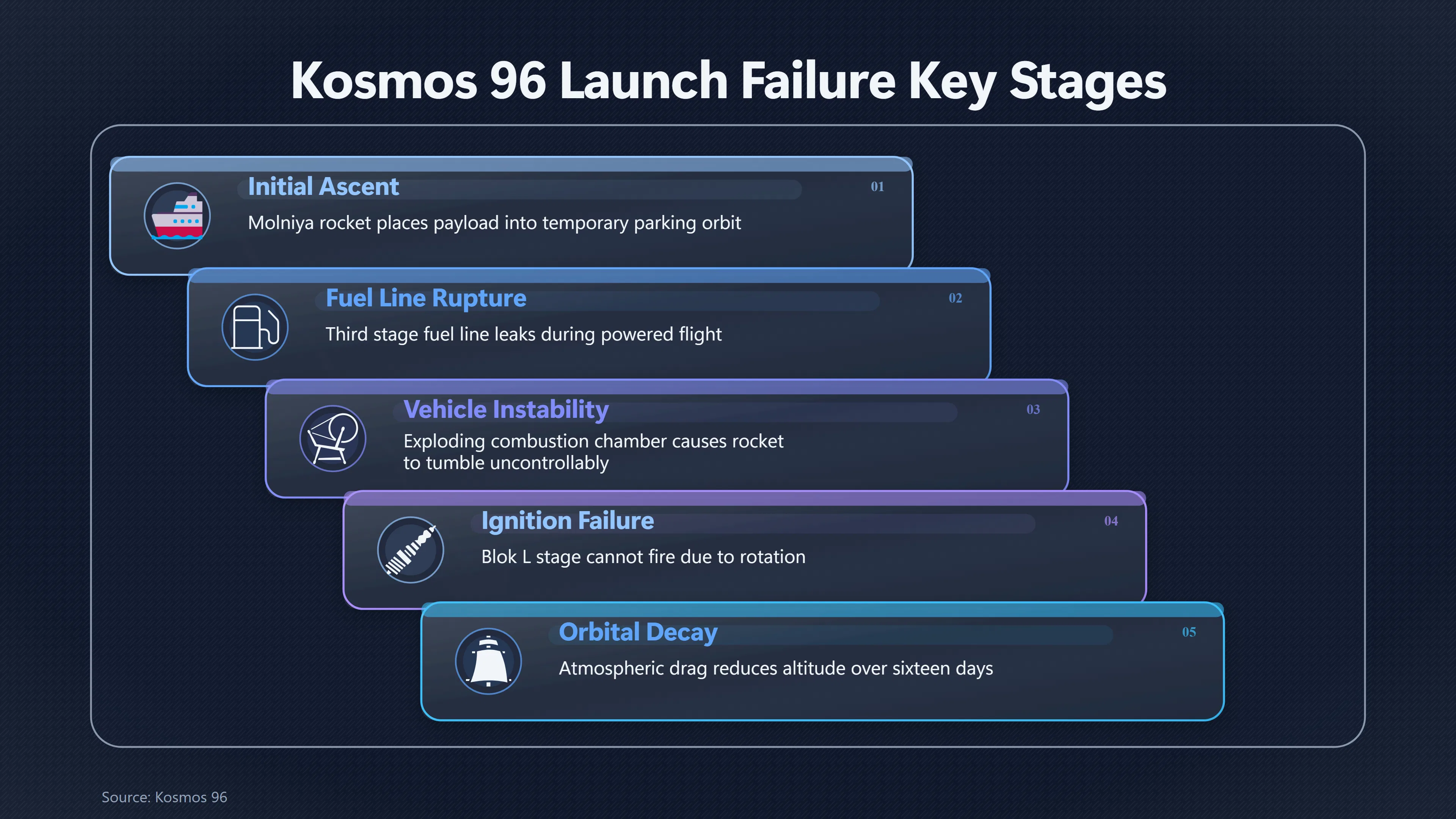
The spacecraft launched from Baikonur Cosmodrome aboard a four-stage Molniya 8K78 rocket during the early hours of 23 November 1965. The lower stages functioned well enough to place the combined payload and upper stage into a temporary parking orbit around Earth, which was the normal first phase of Soviet planetary launches. From there, the final propulsion stage was supposed to perform a second burn that would accelerate the spacecraft beyond Earth’s gravitational influence and place it on a trajectory towards Venus.[Wikipedia]WikipediaKosmos 96Kosmos 96
Instead, the mission failed before that decisive manoeuvre could begin.
Why the Upper Stage Could Not Fire
The critical failure occurred late in powered flight, before the Blok L upper stage had an opportunity to ignite.
According to mission histories, a fuel line in the launch vehicle’s third stage ruptured during ascent. The leak caused one of the engine’s combustion chambers to explode, upsetting the vehicle’s stability. Rather than maintaining the correct orientation for the next stage of the mission, the rocket began tumbling uncontrollably.[Wikipedia]WikipediaKosmos 96Kosmos 96
That instability proved fatal to the mission even though orbital insertion itself was largely successful. The Blok L upper stage depended on a carefully controlled attitude before its engine could be started safely. Because the vehicle was rotating, the ignition sequence could not proceed as planned. The stage never completed the trans-Venus injection burn that would have transformed a temporary Earth orbit into an interplanetary trajectory.[Wikipedia]WikipediaKosmos 96Kosmos 96
The spacecraft therefore remained attached to hardware intended only for the first phase of the mission. Rather than becoming a Venus probe, it became an unintended Earth satellite.

From Planetary Probe to Orbital Debris
Following the failed launch, the stranded spacecraft entered a low Earth orbit with a perigee of roughly 227 kilometres, an apogee of about 310 kilometres, an inclination of approximately 51.9 degrees and an orbital period of around 90 minutes. These were not operational mission parameters but the consequence of the incomplete launch sequence.[Wikipedia]WikipediaKosmos 96Kosmos 96
At such altitudes, Earth’s upper atmosphere still exerts measurable drag. Although extremely thin, the atmosphere gradually removes orbital energy on every revolution. Because Kosmos 96 never received the velocity increase required for escape, orbital decay became inevitable from the moment it entered parking orbit.
Over the next sixteen days the spacecraft completed hundreds of increasingly lower orbits. Each pass through the upper atmosphere reduced its altitude slightly until the drag accelerated rapidly, culminating in atmospheric re-entry on 9 December 1965.[Wikipedia]WikipediaKosmos 96Kosmos 96
This sequence is central to the later Kecksburg debate. The spacecraft did not suffer an unexpected failure while travelling to Venus; it never left Earth in the first place.
Why the Launch Failure Matters to the Kecksburg Theory
The launch accident explains why Kosmos 96 entered discussions of the Kecksburg incident without, by itself, supporting the claim that the two events involved the same object.
Several aspects of the failed mission made the connection initially attractive:
- The spacecraft was known to have remained in Earth orbit rather than departing for Venus.
- Its orbital lifetime naturally ended on 9 December 1965, the same date as the widely reported Great Lakes fireball.
- Western observers initially possessed only limited information about the classified Soviet launch failure because unsuccessful planetary missions were publicly disguised under Kosmos designations.[Wikipedia]WikipediaKosmos 96Kosmos 96
These facts established a plausible starting hypothesis worthy of investigation. However, they concern only the origin of the spacecraft’s re-entry, not its actual location or timing during its final descent. Those questions depend on orbital tracking and re-entry analysis rather than on the circumstances of the failed launch itself.
The launch failure therefore serves as the essential first link in the chain: it transformed a planned Venus mission into an object destined to fall back through Earth’s atmosphere. Without that malfunction, there would have been no Kosmos 96 re-entry to compare with the events later reported near Kecksburg.[Wikipedia]WikipediaKosmos 96Kosmos 96

Amazon book picks
Further Reading
Books and field guides related to How Kosmos 96 Became a Falling Spacecraft. Use these as the next step if you want deeper reading beyond the article.
Challenge to Apollo: The Soviet Union and the Space Race, 194...
The book received the Emme Award for Astronautical Literature at the March 20 2000 luncheon of the Goddard Memorial Symposium, sponsored...
Russian Planetary Exploration: History, Development, Legacy a...
Illustrated with photographs from Soviet Venus and Mars probes, images of spacecraft, diagrams of flight paths and maps of landing sites,...
The Red Rockets' Glare: Spaceflight and the Soviet Imaginatio...
An academic study on the birth of the Soviet space program, situating the birth of cosmic enthusiasm within Russian and Soviet history.
The Rebirth of the Russian Space Program: 50 Years After Sput...
This, fifty years after Sputnik, is the definitive book on the Russian space program. The author covers all the key elements of the curre...
eBay marketplace picks
Marketplace Samples
Live-tested eBay searches with available results related to this page.
Selected fromSoviet space patch oneBay.co.uk.

Current eBay listing
Space Mission / Aviation Patches USA NASA Soviet CCCP - Various

Current eBay listing
Laika, Soviet vintage space — embroidered patches, space patch

Endnotes
1.
Source: Wikipedia
Title: Kosmos 96
Link:https://en.wikipedia.org/wiki/Kosmos_96
Additional References
2.
Source: handwiki.org
Title: Communications lost after flyby, before any data could be returned.^{[12]} | M
Link:https://handwiki.org/wiki/Astronomy%3AList_of_missions_to_Venus
Source snippet
Astronomy:List of missions to Venus - HandWikiMay 19, 2026 — Image Soviet Union | Flyby | Spacecraft failure | Flew past Venus on 27 Febr...
Published: May 19, 2026
3.
Source: in-the-sky.org
Title: Spacecraft information: COSMOS 96
Link:https://in-the-sky.org/spacecraft.php?id=1742
Source snippet
7, 2026 — Spacecraft information: COSMOS 96 Launch Details Launched | 22 November 1965 Flight ended | 8 December 1965 Status | Decayed La...
Published: November 1965
4.
Source: handwiki.org
Title: Astronomy:Kosmos 96
Link:https://handwiki.org/wiki/Astronomy%3AKosmos_96
Source snippet
June 9, 2026 — ASTRONOMY:KOSMOS 96 From HandWiki [Input] Kosmos 96 Mission type | Venus flyby ^{[1]} Operator | OKB-1 COSPAR ID |...
Published: June 9, 2026
5.
Source: science.nasa.gov
Title: Science Venus Exploration
Link:https://science.nasa.gov/venus/exploration/
Source snippet
NASA's Mariner 2 was the first spacecraft to visit any planet beyond Earth when it flew past...
6.
Source: science.nasa.gov
Link:https://science.nasa.gov/venus/exploration/?orde=&page=0&per_page=10
Source snippet
July 17, 2025 — ALL MISSIONS TO VENUS Launch Date | Spacecraft | Nation | Type | Outcome --- | --- | --- | --- | --- Feb...
Published: July 17, 2025
7.
Source: space.skyrocket.de
Link:https://space.skyrocket.de/doc_chr/lau1965.htm
Source snippet
Launches of 1965June 21, 2026 — ORBITAL LAUNCHES OF 1965 * Home * Chronology Choose detailed or compact view [Input] Detailed (all satell...
Published: June 21, 2026
8.
Source: svengrahn.pp.se
Link:https://www.svengrahn.pp.se/histind/Soviemar/sovievenus.htm
9.
Source: usuaris.tinet.cat
Link:https://usuaris.tinet.cat/klunn/venus.html
10.
Source: youtube.com
Link:https://www.youtube.com/watch?v=rMGUA77z80E
Source snippet
Kosmos 96 Venus probe launch failure Surviving Venus in the 1970s Primal Space...
11.
Source: nasa.gov
Title: 50 Years Ago: Manning Third Saturn V Test Accelerates Moon Landing
Link:https://www.nasa.gov/history/50-years-ago-manning-third-saturn-v-test-accelerates-moon-landing/